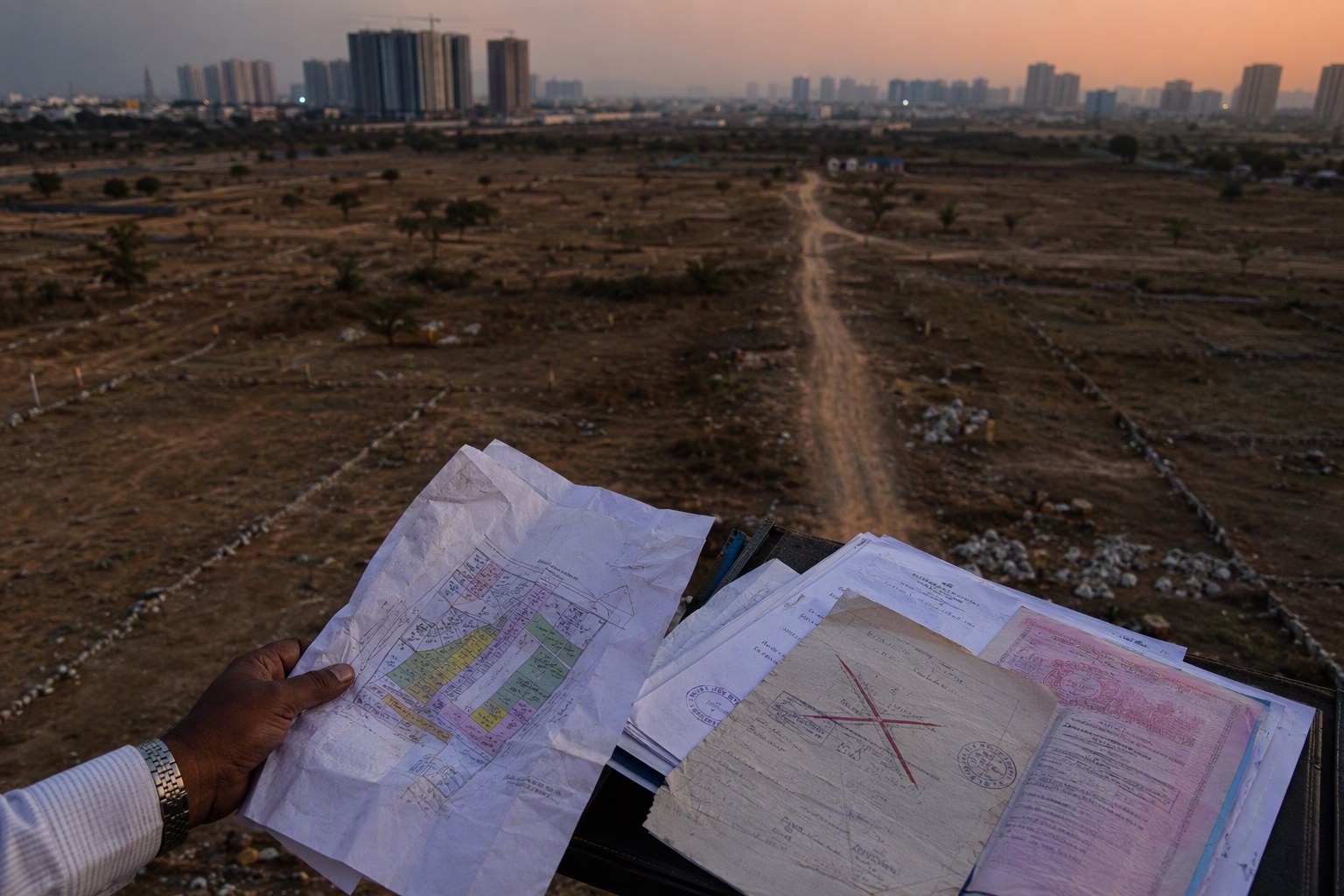
Should You Buy Near a Proposed Telangana Industrial Park?
Short answer: yes, but not because a broker says factory sirens are coming. Buy only if the land survives verification before you pay the token. A proposed industrial park can improve local activity, rental demand, warehousing interest and road spending. It can also create confusion: half-information, speculative pricing, unclear buffers, land acquisition rumours, disputed survey numbers and layouts sold as future gold.
In Telangana, especially around Hyderabad outskirts and the district growth corridors, one line is repeated in many site visits: industrial park pakka, rates will double. That sentence is not due diligence. It is sales talk. A smart buyer separates the industrial story from the property document. First verify whether the specific plot or flat is legally clean, usable, accessible and correctly priced as of today. Future growth should be upside, not the reason you ignore current risk.
My view is simple: never pay a token for a proposed-growth property until the survey number, title flow, land use, access road and prohibited status are checked. Industrial hype does not cure a bad document.
Why Industrial Park Announcements Create Property Heat
Industrial parks change buyer psychology. Once people hear about logistics, manufacturing units, pharma, food processing, textiles, electronics, EV supply chains or warehousing, they assume jobs and migration will follow. That may happen in some belts. But the land market reacts much earlier than the real economy. Rates start moving when a map is shared on WhatsApp, not when workers actually need houses.
This gap is where mistakes happen. Farmers, local brokers, layout promoters and outside investors all start quoting future prices. A plot that was sold based on village value suddenly gets priced as if a factory gate is already operational. Some buyers are comfortable with that risk. Most end-users are not. If you are buying with savings, loan eligibility or family money, you cannot rely on proposal-stage excitement.
Also, industrial development is not uniform. A plot near an access road may benefit differently from a plot behind a nala, quarry belt, burial ground, high-tension line or blocked cart track. One village may get better road connectivity, while the next village may face traffic, noise, restrictions or acquisition uncertainty. So the question is not only whether the park will come. The better question is: what exactly am I buying, and can I prove it before paying even one rupee token?
Proposal, Notification, Acquisition, Execution: Know the Stage
Buyers often treat every stage as the same. It is not. A proposed industrial park can be just an idea, a policy mention, a land parcel under discussion, a notified area, an acquisition process, an approved layout, or an active project with roads and utilities. Each stage carries a different level of certainty.
| Stage you hear about | What it means for a buyer | How to treat pricing |
|---|---|---|
| Rumour or broker map | No reliable project certainty for your property decision | Do not pay future premium |
| Government mention or proposal | Direction may be visible, but boundaries and timelines can change | Price only for present land quality |
| Notified area or official planning layer | Better clarity, but your survey number still needs checking | Consider moderate premium only after document checks |
| Land acquisition or development works | Higher confidence, but nearby private land may face restrictions | Check access, buffers and resale demand |
| Operational industrial activity | Demand can be assessed through real occupancy and rentals | Price can reflect proven market behaviour |
If a seller is charging based on final-stage expectations while the project is still at rumour-stage clarity, the risk is being pushed onto you. That is not investment; that is paying for someone else’s optimism.
The Pre-Token Rule I Recommend
Before token means before booking advance, before oral promise, before WhatsApp confirmation, before cheque, before UPI and before signing a simple receipt. The token stage is where buyers become emotionally locked. Sellers may say refundable, but later they point to terms, time limits, document charges or some family emergency story. So do your checks first.
For any land, plot or under-construction unit near a proposed industrial park, finish these checks before token:
- Confirm the exact survey number, extent, village, mandal and SRO.
- Check whether the property appears in prohibited property data. Telangana prohibited property data is not a small issue; the database context available to us includes 3,076,153 entries for screening.
- Verify ownership flow through registered documents and Encumbrance Certificate.
- Check land use zone and whether industrial, residential, conservation, water body, road or other restrictions apply.
- Confirm layout approval from the right authority, not just a gram panchayat paper being oversold.
- Check access road width, public road status and whether the road is on ground as per documents.
- For projects requiring RERA, verify registration and match details with the brochure.
- Calculate total outflow: price, stamp duty, registration charges, development charges, corpus, GST if applicable and future construction cost.
Use tools early, not after the seller starts pressuring you. Start with Survey Number Finder, Prohibited Property Check, Ec Search and Landuse Zone Finder. If you are not sure about the registration office, check Find Your Sro. For a wider first screen, use Verify My Land.
Title Risk Does Not Disappear Near Industrial Growth
One common buyer mistake is assuming that a booming location must be legally safe. Actually, growth areas can attract more problematic selling. You may see assigned lands, old pattas with family disputes, missing link documents, unregistered partitions, pending court cases, GPA sales, double registrations, mortgage entries, boundary mismatches and conversion issues. The industrial park story simply brings more buyers to the same messy land pool.
For agricultural land, ask whether it is private patta land, assigned land, government land, endowment, wakf, ceiling surplus, forest-related, shikam, water body or affected by road widening. These are not technical words for lawyers only. They decide whether your registration is possible, whether bank funding comes, and whether resale buyers will touch the asset.
An Encumbrance Certificate is a starting point, not a full title opinion. Use Ec Analyzer to read patterns in the EC, but also ask for link documents, pattadar passbook details, mutation records, tax receipts, layout approval, conversion order if relevant and the latest marketable title opinion from a competent advocate. If there is a loan or charge risk, check Cersai Check.
Land Use and Zoning: The Silent Deal Breaker
Industrial park growth does not mean every surrounding parcel becomes good residential land. Some areas may be marked for industrial use, logistics, buffer, road, open space, conservation, water flow, quarry influence or other planning controls. If you buy a plot expecting to build a house later, zoning matters. If you buy land expecting a warehouse, zoning still matters. A wrong assumption here can trap money for years.
In Telangana peri-urban areas, buyers must ask: is this land inside an approved master plan? Is it in HMDA, DTCP or another planning jurisdiction? Is the layout approved or only advertised? Is there a land conversion order? Does the road width support future construction permission? Is the land affected by any proposed road, nala, tank buffer or high-tension line?
Check Landuse Zone Finder and Road Width Check before assuming buildability. If your plan is to construct later, use Fsi Calculator for a rough understanding of development potential. For open space requirements in layouts, Osr Calculator can help frame the right questions.
Residential Plot, Farm Land, Apartment or Commercial Unit?
The right product near an industrial park depends on your intention. A residential plotted layout may suit long-term holding if approvals are clean and access is real. Agricultural land may suit experienced investors who understand conversion, fencing, title, water and resale liquidity. Small commercial units near a future junction may look tempting, but parking, road width and permissions become crucial. Apartments near employment nodes can work when there is visible tenant demand, not only brochure demand.
If you are buying in a plotted project, ask whether it is RERA applicable. Use Rera to verify project details where applicable. Match the RERA record with the project name, promoter, land extent, approvals and promised amenities. A project may show a grand entrance arch and 40-feet roads in marketing material, but the approved plan is what matters.
For a built asset or under-construction unit, do not ignore building cost, depreciation and replacement value. Tools like Building Value Calculator and Composite Value can help you compare land plus construction value instead of paying purely on emotion.
Access Road: The Most Underrated Verification
In industrial-growth belts, access decides value. Two plots may be 500 metres apart, but one touches a public road while the other depends on a private passage through somebody’s field. One may have a blacktop road. Another may have a road shown in a layout but not available on ground. For future buyers, banks and builders, access is not a small detail.
Ask these questions during site visit:
- Is the approach road public or private?
- What is the road width on ground?
- Does the road match the approved layout and revenue map?
- Is there any pending road widening or acquisition?
- Can a car, ambulance, water tanker and construction vehicle reach comfortably?
- Does the property have frontage or only internal access?
Do not buy landlocked property because someone says road will come soon. In Telangana villages, road disputes can become long, personal and expensive. A future industrial park may bring better roads to the area, but it may not solve your exact access problem.
Environmental and Local-Nuisance Checks
Industrial activity can bring opportunity, but also practical concerns. Noise, truck movement, dust, effluents, night operations, worker housing pressure and traffic can affect liveability. Some investors ignore this because they are buying for appreciation. Later, end-users ask stricter questions.
Check the micro-location. Is the plot close to a quarry zone? Use Quarry Zone Check. Is there a burial ground nearby? Use Burial Ground Check. What is the soil nature for construction? Try Soil Type Detector. For area-level intelligence, Geo Insights helps frame a better site inspection list.
These checks are not meant to scare you. They help you price risk correctly. If a plot has a nuisance factor, it may still be buyable at the right price and for the right use. But paying premium pricing while ignoring local negatives is poor investing.
Pricing: Do Not Pay Tomorrow’s Rate Today
Many industrial-park deals fail on valuation discipline. Sellers quote based on expected appreciation. Buyers calculate based on fear of missing out. Nobody anchors the price to current reality. That is dangerous.
Start with the government value using Guideline Value. It is not always the market rate, but it gives a reference. Use Stamp Duty Calculator to estimate registration cost. If you are comparing land and building components, use Composite Value. If you are selling an existing asset to buy this one, check tax impact through Capital Gains Calculator.
My pricing thumb rule for proposed industrial areas: pay for present legal usability, present access, present approval status and present resale market. Treat the industrial park as a bonus. If the deal works only if the industrial park becomes operational exactly as expected, the margin of safety is weak.
Red Flags That Should Slow You Down
- Seller refuses to share survey number before token.
- Only photocopies are shown, no original document inspection.
- Layout approval is unclear or authority name is missing.
- Property is sold as very near industrial park but the exact boundary is not shown.
- Road is shown in brochure but not visible on ground.
- EC has unexplained gaps or suspicious transactions.
- Seller says bank loan is not needed because cash buyers are waiting.
- Same plot number appears in different marketing sheets.
- Agreement mentions one extent, ground measurement shows another.
- Pressure line: token today only, rate increases tomorrow.
When you hear urgency, slow down. Genuine owners can wait for reasonable verification. If they cannot, let the deal go. In property, missed opportunity is cheaper than stuck capital.
What a Safer Buying Process Looks Like
Use a staged approach. First, collect basic details: village, mandal, survey number, plot number, extent and seller name. Second, run online checks for prohibited status, EC, SRO and land use. Third, inspect the site with a local person who understands boundaries. Fourth, ask an advocate to review title and approval documents. Fifth, negotiate price based on findings. Only then pay token with a written receipt or agreement prepared properly.
If you need a draft for sale agreement, token receipt or document checklist, use Document Generator as a starting point. For area and extent conversions between acres, guntas, square yards and square feet, use Area Unit Converter. Local measurements can create costly confusion, especially when agricultural land is carved into plots.
Keep tracking the property after shortlisting. Property Tracker can help you monitor changes and stay organised. If the transaction involves multiple heirs or old documents, maintain a file with every paper, EC extract and verification note. A clean file helps during bank loan, resale and family review.
Who Should Buy Near a Proposed Industrial Park?
This category suits patient buyers. If you can hold for several years, handle document verification, accept uneven development and avoid emotional resale expectations, it can be interesting. It is less suitable for buyers who need immediate rental income, quick resale or guaranteed appreciation.
End-users should be extra careful. Living near an industrial belt may be convenient for some workers and business owners, but not for every family. Check schools, hospitals, daily groceries, public transport, drinking water, drainage and night safety. Investors may tolerate rough edges; families usually cannot.
NRI buyers should not buy only through photos and video calls. Ask a trusted person to verify the ground reality. Telangana rural and peri-urban land can look very attractive on drone shots, but boundaries, access and approvals need physical checking.
Final Take: Buy the Document First, Growth Second
A proposed Telangana industrial park can be a good investment trigger, but it is not a substitute for due diligence. The best deals are usually boring on paper: clear title, correct survey number, proper access, valid approval, sensible price and no prohibited-property issue. The exciting part can come later if the area develops well.
Before you pay token, ask one hard question: if the industrial park takes longer than expected, is this still a good property at this price? If the answer is no, renegotiate or walk away. Telangana has enough opportunities. You do not need to buy the first plot wrapped in factory-growth talk.
Frequently Asked Questions
Is it safe to buy land near a proposed Telangana industrial park?
It can be safe only after verification. Check survey number, prohibited property status, title flow, EC, land use, access road and approvals before token payment. Do not rely only on proposal-stage news.
Should I pay a premium because an industrial park is proposed nearby?
Pay mainly for present legal usability and current market value. A small location premium may be reasonable after checks, but paying full future value before execution is risky.
Which documents should I ask for before booking a plot?
Ask for sale deed link documents, EC, pattadar or ownership records, layout approval, land conversion order if applicable, tax receipts, approved plan, survey details and seller identity documents.
Can industrial growth improve rental demand?
Yes, if the industrial activity becomes operational and workers, vendors or businesses need housing or commercial space. But rental demand should be judged from actual occupancy and connectivity, not only from announcements.
What is the biggest red flag in these deals?
Refusal to share the survey number before token is a major red flag. Without the survey number, you cannot properly check land status, EC, zoning, access or prohibited property risk.