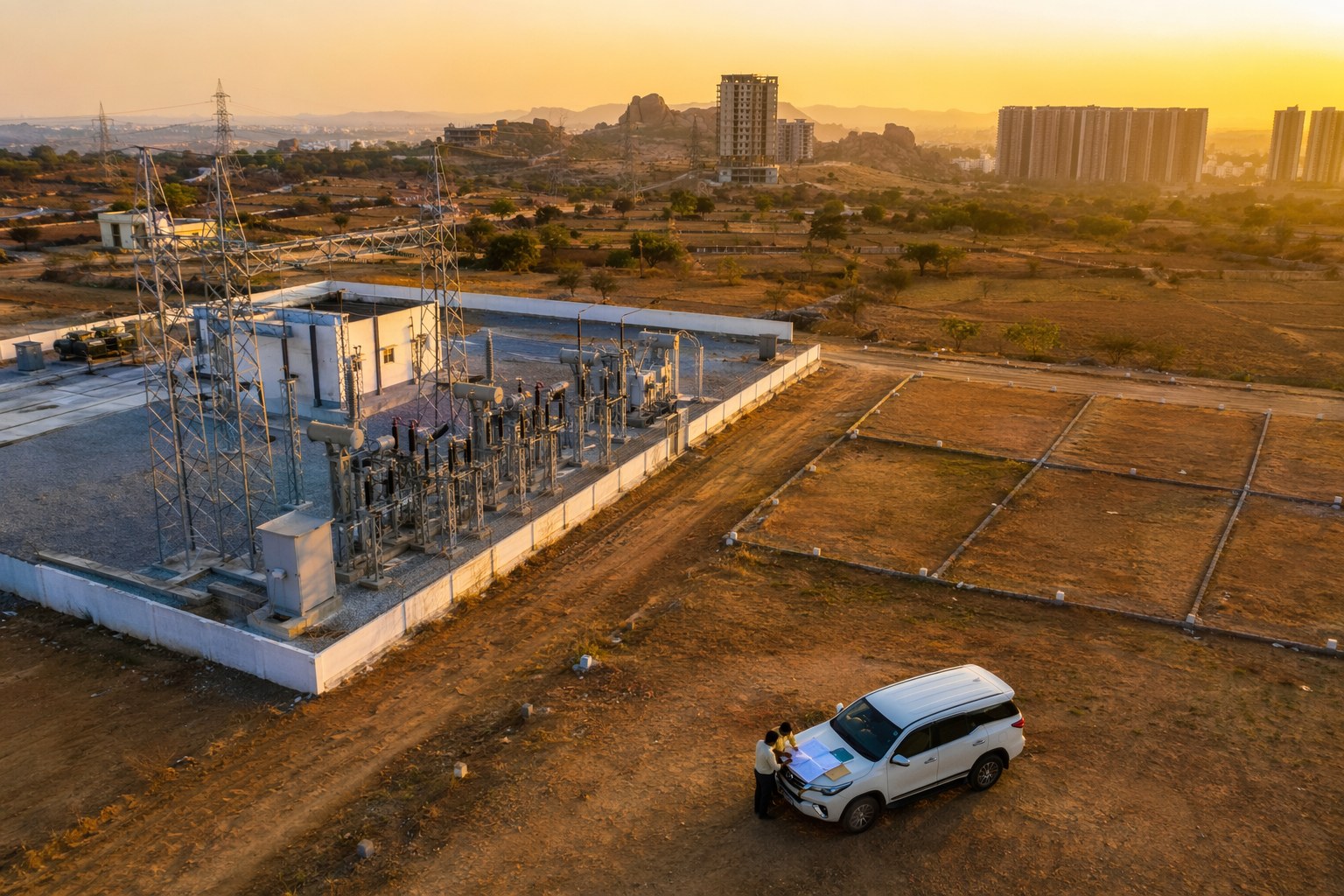



Telangana Land Monetisation Plans Face a 22-A Reality Check as the state’s prohibited property list under Section 22-A stands at 1,47,934 properties. For the government, this is not just a registration department issue. It directly affects land auctions, public land sales, institutional investor appetite, bank funding, and the final price discovered in high-value corridors around Hyderabad.
The core issue is simple: when a property is marked under Section 22-A, the Sub-Registrar Office can refuse registration. For ordinary buyers, that means a stalled sale deed. For government monetisation, it can mean slower bidding, deeper legal checks, price discounting, or in some cases, no serious bids at all unless title clarity is given upfront.
In our experience, serious investors do not fear high prices in Hyderabad. They fear unclear title, revenue disputes, missing survey links, and 22-A surprises after paying earnest money.
Telangana Land Monetisation Plans: Why 1,47,934 22-A entries matter
Section 22-A of the Registration Act is meant to block registration of certain prohibited properties. These can include government lands, assigned lands, waqf lands, endowment lands, ceiling surplus lands, lands under litigation, and properties where registration is restricted by law or court order.
The number now in focus is large: 1,47,934 prohibited properties. That count is big enough to influence buyer behaviour, especially when the government is looking at land monetisation as a serious revenue source.
Hyderabad has already shown what clean, well-located land can fetch. In Kokapet Neopolis, under Gandipet mandal limits, public auction benchmarks crossed headline levels, with the highest bid reported around ₹100.75 crore per acre and average discovery above ₹70 crore per acre in the 2023 auction round. Budvel, closer to Rajendranagar and Himayat Sagar side, saw public auction pricing around ₹36 crore per acre on average. These numbers tell us one thing: if title is clean and development potential is clear, Hyderabad money comes fast.
But the same market becomes cautious when land falls near disputed survey numbers, old revenue entries, assigned land claims, or unclear government notifications. A 22-A shadow can reduce competition. When competition reduces, the government’s monetisation value also takes a hit.
Telangana Land Monetisation Plans and investor pricing risk
Large investors usually price land in three buckets: location value, development potential, and legal risk. Hyderabad’s western corridor scores high on the first two. Kokapet, Nanakramguda, Financial District, Narsingi, Tellapur, Kollur, Mokila, and Gopanpally continue to attract developers because the end-user demand is strong and office employment is nearby.
On the southern side, Shamshabad, Maheshwaram, Tukkuguda, Kandukur, and Adibatla have their own story, driven by ORR access, airport connectivity, logistics, data centres, and industrial land demand. In the northern belt, Medchal, Kompally, Dundigal, and Shamirpet are seeing plotted layouts, warehousing, and mid-market housing interest.
But land monetisation is not only about location. If a parcel has a 22-A flag, investors will ask direct questions:
- Is the survey number fully or partly prohibited?
- Is the restriction linked to government land, assigned land, endowment, waqf, court stay, or revenue dispute?
- Does the Dharani record match the old pahani and Sethwar entries?
- Has the Collector or competent authority issued any de-notification or clarification?
- Will the SRO accept registration without objections?
These questions affect price. A bidder may quote lower to absorb legal risk. Some institutional buyers may avoid the parcel completely, especially if their board policy does not allow disputed land exposure. Banks and NBFCs also become careful while financing acquisition or project construction.
Due diligence becomes the real price maker
For public land deals, the market does not accept verbal comfort. Buyers want documents. They want revenue history, title flow, government orders, litigation status, survey sketch, boundary confirmation, land use status, and SRO-level registration clarity.
Before bidding or buying, investors should run a layered check. A basic market-value estimate can be checked through the Market Value / Guideline Value Search. The ready reckoner value is not the same as market price, but it helps in stamp duty planning and gives a government-recognised base rate.
For title movement, use the Encumbrance Certificate Search. EC alone is not full title proof, but it reveals registered transactions, mortgages, releases, and sometimes gaps that need explanation. For 22-A risk, the most relevant first step is the Section 22-A Prohibited Property Check. If the survey number appears in the prohibited list, do not treat it as a small clerical issue.
Buyers should also identify the correct registration office through Find Your SRO Office, because Hyderabad fringe parcels often create confusion between old mandal boundaries, new district limits, and SRO jurisdiction. For land parcels, especially in Mokila, Velimela, Kollur, Nandigama, and Maheshwaram, checking survey references through the Survey Number Finder can save a lot of trouble.
Where the 22-A issue may pinch Telangana land monetisation most
The highest risk is not necessarily in central Hyderabad, where land records are often better documented through urban conveyance chains. The pinch is sharper in peri-urban belts where agricultural lands, assigned lands, government lands, layout conversions, and old village records overlap.
Take the growth line from Narsingi to Kokapet, Tellapur, Kollur, and Mokila. This belt has genuine premium demand. Apartments in good gated communities near Financial District and Kokapet often quote high land-backed pricing because developers are paying steep acquisition costs. Still, old survey-level clarity remains crucial. A small 22-A issue in one portion of a larger land assembly can delay the full project.
On the Shamshabad-Maheshwaram-Tukkuguda side, large acre parcels are attractive for plotted ventures, warehouses, and industrial uses. Here, buyers must verify land classification, conversion permissions, HMDA/DTCP layout status, and any assigned land angle. For development feasibility, tools like the Land Use Zone Finder, FSI/FAR Calculator, and Road Width Check are useful before preparing the bid model.
In older urban pockets such as Jubilee Hills, Banjara Hills, Madhapur, and Gachibowli, the challenge is different. Land is scarce, rates are already high, and litigation risk can be expensive. A clean parcel can command a premium. A parcel with title noise may sit unsold even in a prime address.
Government must package land like an investor product
If Telangana wants strong land monetisation receipts, it should not offer land as just a survey number and an upset price. It must package each parcel like an investor product with a title pack, survey pack, planning pack, and registration pack.
A good public land dossier should include:
- Latest Dharani extract and historical pahani trail
- Survey sketch with geo-coordinates and boundary stones
- Clear statement on Section 22-A status
- Litigation certificate and court case summary, if any
- Land use zone, road access, and master plan classification
- SRO confirmation on registrability
- Stamp duty and registration cost estimate using the Stamp Duty Calculator
This is where the state can protect its own revenue. Better disclosure does not reduce price. It increases confidence. We’ve seen in Hyderabad auctions that bidders pay aggressively when they believe the post-auction process will be clean.
What buyers should do before participating in Telangana public land deals
For developers, HNIs, family offices, and institutions, the message is practical: do not depend only on auction brochures. Do your own checks before paying EMD or signing any agreement.
Start with the survey number. Match it with village, mandal, district, and SRO. Check whether it appears in 22-A records. Compare Dharani with old revenue documents. Pull EC for the longest available period. Speak to the local revenue office if the land has any assigned, ceiling, endowment, or waqf background. Check approach road width and land use. If a RERA project is already proposed nearby, use the RERA Project Lookup to understand competing supply.
For valuation, do not look only at auction headlines. Kokapet’s ₹100 crore-plus per acre moment cannot be blindly applied to every parcel in Gandipet mandal. Budvel’s pricing cannot be copied to every Rajendranagar-side parcel. A landlocked piece, a parcel with 22-A risk, or a site needing major access improvement must be discounted.
The large 1,47,934 prohibited property count is a reminder that Telangana’s land economy is becoming more data-driven, but also more demanding. Clean title is no longer a back-office formality. It is the main driver of price, speed, funding, and exit.
For the government, the path is clear: clean the records, publish parcel-level clarity, remove wrong entries where legally possible, and give bidders confidence before the auction. For investors, the rule is even clearer: verify first, price later.
Frequently Asked Questions
What is Section 22-A in Telangana property registration?
Section 22-A allows the registration department to refuse registration of prohibited properties such as government land, assigned land, endowment land, waqf land, ceiling surplus land, or land under legal restriction.
How many prohibited properties are listed under 22-A in Telangana?
The current count referred to here is 1,47,934 prohibited properties. This large number can influence government land monetisation, investor pricing, and buyer due diligence.
Can a 22-A property be sold or registered?
Usually, the SRO will not register a property that is active in the 22-A prohibited list. The owner or concerned party must obtain proper legal or revenue clarification before registration can proceed.
Why does 22-A status affect government land auctions?
Investors price legal risk. If a public land parcel has unclear title or 22-A-related doubts, bidders may reduce their offer, demand extra documents, or avoid the auction.
What checks should buyers do before buying land in Hyderabad outskirts?
Check the survey number, Dharani record, pahani history, EC, 22-A status, land use zone, SRO jurisdiction, road access, and any litigation before paying advance or EMD.