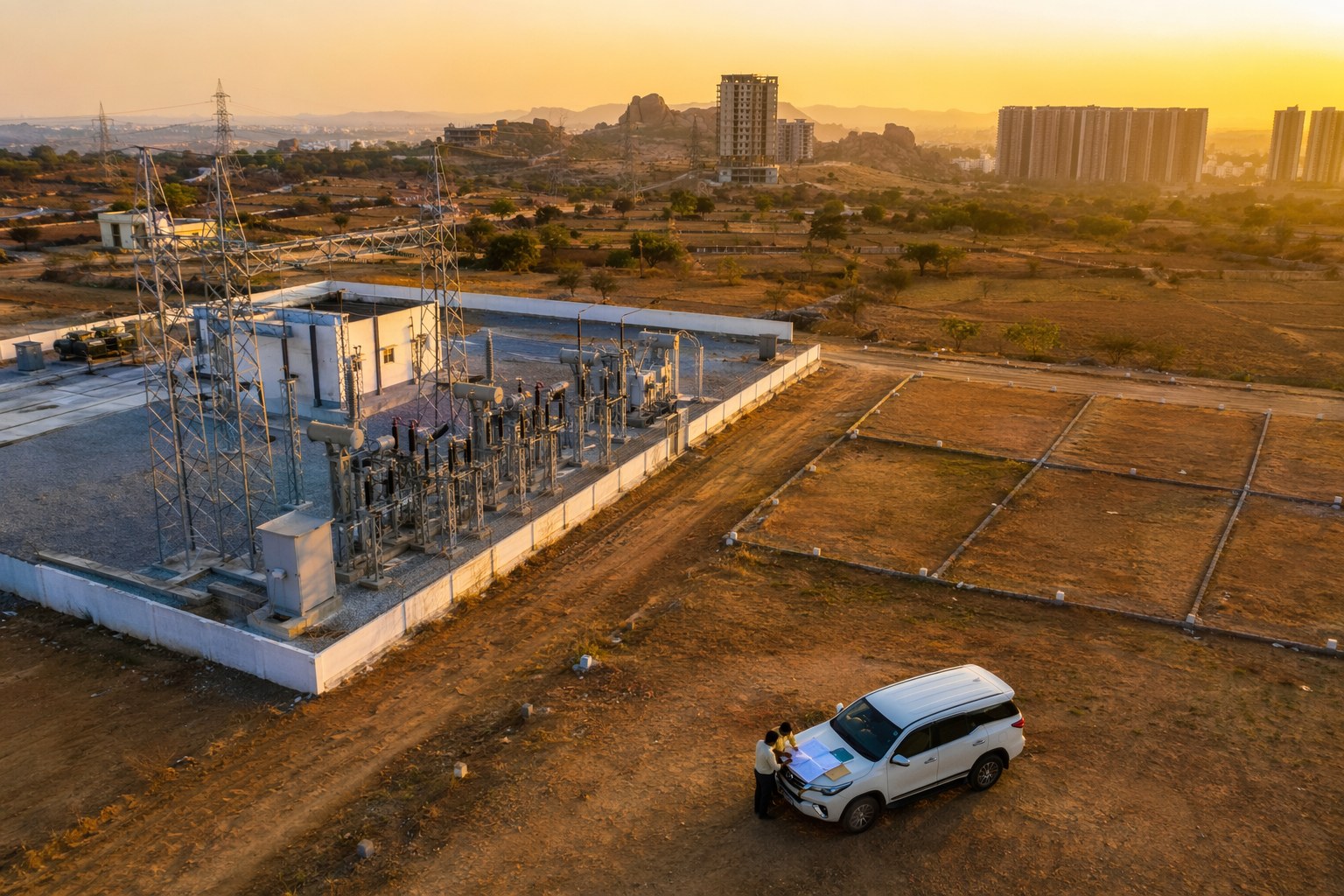



Telangana Infra Payouts Face 22-A Title Verification Test
Telangana Infra Payouts are now facing a practical title verification test because the State has a large prohibited-property base under Section 22-A. The number that should worry landowners, agencies and nearby buyers is 147,934 prohibited properties. For any road widening, metro corridor, drainage channel, reservoir buffer, power line, industrial corridor or urban redevelopment payout, this number changes the finance conversation. Compensation may be sanctioned on paper, but actual release can slow down if the survey number, pahani history, Dharani entry or SRO record shows a 22-A restriction.
In our experience, infrastructure compensation is not delayed only because of budget. Many times, the money is ready, but the title is not clean enough for a direct release. That is where escrow planning, indemnity, legal verification and beneficiary mapping become serious issues.
Why Telangana Infra Payouts now need a 22-A filter
Section 22-A of the Registration Act is used to restrict registration of certain categories of properties. These may include government lands, assigned lands, endowment lands, wakf-related entries, disputed parcels, ceiling surplus lands and other properties flagged by competent authorities. When such land falls in an infrastructure alignment, the acquisition or compensation process becomes slower than a normal private patta land case.
The Telangana prohibited-property count of 147,934 is not a small administrative footnote. It is a financial risk pool. Every infra agency that is planning land acquisition has to ask a simple question: how many affected survey numbers are clean, how many need clarification, and how many may require escrow instead of direct payout?
This is relevant in and around Hyderabad’s growth belt. Think of stretches in Serilingampally mandal near Gachibowli and Nanakramguda, Rajendranagar mandal around Kokapet and Narsingi, Gandipet and Shankarpally side layouts, Shamshabad mandal near airport-linked corridors, Hayathnagar and Abdullapurmet towards Vijayawada Highway, Medchal and Shamirpet on the northern side, and Patancheru-Ramachandrapuram towards the industrial belt. Land values and buyer expectations are high in these areas, so even a small title block can create a large cash-flow issue.
Telangana Infra Payouts: where compensation can get stuck
For landowners, the most frustrating situation is when the government recognises the land as affected by a project, measures the extent, prepares award documents, but does not release compensation directly because the title needs further proof. This can happen when the current possession, old pahani, mutation, Dharani entry and SRO registration history do not speak the same language.
Before expecting a payout, landowners should check whether the survey number appears in the prohibited-property list through a Section 22-A Prohibited Property Check. They should also pull an Encumbrance Certificate Search and compare the names, document numbers and boundaries with revenue records. If the land is inherited, partitioned, gifted or converted, every link in the title chain matters.
My view is simple: compensation is a financial event, but its foundation is a title event. If the title is weak, the payout becomes a negotiation, a legal file or an escrow case.
Agencies too should not wait until the final award stage. If a project corridor has even a moderate number of 22-A flagged parcels, the finance team must budget for staggered releases. A clean-title parcel may get paid first. A disputed or restricted parcel may move to deposit, court reference, escrow or authority-held account. That difference affects project cash flow.
Escrow planning becomes central for agencies and lenders
Escrow is not just a banking formality in such cases. It becomes a risk management tool. If an infrastructure agency releases money to the wrong claimant, it may face audit objections, litigation and recovery problems. If it holds back too much money, the project faces landowner resistance and execution delays. The balance is delicate.
For large linear projects, the land team should divide affected parcels into three buckets:
- Clear title parcels: direct compensation can be processed after routine verification.
- Clarification parcels: mismatch in survey number, extent, pahani entry, mutation or family claims needs documentary correction.
- Restricted or disputed parcels: 22-A entry, government claim, assigned land issue, court case or competing ownership claim may require escrow, deposit or legal adjudication.
This classification helps the finance department prepare realistic payout schedules. It also helps contractors understand why physical possession may not move equally across the alignment. A 10-km road may look ready on the map, but one uncleared 22-A land pocket can disturb the work sequence.
What landowners in Hyderabad growth corridors should check
If your land is near a proposed road, nala widening, metro extension, logistics park, industrial node or public utility corridor, start verification early. Do not wait for the acquisition notice. In places like Kokapet, Tellapur, Mokila, Kollur, Tukkuguda, Adibatla, Bowrampet, Bachupally, Kompally and Uppal, land transactions have gone through many hands over the last two decades. Layout approvals, conversion orders and family settlements must be matched carefully.
Use a Survey Number Finder first if your documents carry only plot numbers or old village references. Then check the Market Value / Guideline Value Search for the government-notified value. The market rate may be far higher in many Hyderabad localities, but compensation and stamp duty discussions usually start with official values, ready reckoner references and the nature of the acquisition law being applied.
For registration-side clarity, identify the correct SRO using Find Your SRO Office. Many mistakes happen when owners assume the wrong SRO jurisdiction, especially around fast-changing municipal and mandal boundaries. For developed plots or apartments near acquired stretches, buyers should also use the RERA Project Lookup before booking.
Nearby buyers should not ignore 22-A risk
Buyers often think infrastructure news automatically means price appreciation. That is only half the story. Yes, a new road, metro line or civic project can improve access. But if nearby land parcels are under title restriction, acquisition dispute or compensation litigation, development can slow down. Approach roads may remain incomplete. Utility shifting may drag. Layout permissions may be examined more closely.
For buyers looking at villas, plotted developments or apartments near major corridors, the basic checks should include land title, conversion, layout approval, RERA status, EC, road access and prohibited-property status. A clean project near a delayed corridor may still be a good long-term bet. But paying a premium only because “road is coming” is risky without checking the land record trail.
We have seen this in Hyderabad’s outer growth zones: one side of a road becomes active with construction, while the opposite side remains stuck because of revenue classification, lake buffer issues, assigned land questions or old government claims. The brochure will not tell you this. The records will.
How the 147,934 prohibited-property base affects timelines
The figure of 147,934 prohibited properties means title verification cannot be treated as a last-mile clerical step. It should be part of early project planning. For landowners, this means compensation timelines may vary sharply between neighbours. One owner may receive money quickly, while another, with land in the same survey cluster, may be asked for extra papers or may face deposit-based payment.
| Stakeholder | Main 22-A risk | Practical response |
|---|---|---|
| Landowner | Compensation held due to restricted title | Check 22-A status, EC, pahani, Dharani and mutation records early |
| Infrastructure agency | Budget sanctioned but payout blocked | Create clean, clarification and escrow buckets before award stage |
| Buyer near project | Price paid on future infra promise | Verify project land, access road and RERA status before booking |
| Lender or investor | Collateral value affected by title restriction | Insist on SRO, revenue and prohibited-property checks |
Where the title is clean, landowners should still prepare for tax and reinvestment planning. Compensation money may trigger capital gains questions depending on the nature of land, location, holding period and legal route. A quick estimate through the Capital Gains Tax Calculator can help owners speak to their CA with better numbers.
Our take on Telangana Infra Payouts and title discipline
Telangana needs fast infrastructure, no doubt. Hyderabad’s expansion towards the west, south and north has already changed land economics. But faster projects cannot be built on unclear title files. The 22-A base is large enough to affect compensation cycles, escrow usage and buyer sentiment around project corridors.
For agencies, the smarter approach is to publish clearer parcel-level status, run title checks before public deadlines become tight, and separate clean payouts from disputed ones. For landowners, the message is sharper: do not assume possession alone will bring compensation. Keep sale deeds, link documents, pahanis, Dharani records, family settlements, court orders and conversion papers ready.
For buyers, infrastructure-led appreciation is attractive, but verification is cheaper than regret. Before paying token advance near any proposed corridor, run the records. In Telangana real estate, a survey number can carry more truth than a sales pitch.
Frequently Asked Questions
What is the link between Telangana Infra Payouts and Section 22-A?
If land affected by an infrastructure project is listed under Section 22-A, direct compensation may be delayed or routed through escrow, deposit or legal verification.
How many prohibited properties are recorded in Telangana?
The available database figure shows 147,934 prohibited properties under Section 22-A in Telangana.
Can a landowner still receive compensation if the land is under 22-A?
It depends on the reason for the restriction. The owner may need to prove title, obtain clarification from authorities, resolve disputes or accept payment through a controlled process.
Should buyers check 22-A status near new infrastructure corridors?
Yes. Buyers should check prohibited-property status, EC, RERA registration, SRO records and land use before investing near proposed roads, metro routes or civic projects.
Which tools can help with basic land verification?
Start with the Section 22-A check, EC search, survey number finder, guideline value search and RERA lookup. These checks reduce avoidable risk before payment.