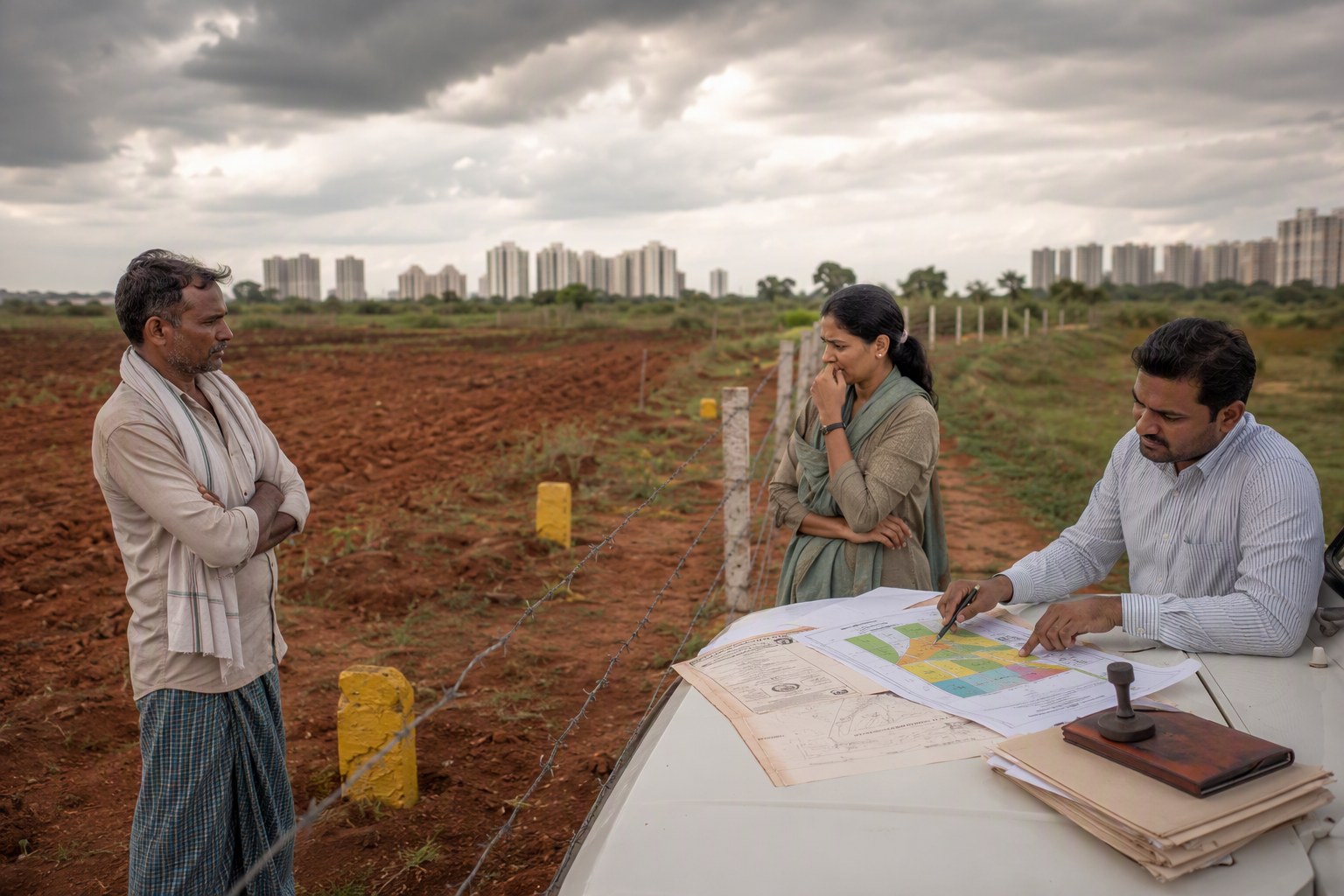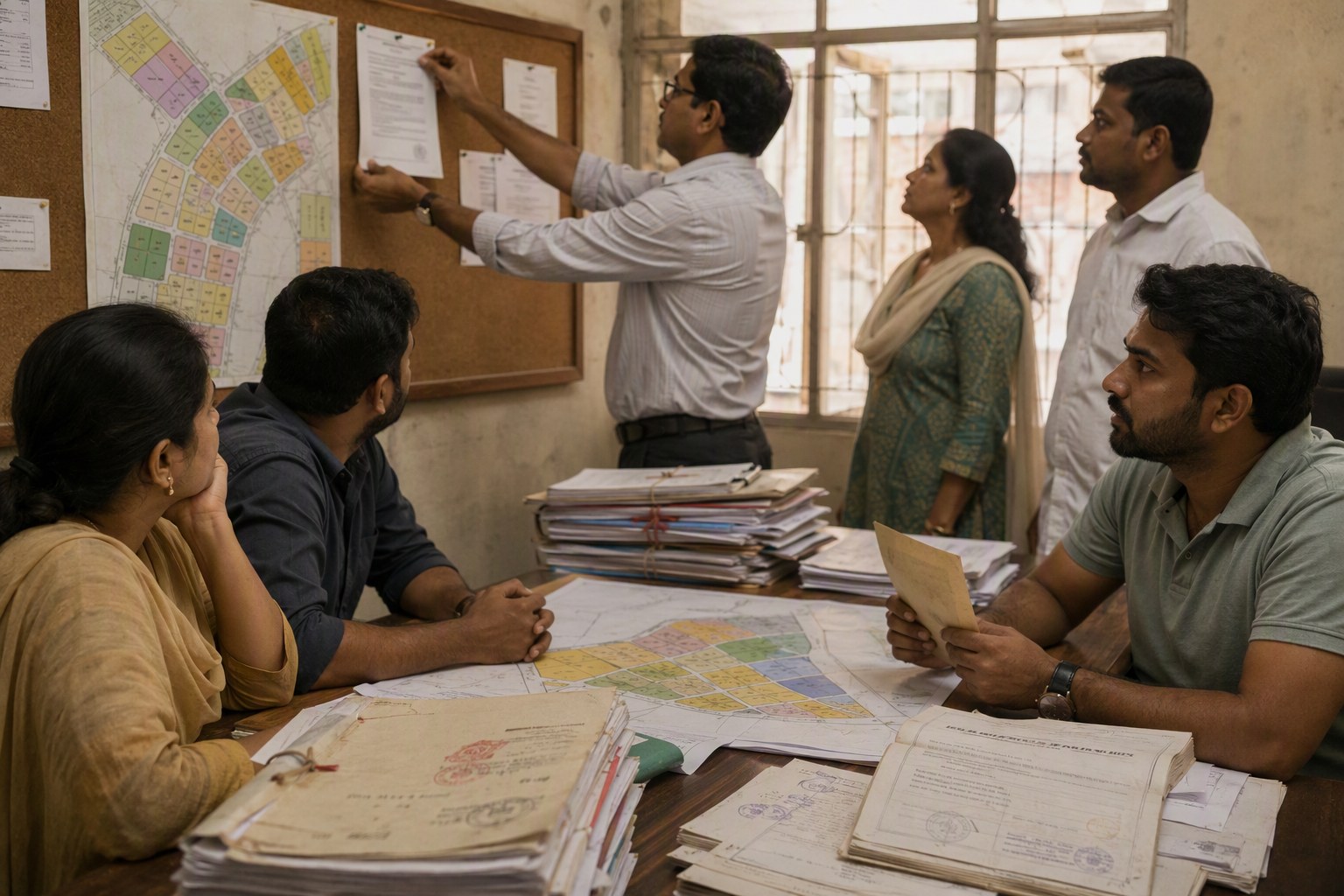
Telangana E-Auctions May Add 22-A Checks Before Bidding is the market signal bidders should take seriously now. In bank auctions, government land auctions and distress sales, the old habit was to first look at reserve price, location and loan eligibility. That may not be enough anymore. With 3,076,153 prohibited properties recorded under Section 22-A as per latest IGRS data, bidders may start checking the 22-A status before paying earnest money deposit, arranging finance or planning registration.
For Hyderabad buyers tracking land in Kokapet, Narsingi, Tellapur, Kollur, Mokila, Adibatla, Shamshabad, Maheshwaram, Ghatkesar and Ibrahimpatnam, this is not a small paperwork point. A property can look attractive in an auction notice, but if the survey number, plot or land parcel is hit by a prohibition entry, the SRO can refuse registration. That is where the bidder’s money, time and loan file can get stuck.
Telangana E-Auctions May Add 22-A Checks Before Bidding: What is changing?
The immediate shift is practical, not dramatic. Serious bidders are likely to do one extra verification before EMD payment: check whether the land is listed under Section 22-A of the Registration Act. Section 22-A covers properties where registration is prohibited or restricted, including certain government lands, assigned lands, endowment lands, wakf-related entries, court-disputed parcels and other notified categories.
We have seen this issue come up especially in peri-urban Hyderabad locations where old revenue entries and present market expectations do not always match cleanly. A bidder sees an auction listing near an ORR exit, a growing corridor or a proposed layout area. The price looks tempting. But the real question is: can the property be registered in the bidder’s name after the auction?
That answer sits with revenue records, Dharani entries, pahani history, SRO data and the Section 22-A list. Before putting money on the table, bidders can use the Section 22-A Prohibited Property Check, cross-check survey details through the Survey Number Finder, and review registration history using the Encumbrance Certificate Search.
Our view is simple: in Telangana auctions, the lowest price is not always the best price. A registrable title is worth more than a discount that later becomes a legal headache.
Why Telangana E-Auctions May Add 22-A Checks Before Bidding in bank cases
Bank e-auctions usually come with standard disclaimers. The property is often sold on an “as is where is” and “as is what is” basis. That means the bidder is expected to inspect the title, possession position, dues and legal status before bidding. Many buyers read the reserve price and auction date carefully, but skip the revenue-layer verification. That is risky in Telangana.
Even if a bank has taken possession under its loan recovery process, the buyer still has to register the sale certificate or related document as per procedure. If the property falls under a prohibited category, the SRO may not accept the registration. A bidder who has already paid EMD, won the auction, arranged bank finance and transferred funds can then face a long follow-up cycle.
This is why lenders, bidders and property advisors may increasingly insist on a 22-A check before EMD. It is not only about legal safety. It also helps avoid failed loan disbursements. A housing loan or loan against auction property can slow down if the bank’s legal team sees a prohibited-property flag, mismatch in survey number, unclear link document or revenue classification issue.
Hyderabad corridors where bidders should be extra careful
The caution is relevant across Telangana, but Hyderabad’s growth corridors need closer attention because land values and buyer urgency are both high. In Gandipet mandal, areas like Kokapet and Narsingi attract premium interest. In Ramachandrapuram and Patancheru-side markets, Tellapur and Kollur see strong demand. In Maheshwaram, Shamshabad, Shabad, Ibrahimpatnam and Ghatkesar belts, land parcels often pass through older revenue histories before entering modern development talk.
That does not mean every auction property in these places is risky. It means bidders should not assume clean title only because the location is famous or the auctioning institution is reputed. A government or bank auction notice is not a substitute for independent verification. The auction may transfer whatever right the seller or secured creditor has, but the registration department will still apply statutory restrictions.
For apartments or under-construction projects, bidders should also check project registration status where applicable using the RERA Project Lookup. For land and plots, the starting point is usually the survey number, village, mandal, khata or account number, pahani record, EC and SRO jurisdiction. If you are not sure which SRO handles the village, use Find Your SRO Office or the SRO Village Directory.
What a 22-A check should include before EMD
A proper pre-bid check should not stop at one screen result. In our experience, auction buyers should create a small file before they pay EMD. It should contain the auction notice, property schedule, survey or plot details, EC, revenue extracts, SRO jurisdiction confirmation and a note on any mismatch found.
| Check | Why it matters | Useful tool |
|---|---|---|
| Section 22-A status | Helps identify whether registration may be prohibited or restricted | Section 22-A Prohibited Property Check |
| Survey number confirmation | Prevents confusion between neighbouring parcels and village boundaries | Survey Number Finder |
| Encumbrance history | Shows past registrations, mortgages and transaction trail available in records | Encumbrance Certificate Search |
| SRO mapping | Confirms the office where registration will be processed | Find Your SRO Office |
| Guideline value | Gives the government market value reference used for duty and registration | Market Value / Guideline Value Search |
Bidders should also compare the auction property schedule with Dharani details, old link documents and available pahani entries. A small spelling difference in village name may be manageable. A mismatch in survey number, extent, classification or boundary description should be treated seriously. If the property is a flat, verify undivided share of land and building approvals. If it is open land, verify land use and approach road issues through tools like Land Use Zone Finder and Road Width Check.
Loan planning: why banks may ask tougher questions
Auction buyers often plan backwards from the final payment deadline. They assume that once they win the bid, a bank loan can be processed quickly. That confidence can be dangerous if 22-A status is not checked upfront. Bank legal teams generally want clean title flow, acceptable registration possibility and no major statutory prohibition. If they spot a 22-A issue late, the loan can stall at the worst possible time.
Stamp duty and registration cost planning also depends on the final document type and market value reference. Before bidding, buyers can estimate duty exposure through the Stamp Duty Calculator and compare government value using the Market Value / Guideline Value Search. This will not replace legal due diligence, but it gives a more realistic cost picture before committing funds.
For high-value Hyderabad assets, bidders should not rely only on broker talk, WhatsApp PDFs or the auction brochure. Ask for copies of title documents, possession notice, valuation summary where available, EC, property tax details if applicable and any litigation disclosures. Then verify the government records independently.
Market impact: discounts may narrow for clean auction titles
If 22-A checks become routine before bidding, the auction market may behave more sensibly. Properties with clean revenue and registration status may attract more confident participation. Properties with unclear classification, old disputes or 22-A flags may see cautious bidding, longer decision time or lower appetite.
This is healthy for the market. Telangana’s real estate market, especially around Hyderabad, has become more data-aware. Buyers already compare ready reckoner values, EC records, RERA details, land use and road access. Adding a Section 22-A check is a natural next step. It protects end-users and serious investors from paying EMD on properties that may not move smoothly through registration.
My advice to bidders is straightforward: do the boring checks before the exciting bid. Auction rooms reward speed, but land records reward patience. A half-day spent checking 22-A status, EC and SRO mapping is far cheaper than months of follow-up after payment.
Practical pre-bid checklist for Telangana e-auctions
- Read the full auction notice, not just the reserve price and last date.
- Confirm village, mandal, survey number, plot number, flat number and extent.
- Run a Section 22-A check before paying EMD.
- Download or inspect EC for the available period and compare names with title flow.
- Check the SRO jurisdiction and whether the property schedule matches SRO records.
- Verify Dharani or revenue record references where land is involved.
- Speak to a local document writer or property lawyer who knows that mandal and SRO.
- For apartments, check RERA registration where applicable and review UDS details.
- Estimate stamp duty and registration costs before final bid planning.
- Keep written screenshots, acknowledgements and notes for your loan file.
Telangana has a large prohibited-property database, with 3,076,153 entries recorded under Section 22-A as per latest IGRS data. That single number is enough reason for auction bidders to slow down and verify. Whether the property is in Serilingampally, Rajendranagar, Gandipet, Medchal, Uppal, Hayathnagar or Shamshabad, the rule is the same: check first, bid later.
Frequently Asked Questions
Should I check 22-A status before paying EMD in a Telangana e-auction?
Yes. A 22-A check before EMD helps you understand whether registration may be blocked or restricted. It is a basic safety step for bank and government auction properties.
Can a bank auction property still have a 22-A problem?
Yes, it can. A bank auction does not automatically remove statutory restrictions. The bidder should verify revenue records, EC, SRO status and Section 22-A entries independently.
Which details are needed for a Telangana 22-A check?
You generally need the district, mandal, village, survey number or property schedule details. For plots and land, correct survey number and village name are very important.
Will a clean EC prove that the property is not prohibited?
No. EC shows registered transactions and encumbrances available in registration records. It should be read along with 22-A status, Dharani or revenue records, title documents and SRO checks.
What should I do if an auction property appears in Section 22-A?
Do not rush into bidding. Take legal advice, ask the auctioning institution for clarification, verify the exact survey number and understand whether the prohibition can be resolved before registration.