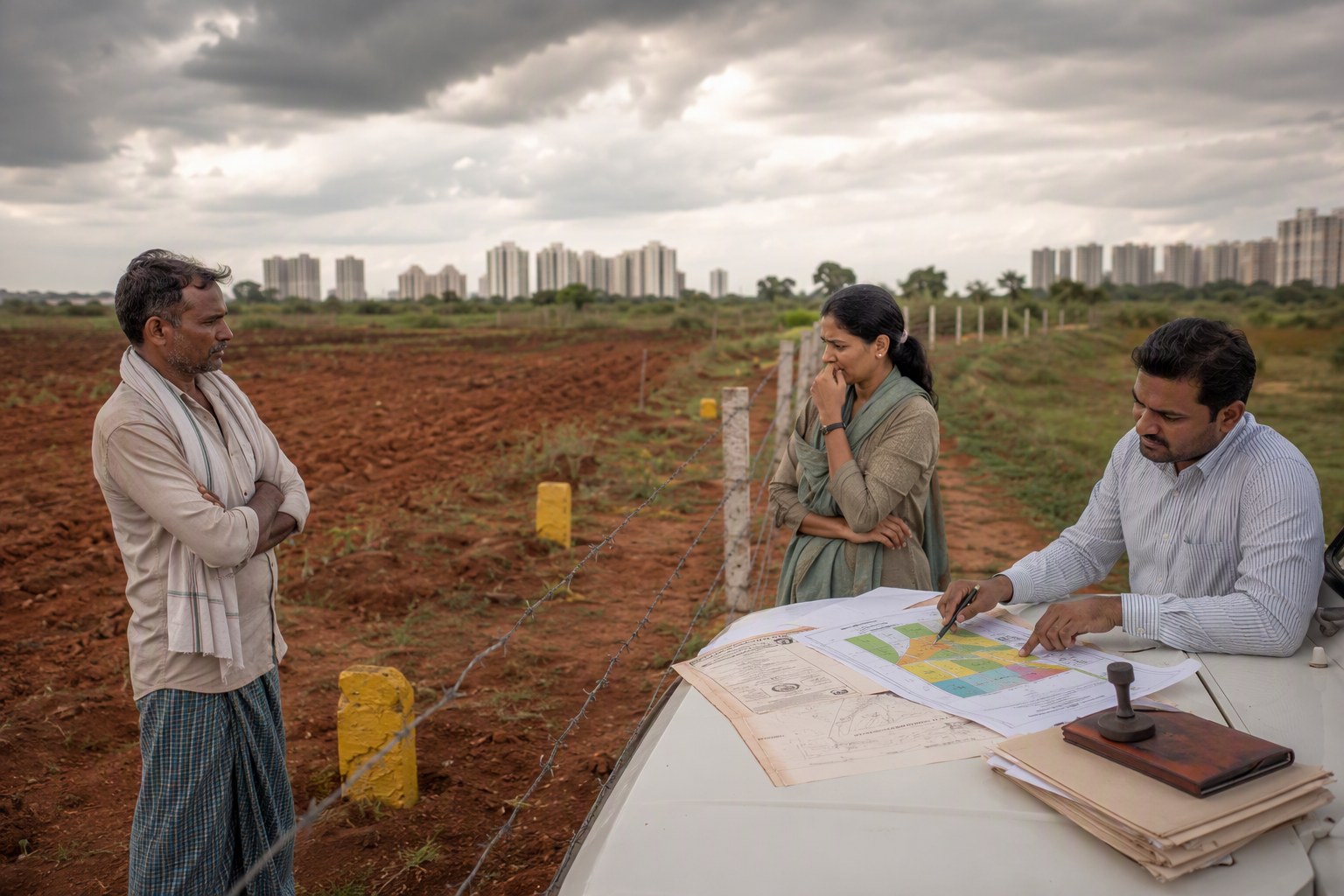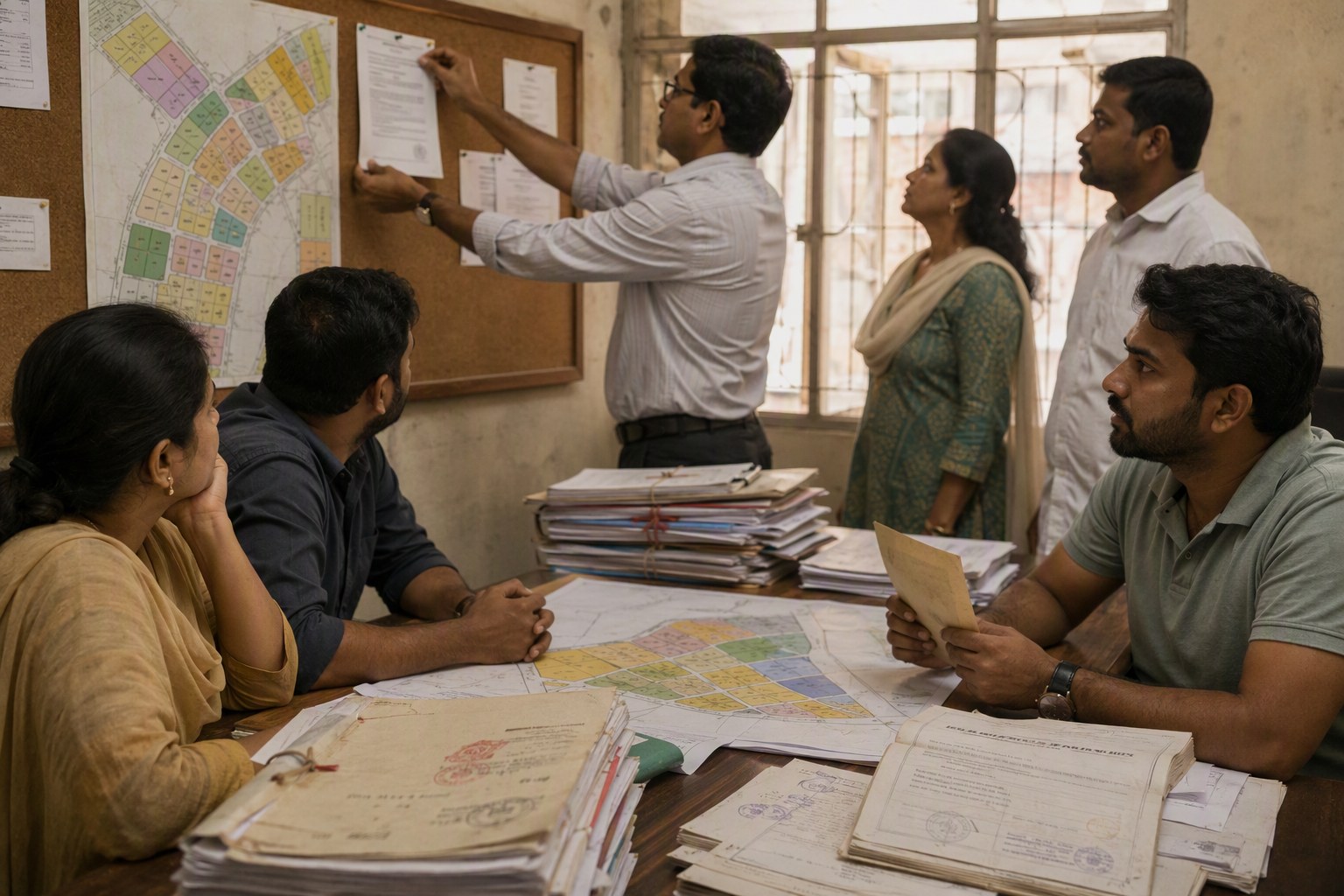
Telangana Registrars May Issue Weekly 22-A Clearance Bulletins — if taken up formally — could become a practical relief for land buyers, document writers, banks and developers who often wait till the last stage to discover that a survey number is blocked under Section 22-A. The idea is simple: instead of buyers checking in the dark, registration offices can publish periodic public updates on survey numbers or properties cleared from the prohibited list.
In Telangana, 22-A is not a small side issue. As per the latest prohibited properties database available to Verified.RealEstate, there are 3,076,153 prohibited property records. That scale explains why even a clean-looking pahani, old sale deed, or family partition document is not enough. For a buyer in Shankarpally, Maheshwaram, Medchal, Ghatkesar, Rajendranagar or Ibrahimpatnam, the real test often happens when the SRO system accepts or rejects the registration.
Our view: weekly public 22-A clearance bulletins will not solve every title problem, but they can reduce last-minute shocks. For Telangana land transactions, timing is half the battle.
Telangana Registrars May Issue Weekly 22-A Clearance Bulletins: Why It Matters
Section 22-A entries block registration of certain properties. These may include government lands, assigned lands, endowment lands, wakf-related entries, ceiling surplus lands, disputed survey numbers, or other categories notified by government departments. In practice, the problem is not only the prohibition itself. The bigger pain point is uncertainty.
A buyer may negotiate an advance for an open plot near Mokila, check the EC, verify the link documents, and even prepare the sale deed. Then, at the registration stage, the SRO office may flag the survey number. Sometimes the land was already represented for deletion from the prohibited list. Sometimes the clearance order exists at one level but has not reflected in the registration system. Sometimes only part of a survey number is affected, but the entire survey number creates doubt.
Weekly bulletins can create a public trail. If the bulletin clearly states which survey numbers, extents, villages, mandals and SRO jurisdictions have been cleared, buyers can plan token payment, bank loan processing, document drafting and slot booking with better confidence.
Before paying a sizeable advance, buyers should still use the Section 22-A Prohibited Property Check, cross-check survey details using the Survey Number Finder, and confirm jurisdiction through the Find Your SRO Office tool. A bulletin is useful, but it should not replace due diligence.
Telangana Registrars May Issue Weekly 22-A Clearance Bulletins For Better Registration Timing
The biggest benefit will be timing. In our experience, many Telangana land deals do not fail because the buyer dislikes the property. They fail because the buyer cannot judge when the property will become registrable. This is especially visible in fast-moving corridors around Hyderabad: Tellapur and Osman Nagar in the west, Tukkuguda and Adibatla in the south, Kompally and Gundlapochampally in the north, and Pocharam and Bibinagar on the eastern side.
Let us say a family is selling agricultural land in a village under Shankarpally mandal. The buyers are ready, the bank is asking for updated title documents, and the seller says the land has already been cleared by the revenue side. Without a public bulletin, the buyer has to depend on verbal updates, local document writers, or repeated visits to the SRO. With a weekly bulletin, all parties can see whether the clearance has reached the public registration workflow.
For developers, this can be even more useful. Layout promoters and villa project buyers often work with tight payment milestones. If one blocked survey number delays registration for several purchasers, the impact spreads quickly. A dated bulletin from the registrar side can help teams decide whether to proceed with execution, hold customer payments, or rework timelines.
What A Useful 22-A Clearance Bulletin Should Contain
A bulletin will help only if it is specific. A vague list saying “certain lands cleared” will not reduce buyer anxiety. The better format would include enough fields for ordinary buyers, advocates and SRO staff to identify the property without confusion.
| Field | Why buyers need it |
|---|---|
| District, mandal and village | Many village names repeat across Telangana. Mandal-level clarity avoids mix-ups. |
| Survey number and sub-division | Part survey clearances are common. Sub-division details matter. |
| Extent cleared | Buyers must know whether their exact land parcel is covered. |
| SRO jurisdiction | Registration happens at the relevant SRO, not just based on revenue records. |
| Reference order or file number | This helps advocates and banks verify the basis of clearance. |
| Date of effect | Registration timing depends on when the system reflects the clearance. |
For Hyderabad and surrounding districts, mandal-level clarity is very necessary. A survey number in Gandipet mandal is not the same as a similar-looking number in Moinabad or Chevella. Likewise, buyers comparing land in Maheshwaram, Kandukur and Shamshabad should not depend on WhatsApp screenshots or half-copied lists.
How Buyers Should Use Weekly 22-A Bulletins
If weekly bulletins become available, buyers should treat them as one layer of verification, not as a final legal opinion. A cleared 22-A entry does not automatically prove perfect title. It only indicates that the registration prohibition has been removed or modified for that entry.
- First, match the survey number: Check the exact survey number, sub-division and village name. Do not rely only on the locality name used by brokers.
- Second, check the EC: Use the Encumbrance Certificate Search and review past transactions, mortgages, releases and court-related entries if any.
- Third, compare market value: Before registration, use the Market Value / Guideline Value Search to understand the ready reckoner value applicable to that area.
- Fourth, estimate registration cost: The Stamp Duty Calculator helps buyers plan duty and fee outflow before the SRO appointment.
- Fifth, verify land use: For lands near ORR growth corridors, use the Land Use Zone Finder before assuming residential use.
One common mistake we see is buyers checking only the current pahani or Dharani extract and ignoring the registration-side block. Revenue visibility and registration eligibility are connected, but they are not always updated at the same speed. That is exactly where a weekly registrar bulletin can reduce confusion.
Impact On Banks, Advocates And Document Writers
Banks and housing finance companies usually insist on clarity before disbursing loans against land or plots. If a property has a recent history of 22-A prohibition, the legal team may ask for proof of deletion or clearance. A public weekly bulletin can support faster legal review, especially where the property is otherwise clean.
Advocates will also benefit. Instead of chasing multiple offices for the same status, they can attach the bulletin reference along with the title report. Document writers near busy SROs like Sangareddy, Kukatpally, Medchal, Ranga Reddy and Hayathnagar can advise clients more responsibly if a public update exists.
For genuine sellers, this is good news. Many owners suffer because their land remains under suspicion even after the issue is resolved on file. A bulletin gives them a public reference point. It can improve buyer confidence without forcing every seller to repeatedly explain the same clearance history.
Where The Risk Still Remains
Weekly 22-A clearance bulletins will not cure old title defects, boundary disputes, family claims, GPA misuse, unregistered agreements, or litigation that does not appear clearly in the registration system. Buyers must still inspect link documents, pattadar passbook history, mutation trail, EC, tax receipts, layout permissions and physical possession.
In HMDA and DTCP layout cases, buyers should also verify whether the plot is part of an approved layout and whether open space, road width and land use conditions are satisfied. For apartments and gated communities, RERA status should be checked through the RERA Project Lookup. For independent building value assessment, buyers can refer to the Building Value Calculator.
Another risk is partial clearance. If a large survey number in a village has multiple extents and only one portion is cleared, buyers must ensure their exact portion falls within the cleared extent. This is where old FMB sketches, village maps, pahani entries and on-ground boundaries become relevant. A bulletin should ideally mention extent and sub-division details to avoid fresh disputes.
Why This Could Improve Market Confidence
Telangana’s real estate market works heavily on confidence. A buyer in Narsingi or Kokapet may be dealing with high-value urban property, while another buyer in Yacharam or Keesara may be purchasing agricultural land for long-term holding. The documents differ, the budgets differ, but the fear is similar: “Will registration happen without trouble?”
With 3,076,153 prohibited property records in the database, even a small improvement in public communication can have a large practical effect. Weekly bulletins can reduce repeated enquiries at SRO offices, help buyers schedule registration slots sensibly, and reduce dependence on unofficial information.
My opinion is straightforward. If the registrar system can publish regular, searchable, village-wise 22-A clearance updates, it will bring more discipline to the market. Buyers will still need lawyers. Sellers will still need clean documents. But the guessing game around clearance status can reduce sharply.
For now, buyers should not wait till the registration day to check 22-A status. Run the prohibited property check early, compare it with Dharani and EC records, and speak to the concerned SRO before paying non-refundable advances. In Telangana land deals, the safest approach is boring but effective: verify first, negotiate next, register only after every key record matches.
Frequently Asked Questions
What is a 22-A prohibited property in Telangana?
A 22-A prohibited property is a property blocked from registration under Section 22-A due to reasons such as government land status, assigned land restrictions, endowment or wakf claims, ceiling issues, disputes or other notified restrictions.
How will weekly 22-A clearance bulletins help buyers?
They can show which properties or survey numbers have been cleared from the prohibited list, helping buyers plan registration timing, bank loan processing and sale deed execution with less uncertainty.
Does a 22-A clearance mean the title is fully safe?
No. A 22-A clearance only addresses the registration prohibition. Buyers must still verify title chain, EC, pahani, mutations, layout approval, possession and any pending disputes.
Which details should I check in a 22-A clearance bulletin?
Check district, mandal, village, survey number, sub-division, extent, SRO jurisdiction, clearance reference and date of effect. The details must match your sale deed and revenue records.
When should I check 22-A status before buying land?
Check it before paying a major advance. Repeat the check before registration because status can change based on government updates, corrections or fresh prohibitory entries.