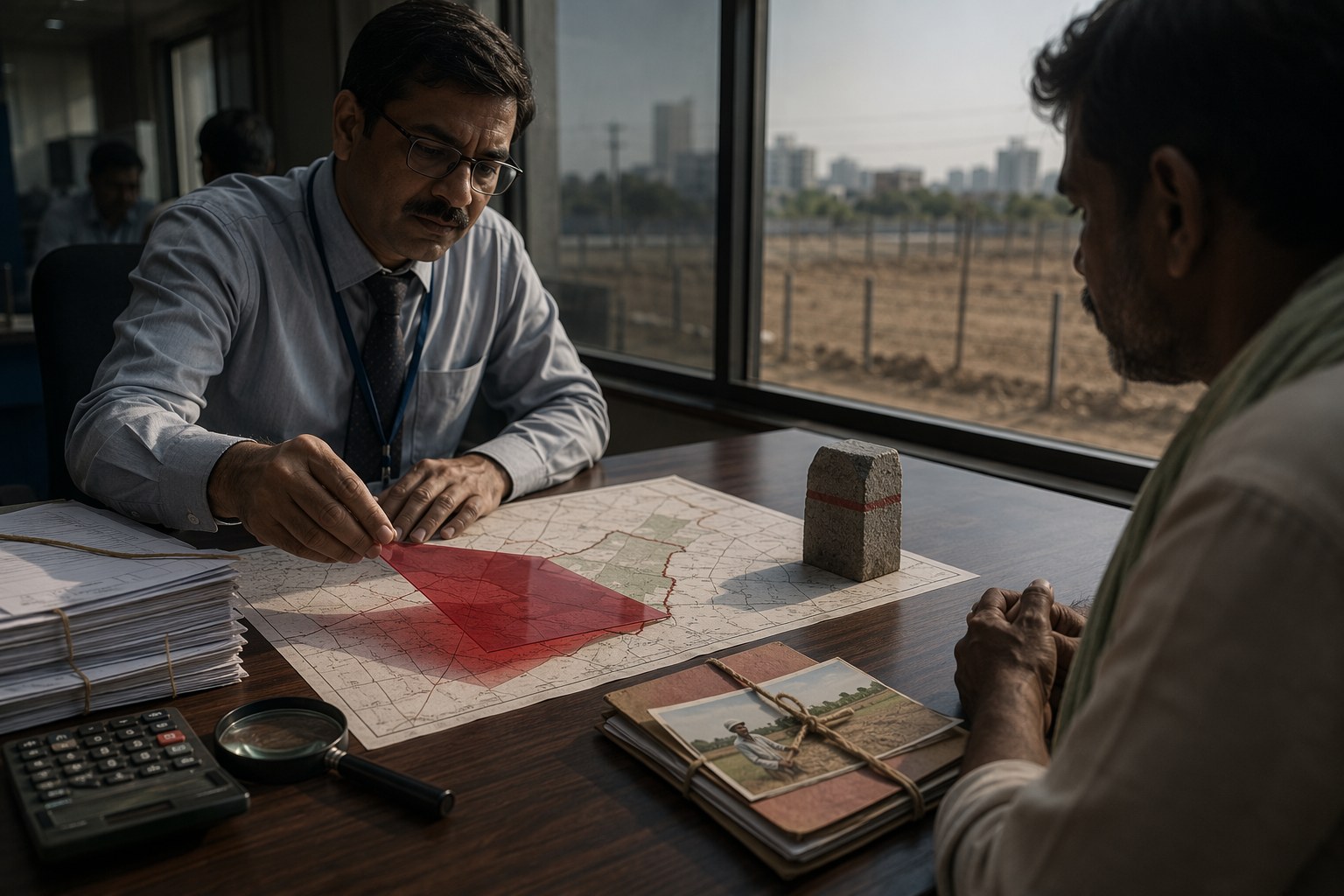
Telangana Banks May Tighten Collateral Haircuts on Land Loans
Telangana banks may tighten collateral haircuts on land loans as lenders take a harder look at land parcels that can fall under Section 22-A prohibited property records. The trigger is not one single bank circular in the public domain. The pressure comes from the size of the risk itself: as per latest IGRS-linked government records available in our database, Telangana has 3,076,153 prohibited property entries under Section 22-A.
For homebuyers, plot buyers and landowners, this is not a small paperwork issue. If a land parcel is in or near a prohibited property record, banks can reduce the collateral value, ask for higher borrower contribution, delay sanction, or refuse the loan. In plain Hyderabad market language: even if the sale price looks attractive in Kokapet, Kollur, Mokila, Adibatla or Ghatkesar, the bank will not treat the land as clean security unless the title, survey number, village record, pahani and registration status are clear.
Our view is simple: Telangana land buyers should now treat Section 22-A checking as a finance issue, not only as a legal issue. A property that cannot be freely registered or mortgaged is not full-value collateral for a bank.
Why Telangana Banks May Tighten Collateral Haircuts on Land Loans
A collateral haircut is the discount a bank applies while valuing a property offered as security. If a borrower claims that a land parcel is worth a certain amount, the bank may accept only part of that value for loan calculation after considering legal risk, marketability, location, access road, land use and title clarity.
Section 22-A is particularly sensitive because it relates to properties that are prohibited from registration. These can include government lands, assigned lands, endowment-related properties, waqf-related records, ceiling surplus lands, court-disputed entries and other categories notified by authorities. The exact reason has to be checked against the specific survey number, village and mandal record.
In our experience, bankers are rarely impressed by only a glossy layout brochure or a seller’s verbal assurance. They want documentary comfort. That means they look at the link documents, Encumbrance Certificate, pattadar passbook details where relevant, Dharani status, pahani, mutation trail, approved layout status, and whether the SRO will actually register the transaction.
With 3,076,153 prohibited property entries sitting in government-linked records, risk teams are likely to be more conservative, especially for land-backed business loans, LAP products, plot purchase loans and builder inventory funding where open land is offered as collateral.
Telangana Banks May Tighten Collateral Haircuts in These Land Corridors
The impact will not be uniform across Telangana. Prime apartment markets in the core city behave differently from plotted development belts on the edge of Hyderabad. Still, buyers should be extra careful in fast-moving land corridors around the Outer Ring Road, Regional Ring Road influence zones, industrial belts and temple-town growth pockets.
We have seen due diligence questions become sharper in areas such as Shankarpally, Moinabad, Gandipet, Rajendranagar, Maheshwaram, Abdullapurmet, Ghatkesar, Medchal, Shamirpet and Patancheru mandals. In localities such as Kokapet, Narsingi, Kollur, Mokila, Tellapur, Bachupally, Miyapur, Adibatla, Tukkuguda, Bibinagar and Yadagirigutta, the common buyer assumption is that demand itself proves safety. It does not.
Market demand can support resale liquidity, but it cannot cure a prohibited property entry. A road-facing parcel near a growth corridor can still face registration refusal if the survey number is flagged. A lender will price that risk into the loan, or avoid the file altogether.
How a Section 22-A issue can affect bank valuation
| Due diligence finding | Likely bank reaction | Buyer impact |
|---|---|---|
| Survey number appears in prohibited property records | Loan may be held, reduced, or rejected until clarification | Buyer may need more own funds or may have to exit the deal |
| Seller has link documents but Dharani or SRO status is unclear | Legal team may ask for revenue records and written clarification | Sanction timeline can stretch |
| EC is clean but land classification is doubtful | Bank may apply a steeper haircut | Lower loan-to-value comfort |
| Layout approval and land use are not matching buyer purpose | Valuer and legal team may raise objections | Construction finance or resale finance can become difficult |
| Clear title, clean EC, matching survey and SRO registration comfort | Normal valuation process is more likely | Better chance of smoother sanction |
What Section 22-A Means for Buyers, Borrowers and Sellers
Section 22-A is not only a legal phrase for advocates. It directly affects the bankability of land. If the property is prohibited from registration, the bank cannot comfortably create or enforce a mortgage. If it cannot enforce security, the collateral value drops sharply from a lender’s point of view.
This is why a buyer should not depend only on the sale agreement. Before paying a token advance, check the survey number, village name, mandal, SRO jurisdiction and EC trail. Use the Section 22-A Prohibited Property Check first. Then verify past transactions through the Encumbrance Certificate Search. If the land is in a plotted layout or project, cross-check approvals through the RERA Project Lookup where applicable.
For valuation comfort, buyers should also compare the ready reckoner or guideline value through the Market Value / Guideline Value Search. Stamp duty outgo can be estimated with the Stamp Duty Calculator. If you are unsure which registration office handles the village, use Find Your SRO Office.
One practical point: the EC alone is not enough. Many buyers in Hyderabad still say, “EC clean undi, so land safe.” That is a risky shortcut. An EC mainly shows registered transactions and encumbrances. It may not fully answer whether the land is assigned, government-notified, disputed in revenue records, or blocked under Section 22-A. That is why survey-number level checking matters.
Loan-to-Value Decisions May Become More Conservative
Land loans are already treated more cautiously than standard apartment home loans. The reason is obvious to any banker: land has title complexity, boundary disputes, access-road issues, zoning questions and lower immediate income generation. Section 22-A risk adds another layer.
If Telangana banks tighten collateral haircuts, the borrower may see any of these outcomes:
- Lower eligible loan against the same land parcel.
- More questions from the bank’s legal and valuation teams.
- Requirement for updated pahani, Dharani extract, mutation proof and SRO clarification.
- Demand for alternate collateral if land title is not fully clear.
- Delay in disbursement until the prohibited property status is clarified.
- Refusal to finance land in villages with unresolved survey-number confusion.
For sellers, this can affect negotiations. A buyer who depends on bank finance will not be able to close quickly if the bank applies a heavy haircut. Cash buyers may still negotiate, but they will also price in legal risk. We have seen sellers in peripheral mandals lose serious buyers because one survey-number mismatch came up during bank legal scrutiny.
Hyderabad Land Buyers Should Change Their Due Diligence Order
The usual buyer sequence is emotional: visit site, like location, bargain, pay advance, then check papers. That sequence is dangerous in Telangana land deals. The better sequence is boring but safer.
- First, identify the exact survey number and sub-division number.
- Check the village and mandal spelling as per revenue records, not only brochure spelling.
- Run a Section 22-A check before paying advance.
- Take the EC for the correct SRO period and document chain.
- Compare seller name, pattadar details, pahani and link documents.
- Check land use, layout approval and access road.
- Only then negotiate token payment and agreement terms.
If the deal is in high-activity belts like Kollur, Mokila, Shankarpally, Tukkuguda, Maheshwaram, Ghatkesar or Yadagirigutta, do not rush only because someone says prices are moving. Fast price movement can also attract weak-title inventory into the market.
For apartments, the risk pattern is different, but not absent. If a project is built on land with unresolved prohibited status, lender approvals can get affected. That is why buyers should check project registration, title summary, EC and mortgage details before relying on a pre-approved loan tag.
What Borrowers Should Ask the Bank Before Offering Land as Collateral
If you are taking a business loan, loan against property, builder finance or plot purchase loan, ask the bank these direct questions:
- Will your legal team check Section 22-A records at survey-number level?
- Will the bank accept Dharani and pahani records provided by the borrower, or will it independently verify?
- What happens if the SRO raises a registration objection later?
- Will the valuation be based on market value, ready reckoner value, or bank panel valuer assessment?
- Will any title uncertainty reduce the sanctioned amount?
- Can I submit alternate collateral if the land file is considered risky?
These questions may sound blunt, but they save time. Many borrowers discover the issue only after processing fees, valuation charges and legal-review delays. Better to know the bank’s view early.
Our Reading of the Telangana Land Finance Market
Telangana’s land market is still active, especially around Hyderabad’s western, southern and eastern growth corridors. Demand for plotted land has not disappeared. But banks are paid to be conservative. When government records show a large base of prohibited property entries, lenders will naturally prefer clean, easily enforceable collateral.
My opinion: the next phase of land buying in Telangana will reward buyers who verify first and negotiate later. The old habit of trusting only local reputation, layout compound walls and word-of-mouth will not work for financed deals. Banks will look for registration certainty, clean title flow and clear revenue classification.
For a genuine buyer, this is not bad news. Stricter bank checks can filter out weak-title land and reduce future disputes. But it also means buyers must keep documents ready and use proper verification tools before committing money.
Frequently Asked Questions
Will Telangana banks stop giving loans on land because of Section 22-A?
No. Clean-title land can still be financed. The concern is with parcels that appear in prohibited property records or have unclear revenue, registration or title status. Banks may reduce valuation comfort or reject such files.
How many prohibited property entries are there in Telangana records?
As per latest IGRS-linked government records available in our database, Telangana has 3,076,153 prohibited property entries under Section 22-A.
Is a clean Encumbrance Certificate enough for a land loan?
No. A clean EC is useful, but it does not replace survey-number checking, pahani verification, Dharani status review, SRO jurisdiction check and Section 22-A prohibited property verification.
Which Telangana areas need extra caution before buying land?
Buyers should be careful in all land deals, especially in fast-moving belts such as Shankarpally, Mokila, Kollur, Maheshwaram, Adibatla, Ghatkesar, Shamirpet, Patancheru and Yadagirigutta. The exact survey number matters more than the locality name.
What should I check before paying advance for a plot?
Check the survey number, village, mandal, Section 22-A status, EC, pahani, Dharani details, SRO jurisdiction, layout approval, access road and land use. Do this before paying token advance.