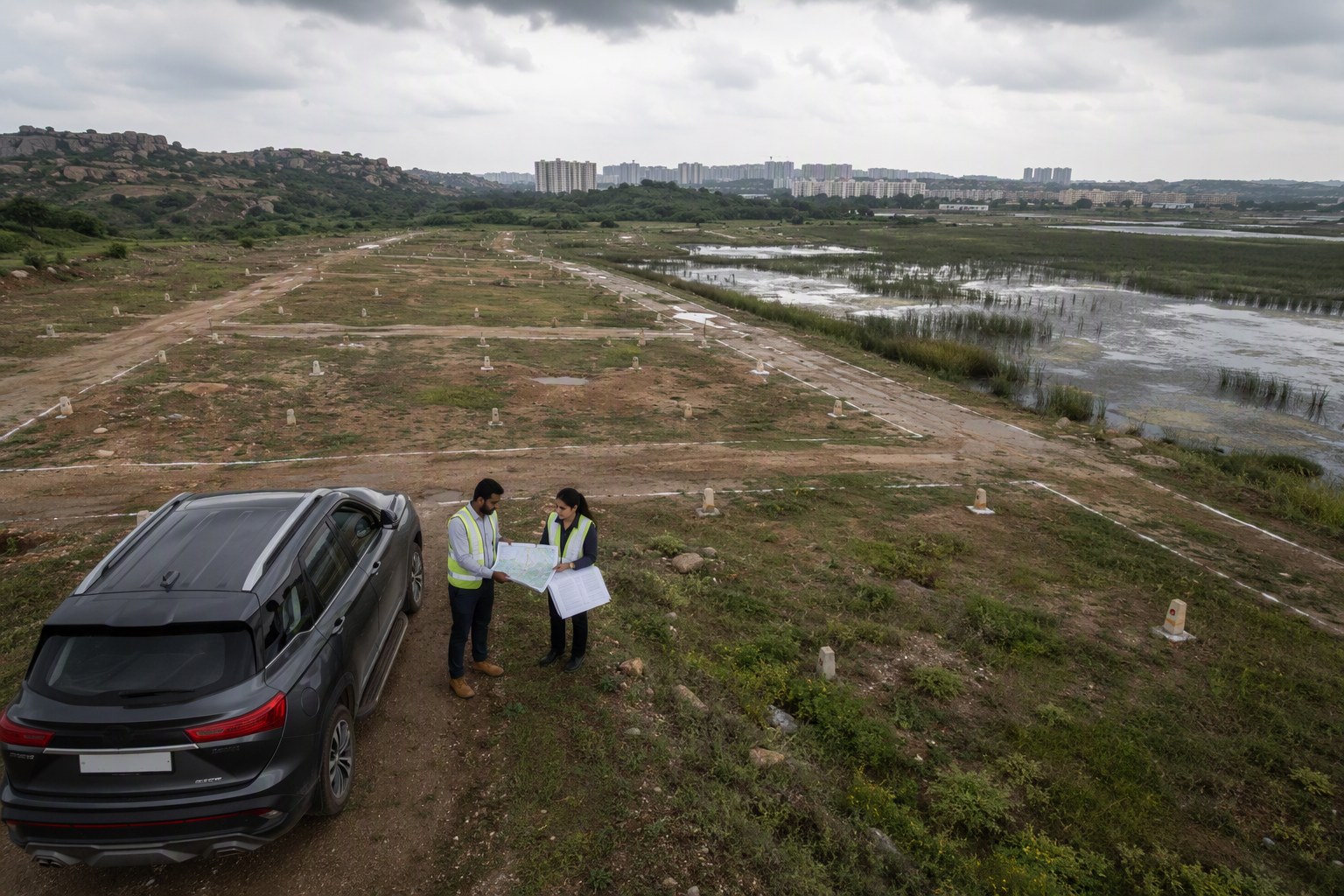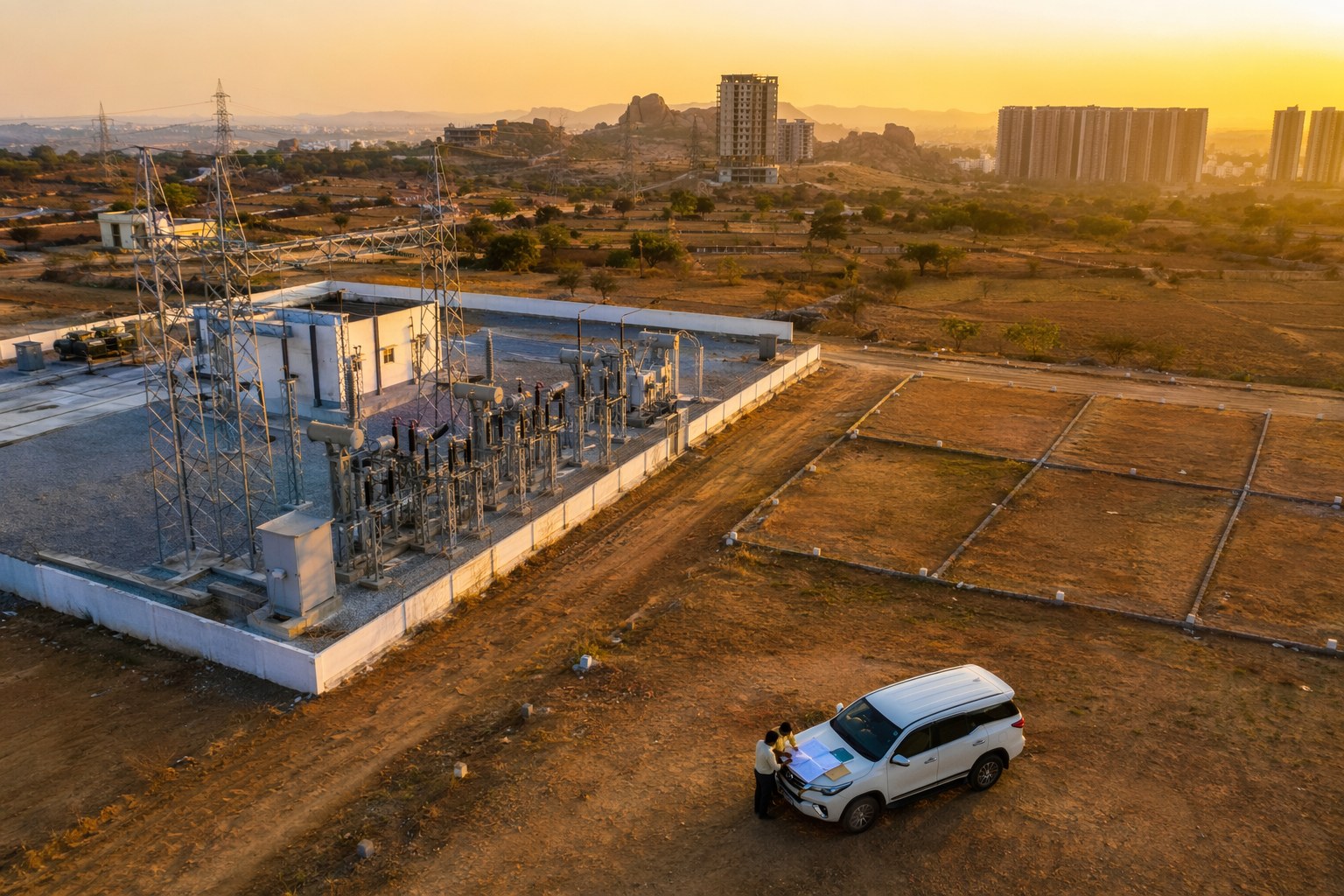



Hyderabad Layout Approvals May Add Native Tree Cover Checks as city planning discussions increasingly connect plotted development with local ecology. For buyers, the practical message is simple: apart from title, EC, pahani, Dharani entries, SRO records and Section 22-A checks, the tree cover condition in a layout may become one more due-diligence item before paying token advance.
This is not just an environmental talking point. In Hyderabad’s expanding plot markets, especially around Kollur, Mokila, Tellapur, Ghatkesar, Adibatla, Shamshabad and Bachupally, layout-level conditions can affect what a buyer can build, where internal roads run, how open space is treated, and whether later permissions face objections.
Our reading is clear: if native tree cover becomes part of layout scrutiny, plot buyers should treat it like road width, land use and OSR — not as a brochure promise.
Hyderabad Layout Approvals May Add Native Tree Cover Checks: what changes for plot buyers
At present, most buyers start with the usual checklist: sale deed chain, Encumbrance Certificate, market value, survey number, prohibited property status, layout approval, and whether the land sits in a permitted land-use zone. That remains non-negotiable.
But a native tree cover condition, if written into layout approvals or planning remarks, can become a practical risk point. It may decide whether existing trees must be retained, whether compensatory plantation is required, or whether the layout’s open space and green buffers are treated seriously at the approval stage.
For example, a buyer considering a plot in Mokila under Shankarpally mandal may focus only on approach road and resale rate. A buyer in Kollur or Tellapur under the western corridor may look at HMDA approval and access to ORR. In our experience, many buyers do not ask one direct question: “Were there any green cover or tree retention conditions in the layout approval?” That question may soon matter more.
Before booking, buyers should use the Encumbrance Certificate Search, confirm survey identity through the Survey Number Finder, and run a basic ownership-risk review through the Property Verification Tool. If the land is part of a plotted venture, also compare the layout plan with ground reality.
Why Hyderabad Layout Approvals May Add Native Tree Cover Checks to routine due diligence
Hyderabad’s growth is moving across multiple edges at the same time. West Hyderabad has strong plotted demand in Mokila, Shankarpally, Kollur and Velimela. South Hyderabad buyers look at Shamshabad, Maheshwaram and Adibatla. East and north-east corridors see activity around Ghatkesar, Pocharam and Bibinagar side. North-west pockets like Bachupally, Mallampet and Dundigal also remain active among end-users and investors.
In these corridors, a plotted layout is not only a title document. It is a land-use decision. It decides roads, open spaces, setbacks, amenity areas, drainage channels and green buffers. If native trees are present on the site, approval authorities may want developers to account for them rather than clearing everything first and marketing the venture later.
For a buyer, the problem appears after registration. Suppose the brochure shows “green living” but the sanctioned plan has a specific condition on tree retention near a boundary or open space. If later the association, developer or individual plot owner ignores that condition, future building permission or mutation-related compliance may become irritating. Nobody wants to discover such issues after paying full consideration and stamp duty.
The legal checklist still comes first
Tree cover checks should not replace basic legal verification. They should sit on top of it. Telangana property records already have enough traps for casual buyers. As per latest IGRS data, Section 22-A prohibited properties include 3,076,153 entries. That single number explains why a “clean-looking” plot cannot be trusted only because the layout has a gate, compound wall and sales office.
Every buyer should still check whether the property is hit by government land restrictions, endowment issues, assigned land entries, court disputes or other prohibitory remarks. Use the Section 22-A Prohibited Property Check before agreement stage, not after registration date is fixed.
After that, verify the SRO jurisdiction through the Find Your SRO Office and compare the official ready reckoner through the Market Value / Guideline Value Search. Buyers often negotiate based on local market talk, but stamp duty and registration work on government market value rules. For cost planning, the Stamp Duty Calculator is useful before arranging funds.
How to check tree-cover risk before buying a Hyderabad plot
There is no need to become a botanist. A practical buyer can ask for documents and inspect the site with common sense. The key is to link the physical trees on the land with the approved layout and planning conditions.
- Ask for the full layout approval file: Not just the glossy layout image. Ask for proceedings, conditions, approved drawing and any environmental or plantation-related remarks.
- Compare site and plan: Check whether old trees, water channels, nalas, rocks and open spaces shown on paper are actually present.
- Check OSR and open space treatment: Use the OSR Calculator to understand whether open space obligations make sense for the project size.
- Verify road widths: Green buffers and tree lines often sit along internal roads or boundary stretches. Use the Road Width Check where road access is a concern.
- Confirm land use: A tree-rich parcel in a sensitive zone needs extra caution. Check zoning through the Land Use Zone Finder.
- Track later changes: If you are buying in a phased venture, monitor layout or ownership changes using the Property Change Tracker.
Locality-wise buyer caution in Hyderabad’s plotted corridors
| Area | Mandal / planning focus | Buyer caution |
|---|---|---|
| Mokila | Shankarpally mandal | Check layout conditions, approach road, survey continuity and any green buffer shown near village boundaries. |
| Kollur | Ramachandrapuram side | Compare approved plan with ground-level development, especially open space and internal road formation. |
| Tellapur | Ramachandrapuram mandal influence | Due diligence should cover title chain, EC, land use and layout conditions, not only proximity to IT corridor. |
| Adibatla | Ibrahimpatnam mandal | Check conversion, layout approval and whether site features have been altered before marketing. |
| Ghatkesar | Ghatkesar mandal | Verify survey number, SRO records, land-use zone and road access before relying on resale claims. |
| Shamshabad | Shamshabad mandal | Airport-side demand is strong, but buyers must examine permissions, road width and any layout-level restrictions. |
What developers may need to disclose more clearly
If native tree cover becomes a stronger approval condition, developers should not hide it in small print. The buyer should know whether trees are to be retained inside OSR, along roads, near setbacks or in common areas. In a plotted venture, this affects future maintenance responsibility also.
We’ve seen buyers accept “HMDA approved” as a full answer. It is not. Approval is a starting point. The conditions attached to approval are equally relevant. A plot buyer should ask the sales team: “Show me the approval conditions page.” If the answer is vague, slow down.
For larger projects, buyers can also check whether the project is registered, where applicable, through the RERA Project Lookup. RERA status does not automatically solve land or tree-cover issues, but it gives one more official layer to review.
Our view: green conditions will become financial due diligence
In Hyderabad, environmental compliance is slowly entering normal property conversations. Earlier, buyers spoke mainly about title and appreciation. Now they ask about nalas, lake buffers, road widening, FTL, zoning and building permission. Native tree cover may join this list because it can affect layout execution and future permission comfort.
For end-users, that is a good development. Mature native trees improve shade, reduce heat on internal roads and make a colony more liveable. For investors, the point is different: any unclear approval condition can reduce liquidity when you try to resell. A cautious buyer will ask for documents today so that the next buyer does not bargain hard tomorrow.
The safest approach is balanced. Do not reject every land parcel with trees. Do not blindly buy a cleared layout either. Check whether the trees were recognised in the approval process, whether open spaces are properly marked, and whether the developer has followed the sanctioned plan. That is how tree cover becomes a due-diligence item, not just a marketing line.
Frequently Asked Questions
Will native tree cover checks become mandatory for Hyderabad layout approvals?
The direction appears to be towards stronger scrutiny, but buyers should verify the actual approval conditions for each layout. Do not assume a rule applies uniformly without checking the file.
Should I check tree cover before buying a plot in Mokila, Kollur or Tellapur?
Yes. Along with title, EC, survey number, land use and Section 22-A status, ask for the layout approval proceedings and see whether any tree retention, green buffer or OSR condition is mentioned.
Can a tree-cover condition affect my building permission later?
It can, if the condition is part of the approved layout and the ground situation violates it. This is why buyers should compare the approved plan with the actual site before registration.
Which checks are still most important before buying a Hyderabad plot?
Start with ownership chain, EC, Dharani or revenue records, SRO details, guideline value, land-use zone, layout approval, road width and Section 22-A prohibited property status.