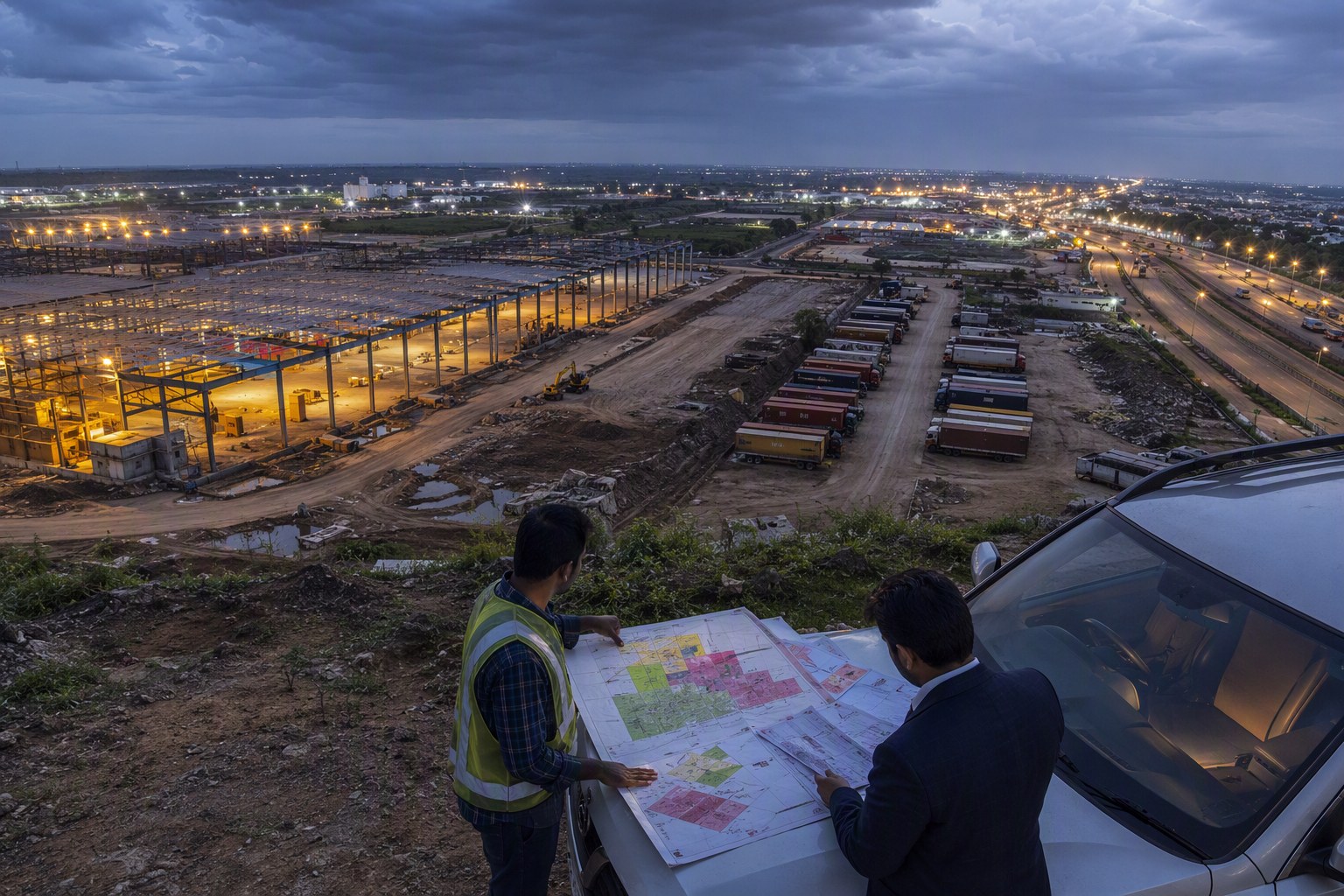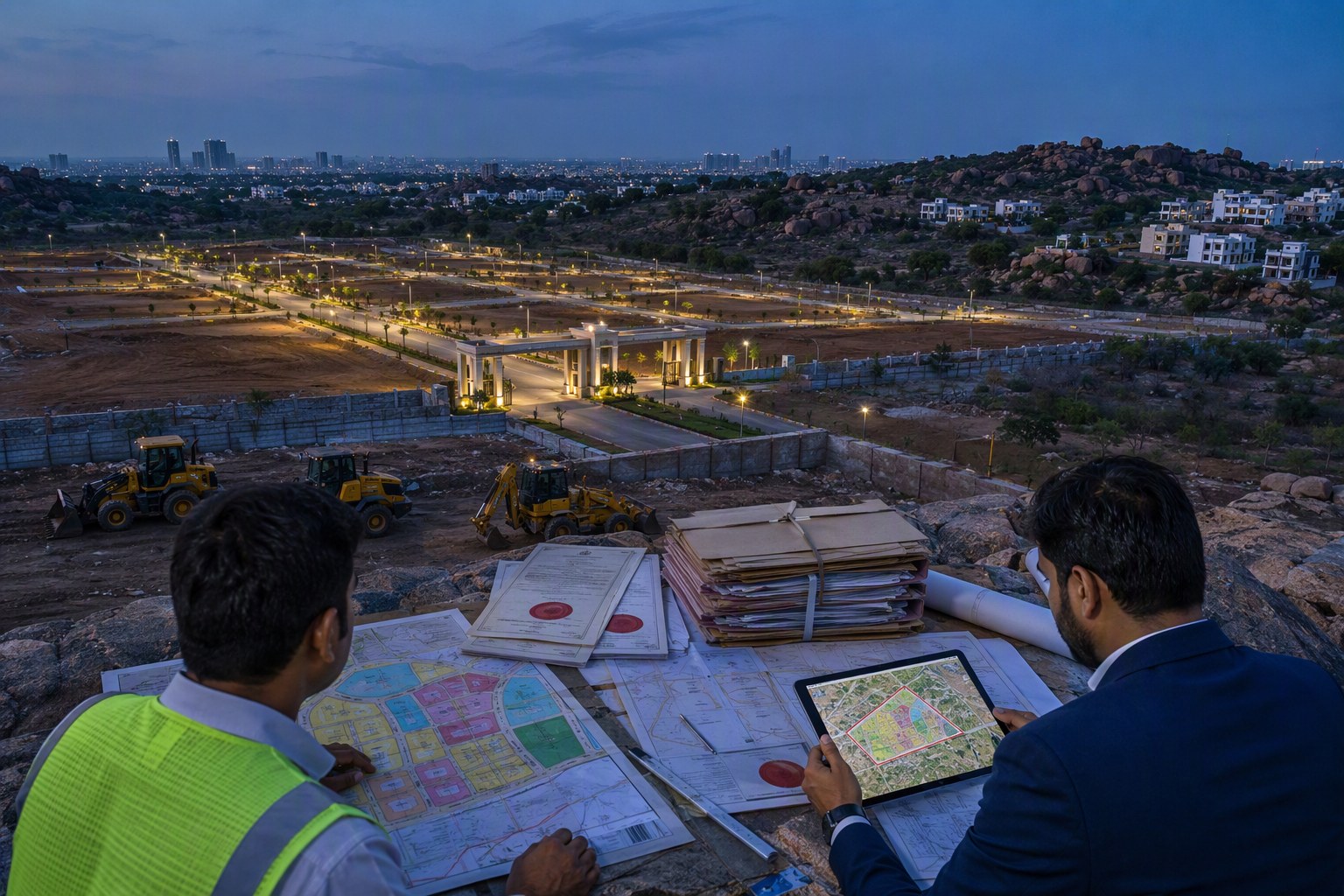
Hyderabad Data Centre Campuses coming up around the city may now force a quieter but serious change in land acquisition practice: complete Section 22-A prohibited property checks before any launch announcement, MoU, board approval, or site acquisition. In our experience, this is where many large-ticket land deals either become bankable or get stuck for months.
The reason is simple. Data centre campuses need large, clean, litigation-safe land parcels with road access, power feasibility, clear land use, and saleable title. If even one survey number in a proposed campus falls under Section 22-A, the Sub-Registrar Office may refuse registration. For investors, that is not a paperwork issue. It is a deal risk.
As per latest IGRS data available with Verified.RealEstate, Telangana has 3,076,153 prohibited property records under Section 22-A. For large land aggregations near Hyderabad, that number is not academic. It directly affects due diligence timelines.
Hyderabad Data Centre Campuses And The 22-A Question
The next wave of industrial-scale real estate around Hyderabad is not only residential layouts and logistics parks. Data centre campuses are also being discussed in belts with strong connectivity to ORR, airport-side corridors, power infrastructure, and industrial zones. Locations that often come up in market conversations include Shankarpally, Chevella, Moinabad, Maheshwaram, Kandukur, Shamirpet, Medchal, Patancheru, Sangareddy-side growth pockets, and the wider Rangareddy-Medchal-Sangareddy triangle.
These are not small apartment projects where one plot document set can be checked quickly. A data centre campus may involve multiple pattadar passbooks, old sale deeds, partition deeds, family settlements, conversion permissions, mutation entries, pahani extracts, dharani records, and village map checks across several survey numbers. One missed 22-A entry can disturb the entire acquisition structure.
That is why developers, land aggregators, private equity teams, and infrastructure investors are likely to move 22-A verification to the first stage itself. Earlier, some teams would sign an MoU, announce intent, and then run full title due diligence. That approach is risky in land-heavy asset classes.
Why Hyderabad Data Centre Campuses Need Pre-Launch Land Verification
Data centres are different from regular commercial buildings. The site has to pass many filters before capital is committed. Land title is only one part, but it is the base layer. If title fails, power planning, design, civil works, bank funding, leasing, and anchor-client discussions all get delayed.
For a proposed campus in Maheshwaram mandal or Kandukur mandal, for example, teams may first look at approach road width, zoning, electricity corridor feasibility, and distance from existing infrastructure. But before a serious cheque is written, the survey numbers should be checked against prohibited property records. The same applies to land near Shamirpet and Medchal, where industrial, institutional, private patta, assigned land, and government-interest parcels can sit close to each other.
In Telangana, Section 22-A broadly affects properties where registration is restricted due to government interest, assigned land issues, court orders, endowment concerns, waqf claims, ceiling matters, or other notified restrictions. The actual reason must be verified case by case. A broker saying “clear land, sir” is not enough.
For first-level screening, buyers can start with the Section 22-A Prohibited Property Check. For survey-level clarity, the Survey Number Finder helps teams avoid checking the wrong parcel, which is a common mistake in village-side transactions.
What Changes Before MoUs And Launch Announcements?
In our reading, the market will become less tolerant of soft announcements backed only by location claims. If a developer says a data centre campus is planned near Hyderabad, investors will ask sharper questions:
- Are all survey numbers checked for Section 22-A restrictions?
- Is the land private patta land, assigned land, government land, endowment land, or mixed?
- Do the latest dharani entries match old link documents?
- Has the SRO accepted similar transactions in that village?
- Is the land use compatible with the proposed data centre activity?
- Are there EC entries, mortgages, attachments, or pending transactions?
Before a public launch, the safer route is to prepare a land due diligence pack. This should include pahani, mutation history, passbook details, link documents, encumbrance certificate, 22-A status, village map reference, land use check, and SRO jurisdiction note. The Encumbrance Certificate Search and EC Analyzer are useful for catching mortgage trails and transaction gaps. For SRO mapping, use Find Your SRO Office or SRO Village Directory.
Hyderabad Data Centre Campuses: Mandal-Level Due Diligence Will Matter
Real estate due diligence in Hyderabad cannot be done only by drawing a circle on Google Maps. Mandal and village records matter. A parcel in Shankarpally mandal will have a different history from land in Maheshwaram or Shamirpet. Even within the same mandal, two adjacent survey numbers can carry completely different legal risks.
| Due diligence item | Why it matters for data centre campuses | Useful check |
|---|---|---|
| Section 22-A status | Registration can be refused if the parcel is prohibited | Section 22-A Prohibited Property Check |
| Survey number identity | Wrong survey number checks create false comfort | Survey Number Finder |
| Encumbrance history | Mortgages, prior sales, and charges affect funding | Encumbrance Certificate Search |
| Market value | Stamp duty, valuation, and deal structuring depend on ready reckoner values | Market Value / Guideline Value Search |
| Land use | Industrial or compatible use must be verified before planning | Land Use Zone Finder |
We have seen many land discussions where the buyer first talks about acres and road frontage. That is natural. But the first legal question should be: “Give me the village, mandal, survey numbers, and latest ownership trail.” Without that, nobody can properly check 22-A, EC, land use, or SRO acceptance.
For valuation work, teams should not rely only on asking prices quoted in the market. The ready reckoner or guideline value should be checked through Market Value / Guideline Value Search, and transaction cost modelling can be run through the Stamp Duty Calculator. We are not quoting a blanket rate here because values change by village, road access, land use, and SRO classification.
Why Investors Will Push For Cleaner Conditions Precedent
Institutional investors do not like unclear land. In data centre deals, the capital outlay does not stop at land purchase. There are heavy commitments towards power systems, cooling infrastructure, security, network connectivity, civil construction, and long-term client contracts. If the land title is challenged after a press release, reputational damage follows.
That is why term sheets may now carry tighter conditions precedent. A buyer may insist that the seller clears 22-A issues, updates mutation records, produces certified copies, resolves family claims, and confirms registration feasibility with the jurisdictional SRO before closing. Some investors may even refuse to release token advances until the land passes a preliminary prohibited-property screening.
This is healthy for the Hyderabad market. It may slow down dramatic announcements, but it improves transaction quality. A clean deal is better than a loud deal that collapses later at registration stage.
What Developers Should Do Before Announcing A Data Centre Campus
For developers and land aggregators, the practical checklist is straightforward:
- Collect exact survey numbers, village names, mandal details, and owner records before commercial negotiation.
- Run a Section 22-A check for every survey number, not only the main parcel.
- Compare dharani data with old link documents, passbooks, pahani, and mutation entries.
- Check EC history for the relevant period available through government records.
- Confirm SRO jurisdiction and registration practice for that village.
- Verify land use, approach road, and development restrictions before design commitments.
- Keep a written title-risk note before MoU signing or public communication.
If the project is proposed as a formal real estate development with sale, lease, or structured offering, RERA applicability should also be reviewed. The RERA Project Lookup can help buyers cross-check registered project details where relevant.
Verified.RealEstate View
Hyderabad has the depth to attract technology infrastructure, warehousing, industrial parks, plotted developments, and residential growth at the same time. But land records are not uniform across the city’s growth corridors. In older villages around the ORR and beyond, one parcel may have clean private title while the next may have government-interest markings, assignment history, or unresolved inheritance issues.
With 3,076,153 prohibited property records in Telangana as per latest IGRS data available with Verified.RealEstate, pre-launch 22-A vetting should become standard practice for large campuses. Not after the press note. Not after the investor call. Before the deal is spoken about publicly.
For data centre campuses, that single discipline can save months of uncertainty. It also protects sellers with genuine land, because clean parcels will stand out faster when buyers run structured checks.
Frequently Asked Questions
What is Section 22-A in Telangana property registration?
Section 22-A refers to properties where registration is prohibited or restricted due to government interest, assigned land issues, court orders, endowment or waqf claims, and other notified reasons. The exact reason must be checked for the specific survey number.
Why are Hyderabad data centre campuses more sensitive to 22-A issues?
Data centre campuses need large land parcels and heavy upfront capital. If even one key survey number is under 22-A restriction, registration and funding can get delayed, affecting the entire project plan.
Should 22-A verification be done before signing an MoU?
Yes. For large land deals, basic 22-A screening should happen before MoU signing, token advance, launch announcement, or investor presentation. It reduces title risk at the earliest stage.
Which records should be checked along with 22-A status?
Check dharani entries, pahani, pattadar passbook details, link documents, mutation history, EC, SRO jurisdiction, land use, approach road, and any court or charge entries.
Can a prohibited property be regularised or registered later?
It depends on the reason for prohibition. Some entries may be corrected after government review or record rectification, while others may remain non-transferable. Legal advice and department-level verification are needed.