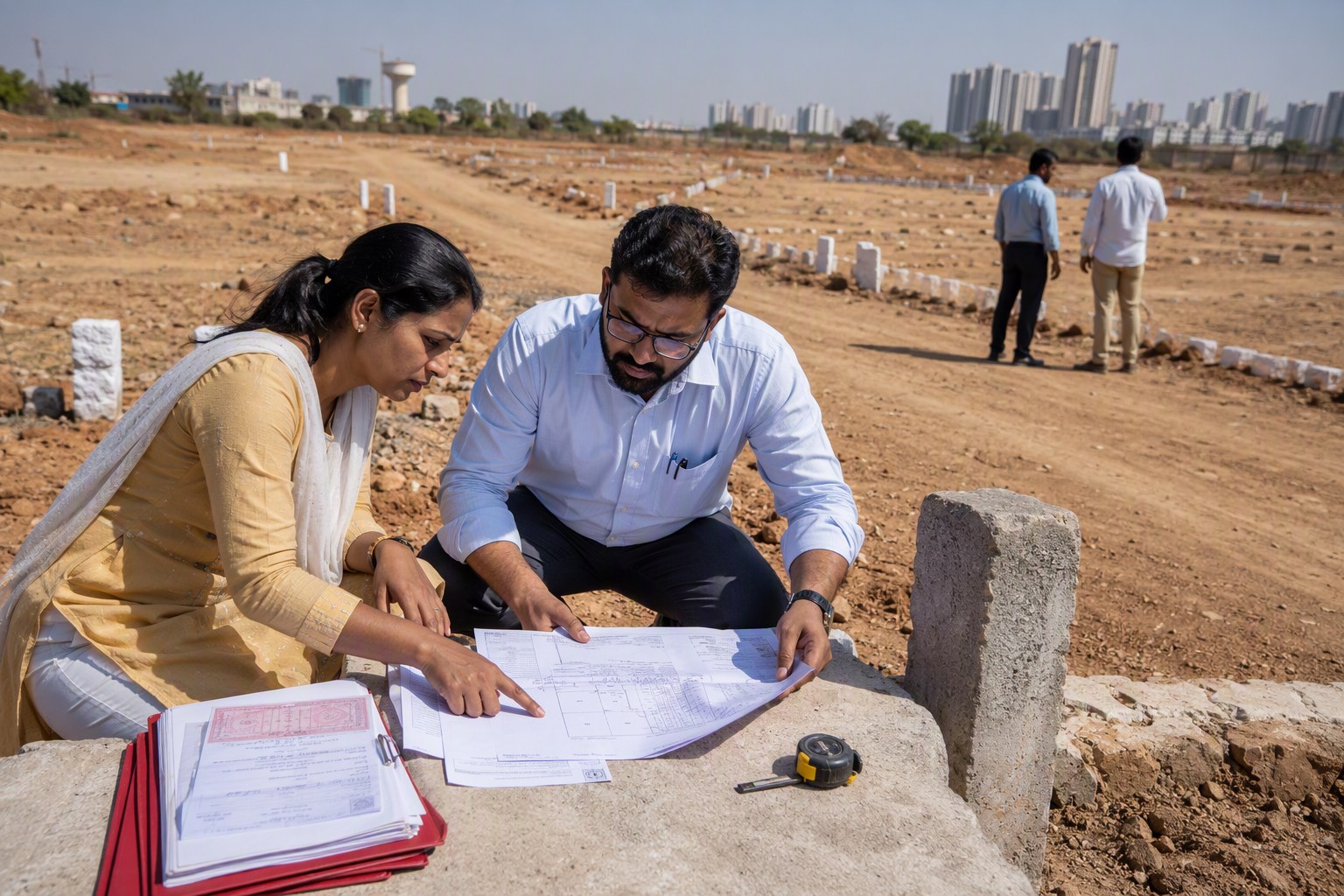
Telangana Township Pre-Launches are likely to face a sharper buyer question now: has the developer audited the full land bank before taking pre-launch bookings? With Telangana’s Section 22-A prohibited property database showing 3,076,153 entries as per latest IGRS data available to Verified.RealEstate, large township and plotted-development promoters can no longer treat land title checks as a back-office formality.
The immediate industry shift we are watching is simple. Before marketing hundreds of acres in areas like Mokila, Shankarpally, Kollur, Tellapur, Patancheru, Maheshwaram, Tukkuguda, Adibatla, Kadthal and Shadnagar, promoters may start commissioning upfront land bank audits. These audits would test survey numbers, pahani records, Dharani status, SRO mapping, mutation history and Section 22-A flags before brochures, WhatsApp creatives and channel partner pitches hit the market.
In our experience, the risk is not only with the final registration. The damage starts much earlier, when a buyer pays a token amount for a plot in a survey number that later turns out to be restricted, disputed or not fully marketable.
Telangana Township Pre-Launches: Why Land Bank Audits Are Moving Upfront
For years, many Hyderabad and Telangana outskirts projects followed a familiar route. First came land aggregation, then informal pre-launch marketing, then layout permissions and RERA registration where applicable. Title due diligence often happened in pieces, especially when the land bank was spread across multiple survey numbers and owners.
That model is becoming risky for large township launches. A township in Shankarpally mandal may not be one neat parcel. It may involve several pattadars, old family partitions, assigned land doubts, road access issues, nala buffers, village boundary confusion and different SRO jurisdictions. In plotted layouts near Maheshwaram, Kadthal or Kandukur mandal, even one affected survey number can disturb the sale plan, mortgage plan and customer confidence.
Section 22-A entries are a major reason. These are properties prohibited from registration under law for specific reasons, including government land, assigned land, endowment land, wakf-related entries, court attachments or other notified restrictions. The exact reason needs case-by-case checking. But the buyer’s practical problem is direct: if a plot falls under a restricted survey number, registration can stop at the SRO stage.
Verified.RealEstate’s current database context shows 3,076,153 prohibited property entries under Section 22-A. That scale is enough for serious developers to change their pre-launch process.
Telangana Township Pre-Launches and the 22-A Marketing Risk
Pre-launch sales are built on trust. In Hyderabad’s western belt, we’ve seen buyers book early in Mokila, Kollur, Narsingi-side growth corridors and Tellapur because they expect price movement after permissions. In the southern belt, Tukkuguda, Adibatla, Maheshwaram and Shadnagar attract buyers looking at long-term plotted investments. The problem is that marketing speed often runs faster than land verification.
A land bank audit before a township pre-launch can reduce three types of risk:
- Registration risk: the SRO may refuse registration if the survey number is flagged under Section 22-A.
- Layout risk: parcels with unclear title, access gaps or land use mismatch can delay approvals.
- Reputation risk: buyers may lose confidence if the promoter changes plot allocations after collecting booking amounts.
For buyers, a glossy master plan is not enough. Ask for the village name, mandal, survey numbers, extent, ownership flow and whether the promoter has run a prohibited property check. If the sales team says “all clear”, request documentary proof rather than only a verbal assurance.
What a Proper Land Bank Audit Should Cover
A good audit is not just an advocate’s short title opinion. For a large township or plotted development, the audit must combine legal, revenue, planning and registration checks. This is where the Telangana system has become more data-driven, but also more unforgiving. Dharani, pahani, market value records, EC records and SRO records must speak to each other.
| Audit Area | What Should Be Checked | Why It Matters |
|---|---|---|
| Survey number verification | Village, mandal, extent, sub-division and boundary consistency | Prevents marketing of the wrong parcel or excess extent |
| Section 22-A check | Whether any survey number appears in prohibited property records | Helps avoid SRO registration refusal |
| Pahani and Dharani review | Pattadar name, nature of land, classification and mutation history | Shows whether revenue records support the sale claim |
| EC review | Past sale deeds, mortgages, agreements and charges | Flags title breaks and financial encumbrances |
| Planning review | Land use zone, road width, access and layout suitability | Supports realistic approval planning |
Buyers can do a first-level check using Verified.RealEstate tools before committing money. Start with the Section 22-A Prohibited Property Check, then verify the village and survey number through the Survey Number Finder. For transaction history, use the Encumbrance Certificate Search and, where a project claims registration, cross-check it through the RERA Project Lookup.
Where This Matters Most Around Hyderabad
The audit conversation is most relevant in high-activity land aggregation belts. In the west, Shankarpally mandal, Mokila, Kollur, Tellapur and Patancheru-side locations see frequent plotted and villa-community proposals. In the south, Maheshwaram, Kandukur, Tukkuguda, Adibatla, Kadthal and Shadnagar continue to attract township-style marketing. On the ORR-linked edges, even small differences in village limits and SRO jurisdiction can affect documentation.
One practical issue is that buyers often know the brand name of the venture but not the revenue identity of the land. A project may be marketed as “near Mokila” or “near Tukkuguda”, but the actual village and mandal may be different. That difference matters for pahani, Dharani entries, ready reckoner values and SRO processing. Use the Find Your SRO Office tool and the Market Value / Guideline Value Search before assuming where the property legally falls.
We’ve seen this confusion especially in pre-launch conversations handled by channel partners. A buyer is told the land is close to a known locality, but the agreement draft later carries another village name. That may still be valid, but it must be checked. Real estate geography and revenue geography are not always the same.
What Developers May Change Before Pre-Launch
Serious developers may begin treating the audit report as a pre-launch document, not a post-booking defence. That means marketing teams may get only audited survey numbers. Sales decks may carry clearer land schedules. Booking forms may mention that allotment is subject to approvals and title clearance in specific parcels. Better promoters may even keep a buyer-readable title note ready.
In my view, this is healthy for the market. It may slow down some aggressive launches, but it will protect genuine buyers and serious developers. Telangana’s land market is too valuable to run on vague location claims and half-checked survey numbers.
For buyers, the rule is straightforward: do not book only on the basis of a layout image. Ask for survey numbers. Check Section 22-A status. Read the EC. Match the mandal and village. If the project is under RERA, verify the registration. If it is not yet under RERA, understand what exactly you are paying for and what refund terms apply.
Before paying a token amount, buyers should also estimate registration costs through the Stamp Duty Calculator and track any later document changes using the Property Change Tracker. These are small checks, but they create a paper trail and reduce surprises.
Buyer Checklist for Telangana Township Pre-Launches
- Ask for the exact village, mandal and survey numbers, not only the project name.
- Run a Section 22-A check for each survey number offered.
- Compare pahani, Dharani and sale deed details for owner consistency.
- Check EC records for mortgages, earlier sales and pending charges.
- Verify whether the layout or project needs RERA registration.
- Confirm the correct SRO before planning registration.
- Do not rely only on channel partner messages or brochure maps.
The next phase of township pre-launches in Telangana may be less about who announces first and more about who can prove clean land first. Buyers should welcome that shift.
Frequently Asked Questions
What is a land bank audit in a Telangana township pre-launch?
It is a detailed check of all land parcels proposed for the project, including survey numbers, pahani, Dharani status, ownership chain, EC records, SRO details, planning suitability and Section 22-A prohibited property flags.
Why is Section 22-A important for plotted developments?
If a survey number is listed under Section 22-A, registration may be blocked at the SRO. For a buyer, this can affect plot registration even after paying a booking amount.
Can I verify a pre-launch plot before paying token money?
Yes. Ask for the village, mandal and survey number, then check prohibited property status, EC records, guideline value and SRO jurisdiction before making payment.
Are all pre-launch township offers unsafe?
No. Some promoters do proper due diligence before marketing. The risk is higher when the seller refuses to share survey numbers, title papers or approval status.
Which Hyderabad outskirts need extra caution?
Buyers should be careful in any fast-growing belt, including Shankarpally, Mokila, Kollur, Tellapur, Patancheru, Maheshwaram, Tukkuguda, Adibatla, Kadthal and Shadnagar, especially where large land aggregation is involved.