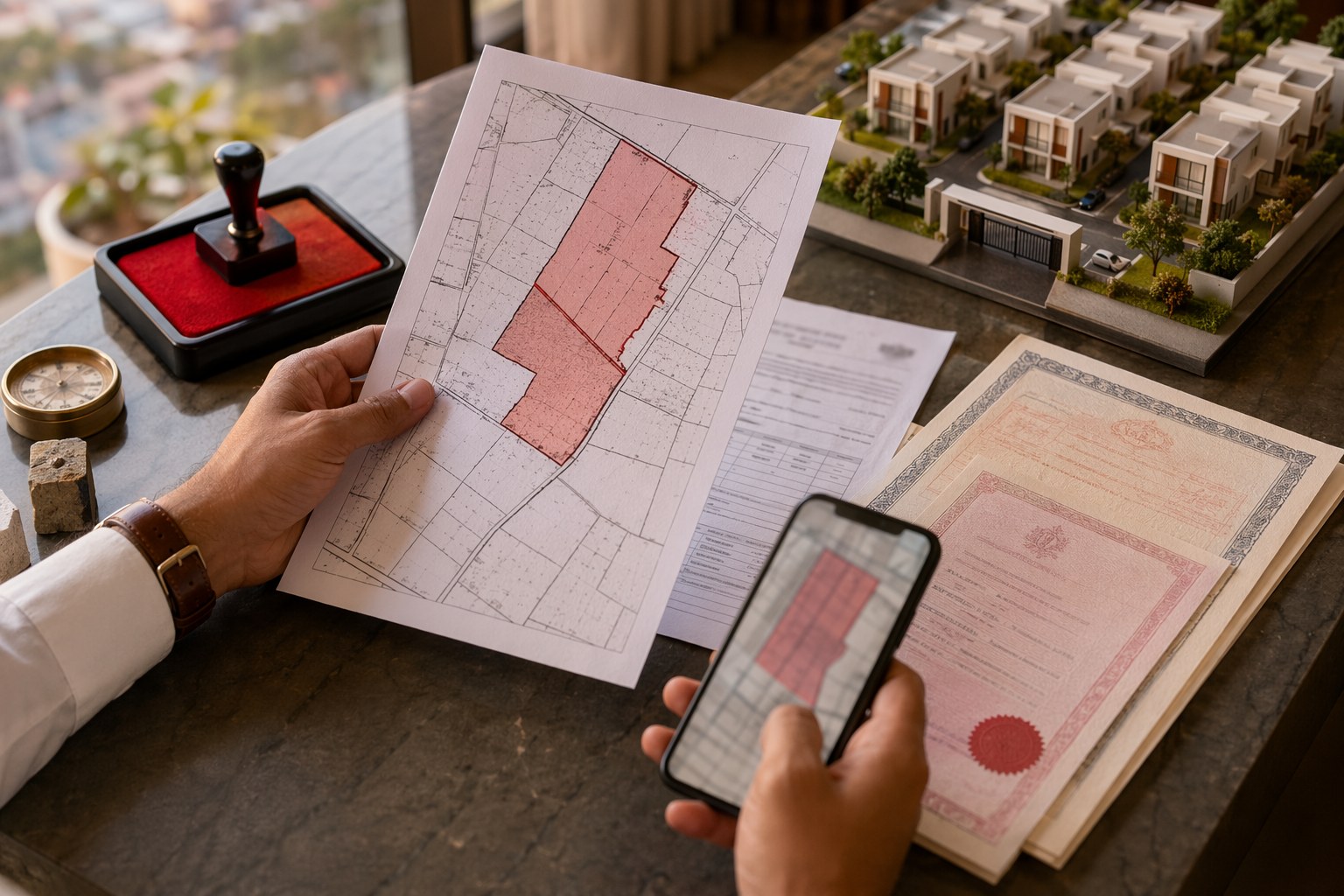


Banks Weigh Higher Haircuts for Telangana Land Collateral as credit teams become more cautious about plots and agricultural land offered as security, especially where title history, Dharani entries, pahani records or Section 22-A status are not clean. The immediate risk backdrop is large: Telangana has 3,076,153 prohibited property records under Section 22-A, according to government records. That number is big enough for lenders to ask a sharper question before sanctioning land-backed loans: if the borrower defaults, can this land be sold, registered and legally transferred without a fight?
For borrowers in Hyderabad’s growth belt — Kokapet, Tellapur, Mokila, Kollur, Shankarpally, Adibatla, Maheshwaram, Shamshabad, Medchal and Patancheru — this can change the loan conversation. A land parcel may look valuable on paper, but banks are likely to give more weight to registration risk, SRO records, survey number matching, access road, land use and whether the property appears in any prohibited list.
Banks Weigh Higher Haircuts for Telangana Land Collateral: The News Point
The shift is not about banks suddenly rejecting all land. It is about lenders becoming less willing to treat every open plot or agricultural parcel as easy collateral. In our experience, land is the most emotionally priced asset in Telangana. Sellers quote based on the next layout, next ORR exit, next villa project or next rumour. Banks, however, underwrite on enforceability.
A haircut simply means the lender values the collateral lower than the borrower expects, or asks for a higher margin before giving the loan. If a borrower offers land worth a certain amount based on local market talk, the bank may still accept only a lower internal value after checking legal and technical risk. With Section 22-A records running into 3,076,153, that caution is understandable.
The practical effect can be seen in three places. First, borrowers may need more supporting documents. Second, banks may insist on stronger legal opinions from panel advocates. Third, sanction amounts may be lower where land title is unclear, access is disputed, or the survey number is not matching across Dharani, old pahani, EC and SRO records.
Our view: in Telangana, land collateral will not be judged only by location anymore. Clean transferability will matter as much as market demand.
Why Banks Weigh Higher Haircuts for Telangana Land Collateral in Telangana
Section 22-A properties are restricted from registration due to legal, government, assigned land, endowment, wakf, court or other notified issues. Not every entry means fraud. Some cases are old, some need correction, and some may involve classification disputes. But for a bank, the risk is simple: if a property cannot be freely registered, it cannot be easily sold after default.
This is where Hyderabad’s land market becomes tricky. A buyer may hear strong demand in Mokila of Shankarpally mandal or around Tellapur in Ramachandrapuram mandal. A banker will ask different questions: Is the survey number clean? Is there an Encumbrance Certificate trail? Is the land in the correct village and SRO jurisdiction? Is there a prohibited property remark? Is the borrower showing only a pattadar passbook, or is the full title chain available?
Before giving land as collateral, borrowers should run a quick internal check using Section 22-A Prohibited Property Check, Encumbrance Certificate Search and Market Value / Guideline Value Search. These do not replace a bank legal opinion, but they help identify obvious red flags before the file reaches the branch.
What Lenders May Recheck Before Accepting Land Security
Land-backed loans in Telangana usually move through legal, valuation and technical review. When risk perception rises, these reviews become stricter. A plot in a HMDA-approved layout near Kollur may be assessed differently from agricultural land in the same broad belt. A regularised plot with clean link documents may get smoother treatment than a parcel where mutation is recent and old ownership records are missing.
| Bank concern | What it means for borrowers | Useful check |
|---|---|---|
| Section 22-A risk | Registration restriction can reduce collateral comfort | Section 22-A Prohibited Property Check |
| Title chain gaps | Missing link documents can delay sanction | Property Verification Tool |
| EC mismatch | Old mortgages, sales or court entries may appear | EC Analyzer |
| SRO jurisdiction confusion | Wrong SRO search can miss transactions | Find Your SRO Office |
| Survey number mismatch | Dharani, pahani and sale deed must speak the same language | Survey Number Finder |
We have seen files where the borrower was confident because the family had possessed the land for years. But possession and bankable title are not the same. A bank wants a clean route to enforce its security. If the survey number is partly affected, if the land use is not clear, or if the village record differs from the sale deed schedule, the valuation can get marked down.
Hyderabad Growth Corridors May Face Sharper Scrutiny
The impact will be felt most in locations where land values are driven by future expectations. Around Kokapet and Gandipet mandal, lenders already look closely at layout permissions and access. In Tellapur and Kollur, the difference between approved plotted development and raw land can be large in bank assessment. Towards Adibatla, Maheshwaram and Shamshabad, land use, approach road and title history often decide whether the collateral is treated comfortably.
Medchal, Kompally, Ghatkesar, Hayathnagar and Patancheru also have mixed land pockets — old agricultural holdings, converted plots, industrial parcels and layouts. A borrower may say the land is near a highway or close to a developing cluster. The bank may still ask for EC, link documents, latest market value, pahani, passbook, mutation details and any SRO remarks.
For apartment buyers, this discussion may look distant. It is not. If a developer has borrowed against land, or if a landowner is funding construction through mortgage-backed credit, stricter collateral treatment can affect project timelines. Buyers should check project registration through RERA Project Lookup and understand land value assumptions using Composite Value Calculator.
Borrowers Should Prepare a Cleaner Collateral File
If you are planning to borrow against land in Telangana, do not walk into the bank with only a sale deed photocopy. Prepare the file like a lender will audit it. Keep the parent deeds, latest EC, Dharani details, pahani or revenue extracts where applicable, tax receipts, layout approval if any, mutation documents and identity proof of current owners.
Also check whether any charge has already been created. In many family transactions, one co-owner may not know that a past loan or institutional charge exists. A quick CERSAI Charge Check can prevent embarrassment during bank processing. For stamp duty and registration planning, use the Stamp Duty Calculator. If the land is being sold to repay a loan or restructure debt, tax impact should be estimated with Capital Gains Tax Calculator.
What This Means for Telangana Land Prices
Will higher haircuts reduce land prices across Telangana? Not immediately. Hyderabad land is still driven by scarcity, infrastructure expectations and family wealth parking. But financing discipline can cool overheated pockets where buyers depend heavily on borrowed money. If a bank gives a lower collateral value than expected, the borrower must bring more own funds or offer another security.
That can create a gap between quoted price and bankable value. In our view, this gap will become more visible in raw land outside approved layouts. Clean plots with proper approvals, clear SRO history and no prohibited remarks will still attract lender comfort. Risky parcels may need price negotiation, legal correction or patient buyers.
The big takeaway is simple: Telangana land collateral is moving from “location story” to “document story”. A parcel near a hot locality is not enough. The file must stand up to legal, revenue and registration checks.
Frequently Asked Questions
Frequently Asked Questions
What does a higher haircut on Telangana land collateral mean?
It means the bank may value the land lower for lending purposes or ask the borrower to bring a higher margin. The land may still be accepted, but the sanction amount can be more conservative.
Why are Section 22-A prohibited properties a concern for banks?
Section 22-A properties can face registration restrictions. If a borrower defaults, the bank wants to sell and transfer the property legally. Any restriction makes enforcement harder.
How many prohibited property records are there in Telangana?
According to government records, Telangana has 3,076,153 prohibited property records under Section 22-A.
Which documents should I check before offering land as collateral?
Check the sale deed, parent documents, EC, Dharani details, pahani where applicable, mutation records, SRO jurisdiction, survey number match and any Section 22-A remarks.
Can a good locality still get a lower bank valuation?
Yes. Even land in strong Hyderabad corridors can face a lower collateral value if title, access, land use, EC or survey records are unclear.