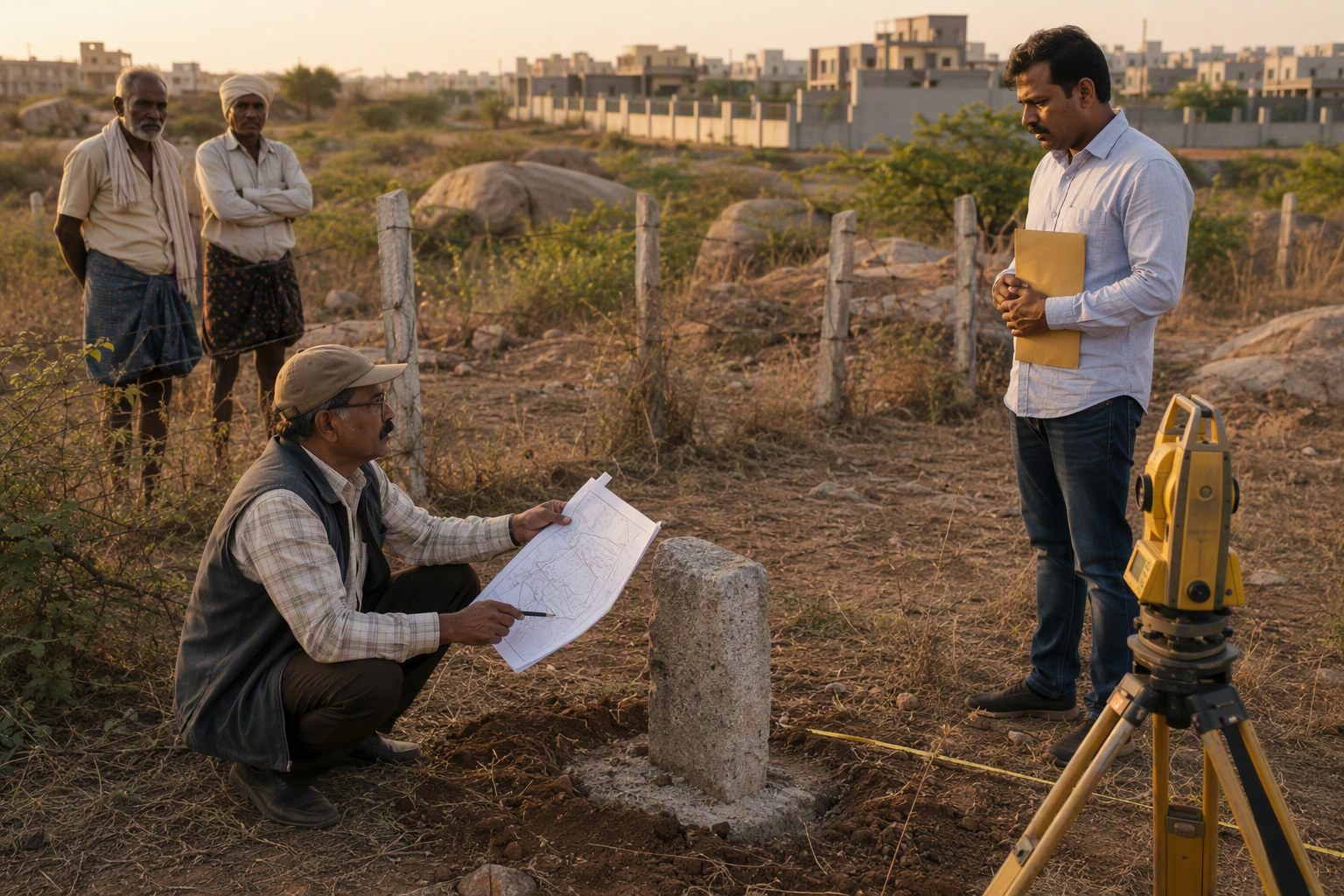



Telangana Valuers Explain Hidden Discounts in Risky Plots
Telangana Valuers Explain Hidden Discounts in Risky Plots is not just a catchy headline. It is a live pricing problem across Hyderabad’s expanding land market. As per latest IGRS data available with Verified.RealEstate, Telangana has 3,076,153 prohibited properties under Section 22-A. That single figure changes how valuers look at open plots, gram panchayat layouts, old pattas, assigned land claims, court-dispute parcels and even attractive roadside bits near growth corridors.
In plain English: a risky plot may not be cheap because the seller is generous. It may be cheap because the market is quietly deducting for registration risk, title risk, bank loan risk, resale risk and the time needed to clean up documents. We spoke to Telangana-facing valuers, document consultants and field verification teams who regularly work around Kokapet, Narsingi, Tellapur, Mokila, Shankarpally, Moinabad, Shamshabad, Maheshwaram, Adibatla, Ghatkesar, Medchal, Kompally and Patancheru. Their message is sharp: before token payment, calculate the discount. After token payment, you may only be calculating the loss.
Telangana Valuers Explain Hidden Discounts in Risky Plots: the data behind buyer hesitation
The number 3,076,153 matters because Section 22-A entries are not a small side issue in Telangana land transactions. When a property is listed as prohibited, the SRO may refuse registration or ask for clarity. Sometimes the issue is government land. Sometimes it is assigned land. Sometimes it is wakf, endowment, ceiling, court attachment, missing survey clarity or an old revenue classification that never got cleaned up after village records shifted into digital systems.
Valuers do not treat all these cases equally. A plot in Gandipet mandal with clean link documents but a minor survey mismatch is not the same as a plot in Maheshwaram mandal where the survey number itself appears in a prohibited list. A HMDA-approved plotted development in Mokila cannot be priced like an unapproved resale bit in a disputed village boundary near Shankarpally. A plot near Adibatla may look attractive because of road connectivity and employment demand, but if the pahani, Dharani record, EC and layout approvals are not matching, the market starts cutting value silently.
“The hidden discount starts the moment a buyer cannot get comfortable with registration. If the SRO risk is real, the buyer is no longer valuing land. He is valuing a problem,” one Hyderabad-based valuer told us.
This is why Verified.RealEstate always asks buyers to run a basic chain check first: use the Section 22-A Prohibited Property Check, verify survey details through the Survey Number Finder, and then review past transactions through the Encumbrance Certificate Search. These three checks will not replace a lawyer, but they can stop a bad token payment.
Telangana Valuers Explain Hidden Discounts in Risky Plots before token payment
Most buyers think negotiation means asking for a lower price. Valuers see it differently. In their working style, negotiation begins with identifying the exact risk bucket. Is the plot risky because of title? Is it risky because of layout approval? Is it risky because road access is informal? Is it risky because the land use does not support the buyer’s plan? Or is it risky because the seller is asking for payment before showing original documents?
In our experience, a buyer who asks only “final rate cheppandi” is usually weaker than a buyer who asks for pahani, link documents, EC, Dharani status, SRO jurisdiction and layout approval copy. The first buyer is negotiating emotionally. The second buyer is negotiating with evidence.
Across Hyderabad’s land belts, valuers say discounts often appear in four ways:
- Visible discount: The quoted price is below nearby clean plots because everyone knows there is a registration or title issue.
- Time discount: The seller says the issue will be cleared “soon”, so the buyer is expected to wait. Waiting has a cost.
- Liquidity discount: Even if you buy, resale may be difficult because the next buyer will ask the same questions.
- Loan discount: Banks and housing finance companies may avoid lending where title, approval or SRO registration risk is unclear.
A plot in Tellapur with clean approvals and clear SRO registration confidence will attract a different buyer profile from a plot in a nearby village where documents are still revenue-record heavy and not layout-approval heavy. Similarly, Shadnagar, Kothur and Shamshabad-side transactions need separate checking because investment demand is high, but land records vary from village to village. The same applies to Ghatkesar, Bibinagar-side interest, and Medchal-Kompally growth pockets where road access and conversion history matter.
How valuers read Section 22-A risk in Telangana plot pricing
Section 22-A is not just a legal label. In pricing, it behaves like a warning signal. Valuers look at the reason behind the entry, the possibility of correction, the seller’s document strength and whether the buyer can register without delay. A property may be physically available, fenced, and even occupied by a seller, but if the government record blocks registration, market value takes a hit.
Here is the practical valuation lens we see in Hyderabad land work:
| Risk point | What valuers check | Pricing impact |
|---|---|---|
| Section 22-A match | Survey number, village, mandal and nature of prohibition | Major discount or no-deal stance until clarified |
| EC mismatch | Names, document numbers, old sale deeds, mortgage entries | Discount for uncertainty and legal cost |
| Dharani and pahani conflict | Owner name, extent, classification and mutation history | Discount for revenue correction risk |
| Layout approval doubt | HMDA, DTCP, gram panchayat, LRS position | Discount for development and resale risk |
| Access road issue | Road width, recorded access, village map and site access | Discount if access is informal or disputed |
| Land use concern | Master plan zoning and permitted use | Discount if buyer’s intended use is not supported |
For quick checks, buyers can combine the Property Verification Tool, Land Use Zone Finder and Road Width Check. If the plot is part of a larger layout or future villa plan, the FSI/FAR Calculator also helps you understand whether the land can support the built-up expectations being sold in the brochure or WhatsApp pitch.
The local market reality: Kokapet confidence is not Shankarpally confidence
Telangana land pricing is hyper-local. Even inside Hyderabad’s western corridor, a buyer’s confidence changes from Kokapet to Narsingi, from Tellapur to Kollur, from Mokila to Shankarpally. In Kokapet and Narsingi, buyers often expect stronger documentation because the ticket size is high and the market is more institutional. In Mokila and Shankarpally, plotted development activity is active, but buyers still need to separate approved layouts from informal farmhouse-style offerings.
In Moinabad and Chevella mandals, the emotional pitch is usually lifestyle: greenery, weekend homes, farm land feel, and future appreciation. But valuers are cautious here. Agricultural land, conversion, access roads, assignment history and prohibited entries must be checked with patience. In Shamshabad and Maheshwaram, airport-side growth creates confidence, yet some village-level survey histories can be messy. In Adibatla and Ibrahimpatnam, IT and industrial narratives can push buyers to rush. A good valuer will slow the conversation down and ask for survey clarity first.
On the northern side, Kompally, Medchal and Ghatkesar have their own document patterns. Some plots are clean and easy to verify. Some are old layouts with partial documentation. Some are resale plots where the current seller may not even know the full link-document story. That is where EC, SRO record and survey mapping are not optional.
“A discount is useful only when the risk is measurable. If the risk is unknown, the right price may be zero for that buyer,” said another valuation professional who handles Hyderabad and surrounding mandals.
Why risky plots look attractive on WhatsApp but weak at the SRO
Many risky plots are sold beautifully. Good drone video. Boundary stones. Nearby highway name. Metro extension rumour. Pharma City mention. ORR access. Regional Ring Road talk. A neat Google Maps pin. But the SRO does not register a drone video. The SRO looks at documents, prohibitory lists, party details, property description and legal eligibility for registration.
Before paying token, ask the seller which SRO handles the property. If you are not sure, use Find Your SRO Office or the SRO Village Directory. Then compare the village name, survey number, extent and owner details across the sale deed, EC, pahani and Dharani. Many disputes begin with small spelling, extent or village-boundary confusion. In Telangana, the same locality name used in marketing may not be the same as the revenue village name used for registration.
This is very common around expanding edges. A seller may say “near Tellapur”, but the revenue record may fall elsewhere. A plot marketed as “Mokila side” may be in a different village or mandal. A “Kompally plot” may actually sit in a nearby Medchal-side village. That does not automatically make it bad, but it changes your comparison set and your valuation.
How hidden discounts are calculated without inventing a fake rate
Valuers do not need to invent a magic discount number. They first anchor the property against clean comparable plots in the same village or immediate competing locality. Then they remove value for each unresolved risk. The government market value or ready reckoner gives a base reference, but it is not the full market story. For that base check, buyers can use the Market Value / Guideline Value Search. For duty planning, use the Stamp Duty Calculator.
The real market rate is usually formed by three layers:
- Government value: The value used for registration purposes, subject to the latest applicable records.
- Clean market value: What buyers are willing to pay for a similar plot with clear title, approval and access.
- Risk-adjusted value: What a careful buyer should consider after deducting for 22-A risk, litigation risk, approval risk, loan risk and resale difficulty.
That third number is where valuers earn their fee. A seller may say, “Sir, only small issue, after registration everything fine.” A valuer will ask, “If it is small, why is the price lower than a clean plot, and why do you want token before giving full papers?” That one question has saved many buyers from poor decisions.
Buyer confidence: why one bad entry can affect nearby plots
Prohibited property entries do not always damage only one parcel. They can affect buyer mood across a pocket. If buyers hear that a certain survey number, layout stretch or village has registration issues, they start checking nearby plots more aggressively. Brokers may call it overthinking. Valuers call it market memory.
We have seen this in different forms around peri-urban Hyderabad. One disputed patch can make buyers ask for extra proof in the full neighbourhood. One failed registration story can reduce token-payment speed. One bank rejection can push several buyers to demand legal opinion before agreement. This is how hidden discounts spread: not always through official price correction, but through slower decisions, tougher questions and smaller advance payments.
In cleaner markets, the buyer worries about price. In risky markets, the buyer worries about exit. Can I sell this later? Can my children mutate it? Can a bank finance it? Can the SRO register it? Can a court case appear later? These questions reduce confidence, and reduced confidence becomes a discount.
Negotiation strategy before token payment
Token payment is where many buyers lose control. Once money is paid, the seller and broker may push the buyer to adjust. “Sir, this is normal.” “Madam, all plots here are like this.” “Registration will happen.” “We know people.” These lines are not due diligence.
Before token, follow this sequence:
- Check Section 22-A first: If the property appears risky, do not pay token until you understand the reason.
- Confirm survey number and village: Marketing names are not enough. Revenue identity matters.
- Pull EC: Look for ownership flow, mortgages, attachments and document continuity.
- Compare Dharani and deed details: Owner name, extent and classification should make sense.
- Check SRO jurisdiction: Wrong assumptions about SRO can delay or disturb registration.
- Ask for original document inspection: Photocopies and WhatsApp PDFs are only the starting point.
- Write token conditions: If you still pay, mention refund conditions for title, 22-A, approval or loan failure issues.
Use the Legal Document Generator only after your document checks are done, not as a substitute for checking. If you are tracking a property over time, the Property Change Tracker can help you monitor changes that may affect your decision.
What sellers should understand about risky plot discounts
This is not only a buyer problem. Genuine sellers also suffer when their land is trapped in unclear records. If a seller has clean ownership but an old revenue entry is creating doubt, clearing it early can protect value. Waiting until a buyer is ready usually weakens the seller’s position. The buyer will either walk away or ask for a steep risk adjustment.
For sellers in areas like Patancheru, Bachupally, Tellapur, Shamshabad, Maheshwaram and Ghatkesar, the best preparation is simple: keep link documents, EC, tax receipts if applicable, layout approval copies, mutation records and identity documents ready. If there is a past court case, disclose it. If there is a family settlement, show it. If there is a pending correction, explain the status with proof. A transparent seller may not always get the highest quote, but usually gets a more serious buyer.
Final view from Verified.RealEstate
The Telangana land market rewards patience. The presence of 3,076,153 prohibited properties in government records means buyers cannot treat due diligence as a formality. A cheap plot near a growth corridor may be a smart buy, or it may be a document trap. The difference is visible only when you check survey number, SRO record, EC, land use, road access and approval status before token payment.
Our opinion is clear: do not negotiate blindly. First identify the risk. Then price the risk. If the seller cannot explain the discount, you should not fund it.
Frequently Asked Questions
What is a hidden discount in a risky plot?
A hidden discount is the price reduction created by title risk, Section 22-A risk, approval doubts, loan difficulty, resale concern or document mismatch. It may not be openly stated by the seller, but careful buyers and valuers factor it into the offer.
Why does Section 22-A matter before buying a Telangana plot?
Section 22-A can affect registration at the SRO. If a plot or survey number appears as prohibited, the buyer may face refusal, delay or the need for legal and revenue clarification. That risk directly affects valuation.
Should I pay token before checking EC and prohibited property status?
No. Check Section 22-A status, EC, survey number, SRO jurisdiction, Dharani details and layout approval before token. If you still pay token, record refund conditions clearly in writing.
Are all discounted plots in Hyderabad risky?
No. Some sellers discount for urgency or location limits. But if the discount is large or unexplained, verify title, approval, road access and registration eligibility before assuming it is a bargain.
Which tools can help me check a risky plot?
Start with the Section 22-A Prohibited Property Check, Survey Number Finder, Encumbrance Certificate Search, Guideline Value Search and Find Your SRO Office. These checks help you ask better questions before legal review.