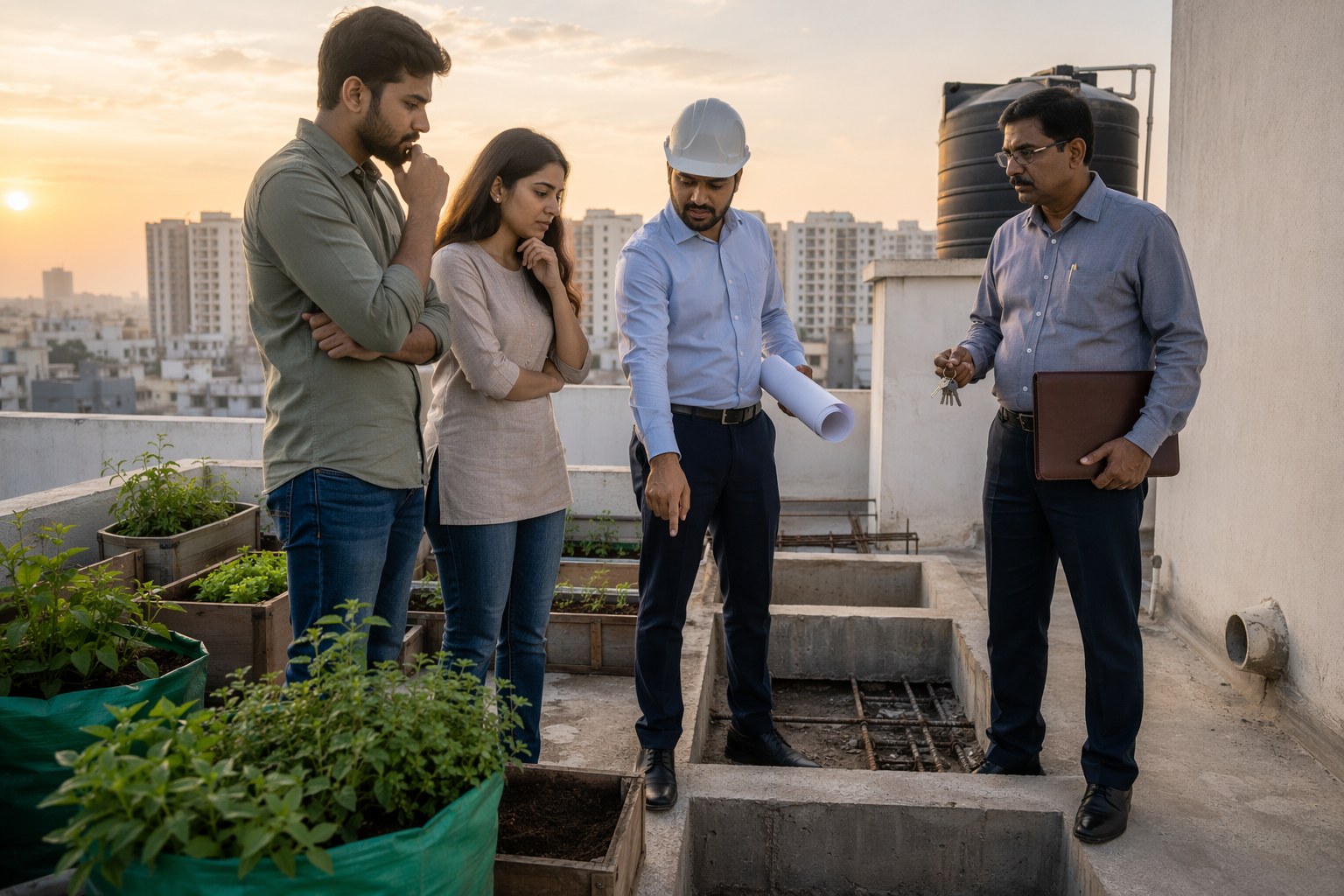



Telangana Token Paid, Then 22-A Appears is not a rare story in Hyderabad property deals. A buyer likes a plot near Mokila, Kollur, Adibatla, Shadnagar, Bachupally or Ghatkesar, pays a token advance on trust, and only later someone checks the survey number properly. Then the shock comes: the land is showing under Section 22-A prohibited property list. In our experience, the next few days decide whether the buyer saves the money, renegotiates safely, or walks into a registration refusal at the SRO.
Let me put it through a typical Hyderabad case. A salaried buyer from Kondapur identifies a plot on the Shankarpally side, close to Mokila. The seller shows a pattadar passbook, an old sale deed, tax receipts and layout sketch. The broker says, “Sir, token pettandi, tomorrow another party is ready.” The buyer pays a token advance through bank transfer and takes a handwritten receipt. Two days later, his friend checks the survey number and finds a 22-A alert. Suddenly, everyone becomes silent.
When Section 22-A appears after token payment, don’t panic and don’t rush to pay the next advance. First verify whether the entry is genuine, survey-specific, owner-specific, or a data mismatch. Then decide between correction, refund, revised agreement, or cancellation.
Telangana Token Paid, Then 22-A Appears: What does it mean?
Section 22-A of the Registration Act allows the government to notify certain properties as prohibited for registration. In simple terms, the Sub-Registrar Office can refuse registration if the property falls in a prohibited category. These can include government land, assigned land, endowment land, waqf land, ceiling surplus land, lands under acquisition, court-attached properties, or other categories notified by the authorities.
As per the Verified.RealEstate database context, Telangana has 3,076,153 prohibited property entries under Section 22-A. That number alone tells you why a casual token payment based only on a broker’s word is risky. One digit mistake in survey number, one sub-division not checked, or one old assignment entry can spoil an otherwise attractive deal.
In Hyderabad growth corridors, this issue comes up often in peri-urban areas. We’ve seen buyers get stuck around villages in Gandipet mandal, Shankarpally mandal, Maheshwaram mandal, Ibrahimpatnam mandal, Ghatkesar mandal, Farooqnagar mandal and Kandukur mandal. Not every alert means fraud. Sometimes the prohibited entry applies to a different extent in the same survey number. Sometimes it is an old entry not corrected after proceedings. But sometimes it is exactly what it says: the land cannot be registered.
Telangana Token Paid, Then 22-A Appears: First 24 hours action plan
The first mistake buyers make is calling the seller in anger and making verbal accusations. That gives the other side time to create a story. The better approach is calm, written, and document-based.
- Stop further payment immediately. Do not pay part-sale consideration, development charges, booking amount, legal fee, or “file movement” money.
- Collect all papers in PDF. Ask for sale deed link document, pattadar passbook, Dharani details, pahani/adangal, mutation proceedings, layout approval, tax receipts, family consent papers and any court orders.
- Write to the seller. Send a WhatsApp and email saying that payment is paused because a Section 22-A entry has appeared and clarification is required.
- Preserve proof of token. Bank transfer screenshot, UTR number, receipt, broker chat, property description, survey number, village and mandal details should be saved.
- Do independent checks. Do not depend on screenshots sent by the broker.
For a quick first layer, use Section 22-A Prohibited Property Check. Then cross-check title movement through Encumbrance Certificate Search and identify the correct registration office through Find Your SRO Office. These three checks usually tell you whether the matter is a simple mismatch or a serious legal block.
Why a 22-A entry can appear after you paid token
Many buyers ask one thing: “If there is a problem, why did the seller show documents?” Because documents can be incomplete, old, selective or misunderstood. A sale deed only proves that a document was registered at one point. It does not automatically mean the land is clean today.
1. Survey number mismatch
In Telangana villages, one survey number may have several sub-divisions and extents. For example, a buyer may be shown land in Survey No. X/AA, while the prohibited list may mention Survey No. X or another sub-division. You must check whether the exact extent, boundaries and sub-division match. The Survey Number Finder is useful when the buyer has only a village name, owner name or rough location.
2. Assigned land history
Some lands were originally assigned to landless persons. These lands often have transfer restrictions. In Telangana, assigned land history can create a registration block even if private parties executed documents earlier. This issue is seen in several mandals outside the ORR and in older village records.
3. Government or shikam land confusion
Near tanks, nalas and village boundaries, classification issues are common. A plot may be marketed as private patta land, while old records show government, shikam, poramboke or road-affected classification. Do not rely only on a fence and a board at site.
4. Court case or acquisition trail
Sometimes 22-A entries are linked to disputes, acquisition notifications or court restraints. The seller may say, “Case settled long back.” Ask for certified copies, final orders and mutation proof. Oral assurances are not enough when the SRO system refuses registration.
5. Data not updated after correction
There are cases where the owner has an order in hand, but the prohibited list is not updated in the registration database. In such cases, the seller must get the correction reflected officially before you proceed. A buyer should not become the person running behind mandal and district offices after paying full money.
Documents to verify before taking legal or negotiation step
Before you decide whether to demand refund, issue legal notice, or give the seller time for correction, verify the property file properly. This is where many token disputes are won or lost.
| Document or check | What to verify | Why it matters |
|---|---|---|
| 22-A prohibited check | Village, mandal, survey number, sub-division, extent and nature of prohibition | Confirms whether SRO can accept registration |
| EC | Past transactions, mortgages, attachments, sale deeds and release deeds | Shows registered title movement |
| Pahani / adangal | Land classification, cultivator, pattadar and extent | Helps catch government or assigned land issues |
| Dharani record | Pattadar name, khata, survey extent and transaction status | Shows current revenue record position |
| Link documents | Chain from earlier owners to present seller | Checks whether seller has marketable title |
| Layout approval | HMDA, DTCP, gram panchayat or municipal approval status | Relevant for plotted layouts and development permissions |
| SRO confirmation | Whether document can be accepted for registration | Practical registration risk check |
If the property is an apartment or villa project rather than open land, do not ignore RERA. Check the project through RERA Project Lookup. For open plots, the 22-A check, EC, revenue record and layout approval matter more than glossy brochures.
For value sanity, use Market Value / Guideline Value Search. I am not giving one blanket “Hyderabad rate” here because ready reckoner values change by village, ward, road influence, property type and SRO jurisdiction. Kokapet in Gandipet mandal, Tellapur in Sangareddy side, Bachupally in Medchal-Malkajgiri and Adibatla in Ibrahimpatnam cannot be compared using one WhatsApp rate. Check the official market value for the exact property description before you negotiate.
Should you go to the SRO immediately?
Yes, but go prepared. The SRO staff will not give you legal counselling like a private advocate. They can, however, confirm whether the property is appearing in the prohibited category for registration purposes. Carry the survey number, village, mandal, seller name, old document number if available, and your draft sale deed if already prepared.
If you are unsure which SRO handles the property, use SRO Village Directory or Find Your SRO Office. Many buyers living in Gachibowli or Madhapur assume their nearby SRO is relevant. For land, the jurisdiction is tied to the property location, not your residence or the broker’s office.
Ask the SRO-side document writer one practical question: “If I present this sale deed today, will it be accepted or refused due to 22-A?” But do not treat a document writer’s oral reply as final legal clearance. For a token-paid case, you need a written trail with the seller.
How to talk to the seller after 22-A appears
Your tone matters. If the seller is genuine, an aggressive first call may spoil a possible refund. If the seller is not genuine, an emotional call gives him clues to prepare excuses. Keep it direct.
You can write something like this:
“We have paid token advance for the property in [village], [mandal], Survey No. [number]. During verification, a Section 22-A prohibited property entry is appearing. Kindly provide official clarification, deletion/correction order if any, and confirmation that the property is registerable. Until then, we are pausing further payment. If the property is not registerable, kindly refund the token amount as the basic condition of sale fails.”
This message does three things. It records the property identity. It records the reason for pause. It also links refund to registerability, not personal distrust.
Legal options after token advance and 22-A discovery
Your exact remedy depends on the receipt, chats, agreement terms and facts. Still, the practical routes are usually these:
Option 1: Seller proves the entry is wrong
If the seller has a government order, court order, Collector proceedings or official deletion proof, ask him to get the database corrected before you pay further. Do not accept “registration will happen, I know people” as comfort. In our experience, clean correction first is safer than heroic registration attempts later.
Option 2: Seller accepts problem and refunds token
This is the cleanest outcome. Take refund through bank transfer. Send a short cancellation acknowledgement stating that the property verification revealed a registration issue and both parties are closing the token arrangement. If a broker is involved, include him in the written communication.
Option 3: Seller asks for time to clear 22-A
You may give time only through a written addendum. Mention a deadline, documents required, and automatic refund obligation if clearance is not produced. Do not pay another rupee during this period. If the seller is confident, he should not object to written terms.
Option 4: Seller refuses refund
Then speak to a property lawyer. Depending on the facts, the lawyer may send a legal notice for refund, misrepresentation, failure of consideration or breach of agreed condition. If the token receipt says “non-refundable”, it still may not protect the seller if the property itself is not legally registerable and the issue was hidden. But this is fact-specific, so get legal advice before making threats.
What if the agreement says token is non-refundable?
Many receipts in Hyderabad are one-page writings: “Received token advance, balance before registration, token non-refundable.” Buyers sign because they are afraid of losing the property. But a non-refundable clause is not magic. If the seller did not disclose a serious title or registration defect, the buyer can still contest it.
At the same time, buyers should be realistic. If the 22-A entry is only a mistaken tag and the seller clears it within the agreed time, cancellation may not be simple. That is why your communication should focus on verification and registerability, not immediate blame.
Before paying token in Telangana, follow this order
This is the order I prefer for land and plotted deals in Telangana:
- First, identify exact village, mandal, survey number and sub-division.
- Run Section 22-A Prohibited Property Check.
- Check EC through Encumbrance Certificate Search.
- Check government value through Market Value / Guideline Value Search.
- Verify SRO jurisdiction through Find Your SRO Office.
- Review pahani, Dharani, passbook and link documents.
- For flats and villas, check RERA Project Lookup.
- Only then pay token, preferably with a written refundable clause tied to title and registration clearance.
If you have already paid, use Property Verification Tool to organise the checks and create a proper verification path. If you are watching a property over a few weeks, Property Change Tracker helps you keep an eye on changes instead of depending on broker updates.
Clauses every token receipt should have
A proper token receipt is not just “paid and received”. It should protect both sides. At minimum, include:
- Full property description: village, mandal, survey number, sub-division, extent, boundaries and document reference.
- Seller declaration that the property is free from Section 22-A prohibition, acquisition, litigation, mortgage and undisclosed claims.
- Refund clause if title, EC, 22-A, revenue or SRO verification fails.
- Time period for seller to provide documents.
- Mode of refund and deadline.
- Broker role and commission condition, if any.
- Clear statement that further payment depends on legal verification.
You can prepare a cleaner draft using Legal Document Generator, but for high-value land, let a Telangana property lawyer review it before signing.
My view: token before verification is a weak position
Hyderabad buyers are under pressure. In Kokapet, Narsingi, Tellapur, Kollur, Mokila, Tukkuguda, Adibatla and Shadnagar belt, good properties move fast. Brokers use that urgency. Still, paying token before checking 22-A is like booking a car without checking whether it has an engine. The seller may be genuine, the location may be excellent, and the price may look attractive. But if the SRO refuses registration, your bargain has no practical value.
Our advice is simple: token should be small, traceable and conditional. Never pay cash. Never accept vague property descriptions. Never agree that token is forfeited even if title fails. If the seller objects to basic verification, that itself is market feedback.
When Telangana token is paid and then 22-A appears, the buyer’s best weapon is not shouting. It is paper. Exact survey details, government checks, EC, SRO position, written communication and a well-drafted refund demand will put you in a stronger place. If the property is clean, proceed after correction. If it is blocked, exit early. Losing a tempting deal is painful. Losing money in a prohibited property is worse.
Frequently Asked Questions
Can I register a property if it appears under Section 22-A in Telangana?
Usually, no. If the property is active in the prohibited list, the SRO can refuse registration. First verify whether the entry applies to your exact survey number, sub-division and extent. If it is a mistake, the seller should get official correction before sale.
I paid token advance before finding 22-A. Can I demand refund?
Yes, you can demand refund if the property is not legally registerable or if the seller failed to disclose the issue. Send a written message first, collect verification proof, and speak to a property lawyer if the seller refuses.
Does a registered old sale deed mean the land is safe now?
No. An old registered deed is only one part of title checking. You must also check current EC, Dharani or revenue records, pahani, 22-A status, layout approval and SRO position before paying major amounts.
Who should clear the 22-A issue, buyer or seller?
The seller should clear it before asking for further payment. A buyer can monitor the process, but should not take responsibility for correcting the seller’s title or government record problem after paying token.
Is a non-refundable token clause valid when 22-A appears?
It depends on facts and wording. If the seller hid a registration defect, the buyer may still challenge forfeiture. Keep all payment proofs and chats, then take legal advice before issuing notice.