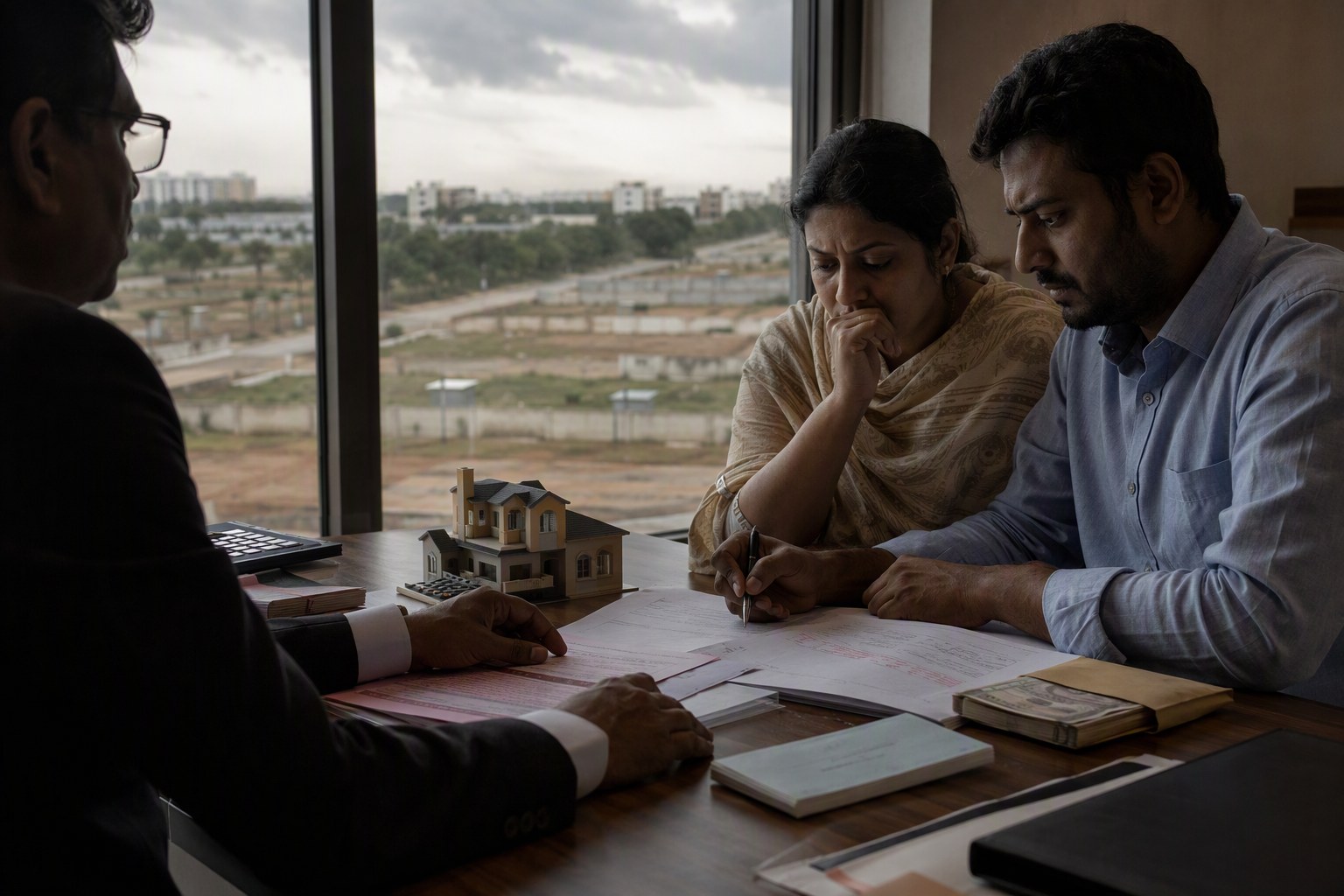



Telangana Lenders Recheck 22-A Before Loan Disbursal is no longer just a backend legal formality. With 3,076,153 prohibited property entries recorded under Section 22-A as per latest IGRS data, banks and housing finance companies in Telangana are treating the final pre-disbursal title check with much more caution. For buyers in Hyderabad, Rangareddy, Medchal-Malkajgiri, Sangareddy and the fast-growing HMDA belt, this can affect loan timing, sale agreement clauses, token payment decisions and even registration day planning.
The big change is not that banks suddenly discovered 22-A. They always checked it. The shift is in timing and intensity. Earlier, many buyers assumed that once the loan was sanctioned, disbursal would follow after valuation and documentation. Now, legal teams are often rechecking Section 22-A status closer to disbursal, especially for land, independent houses, resale flats with land share issues, plotted layouts and properties where survey numbers are not cleanly mapped.
Our reading is simple: in Telangana, a loan sanction letter is not a title clearance certificate. Until the bank legal team clears the property at disbursal stage, buyers should not treat the money as guaranteed.
Telangana Lenders Recheck 22-A Before Loan Disbursal: what is happening on ground?
Across Hyderabad’s active property corridors, the legal scrutiny is getting sharper. In Kokapet and Narsingi under Gandipet mandal, buyers are often dealing with high-value apartments and villa plots where the parent land history matters. In Gachibowli, Kondapur and Nanakramguda under Serilingampally mandal, resale flats may look clean at apartment level, but banks still examine link documents and land schedule. In Tellapur, Osman Nagar and Kollur on the Sangareddy side, lenders are cautious when land parcels have conversion, layout or old pahani-related questions.
The same pattern is visible in Kompally and Suchitra around Quthbullapur mandal, Bachupally and Nizampet, Adibatla under Ibrahimpatnam mandal, and Maheshwaram-Shamshabad belt where plotted development, old agricultural survey numbers and regularisation history can overlap. The buyer may be purchasing only a flat or plot, but the bank wants to know whether the underlying survey number has any restricted entry.
For a quick first-level check, buyers can use the Section 22-A Prohibited Property Check. It should not replace a lawyer’s opinion, but it helps buyers ask the right questions before paying a large advance.
Why Section 22-A matters to banks in Telangana
Section 22-A deals with properties that are prohibited from registration. In practical buyer language, if a property or its survey number is in the prohibited list, the Sub-Registrar Office may refuse registration. That is a major risk for any lender because the bank’s mortgage depends on valid title, proper registration and enforceable security.
Banks do not want to disburse loan money into a transaction that cannot be registered or where the title later becomes doubtful. A property can look attractive in brochures, have a good approach road, be near ORR or Metro expansion corridors, and still face trouble if the legal title is not clean. This is why bank advocates check sale deed chains, EC, pahani or revenue records where relevant, layout approvals, RERA details in case of projects, and SRO-level registration feasibility.
In Telangana, the Dharani ecosystem, IGRS records, municipal permissions and RERA project documents do not always answer the same question. Dharani may help with agricultural land and revenue-side data. IGRS and SRO records deal with registration history. RERA focuses on project registration and disclosures. A bank legal officer will usually stitch these records together before giving a final go-ahead.
Telangana Lenders Recheck 22-A Before Loan Disbursal because entries can change the deal
For buyers, the painful part is timing. Many families finalise the property, pay token, sign agreement of sale, submit loan papers, get sanction, and only then hear that the bank has asked for one more legal clarification. That clarification may relate to 22-A status, survey number mismatch, old link document gap, missing mutation trail, or a doubt raised by the empanelled advocate.
In our experience, the biggest mistakes happen when buyers treat sanction as disbursal. Sanction means the borrower’s income, credit profile and broad property details have passed the first stage. Disbursal means the bank is ready to release money after legal, technical and documentation checks. A 22-A issue sits mainly in the legal bucket, and it can hold the file even when the borrower has excellent income.
Before paying any major amount, buyers should cross-check the survey number and SRO jurisdiction. The Survey Number Finder can help buyers understand the survey details they must ask from the seller. The Find Your SRO Office tool is useful when a property sits near mandal or district boundaries, which is common around ORR growth locations.
How this affects home loan disbursal timing
A 22-A recheck can affect disbursal in four ways.
1. The bank may ask for fresh legal documents
If the legal team sees a mismatch between sale deed schedule, EC description and revenue records, they may ask for clarification. In apartments, this can mean parent documents, development agreement, GPA, link deeds or layout approval papers. In plots, the scrutiny is often tighter because the buyer directly depends on the land’s survey number status.
2. The lender may insist on updated EC
An Encumbrance Certificate is still one of the most common legal checks before disbursal. It shows registered transactions for the property for the searched period. Buyers can start with the Encumbrance Certificate Search and then ask their lawyer to interpret it. A clean EC alone does not prove that the land is free from 22-A restriction, but it is part of the same title-check file.
3. The disbursal may move from planned date to conditional release
Some banks may not reject immediately. They may keep the file pending until the seller provides a clarification, NOC, correction deed, updated proceedings or better link document trail. For buyers, this is where agreement clauses matter. If the agreement says balance payment must be made by a fixed date without protecting the buyer from title defects, the buyer can get trapped between seller pressure and bank delay.
4. The buyer may need to renegotiate payment milestones
Where 22-A status is unclear, buyers should avoid large non-refundable payments. A better structure is token first, legal verification next, agreement after document review, then loan processing, and final payment only after bank legal clearance and registration slot planning. Sellers may not like this, but a serious seller with clean papers should be able to cooperate.
What buyers should verify before paying token or advance
In Hyderabad’s competitive micro-markets, buyers often rush because they fear losing a flat, plot or villa. We have seen this in Narsingi, Tellapur, Miyapur, Kompally, Mokila, Tukkuguda and Adibatla. But a rushed token payment is risky when the property documents are not even reviewed.
At minimum, buyers should ask for these details before paying more than a small refundable token:
- Exact survey number, sub-division number and village name.
- Mandal and district details, not just project location branding.
- Current owner’s sale deed and previous link deeds.
- Latest EC for the relevant period.
- Layout approval or building permission documents, where applicable.
- RERA registration details for eligible ongoing projects.
- Draft agreement of sale with refund terms if bank legal clearance fails.
- Confirmation that the property is not in Section 22-A prohibited list.
For apartments in registered projects, buyers should also use the RERA Project Lookup. RERA registration does not automatically clear every title issue, but it gives another layer of project-level information. For a broader first-pass review, the Property Verification Tool can help organise the checks before speaking to a lawyer or banker.
Bank legal check versus buyer legal check: both are needed
Many buyers ask, “If the bank is giving a loan, why should I separately verify?” That is a dangerous shortcut. Bank verification protects the bank’s lending risk. Buyer verification protects the buyer’s ownership risk. These two overlap, but they are not the same.
A bank may be comfortable with a property because it meets its internal risk policy. Another bank may reject the same property. One lender may accept a clarification letter, another may insist on old revenue records. A buyer should not outsource common sense to the bank’s legal department.
Independent verification becomes more important in resale transactions. Suppose a family is buying a resale flat in Manikonda, Puppalaguda or Hafeezpet. The flat has been occupied for years. Maintenance is paid. Property tax is paid. The society is functioning. Even then, the bank may examine whether the original land had any issue, whether the builder had proper authority to sell, and whether the current seller’s title chain is complete.
Where ready reckoner and stamp duty checks fit in
Section 22-A is not the same as market value or stamp duty. But all these checks come together at the time of registration and loan disbursal. The SRO will look at documents, property description, government value and registration eligibility. The bank will look at title, valuation and mortgage creation. The buyer has to keep both sides aligned.
Before finalising a sale consideration, buyers should check the government guideline value through the Market Value / Guideline Value Search. For registration cost planning, the Stamp Duty Calculator is useful. We are not quoting generic Hyderabad rates here because ready reckoner values depend on locality, village, property type and SRO classification. A flat in Gachibowli and a plot near Shadnagar cannot be treated with one broad number.
If the bank valuation, agreement value and SRO guideline value are not aligned properly, the loan file can face more questions. This is separate from 22-A, but it adds to the same closing pressure. Buyers should not discover these issues one day before registration.
Practical impact on sellers and builders
Sellers are also affected by stricter 22-A rechecks. A seller may have an interested buyer with sanction ready, but if the bank asks for extra documents, the transaction slows down. In a resale deal, this can disturb the seller’s own purchase plan. In plotted layouts, multiple buyers may start asking the same 22-A question, especially if one bank raises an objection.
Builders and developers with clean land records should proactively keep title documents ready. In our view, the better developers already do this. They share title opinion, EC, approval copies and RERA details without making the buyer chase every paper. Smaller sellers sometimes treat document requests as mistrust. That attitude is outdated. In Telangana’s current title environment, proper paperwork is part of the sale product.
Payment decisions buyers should change immediately
The safest buyer behaviour is to link payments to verification milestones. This is especially true for land and independent house transactions where survey-level clarity is critical.
| Stage | Buyer action | Why it matters |
|---|---|---|
| Before token | Ask for survey number, village, mandal, SRO and owner deed | Basic identity of the property must be clear |
| After token | Run 22-A, EC and RERA checks where applicable | Early warning before large advance |
| Before agreement | Get lawyer review and bank legal document list | Avoid one-sided payment deadlines |
| Before disbursal | Confirm bank legal clearance is final, not pending | Prevents last-minute funding gap |
| Before registration | Check SRO, stamp duty, guideline value and draft deed | Registration day should not become a document dispute |
Use simple clauses in the agreement. If the bank refuses due to title defect, prohibited property status, or inability to register, the buyer should have a clear refund route. The exact wording must come from a lawyer, but the commercial understanding should be discussed before signing.
What to do if a 22-A issue appears
Do not panic, but do not ignore it. First, identify whether the issue is with the exact property, the survey number, a part of the survey number, or a data mismatch. Telangana land records can have spelling variations, old village references, sub-division changes and boundary description differences. Some issues may be clarified. Some may be serious enough to walk away.
Ask the seller for documentary proof, not verbal assurance. If the seller says the entry is wrong, ask for official correction proceedings or relevant government communication. If the seller says registration happened earlier, check whether that earlier registration actually covers the same land and whether later restrictions were added. If the property is part of a larger layout, see whether the plotted area and common roads have proper approvals.
For properties where an existing mortgage is involved, buyers should also check whether any charge is recorded. The CERSAI Charge Check can be useful for loan-backed transactions, especially resale flats and houses.
Our view for Hyderabad buyers
The 3,076,153 prohibited property entries figure should make buyers more disciplined, not fearful. Telangana still has strong demand across western Hyderabad, northern growth corridors, airport-side development and ORR-linked locations. But the old habit of paying first and verifying later is risky.
If you are buying in Serilingampally, Gandipet, Rajendranagar, Shankarpally, Quthbullapur, Bachupally, Shamshabad, Maheshwaram or Ibrahimpatnam mandals, insist on survey clarity. If you are buying an apartment, do not stop at flat number and tower name. Ask about the land schedule. If you are buying a plot, do not rely only on venture marketing. Check the actual survey number, layout approval and 22-A status.
Most good deals survive verification. Weak deals usually create pressure: “pay today”, “bank will manage”, “all flats are sold”, “registration is happening for everyone”. In our experience, genuine sellers and credible developers are ready for document scrutiny. The buyer who asks early saves time, money and tension later.
The practical takeaway is clear: treat 22-A recheck as a normal part of loan disbursal in Telangana. Build it into your timeline. Keep payment clauses sensible. Use public record tools, speak to your banker early, and take a lawyer’s view before committing serious money.
Frequently Asked Questions
What is Section 22-A in Telangana property registration?
Section 22-A covers properties that are prohibited from registration. If a property or survey number falls in this list, the SRO may refuse registration, and banks may hold or reject loan disbursal until the issue is clarified.
Can a bank stop home loan disbursal after sanction because of 22-A?
Yes. Loan sanction is not the same as final disbursal. If the bank legal team finds a 22-A concern or title issue before disbursal, it can ask for clarification, keep the file pending or refuse funding.
How can I check whether my Telangana property is in the prohibited list?
You can start with a Section 22-A check using the property’s survey number, village and mandal details. For serious transactions, also get a lawyer to review EC, link documents, revenue records and SRO-related details.
Should I pay advance before bank legal clearance?
Keep any early token small and refundable wherever possible. Large advance payments should ideally come after document review, 22-A check, EC review and clarity on what happens if bank legal clearance fails.
Does RERA approval mean there is no 22-A issue?
RERA registration is useful project-level information, but it does not replace a title check. Buyers should still verify land records, EC, survey number status and Section 22-A position before relying on loan disbursal.