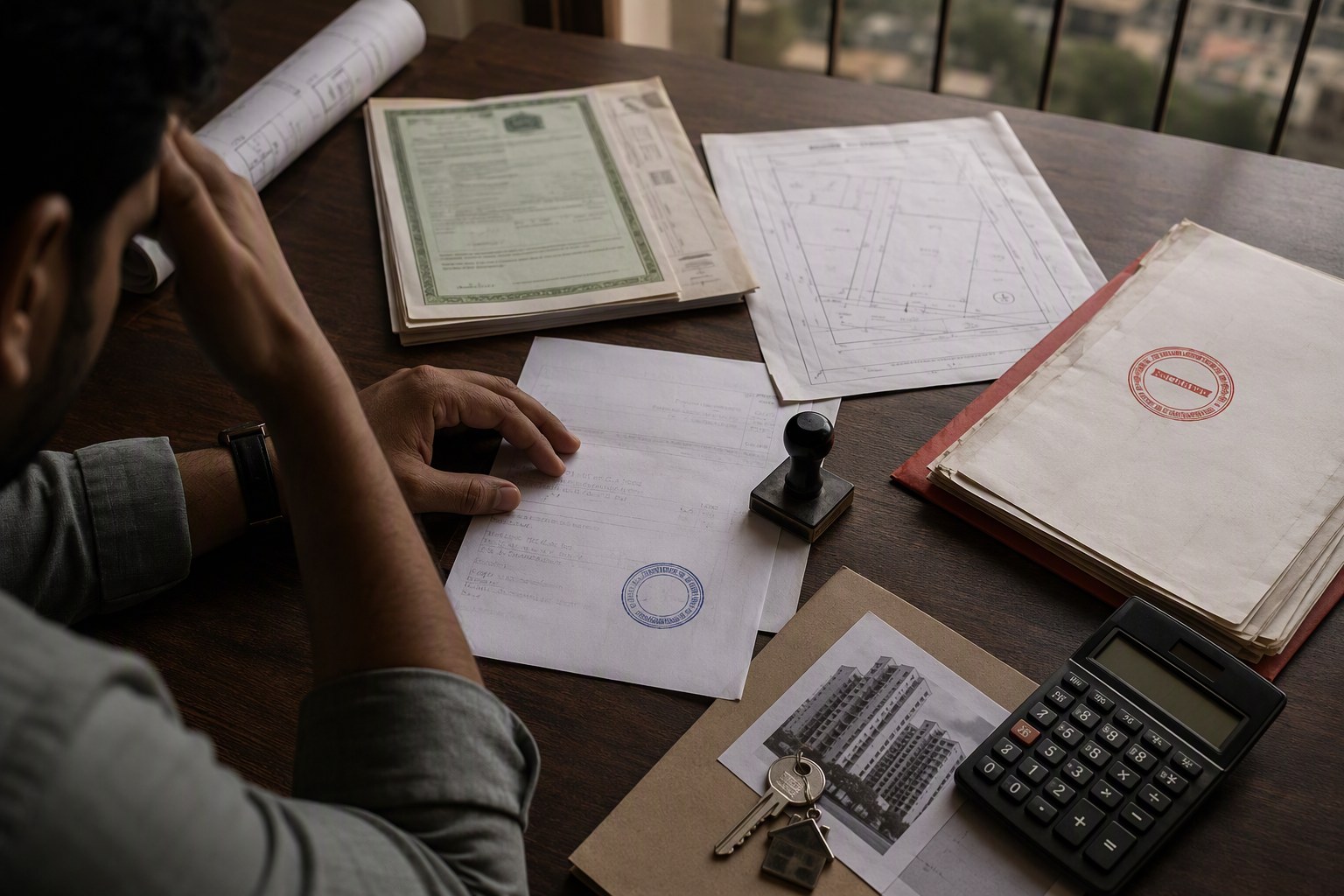
Margin Money Shock is not a rare Hyderabad home-buying problem. Telangana has 3,076,153 prohibited properties listed under Section 22-A as per latest IGRS data, and that single number explains why banks do not simply fund a property because the buyer and seller agreed on a price. For a bank, a home loan is not only about your salary and credit score. It is also about the property’s market value, guideline value, title history, SRO records, EC entries, dharani status, approvals and resaleability.
The short answer: banks may fund less than expected when their valuation is lower than your agreement value, when title risk is visible, or when the property falls into a category the lender is not comfortable with. The gap becomes your margin money. In our experience, this is where many buyers in Hyderabad get a shock after paying token advance.
Verified.RealEstate view: Do not calculate your cash requirement only from the builder’s price sheet or seller’s WhatsApp quote. Calculate it from the bank’s eligible loan value after valuation, legal scrutiny and technical inspection.
Margin Money Shock starts with one hard fact: banks fear title risk
The figure of 3,076,153 prohibited properties is not a small background detail. It is the reason legal teams at banks take Telangana property documents seriously, especially in land-heavy belts around Hyderabad. Section 22-A entries can block or restrict registration. Some buyers discover the issue only when the SRO raises an objection, or when the bank’s advocate flags it before disbursement.
We have seen this caution play out across Serilingampally, Gandipet, Rajendranagar, Shankarpally, Maheshwaram, Ghatkesar, Medchal, Hayathnagar and Shamshabad mandals. The property may look attractive on ground. The approach road may be decent. The seller may have a registered document. Still, if the legal chain is weak or the survey number has a red flag, the bank can reduce funding or refuse the case.
This is not banks being difficult for fun. A bank wants a mortgage that can be enforced if the borrower defaults. If the property cannot be registered cleanly, cannot be sold easily, or has an unresolved claim, the lender’s risk increases. That risk usually lands on the buyer as higher margin money.
Before paying advance for land, villa plots, old independent houses or small builder floors, use the Section 22-A Prohibited Property Check. For apartments, also check project details on the RERA Project Lookup where applicable. If the property is in a developing corridor such as Kollur, Tellapur, Narsingi, Kokapet, Adibatla, Kompally or Bachupally, do not skip survey-level verification.
What is margin money in a Hyderabad property loan?
Margin money is the amount you must bring from your own pocket after the bank decides how much it will lend. Buyers usually think of it as down payment. That is only partly correct. The real margin money can change after the bank completes three checks: borrower eligibility, property valuation and legal verification.
Suppose you agree to buy a flat in Kondapur, a resale flat in Miyapur, a house in LB Nagar, or a plot near Shankarpally. You may assume the loan will be based on the agreement value. But the bank may say its approved valuation is lower. Or the bank may accept the value but reduce funding because the title documents are not clean enough. Or the bank may approve the loan but keep part of the disbursement on hold until missing approvals are produced.
That is the moment buyers feel the margin money shock. The agreement with the seller is already signed. The advance is already paid. The registration date is getting closer. The seller may not want to wait. Suddenly, the buyer has to arrange extra funds without enough time.
Margin Money Shock due to LTV: the loan is based on bank comfort, not buyer excitement
LTV means loan-to-value. In simple terms, it is the portion of value the bank is willing to fund. The tricky part is this: value does not always mean the price you negotiated. Banks generally go by the lower or safer value after checking the agreement, technical valuation, ready reckoner or guideline value, location quality and legal comfort.
In Hyderabad, this difference becomes visible in fast-moving pockets. A seller in Narsingi may quote based on recent neighbourhood demand. A builder near Kollur may price based on the future growth story. A resale owner in Manikonda may expect a premium because the flat is fully furnished. The bank valuer may not treat all these items the same way. Furniture, interiors, floor preference, club-house hype and future road promises may not get the same weight in loan valuation.
Use the Market Value / Guideline Value Search before you assume the bank will accept the transaction price. It gives you a government-record reference point. It is not the same as open market price, but it helps you understand how far the deal has moved away from official values. For flats with land share and construction value, the Composite Value Calculator can help you think more clearly before the loan file goes to the bank.
In our experience, the most common mistake is this: buyers calculate their savings requirement on the sale price, while the bank calculates loan eligibility on a more conservative property value. That difference is not funded by the lender. It comes from the buyer.
Why bank valuation can be lower than the agreed property price
Valuation is not just a casual visit by a person with a tape and camera. The valuer studies the location, access, building condition, age, approvals, marketability and comparable transactions available to them. For under-construction projects, the stage of construction also matters. For independent houses, land extent, building quality and municipal permissions matter. For plots, road access, layout approval, survey number and land use are major factors.
Here is how the gap usually appears:
| Buyer assumption | Bank view | Effect on margin money |
|---|---|---|
| Seller price is the property value | Bank may use its own valuation and legal comfort | Buyer may need more own funds |
| Interiors should be funded as part of flat cost | Bank may treat interiors separately or conservatively | Loan amount may not match buyer expectation |
| Future metro, road or IT growth should increase value | Bank usually values present security, not only future promise | Speculative premium may not get funded |
| Registered document means title is safe | Bank checks EC, link documents, SRO record and restrictions | Legal issues can reduce or stop funding |
| Guideline value and market price are same | They can differ by locality and property type | Cash planning can go wrong |
This is why two buyers in the same locality can have different loan outcomes. One apartment in Gachibowli may have a clean project approval and accepted valuation. Another resale unit nearby may have missing link documents, a pending society issue or an unclear parking allocation. Same neighbourhood, different bank comfort.
Title risk: the silent reason behind reduced funding
Title risk is the part many buyers underestimate. A property can be physically excellent but legally weak. Banks look for a clean chain of ownership, proper registration, no suspicious gaps in link documents, no adverse EC entries, no conflicting claims, no prohibited property restriction, and no mismatch between property description and ground reality.
For agricultural lands converted for plotting, dharani and pahani history become very relevant. In mandals such as Maheshwaram, Shankarpally, Ghatkesar and Moinabad, buyers often hear terms like patta land, assigned land, ceiling land, government land, gramakantam and shikam. These words are not casual labels. Each one can change how a bank treats the property.
For urban properties, SRO records and EC entries are key. Run an Encumbrance Certificate Search and, where you already have the EC, use the EC Analyzer to read it more carefully. If the bank later finds a mortgage entry, attachment, court-related reference or inconsistent schedule, your loan may be delayed or reduced.
For land parcels, the survey number is the starting point. Use the Survey Number Finder and then cross-check with village, mandal and SRO records. If you are not sure which registration office covers the property, check through Find Your SRO Office or the SRO Village Directory.
How stamp duty and registration costs add to the cash requirement
Many buyers focus only on the bank-funded portion and forget registration-side cash planning. Stamp duty, registration charges, transfer charges, legal charges, documentation cost, society charges, corpus demands and shifting expenses do not always get funded in the way buyers expect. Some costs may have to be paid upfront.
Before fixing the registration date, use the Stamp Duty Calculator. This is especially useful for resale flats in Ameerpet, Kukatpally, Uppal, Tarnaka, Dilsukhnagar and Secunderabad, where buyers often negotiate hard on price but forget the cash needed at registration. For a land transaction, stamp duty planning must sit along with title verification, not after it.
There is another practical point. If the agreement value, guideline value and bank valuation do not align comfortably, the bank may ask questions. The SRO will have its own process. The valuer will have a separate view. The bank’s legal team may raise another query. A buyer who has planned a thin margin can get stuck between all three.
Builder projects: approval comfort can affect loan disbursement
In a builder project, the bank is not only checking your income. It is also checking the project. Is the project approved by that bank? Are permissions in place? Is RERA registration applicable and available? Is the construction stage matching the disbursement request? Are there deviations that can become a risk later?
In large gated communities around Kokapet, Tellapur, Narsingi and Kollur, banks may have project-level tie-ups. That can make processing smoother, but it does not remove buyer responsibility. Tie-up does not mean every flat, every charge and every promise is automatically safe. Always verify RERA details through the RERA Project Lookup, check the agreement draft, and understand what exactly the bank will disburse at each stage.
For small standalone apartments in areas like Pragathi Nagar, Nizampet, Peerzadiguda, Boduppal, Bandlaguda Jagir and Attapur, buyers should be extra careful with permissions, UDS, parking allocation, setbacks and occupancy-related documents. Smaller projects can be perfectly valid, but documentation discipline varies widely.
Resale properties: old documents can create new cash pressure
Resale homes are where margin money surprises are very common. The seller may have an old loan closure letter but not the latest release document. The EC may not reflect closure clearly. The earlier sale deed may have a schedule mismatch. The flat number in municipal records may not match the sale deed description. The bank may ask for extra papers, indemnities or clarification from the previous lender.
If there is an existing loan on the property, check whether a charge is visible through the CERSAI Charge Check. A closed loan and a properly released mortgage are not the same in practical banking. Until the charge trail is clean, your lender may be cautious.
Buyers of independent houses in older colonies such as West Marredpally, Himayatnagar, Banjara Hills inner lanes, Malakpet, Sainikpuri and Chaitanyapuri should pay attention to building permissions and land extent. Old family properties can have multiple heirs. A registered sale deed from one person may not be enough if succession documents are weak.
How to avoid Margin Money Shock before paying advance
Here is the workflow we recommend at Verified.RealEstate. Do this before you emotionally commit to the property.
- Check prohibited status: Run the survey number or property details through the Section 22-A Prohibited Property Check, especially for land and independent houses.
- Read the EC: Search the EC and study the ownership trail, mortgage entries and transaction pattern. Use Encumbrance Certificate Search and EC Analyzer.
- Compare government value: Check guideline value through the Market Value / Guideline Value Search. This gives a sober reference before you accept the seller’s quoted rate.
- Confirm SRO and village: Use Find Your SRO Office for registration jurisdiction. Wrong assumptions about SRO can delay document checks.
- Verify project status: For apartments and villas in registered projects, check details on the RERA Project Lookup.
- Plan registration cash: Use the Stamp Duty Calculator before finalising payment schedule with the seller.
- Get bank valuation early: Do not wait until the last week before registration. Ask the bank to start legal and technical checks as early as possible.
A small delay before advance is better than a big cash scramble before registration. Sellers may push urgency, especially in active localities. Still, the buyer carries the risk if the bank later funds less.
Margin Money Shock is avoidable if you treat the bank as a risk signal
Many buyers feel offended when a bank reduces the eligible loan amount. I see it differently. A cautious bank is giving you a risk signal. Sometimes the issue is only valuation, and you can decide whether the property is still worth buying with more own funds. Sometimes the issue is title, and walking away may be the safer decision.
The worst response is to borrow informally at high cost just to close the deal. If the bank is uncomfortable with the property, pause and understand why. Ask for the legal query in writing where possible. Speak to your advocate. Check SRO records. Re-read the EC. Verify the survey number. If it is a project, compare the builder’s documents with RERA and approval records.
Hyderabad real estate has strong demand, especially in the western and growth corridors. But strong demand does not clean a weak title. A good property should pass both market sense and document sense. When both are aligned, bank funding becomes more predictable and your margin money planning becomes realistic.
Final buyer checklist before loan sanction
- Do not assume the sale price will be accepted as bank value.
- Do not pay a large non-refundable advance before legal screening.
- Check Section 22-A risk, EC, SRO jurisdiction and survey number.
- Keep extra liquidity for registration and charges outside loan funding.
- For resale property, verify prior mortgage closure and CERSAI charge status.
- For land, review dharani, pahani, conversion and layout approval records.
- For apartments, verify RERA, approvals, UDS, parking and construction stage.
Margin money is not just a finance term. It is where valuation, title and buyer planning meet. If you understand that before signing, you can negotiate better, choose safer properties and avoid last-minute pressure.
Frequently Asked Questions
Why did my bank approve a lower home loan than expected?
Your bank may have valued the property lower than the agreement price, found title concerns, or applied internal lending norms based on location, approvals and resaleability. The shortfall becomes your margin money.
Can Section 22-A prohibited property status affect my loan?
Yes. If a property is restricted under Section 22-A or has a related title concern, banks may refuse funding or ask for clarifications. Always check prohibited status before paying advance.
Is bank valuation the same as market price in Hyderabad?
No. Market price is what buyer and seller agree to. Bank valuation is a lender’s risk-based assessment. It may exclude hype, interiors, speculative premiums or unclear legal value.
How can I reduce the chance of margin money shock?
Check EC, Section 22-A status, guideline value, SRO jurisdiction, RERA status and CERSAI charge before finalising. Start bank legal and technical checks early, not just before registration.