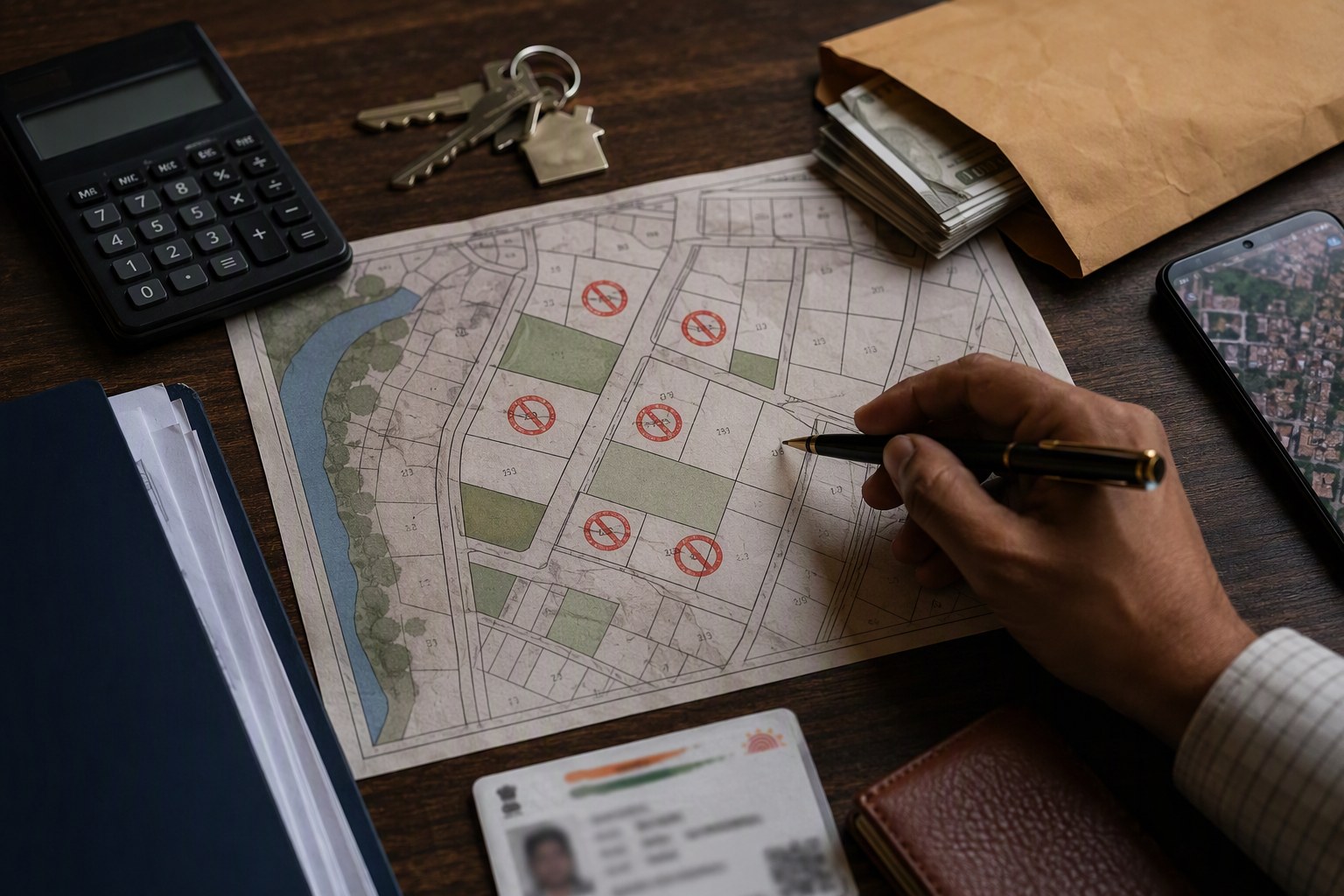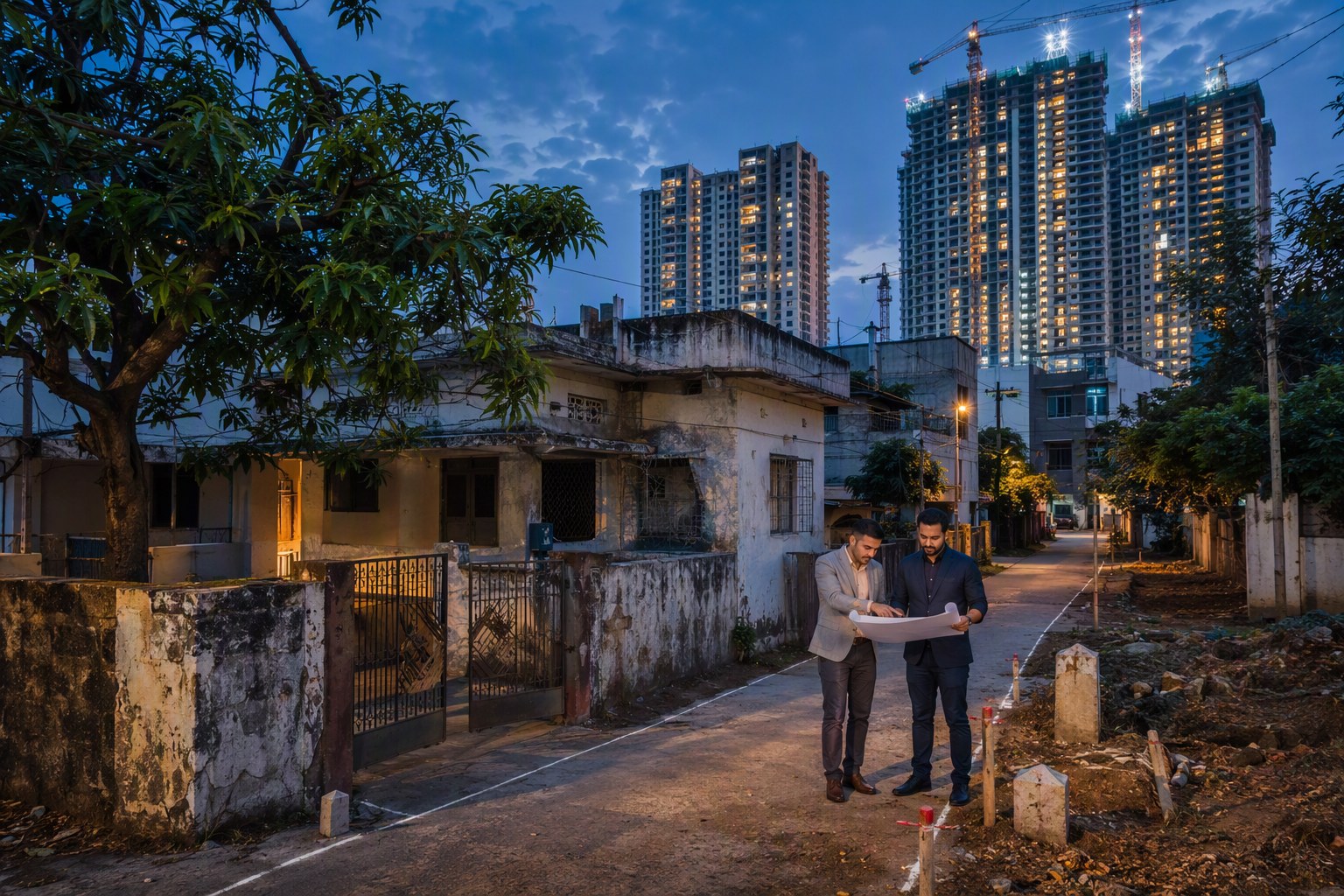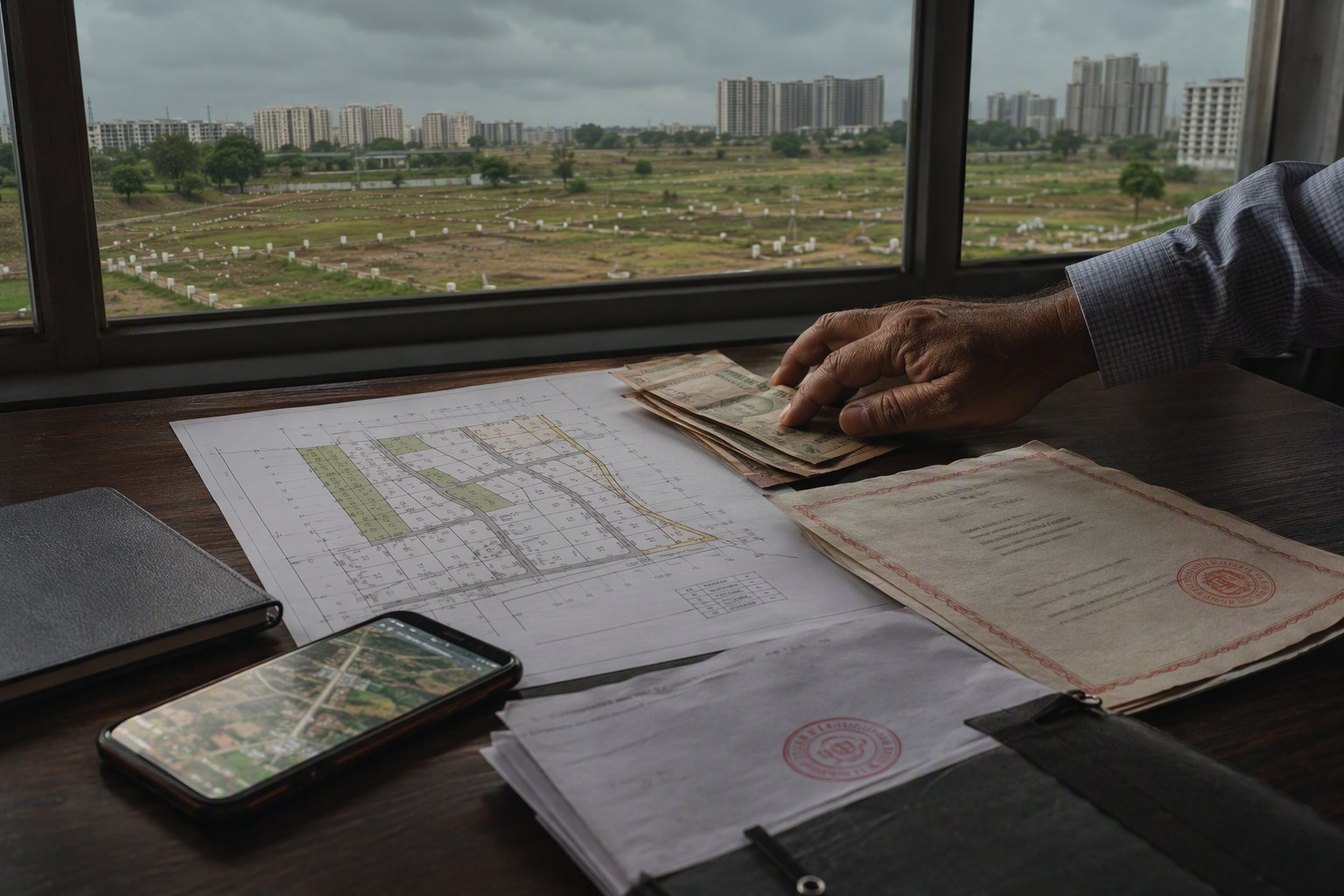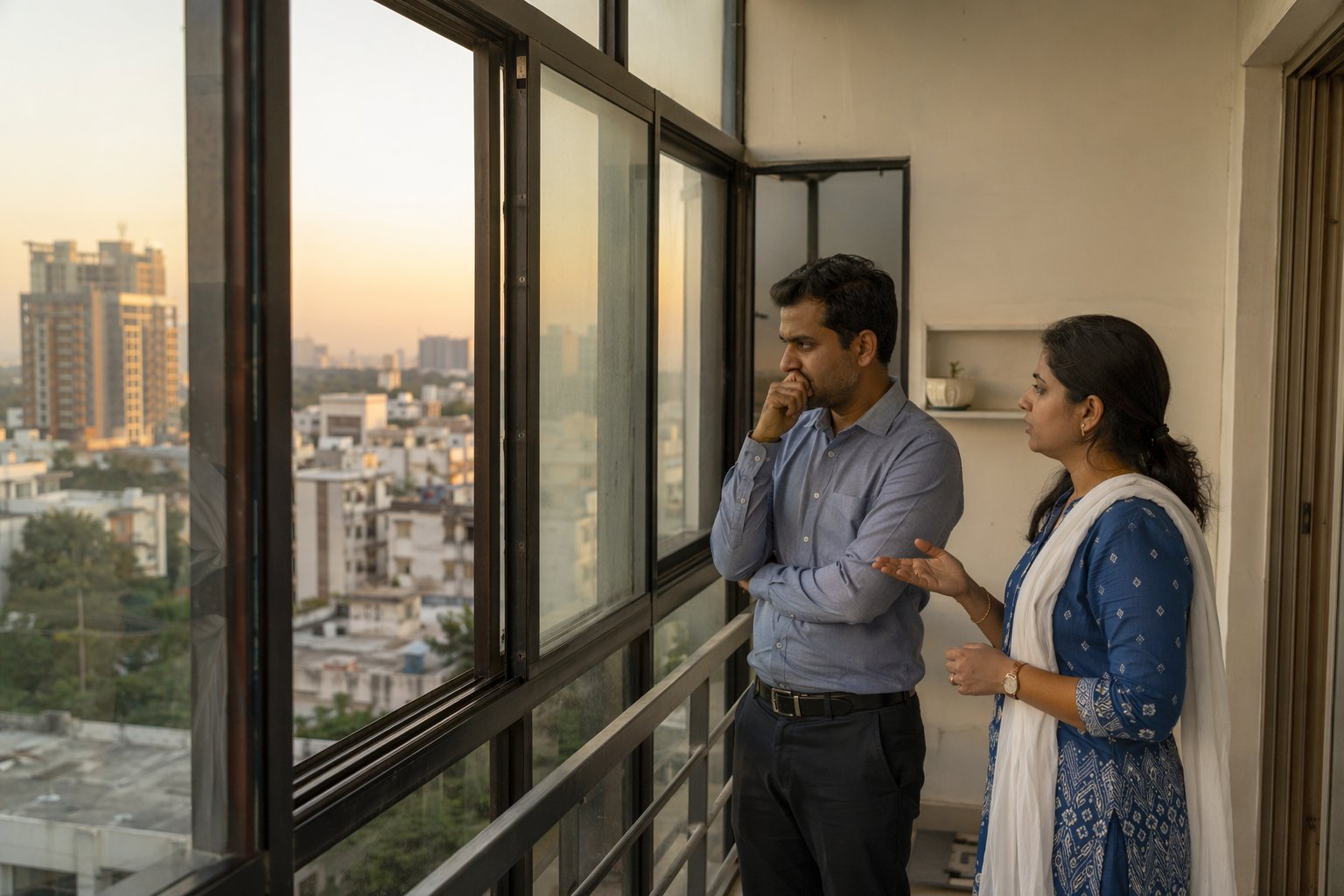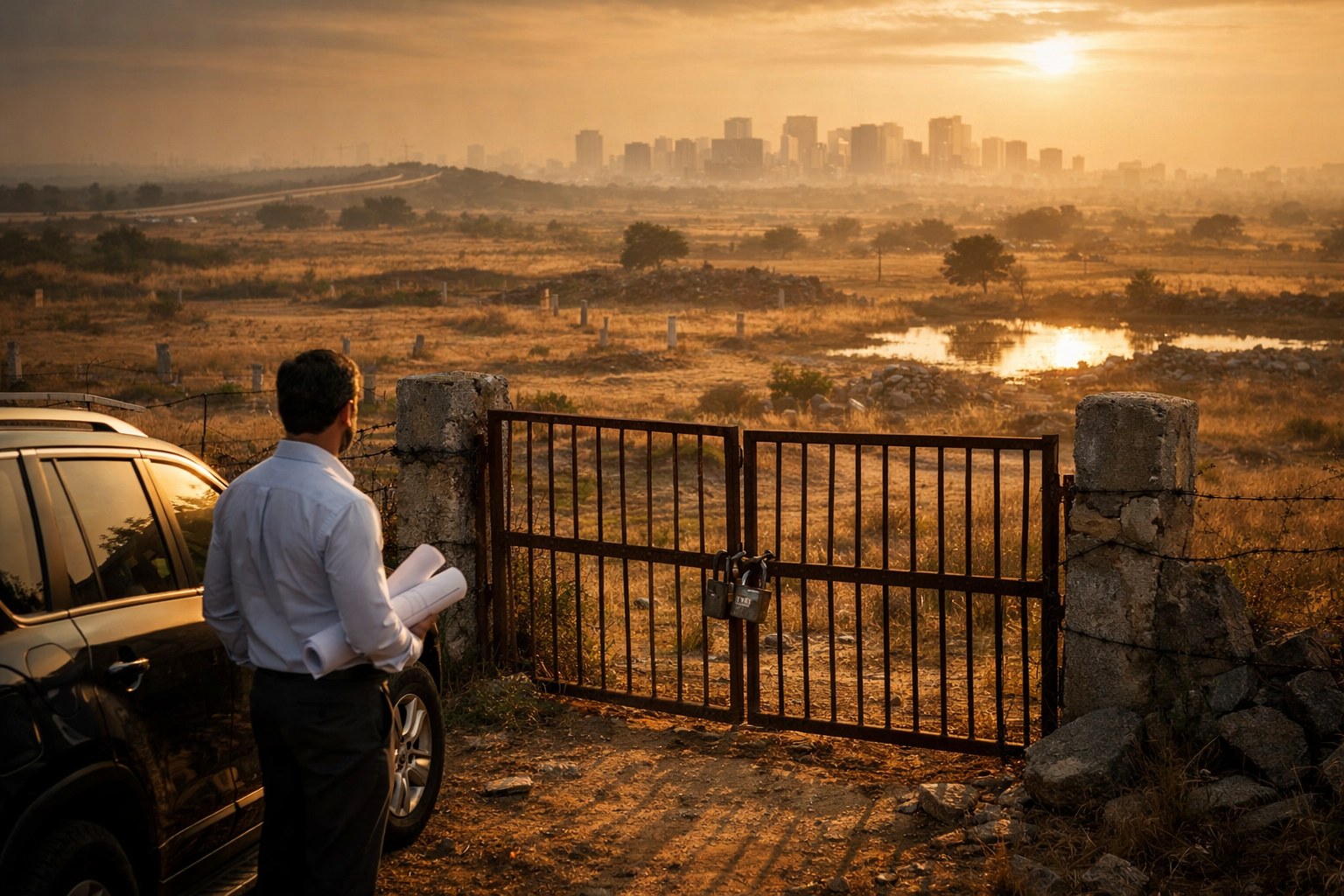
Telangana Land Banking sounds very attractive when the price is low and the seller keeps saying Hyderabad is coming this side. That is exactly how Ramesh, a salaried investor from Kukatpally, nearly locked himself into one acre near the Yacharam-Manchal belt. The quote was ₹42 lakh per acre. On paper, it looked far cheaper than anything near Shankarpally, Chevella or Shadnagar. The pitch was simple: buy now, wait five years, double your money.
He had already arranged ₹5 lakh as token. The broker showed him a mud road, a borewell next to the land, and a few stones marking the boundary. Two other buyers were supposedly waiting. Very standard pressure tactic. In our experience, this is the exact moment when small investors make the costliest mistake in land banking: they check price first, location second, and title only after payment.
Cheap land near Hyderabad is not automatically undervalued land. Sometimes it is cheap because nobody serious can register it, convert it, access it, develop it or resell it.
Ramesh paused because his cousin insisted on checking the survey number, EC, Dharani status and land-use zone. That one week saved him from a classic dead money situation. The land was not fully blocked, but part of the survey had a 22-A flag in old village records, the access was only a cart track through another farmer's land, and the master plan zoning did not support the residential plotting story being sold to him.
Telangana Land Banking starts with a low number, but ends with paperwork
Land banking means buying land today and holding it for future appreciation. Around Hyderabad, it usually happens in belts such as Kadthal, Mucherla, Kandukur, Yacharam, Manchal, Shadnagar, Farooqnagar, Chevella, Moinabad, Shankarpally, Bibinagar, Bhuvanagiri, Shamirpet and Toopran. The logic is familiar: airport expansion, Regional Ring Road talk, pharma or industrial corridors, new roads, and spillover demand from the city.
I don't dislike land banking. In fact, we've seen disciplined investors make excellent returns by buying clean parcels before infrastructure became visible. But the word clean is doing all the heavy lifting. A clean acre with clear title, legal road access, correct land use and realistic exit demand is a very different asset from a cheap acre sitting in a disputed survey number.
In flats, a buyer may still get some guardrails through RERA, bank loan scrutiny and apartment association visibility. In open agricultural land, especially outside approved layouts, you are mostly depending on your own diligence. The broker's confidence is not a legal opinion. A coloured boundary map on WhatsApp is not a title report.
Why Telangana Land Banking traps small investors
The biggest risk is not that prices fall. That can happen in any property investment. The bigger risk is that your money gets stuck in land that cannot be sold except at a heavy discount. In land banking, liquidity is the silent killer.
- 22-A or prohibited property status: If the land falls under a prohibited category, registration can be blocked.
- Access weakness: A mud path used by villagers is not always a legal road.
- Land-use mismatch: Agricultural land cannot be assumed to become residential plotting land.
- Fragmented ownership: One survey number may have many pattadars, family claims or unregistered arrangements.
- Speculative pricing: Some belts quote future prices before basic infrastructure arrives.
- Low resale depth: There may be many sellers, but very few genuine end buyers with full cash.
Before paying even a token amount, run the survey number through the Section 22-A Prohibited Property Check, verify the market value through the Market Value / Guideline Value Search, and check past transactions using the Encumbrance Certificate Search. These three steps alone eliminate many bad deals.
Telangana Land Banking and the 22-A shock: 147934 prohibited properties are not theory
Telangana has a serious prohibited property issue. As per the available database fact, there are 147934 prohibited properties under Section 22-A. For a small investor, this number should be a warning. It means the risk is not rare or academic. It exists across districts, mandals and village records.
Section 22-A blocks can arise for different reasons: government land, assigned land, endowment land, wakf claims, ceiling surplus land, court disputes, land acquisition entries or historical classification issues. Sometimes only part of a survey number is affected. Sometimes the seller says the entry is old and will be removed soon. That may even be true in a few cases, but you should not fund that uncertainty.
In Ramesh's case, the broker argued that neighbouring survey numbers had registrations recently. That is not enough. Survey numbers in Telangana can be tricky. Sub-divisions, old pahani entries, Sethwar records, Dharani data and SRO registration history must be matched. A clean neighbouring land parcel does not clean your parcel.
Use the Survey Number Finder to identify the correct survey details, then cross-check with the Find Your SRO Office tool to know where registration history has to be verified. If there is any 22-A doubt, don't treat it as a small clerical point. Treat it as a deal-breaker until cleared in writing by competent authority.
Access is where many cheap acres fail
On site visits, access is often shown casually. The vehicle goes through a village path, over a neighbour's bund, or along a kachcha route used for tractors. Everyone says this is the road. Legally, that may not be enough.
For land banking, access has three layers. First, is there a road shown in village map or FMB sketch? Second, does the land physically touch that road? Third, is the road width enough for your future use? A buyer planning only to hold may ignore this. A future buyer will not.
In the outskirts, I have seen one-acre parcels selling at 20 to 30 percent discount only because the final 80 metres of access passed through another farmer's land. The first buyer thought it was manageable. The second buyer asked for registered right of way. The neighbour demanded money. The deal collapsed.
If you are buying near Kandukur, Kadthal, Yacharam, Shamirpet or Bibinagar, don't just ask where is the road. Ask whether the road is revenue road, panchayat road, HMDA master plan road, private approach or informal pathway. Run a basic check using the Road Width Check. For future plotting or farmhouse use, road width can decide whether your acre has premium value or distress value.
Land-use conversion can break the land banking story
Most small investors buy agricultural land near Hyderabad but mentally value it as future residential land. That gap is dangerous. Non-agricultural conversion, layout approval, master plan zoning, road width, open space requirements and local restrictions all affect the final usable value.
If the land is in an agricultural or conservation zone, your exit may be limited to another agricultural buyer or a long-horizon speculator. If it falls in a residential zone with good road access, the story improves. If it sits near an industrial corridor, demand may come from warehousing or small industries, but only if zoning and approach support it.
Take the Yacharam and Kandukur side. Buyers hear Pharma City, Mucherla and airport connectivity. But two parcels in the same mandal can behave very differently. One may be near a wider road and suitable for future development. Another may sit behind fields with no legal access and no immediate conversion path. Same buzz, different value.
Before believing a plotting story, check the land-use classification with the Land Use Zone Finder. If you are comparing a raw acre with an approved layout plot, also use the OSR Calculator and FSI/FAR Calculator to understand how much land may actually become saleable in a development scenario.
Real rates around Hyderabad: cheap compared to what?
Price must be judged stretch by stretch. A ₹60 lakh acre may be expensive in one village and a bargain in another. Below are common asking ranges we have seen in 2024-25 field conversations for plain agricultural land around Hyderabad. These are market asks, not final registered values. Always compare with ready reckoner values and recent EC data before deciding.
| Stretch | Mandals / localities | Common asking range per acre | Main risk to check |
|---|---|---|---|
| South-east growth belt | Kandukur, Kadthal, Mucherla side | ₹45 lakh to ₹1.25 crore | Land-use zone, road access, acquisition rumours |
| Yacharam-Manchal belt | Yacharam, Manchal, Ibrahimpatnam fringe | ₹35 lakh to ₹90 lakh | 22-A entries, access through fields, resale depth |
| South Hyderabad highway belt | Shadnagar, Farooqnagar, Balanagar | ₹70 lakh to ₹2.5 crore | Speculative pricing, layout approval status, distance from NH-44 |
| West Hyderabad premium belt | Chevella, Moinabad, Shankarpally | ₹2 crore to ₹8 crore | GO-related restrictions in some pockets, title history, farmhouse demand cycles |
| East Hyderabad belt | Bibinagar, Bhuvanagiri, Ghatkesar side | ₹50 lakh to ₹1.8 crore | Access, conversion path, distance from Warangal highway |
| North corridor | Shamirpet, Medchal fringe, Toopran | ₹1.2 crore to ₹4 crore | Industrial influence, lake buffer issues, road width |
The ready reckoner value may be much lower than the market ask. That does not automatically mean the market price is fake. It simply means you must understand both. Use the Market Value / Guideline Value Search to see the government value and then compare it with nearby registered transactions through EC. If a seller is asking ₹80 lakh per acre but the latest registered deal nearby was ₹42 lakh, ask why. Maybe his land has road frontage. Maybe he is just testing the market.
Telangana Land Banking needs exit planning before entry
Many buyers talk only about entry price. Serious investors talk about exit. If you buy a 2BHK in Kondapur, Nallagandla, Miyapur or Kukatpally, there is usually a visible buyer pool: end users, tenants, bank-funded buyers and investors. Land outside the city is different. The buyer pool narrows sharply.
For raw land, your future buyer may need full cash or limited loan support. He will also repeat the same checks: 22-A, EC, pahani, Dharani, access, zoning and boundaries. If any of these are weak, he will either walk away or demand a deep discount.
Consider a ₹42 lakh acre. Telangana's usual transaction costs can add roughly 7.5 percent toward stamp duty, transfer duty and registration charges, depending on the nature of transaction and prevailing rules. That is about ₹3.15 lakh on ₹42 lakh, before broker fees, fencing, survey, legal opinion and travel. Use the Stamp Duty Calculator before thinking your cost is only the sale price.
Now assume you want to exit after three years at ₹60 lakh. Sounds good. But if the market has no buyer for that village, or if the road issue scares people, the quoted value becomes useless. Land appreciation is visible on paper; liquidity is tested only when you try to sell.
The Ramesh checklist: what saved his ₹5 lakh token
Ramesh did not become a legal expert. He simply refused to pay token before basic checks. That discipline is rare, especially when the broker says another party is coming in the evening.
- He verified the exact survey number and sub-division.
- He checked whether any 22-A or prohibited property entry existed.
- He pulled EC history and looked for recent transfers, mortgages and court references.
- He matched the pattadar name with Dharani and seller documents.
- He asked for pahani, title deeds, link documents and family consent where needed.
- He visited the land with a local surveyor, not only the broker.
- He checked if the approach road was recorded or merely used informally.
- He reviewed master plan land use before believing the residential layout pitch.
- He compared market ask with guideline value and neighbouring sale references.
- He calculated total cost including stamp duty and legal fees.
- He asked who would buy this land from him later and at what ticket size.
- He refused cash token without written conditions for refund.
For a faster first-level scan, use the Property Verification Tool. If you are tracking a land parcel over time, the Property Change Tracker can help you monitor changes that may affect your decision. If the asset is part of a plotted development, run the developer or project details through the RERA Project Lookup.
How I would judge a cheap acre near Hyderabad
My thumb rule is simple. If the land is cheap, I first assume there is a reason. Then I try to find it. If I cannot find any serious defect after title, access, zoning and liquidity checks, only then I treat it as an opportunity.
A good land banking parcel near Hyderabad should satisfy at least these conditions:
- Clear and traceable ownership for past transactions.
- No 22-A, assigned land, endowment, wakf or government claim issue.
- Physical possession matching revenue records.
- Legal access from a recorded road.
- Land use that supports the future story being sold.
- Reasonable distance from a real road, not only a proposed road line.
- Exit demand from farmers, investors, developers or institutions.
- Price not wildly above comparable transactions.
One more opinion from the field: don't buy land only because a famous infrastructure name is being used in the pitch. Regional Ring Road, Pharma City, airport cargo, industrial corridor, IT expansion, warehouse demand; all these can influence values. But land value is still survey-number specific. One acre with road frontage can move. Another acre 500 metres inside without recorded access can sit unsold for years.
When cheap acres become dead money
Dead money does not always mean total loss. It often means your capital is locked without income, without easy resale and without clear development possibility. You still own the land. You may even be told the price has gone up. But when you need cash, buyers disappear or start pointing out defects you ignored.
This is why small investors must avoid emotional land banking. Don't pay token because your friend bought nearby. Don't believe that all land near Hyderabad will become plots. Don't assume Dharani entry alone is full title comfort. Don't treat a broker's urgency as market demand.
Ramesh eventually skipped that Yacharam-Manchal acre. A month later, he shortlisted a smaller parcel near Shadnagar side with cleaner access and better EC history, though the price per acre was higher. Was it less exciting? Yes. Was it safer? In my view, definitely.
Telangana land banking can still work, but only when the acre is legally clean, physically accessible, correctly zoned and realistically saleable. Otherwise, the low price is not a discount. It is a warning label.
Frequently Asked Questions
Is Telangana land banking a good investment near Hyderabad?
It can be good if the land has clear title, no 22-A issue, legal access, suitable land use and genuine resale demand. Buying only because the acre price is low is risky.
What is the biggest risk in buying cheap agricultural land?
The biggest risk is liquidity. You may own the land but struggle to sell it if there is a 22-A block, weak road access, zoning restriction or unclear title history.
How do I check if land is prohibited under Section 22-A?
Check the survey number through a Section 22-A prohibited property search, verify Dharani records, review SRO history and take a local legal opinion before paying any token.
Is a mud road enough for land banking?
No. A mud road may only be informal access. Confirm whether the road is recorded in village maps, FMB, panchayat records or master plan documents.
Should I pay token before checking EC and land use?
Preferably no. If you must pay, make it a small refundable token with written conditions linked to EC, 22-A status, access, title and land-use verification.