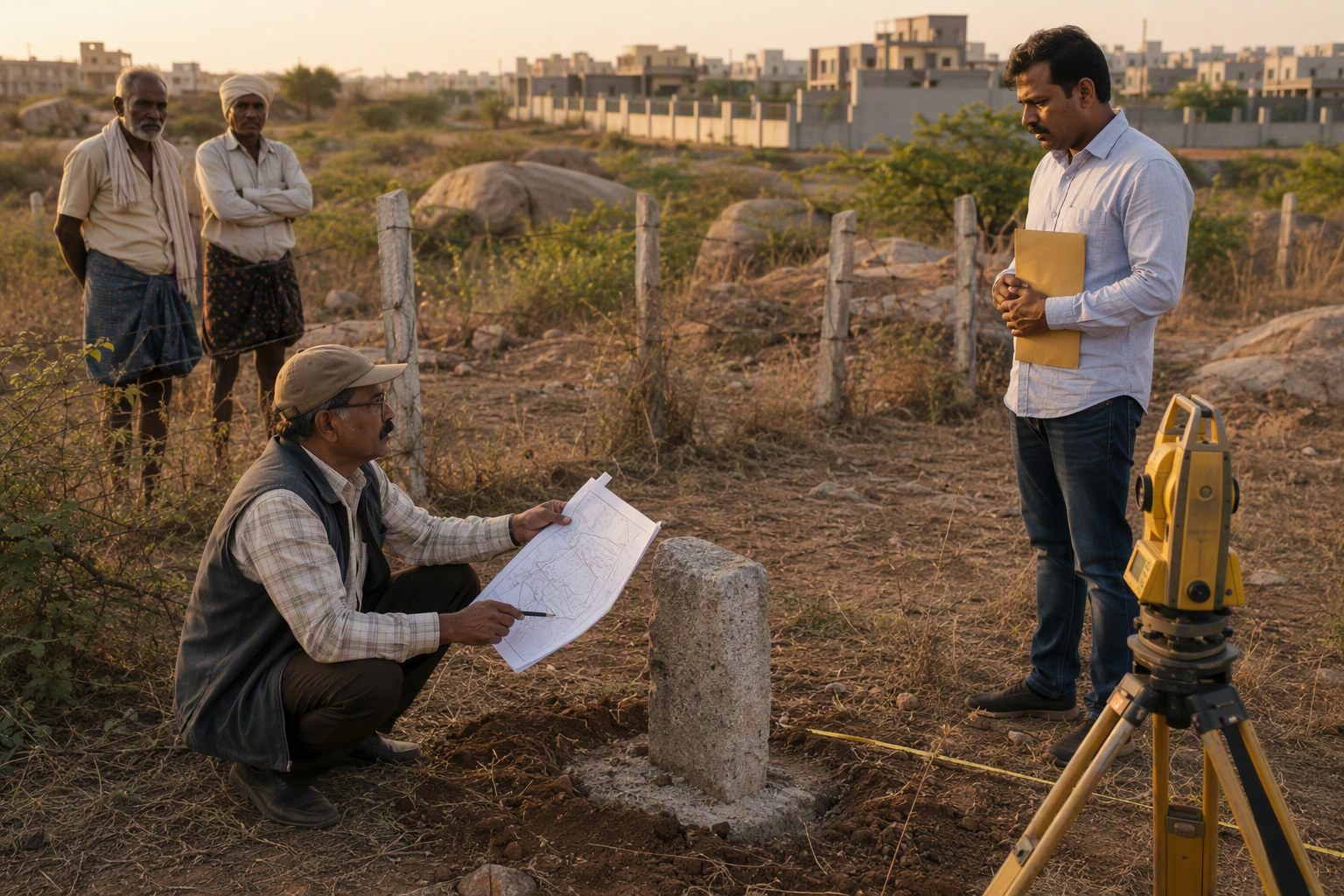



Telangana Experts Warn Buyers About Record Update Lag
Telangana Experts Warn Buyers About Record Update Lag because a property can look clean on paper in one department and still carry a pending risk in another. The warning has become sharper with 147,934 prohibited property entries under Section 22-A in Telangana. For buyers in Hyderabad, Rangareddy, Medchal-Malkajgiri, Sangareddy, Yadadri and Mahabubnagar growth corridors, this is not a small clerical issue. A delay in updating Dharani, SRO registration records, pahani, court orders or layout approvals can block registration, bank loan, mutation or resale.
The short answer is simple: do not rely on one document. A sale deed, EC, pattadar passbook, pahani, mutation entry, RERA page and Section 22-A status must talk to each other. If they do not, pause the deal.
Why Telangana Experts Warn Buyers About Record Update Lag
In our experience, the most dangerous property problem is not always fraud. Many times, it is lag. One office has updated the record. Another has not. The buyer sees a clean EC, but the land survey number may be under a prohibited list. Or a seller shows a recent Dharani mutation, but the SRO database has not fully reflected the supporting change. In apartment deals, the builder may have RERA registration, but the underlying land record may still need closer checking.
This lag matters because Telangana property transactions are document-heavy. For agricultural land, buyers usually check Dharani, pahani, ROR, survey number, pattadar details and encumbrances. For converted plots and apartments, the checks move towards SRO records, HMDA or DTCP layout status, building permission, RERA, market value and local body approvals. A gap in any one layer can create a nasty surprise after the token advance.
Our view is blunt: if a buyer is paying Hyderabad prices, the buyer deserves Hyderabad-level verification. A one-page EC is not enough anymore, especially around fast-moving mandals like Gandipet, Shankarpally, Ibrahimpatnam, Maheshwaram and Farooqnagar.
Buyers should start with a Section 22-A Prohibited Property Check, then cross-check the same survey number through the Survey Number Finder and run an Encumbrance Certificate Search. These are not optional steps if the deal involves open plots, agricultural land, old GP layouts, inherited land or resale flats where title history is not cleanly explained.
The 147,934 Section 22-A Entries Show the Scale of the Risk
Telangana has 147,934 prohibited property entries under Section 22-A. That number should make every buyer slow down. Section 22-A generally covers properties barred from registration due to reasons such as government land, assigned land, endowment land, wakf land, ceiling surplus land, court orders, acquisition issues or other notified restrictions. The exact reason has to be checked case by case.
The problem is that buyers often hear only one side of the story. The seller says, the neighbouring plots got registered. The agent says, only one old entry is pending. The local broker says, it will be cleared after registration. We have seen buyers accept such oral assurances in places like Shadnagar, Kothur, Maheshwaram, Adibatla, Yacharam and Moinabad. Some got lucky. Some got stuck with land they could not register, mortgage or sell.
A prohibited entry is not a small spelling mistake. If the SRO refuses registration, the buyer may lose the deal timeline, bank sanction, token advance and sometimes the confidence to buy in that locality again. If registration happens despite a record mismatch, the risk may still return during mutation, loan processing, litigation or resale.
Telangana Experts Warn Buyers About Record Update Lag in Hyderabad Growth Corridors
Record update lag hurts most where land values are rising quickly. When prices move fast, documentation quality often struggles to keep up. In Hyderabad, this is visible in western, southern and northern corridors. A 200 square yard plot in a developing pocket can jump sharply in asking price within one year, but mutation, layout regularity and old encumbrance trails may still remain messy.
| Area | Mandal / District context | Indicative market asking band | Common record-lag risk |
|---|---|---|---|
| Mokila and Kondakal | Shankarpally mandal, Rangareddy | Open plot quotes often around Rs 45,000 to Rs 80,000 per sq yd depending on layout, road and approvals | Survey number history, old agricultural title, conversion and layout approval mismatch |
| Kollur and Tellapur belt | Ramachandrapuram / Sangareddy side | Approved plot and villa land values can sit around Rs 60,000 to above Rs 1 lakh per sq yd in active pockets | HMDA layout status, land pooling history, EC continuity and mortgage releases |
| Kokapet, Narsingi and Gandipet | Gandipet mandal, Rangareddy | Premium plotted and redevelopment land can quote well above Rs 1.5 lakh per sq yd in select pockets | High-value resale title checks, road widening impact, old link documents and court claims |
| Adibatla and Kongara Kalan | Ibrahimpatnam mandal, Rangareddy | Plotted layout quotes often around Rs 25,000 to Rs 45,000 per sq yd depending on approvals and access | Assigned land suspicion, conversion papers, village map and survey boundary variation |
| Shadnagar and Farooqnagar | Rangareddy / Mahabubnagar growth side | Many plotted projects quote around Rs 12,000 to Rs 25,000 per sq yd based on location and permissions | Old GP layout claims, Section 22-A risk, unverified approach roads and delayed mutation |
| Kompally and Dundigal side | Quthbullapur / Dundigal Gandimaisamma, Medchal-Malkajgiri | Approved plot and villa pockets can range around Rs 70,000 to Rs 1.2 lakh per sq yd | Lake buffer, ORR access claims, building permission status and SRO record gaps |
These ranges are indicative market asking bands seen in active 2025-26 listings and broker quotes. The ready reckoner or government market value can be lower than market price, so buyers must check both. Use the Market Value / Guideline Value Search before finalising stamp duty expectations and negotiation numbers.
How Record Update Lag Affects Registration, Loan and Mutation
A buyer usually thinks the deal is safe once the sale agreement is signed. That is exactly where many mistakes begin. Record lag can hit at four stages.
1. Before registration
The SRO may refuse registration if the property appears in Section 22-A or if the survey number, extent or classification does not match. This is why buyers should find the exact registration office through Find Your SRO Office and check the SRO-level status before paying a large advance. Do not assume that the seller’s preferred SRO is automatically correct.
2. During bank legal verification
Banks are stricter than many individual buyers. A bank panel advocate may ask for 30 years of link documents, EC, tax receipts, layout approvals, building permissions, land conversion orders, family settlement records and release deeds. If one document is not updated, the loan can be delayed or reduced. A buyer who committed to a 30-day registration deadline may then face penalty pressure from the seller.
3. After registration during mutation
Registration is not the end of ownership housekeeping. Mutation in revenue records, municipal tax transfer, apartment association records and utility connections matter. For land, Dharani mutation and pahani update must reflect the buyer’s name correctly. If not, the buyer may face trouble during future sale or loan top-up.
4. During resale
Many buyers discover old gaps only when they become sellers. A missing release deed, wrong survey sub-division, unclosed mortgage, unregistered family partition or pending court order can reduce resale value. The property may be good physically, but a cautious buyer will price the risk.
Before Paying Token Advance, Run These Checks
Token advance culture is strong in Hyderabad. In hot localities, buyers are told that another party is waiting. We have heard this line from Narsingi to Bachupally and from Shamshabad to Shadnagar. A serious buyer can move fast, but not blindly.
- Check Section 22-A first: Use the Section 22-A Prohibited Property Check before signing the sale agreement.
- Match survey number: Verify village, mandal, survey number, sub-division and extent through the Survey Number Finder.
- Pull EC: Run an Encumbrance Certificate Search for the correct SRO period. For older properties, ask for a manual search if needed.
- Check government value: Use the Market Value / Guideline Value Search to compare ready reckoner value with the agreed sale value.
- Verify land and documents together: Use the Property Verification Tool when the title chain has agricultural conversion, inheritance or old GPA history.
- Track future changes: If you are waiting for registration, monitor changes through the Property Change Tracker.
For a resale flat in Gachibowli, Manikonda, Kondapur, Miyapur or Uppal, the same logic applies with a different document set. Check EC, mother deed, link documents, occupancy certificate, property tax, association dues, builder NOC where applicable and mortgage release. If it is an under-construction project, verify it through the RERA Project Lookup.
Stamp Duty Cost Makes a Failed Deal Painful
Telangana buyers generally budget around 6% government charges on a sale transaction: stamp duty at 4%, transfer duty at 1.5% and registration fee at 0.5%. On a Rs 1 crore property, that is about Rs 6 lakh in statutory charges. Use the Stamp Duty Calculator before you freeze the payment plan.
Record lag can disturb this calculation. Suppose a buyer agrees to buy a plot for Rs 80 lakh in a Shankarpally-side layout. The buyer pays Rs 5 lakh token, applies for loan and books a registration date. Later, the SRO record throws up a restriction on the survey number or the EC shows a missing release deed. The buyer may not lose stamp duty if registration has not happened, but the token advance, legal fee, loan processing fee and time are at risk.
On the seller side, some owners genuinely do not know that a record has not been updated. A family may have partitioned land in 2018, mutated it later and sold a portion in 2025. If the sub-division is not reflected consistently in Dharani, pahani and SRO descriptions, the buyer’s advocate may ask for corrections before registration. That is not buyer harassment. That is sensible risk control.
Apartment Buyers Are Not Fully Safe Either
Many apartment buyers assume that land record issues apply only to open plots. Not true. In Hyderabad’s high-rise market, the apartment sits on land. If the land title has gaps, the flat buyer can face delayed OC, delayed bank approvals, association disputes or future resale questions. This is especially relevant in large projects around Tellapur, Kokapet, Nanakramguda, Puppalaguda, Bachupally, Miyapur and Kompally where land parcels often have long title histories.
For RERA-registered projects, buyers should check the RERA registration number, sanctioned plan, completion timeline, land ownership or development agreement, mortgage disclosures and litigation declarations. RERA improves transparency, but it does not replace independent title verification. The builder’s brand name is not a substitute for clean documents.
For a resale flat, insist on the previous sale deed, link deed, EC from date of land purchase or at least from project commencement, occupancy certificate, property tax mutation and no-dues letter. If the flat is mortgaged, the bank release process must be clearly written into the sale agreement.
Our Opinion: Telangana Needs Faster Record Synchronisation
Telangana has made many digital improvements in land and registration systems. Dharani, online EC, online market value search and RERA records have made buyers more informed than a decade ago. Still, the weak point is synchronisation. Revenue records, registration records, municipal records, court orders and prohibited property lists must speak to each other faster.
When 147,934 prohibited property entries exist, even a small delay in updating corrections can affect thousands of genuine buyers and sellers. A property wrongly remaining on a prohibited list can block a clean owner. A property wrongly appearing clean can trap a buyer. Both outcomes damage market confidence.
We have seen buyers in Hyderabad become more data-aware after 2020. They ask for EC, RERA and layout approval more confidently now. That is good. The next step is record matching. Do not check documents in isolation. Read them like one story. Names, survey numbers, extents, boundaries, village, mandal, SRO, plot number and flat number must match across records.
Practical Red Flags Buyers Should Not Ignore
- The seller refuses to share the survey number before token advance.
- The EC is given only for 3 or 5 years though the property has a 30-year history.
- The land is described as agricultural in one record and residential plot in another, with no clear conversion document.
- The sale agreement says one extent, but pahani or layout approval shows another.
- The SRO mentioned by the seller does not match the property location.
- The property has old GPA transactions without proper registered sale deeds.
- The builder says RERA is applied for, but cannot give a valid registration number.
- The price is far below the active market in that locality without a clear reason.
A low price is not always a bargain. Sometimes it is the market quietly pricing a title risk. In Shadnagar, Adibatla, Maheshwaram and Moinabad, we have seen good lands and risky lands sit very close to each other. The road may be same. The documents may not be.
What Buyers Should Put in the Sale Agreement
A strong sale agreement can protect the buyer when records are pending. Add clauses that make the deal subject to clear EC, Section 22-A clearance, bank legal approval, original document verification, mortgage release and mutation support from the seller. Mention refund timelines if registration is refused due to title defect or prohibited property status.
For land, include exact survey number, sub-division, village, mandal, district, extent, boundaries, approach road details and approval status. For flats, include flat number, floor, undivided share of land, parking, project approval details, OC status and association dues. Do not leave these points to WhatsApp messages.
My practical advice is this: pay a small, clearly refundable token until verification is complete. Once records are checked, then move to a larger advance. Good sellers will accept this logic. If a seller becomes angry because you asked for basic title proof, treat that as a signal.
Bottom Line for Telangana Buyers
The warning from Telangana real estate experts is not to stop buying. Hyderabad and its surrounding districts still offer strong long-term property demand. The warning is to buy with record discipline. Section 22-A status, EC, Dharani, pahani, SRO records, RERA and approvals must be checked together.
With 147,934 prohibited property entries in the state, buyers cannot depend on broker confidence or seller reputation alone. The safest buyer is not the slowest buyer. The safest buyer is the one who checks the right records before paying serious money.
Frequently Asked Questions
What is record update lag in Telangana property transactions?
Record update lag means one government or approval record is updated while another still shows old or conflicting information. It can involve Dharani, pahani, SRO records, EC, Section 22-A lists, municipal records or RERA details.
Why are Section 22-A prohibited property entries risky for buyers?
Section 22-A entries can block registration if the property is notified as prohibited due to government land, assigned land, endowment, wakf, court order or other restriction. Telangana has 147,934 such entries, so checking before token advance is essential.
Is an Encumbrance Certificate enough to buy land in Telangana?
No. EC is necessary, but not enough. Buyers should also check Section 22-A status, survey number, pahani, Dharani mutation, link documents, layout approval, land conversion and SRO jurisdiction.
Do apartment buyers need to worry about land record delays?
Yes. A flat sits on land, so land title issues can affect bank loans, occupancy certificate, resale and association records. For under-construction projects, buyers should check RERA details, sanctioned plans and land ownership documents.
What should I do before paying a token advance in Hyderabad?
Check Section 22-A status, EC, guideline value, SRO, survey number and ownership documents first. Keep the token small and refundable until legal verification and bank checks are complete.