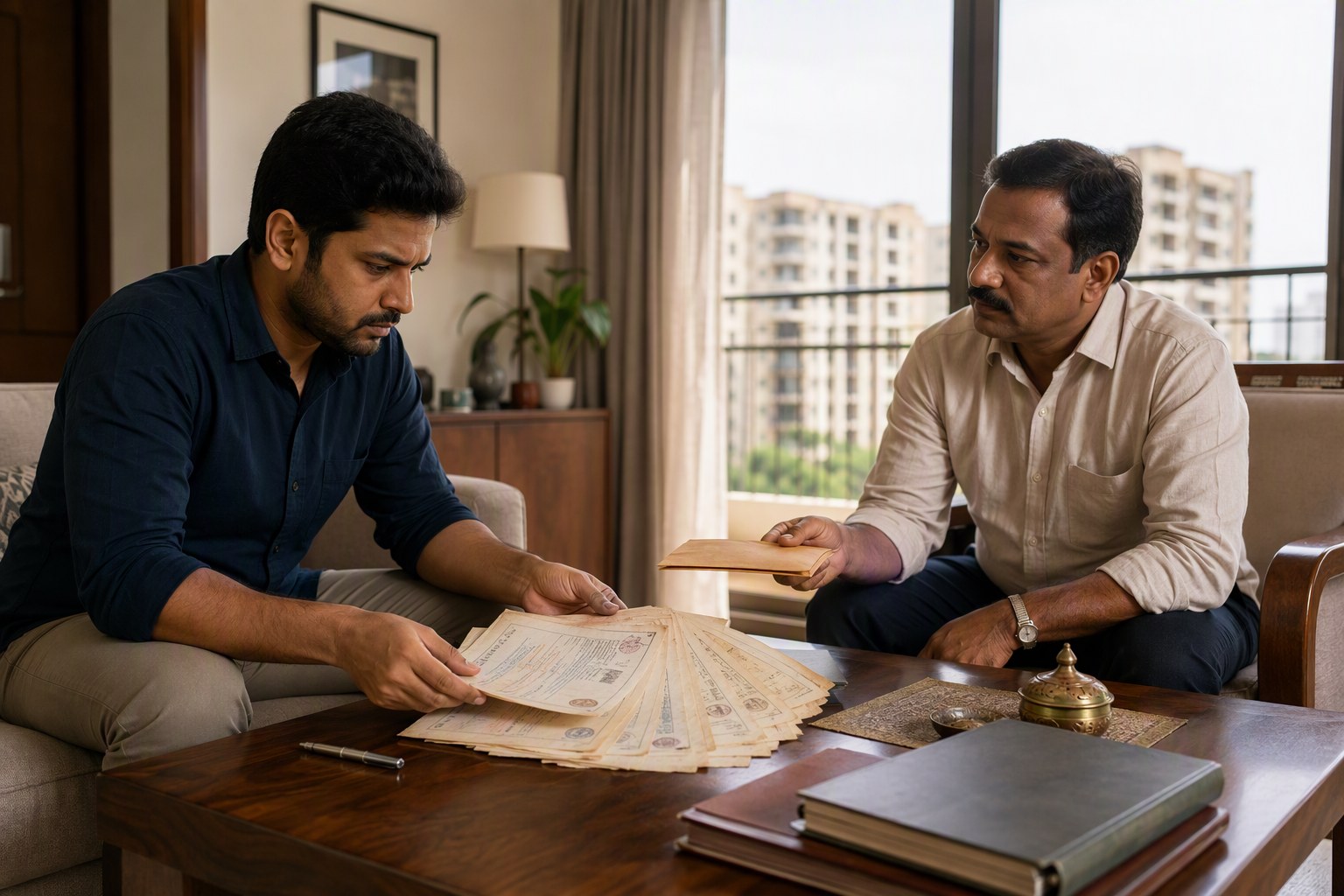



Selling a Plot in Telangana can look simple until the buyer bends down near the boundary stone, looks at the mud track, and asks one sharp question: Is this road shown in records? I have seen this scene in Mokila, Tukkuguda, Bachupally and even around Tellapur. The seller proudly shows the plot, talks about ORR access, nearby villa projects and future growth. The buyer does not argue about location. He asks for the road proof. That is where many negotiations start shaking.
Here is the straight answer: before you list a plot, keep documentary proof that the approach road exists, reaches your survey number, and is not just a neighbour's goodwill passage. Physical access is useful. Recorded access is what protects your price.
A plot without clear road proof is not unsellable, but it becomes harder to sell at your expected price. Buyers use road ambiguity to delay, renegotiate or walk away.
Selling a Plot: why road proof comes before price talk
In Hyderabad's growing edges, sellers often spend time on photos, fencing, Google Map pins and asking price. Good. But road access sits above all of that. If the buyer cannot confirm how he legally enters the land, every other selling point becomes secondary.
Take Shankarpally mandal. Around Mokila and Kondakal side, many buyers are looking at plotted land because of west Hyderabad demand. A seller may say, “Road is already there, cars are going daily.” The buyer's advocate will still ask for village map, FMB sketch, sale deed boundaries and link documents. Same story in Maheshwaram mandal near Tukkuguda, Ramachandrapuram mandal near Tellapur, Gandipet mandal around Kokapet side, and Bachupally mandal where old agricultural parcels and newer layouts sit close to each other.
In our experience, sellers lose momentum when they treat the road as a visual feature. A buyer treats it as a legal and planning question. Is it a public road, layout road, cart track, private pathway, panchayat road or only a temporary access left by adjacent owners? The answer changes how a buyer values the plot.
Before quoting a premium over the ready reckoner value, check the official market value using Market Value / Guideline Value Search. But do not stop there. The guideline value will not by itself prove access. For that, you need survey, title and layout records to speak the same language.
Selling a Plot without road records weakens your price
A buyer may still like your land. He may like the mandal, the SRO, the nearby development and the shape of the plot. But if he is unsure about access, his mind moves from appreciation to risk. That is when he starts saying things like:
- “My bank may not accept this.”
- “Building permission may become a problem later.”
- “If neighbour blocks the track, what will I do?”
- “Let me check with my lawyer and come back.”
- “Sir, reduce the price because access is not clear.”
That last line is the real pain point for sellers. Road doubt becomes a negotiation tool. Buyers know that once the issue is raised, other interested parties will also raise it. If your documents are ready, you can answer calmly. If not, you start defending the plot with words, and words do not carry much weight in land deals.
We have seen sellers in Kollur, Nandigama, Adibatla and Patancheru outskirts say, “Everyone knows this road.” That may be locally true. But a buyer from Gachibowli or Secunderabad, who is putting family savings into land, will not rely only on village understanding. He wants records.
What exactly counts as road access proof?
There is no single magic paper that solves every plot. Road proof is usually built from a set of documents. The stronger the set, the better your selling position.
| Document | What it helps prove | Seller's practical use |
|---|---|---|
| Sale deed schedule | Boundaries, road mention, access description | Shows whether road was part of the original transfer language |
| Link documents | Past ownership and repeated boundary descriptions | Helps show road was not inserted suddenly in recent papers |
| Village map or cadastral map | Recorded rasta, road alignment or survey access | Useful when buyer asks whether the road exists in government records |
| FMB or tippon sketch | Survey-level layout and measurements | Helps connect the survey number to the approach path |
| Pahani or ROR extract | Land record entries and classification context | Supports identity of the land and survey number |
| Dharani land details | Current revenue record reference | Helps buyers cross-check ownership and land particulars |
| HMDA, DTCP or gram panchayat layout approval, where applicable | Approved layout road and plot position | Strong support for plotted ventures |
| Encumbrance Certificate | Registered transactions and charges | Shows title flow, though it does not alone prove road width |
For a plotted layout, road access proof is usually easier if the layout approval is clean and the plot number sits on an approved internal road. For standalone agricultural land, inherited land or converted land, the proof work is more detailed. You need to show how the survey number is approached from the nearest public road.
Start with your survey number. If there is any confusion in village spelling, old survey subdivision or mandal jurisdiction, use Survey Number Finder. Many sale discussions get delayed because the seller says one survey number, the old deed shows another sub-division, and the buyer's person on ground marks a different parcel.
Road shown on ground is not always road shown in records
This is the most common trap. A tractor path, a gravel track or even a cemented lane may exist on ground. That does not automatically mean your plot has legally secure access.
In some villages, the visible path may be passing through private patta land. In some places, the road was left during an unapproved plotting exercise. In a few cases, the owner of the neighbouring land allowed access for years, and everyone started treating it as a road. When land values rise, such informal arrangements break.
If you are selling near fast-moving corridors like Narsingi, Mokila, Tukkuguda, Bachupally, Kollur or Adibatla, assume the buyer will investigate. Do the work before he does. Check the approach width, road continuity, and whether the access connects to a public road without crossing disputed land. For a quick starting point, use Road Width Check. It is not a replacement for official survey records, but it helps you prepare the discussion properly.
Also check land use. A plot may have access but still face planning limitations depending on its zone, master plan road proposals or local restrictions. Sellers should verify this early through Land Use Zone Finder, especially in HMDA and urban fringe areas.
How to prepare your road file before listing the plot
I advise sellers to create a small “road file” before giving the plot to brokers or posting it online. This file should be separate from your general title file. When a serious buyer asks about access, you can send selected papers quickly instead of searching in panic.
Start with the deed language
Read your own sale deed schedule. Does it mention a road on any side? Does it say panchayat road, layout road, pathway, rasta or neighbour's land? Check whether older link documents use the same boundary description. If older documents say “land of so-and-so” and the recent document suddenly says “road”, expect questions.
Match the road with survey records
Get the village map, FMB sketch or other survey reference available for your land. If you are not comfortable reading these, take help from a licensed surveyor or someone who regularly handles mandal-level land work. The point is simple: the buyer must be able to see how the road touches or reaches your parcel.
Check EC and title movement
Run an Encumbrance Certificate search before the buyer does. Use Encumbrance Certificate Search or EC Analyzer to understand the title trail. EC will not prove road access by itself, but it helps you avoid surprises such as missing transactions, mortgages or descriptions that do not match your current claim.
Verify SRO and jurisdiction
Many buyers ask which SRO handles the property. Sellers casually answer based on nearby town names, but SRO jurisdiction can be different from what people assume. Use Find Your SRO Office and keep the correct SRO details ready. It gives buyers confidence that you are not guessing.
Screen for prohibited property issues
Road access is not the only deal breaker. Section 22-A prohibited property entries can stop registration or create serious doubts. Verified.RealEstate's database context records 3,076,153 prohibited properties under Section 22-A. That is not a small background issue for Telangana sellers. Before listing, run a check through Section 22-A Prohibited Property Check. If a buyer discovers a red flag before you do, your negotiating power falls immediately.
What if the road exists but papers are weak?
Do not hide it. A smart buyer will find out. The better approach is to disclose the situation carefully and show what proof you have.
If the road is used by the village but not clearly reflected in your deed, collect supporting papers. If the pathway is through private land, understand whether there is any registered easement or written access arrangement. If the plot is in an old unapproved layout, do not market it as if it has the same comfort as an approved HMDA or DTCP layout. That kind of over-selling leads to painful renegotiation.
For some lands, a government survey or boundary demarcation may help. For others, you may need legal advice on easement rights. In a few cases, the correct commercial decision is to fix the road issue before selling, even if it takes time. A cleaner plot generally attracts more serious buyers than a cheaper plot with a doubtful approach.
In Telangana land deals, sellers sometimes feel buyers are asking too many questions. Frankly, the market has changed. Buyers are checking Dharani entries, EC, Google location, village maps, layout approvals, SRO data and even neighbouring survey numbers. You cannot stop that. You can only be better prepared.
How road proof affects buyer confidence in Hyderabad outskirts
Road access matters everywhere, but it becomes sharper in the outskirts because land parcels are changing use quickly. Agricultural land becomes plotted land. Old cart tracks become internal roads. Private layouts sit beside revenue roads. Proposed master plan roads create excitement, but existing access still matters for day-to-day use.
In Tellapur and Kollur side, buyers may compare your plot with approved layouts nearby. Around Tukkuguda and Maheshwaram, airport-side growth creates demand, but buyers still check whether the plot has clear approach from an existing road. In Bachupally and Dundigal side, old village roads, layout roads and private passages can sit close together. In Mokila and Shankarpally side, premium land demand means buyers are willing to pay for clarity, not just location stories.
When the road proof is clean, a seller can speak with confidence: “Here is the deed, here is the map reference, here is the EC, here is the SRO, and here is the access shown on ground.” That tone itself changes the negotiation.
Selling a Plot: price, ready reckoner and the road question
Sellers often ask, “If my area has demand, why should road proof affect price?” Because buyers do not pay only for land area. They pay for usable, transferable, financeable and resale-friendly land. Road access affects all of these.
The ready reckoner or government market value gives a baseline for registration valuation. Use Market Value / Guideline Value Search and then estimate stamp duty using Stamp Duty Calculator. But remember, the buyer's final offer is shaped by comfort. If the road is unclear, he may mentally deduct risk even if the government value is clear.
For capital gains planning, use Capital Gains Tax Calculator before you sign an agreement. A delayed deal because of road proof can disturb your tax planning, reinvestment timeline and family arrangements. Sellers focus on token advance, but the real deal is completed only when the buyer's due diligence is satisfied.
Red flags buyers notice during site visits
During plot visits, buyers and their advisors watch small things. Sellers should watch the same things before listing.
- The approach road narrows suddenly near the plot.
- The road passes through another fenced land.
- Boundary stones do not match the map or deed description.
- The plot is reachable only in dry season.
- Neighbouring owners dispute the path verbally.
- The online location pin does not match the survey position.
- Sale deed boundaries mention names but not a road.
- Layout brochure shows a road, but approval copy is missing.
If any of these apply, do not panic. But do not ignore them. Correct the listing description. Tell brokers the exact position. Keep supporting documents ready. If needed, price the risk honestly rather than allowing buyers to discover it and attack the deal later.
Use verification as a selling advantage
Many sellers think verification is only for buyers. I disagree. A well-prepared seller uses verification as a marketing advantage. When you can show title, EC, SRO, road proof and land status upfront, serious buyers spend less time doubting you and more time discussing terms.
You can begin with Property Verification Tool to organise the checks. Then use road, EC, SRO, guideline value and prohibited property tools based on your case. If your land is in or near a planned development area, also check zoning. If it is part of a plotted venture, keep approval papers ready before the first visit.
Do not send every document casually to every caller. Share carefully with shortlisted buyers. But at your end, keep the file ready. The seller who answers quickly usually controls the conversation better than the seller who says, “I will search and send later.”
Final word for Telangana plot sellers
Selling a plot is not only about finding a buyer. It is about surviving the buyer's due diligence. In Telangana, especially around Hyderabad's expansion zones, the road question can decide whether a deal moves forward or collapses after weeks of discussion.
Before listing, stand at your plot and ask yourself: can I prove this road on paper? If the answer is yes, organise the proof. If the answer is no, fix the gap or disclose it honestly. A buyer may forgive a correctable issue. He will not forgive surprise.
Road access proof is not glamorous. It does not look as exciting as drone photos or highway-distance claims. But when the buyer's lawyer starts asking questions, that humble road file may protect your price, your time and your peace of mind.
Frequently Asked Questions
What road proof should I keep before selling a plot in Telangana?
Keep the sale deed schedule, link documents, village map or FMB sketch, Dharani land details, pahani or ROR extract, layout approval if applicable, EC and clear site photographs. The aim is to show that the approach road reaches your survey number legally, not just physically.
Is a physical road enough to sell my plot?
No. A visible road helps during the site visit, but buyers usually want record proof. If the road is only an informal pathway through private land, the buyer may reduce the offer or avoid the deal.
Can an Encumbrance Certificate prove road access?
An EC helps verify registered transactions and title movement, but it does not by itself prove road access or road width. Use it along with deed schedules, survey maps, layout approvals and ground verification.
What should I do if my deed does not mention a road?
Check older link documents, village maps, FMB sketches and local revenue records. If the access is through private land, take legal advice on easement or written access rights before marketing the plot as road-facing.
Should sellers check Section 22-A before listing land?
Yes. A Section 22-A issue can affect registration and buyer confidence. Run a prohibited property check before listing so that you are not surprised during negotiation or at the SRO stage.