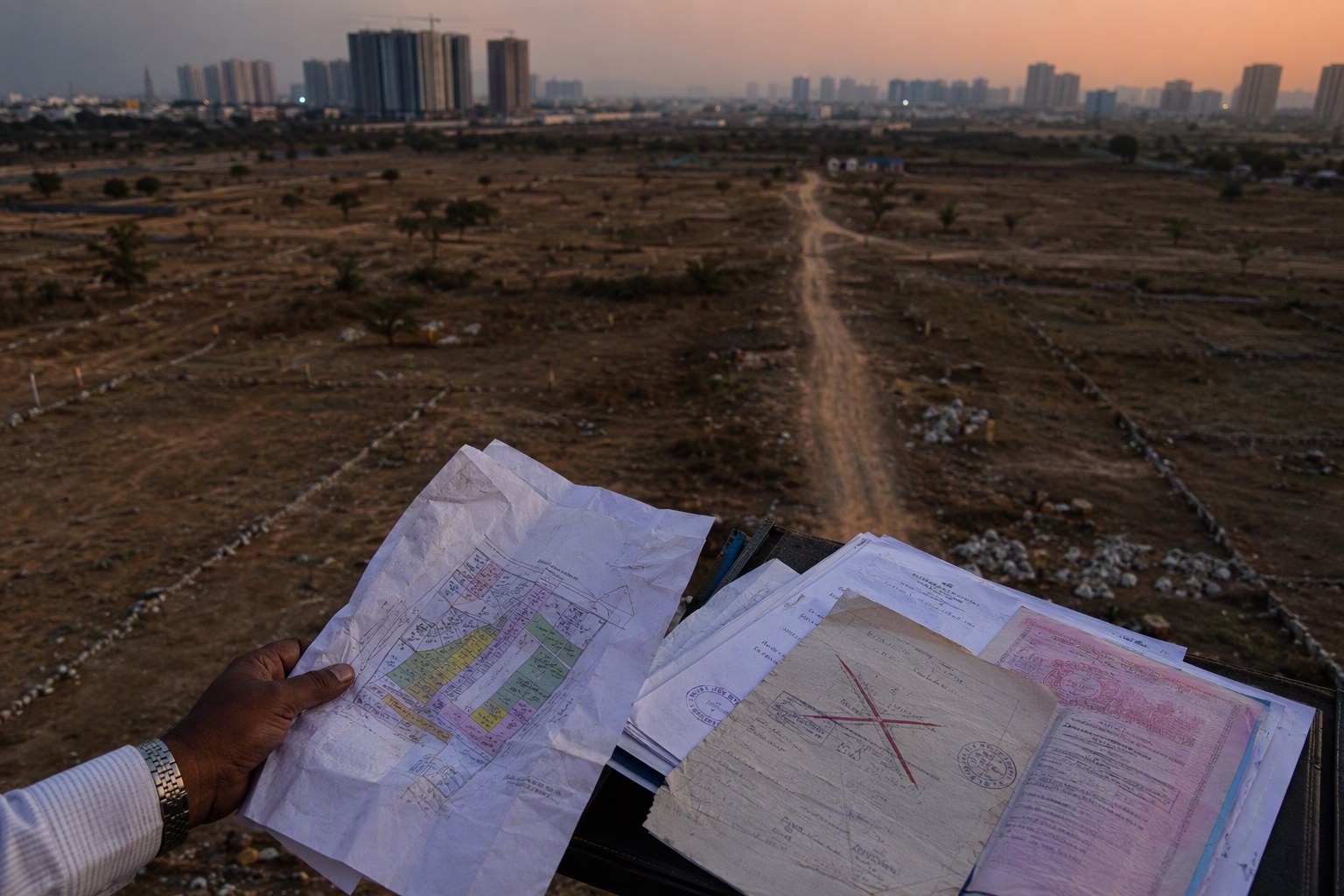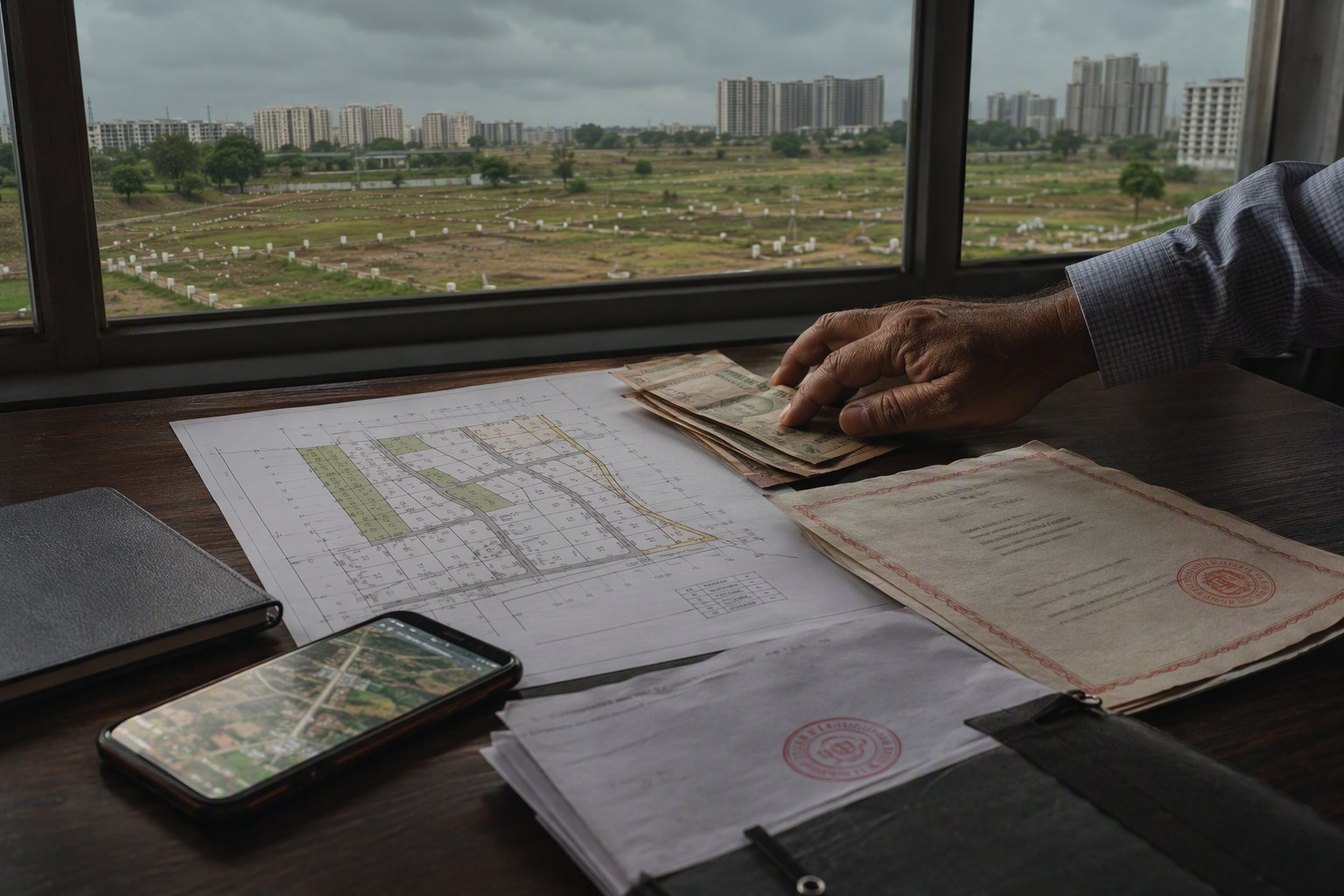
Hyderabad Investors: Can Title Clean-Up Time Change IRR? Yes, and often by more than investors expect. Telangana has 1,47,934 prohibited properties under Section 22-A, and that single number should make every buyer pause before assuming a neat 18% or 20% annual return. A land parcel in Shankarpally, a plotted venture near Tukkuguda, or a resale flat in Kondapur may look profitable on paper. But if the title clean-up takes 6 to 18 months, your actual IRR can quietly drop.
We have seen this repeatedly in Hyderabad and its growth corridors. The investor calculates purchase price, expected resale value, development potential, and stamp duty. But the time spent correcting pahanis, checking Dharani entries, clearing old EC gaps, dealing with SRO objections, or removing a wrong prohibited-property tag is treated like a small operational delay. It is not small. Time is a cost.
In property investment, a bad title does not only create legal risk. It creates time risk. And time risk directly hits IRR.
Title Clean-Up Time Can Change IRR Even When the Deal Looks Profitable
IRR, or Internal Rate of Return, measures return against time. That is why a delay hurts. If you buy land for ₹1 crore and sell it for ₹1.30 crore in one year, the return looks strong. If the same sale happens after two years because the buyer’s banker refuses funding due to a title issue, your annualised return changes sharply.
Hyderabad investors often discuss price movement locality-wise: Kokapet, Neopolis, Tellapur, Narsingi, Kollur, Mokila, Shankarpally, Maheshwaram, Tukkuguda, Adibatla, Bachupally, Kompally, Medchal. Fair enough. Location matters. But clean transferability matters just as much. A property that cannot be registered, mortgaged, or resold without long explanations deserves a discount.
Before you enter any deal, run three basic checks: Section 22-A Prohibited Property Check, Encumbrance Certificate Search, and Property Verification Tool. These are not clerical steps. They are return-protection steps.
Why the 1.48 Lakh Prohibited-Property Count Matters for Hyderabad Investors
The figure of 1,47,934 prohibited properties under Section 22-A is not just a government statistic. It tells us how many assets can face registration blockage or serious transaction friction. Section 22-A properties may include government lands, assigned lands, endowment lands, Wakf-related entries, ceiling surplus lands, lands under litigation, or properties restricted by specific notifications.
For an investor, the exact legal category matters less at the first screening stage. The immediate question is simpler: can this property be registered and resold without drama? If the answer is not clear, your return model must include a delay buffer.
In our experience, title issues are not limited to remote agricultural land. We have seen confusion in village records around fast-growing mandals such as:
- Gandipet mandal around Narsingi, Kokapet and Manchirevula, where high-value land has multiple layers of old claims and development agreements.
- Serilingampally mandal around Kondapur, Gachibowli, Miyapur and Chandanagar, especially in older resale flats and society lands.
- Shankarpally mandal around Mokila, Kondakal and Shankarpally town, where agricultural land conversion, layouts, and survey boundaries must be checked carefully.
- Maheshwaram mandal around Tukkuguda, Mansanpally and Maheshwaram, where investor activity is high due to ORR and airport-side growth.
- Medchal and Shamirpet belts, where HMDA layout approvals, gram panchayat legacy layouts, and land-use checks can affect exit value.
None of this means these areas are risky by default. They are some of the most active real estate pockets in Telangana. The point is that high transaction activity attracts disputes, documentation gaps, and speculative buying. That is exactly where title clean-up time becomes a financial variable.
Title Clean-Up Time: A Simple IRR Example for Hyderabad Land Investors
Let us take a practical example. Assume an investor buys a plot or small land parcel near Mokila or Tukkuguda for ₹1 crore. The expectation is to exit at ₹1.30 crore after one year. On paper, it looks like a 30% gain before taxes and costs.
| Scenario | Purchase Cost | Exit Value | Time Taken | Approx Annualised Return |
|---|---|---|---|---|
| Clean title, quick resale | ₹1 crore | ₹1.30 crore | 12 months | 30% |
| Minor EC or link-document delay | ₹1 crore | ₹1.30 crore | 18 months | About 19% |
| Dharani or pahani correction delay | ₹1 crore | ₹1.30 crore | 24 months | About 14% |
| Section 22-A objection or serious title clean-up | ₹1 crore | ₹1.30 crore | 36 months | About 9% |
Same purchase. Same exit price. Different time period. That is the whole problem. A deal that looked like a fast 30% gain can become a slow 9% annual return if title clean-up drags for three years.
This table does not even include loan interest, legal fees, travel, mutation expenses, missed opportunities, or capital gains tax. If you are using borrowed money, the pain is sharper. Use the Capital Gains Tax Calculator and Stamp Duty Calculator before you decide whether the net return is still attractive.
How Title Clean-Up Time Creates Resale Friction
Many investors think title risk matters only at purchase. Actually, it hurts more at exit. When you are buying, you may be ready to take a view. When you are selling, your buyer, his lawyer, his bank, and sometimes his family will all take their own view. Any doubt becomes a negotiation weapon.
Here are common resale friction points we see in Hyderabad and surrounding Telangana markets:
- Old EC gap: The Encumbrance Certificate does not clearly capture a past transaction, mortgage release, partition deed, or court order.
- Survey number mismatch: Sale deed says one survey number, pahani or Dharani shows another subdivision.
- Wrong owner name in revenue records: The seller has a registered deed, but mutation is pending or wrongly updated.
- Prohibited-property alert: The land appears in or near a Section 22-A list, even if the seller claims it is a clerical issue.
- Layout approval doubt: Buyer asks whether it is HMDA-approved, DTCP-approved, gram panchayat layout, or an unapproved subdivision.
- Land-use conflict: The buyer expected residential use, but zoning does not support his intended development.
- Boundary dispute: The physical land and survey sketch do not match neatly, common in peri-urban agricultural parcels.
Each issue may be solvable. But solvable does not mean instant. A 45-day correction is manageable. A 15-month correction changes the investment result.
For land, start with the Survey Number Finder, then check land use through the Land Use Zone Finder. For apartments and villas, use the RERA Project Lookup if the project falls under RERA registration requirements.
Hyderabad Investors Should Price Title Clean-Up Time Like a Cost
My view is simple: if a property needs clean-up, the discount must be visible. Not emotional, not vague, not based on the broker saying, sir small issue only. Put a number on it.
Suppose market value for a clean plot in a good part of Kollur or Mokila is ₹70,000 per square yard, and a similar plot with document gaps is offered at ₹62,000 per square yard. The ₹8,000 discount may look tempting. But ask:
- How long will correction take?
- Who will handle it?
- Is the seller giving indemnity?
- Will banks lend on this property today?
- Can the property be registered immediately at the correct SRO?
- Will the next buyer accept the explanation?
In some deals, a 10% discount is not enough. In others, the issue is minor and the discount is attractive. The only sensible way is to connect legal risk with financial return.
You should also compare guideline value and market value. Telangana ready reckoner values may be lower than actual market rates in high-demand pockets such as Kokapet, Narsingi, Tellapur, Gachibowli, Kondapur and Miyapur. In emerging belts like Kandukur, Yacharam, Medchal, Shamirpet and Bhongir side, the gap between guideline value and negotiated market rate can be wide. Check the government-facing value using our Market Value / Guideline Value Search before finalising cash flow.
Where Document Delays Usually Come From in Telangana Deals
Title clean-up is a broad phrase. In Telangana, it usually comes from one or more of these document layers:
1. Dharani and revenue record mismatch
For agricultural land, Dharani entries carry major weight. If the seller’s name is not updated, extent is wrong, land nature is disputed, or old pahanis show a different trail, buyers will hesitate. In Shankarpally, Moinabad, Chevella, Kandukur and Maheshwaram mandals, this is a regular due diligence item.
2. Section 22-A prohibited-property entry
A prohibited-property flag can stop registration or trigger deeper scrutiny. The issue may be genuine or mistaken, but either way, the investor must budget time. With 1,47,934 such properties in the system, this cannot be treated as a rare problem.
3. SRO-level registration concerns
Sometimes the Sub-Registrar Office raises questions on link documents, prior registrations, market value, or nature of land. Before buying, identify the relevant SRO using Find Your SRO Office. Local SRO practice matters because Hyderabad’s property documentation history is not uniform across all zones.
4. Layout and approval gaps
HMDA, DTCP, municipal, gram panchayat and unapproved layouts are not the same. Investors sometimes buy based on road access and fencing, but exit buyers ask for layout approval, mortgage release status, open space details, and final layout proceedings.
5. Development potential overestimated
A plot may be legally transferable but still not support the expected construction. Road width, FSI/FAR, land-use zone, and local master plan restrictions can reduce value. Before pricing a redevelopment or villa project angle, check FSI/FAR Calculator and Road Width Check.
Title Clean-Up Time and the Hidden Cost of Waiting
Waiting has four hidden costs. Most investors count only one.
| Hidden Cost | How It Affects the Investor |
|---|---|
| Capital lock-in | Your money is stuck while another clean opportunity may move faster. |
| Buyer discounting | At exit, buyers reduce offer price due to perceived risk. |
| Financing difficulty | Banks may refuse loan, shrinking the buyer pool to cash-heavy buyers. |
| Legal and liaison expenses | Lawyer fees, document copies, affidavits, survey work, and follow-up visits add up. |
A clean property in Tellapur may fetch strong buyer interest because banks, end-users, and investors are comfortable. A similar-looking asset with unclear link documents may still sell, but usually to a smaller buyer pool. Smaller buyer pool means weaker negotiation power.
This is why I prefer clean, slightly expensive assets over cheap, unclear assets unless the discount is deep and the legal path is well understood. Many investors celebrate buying below market. The real test is whether you can sell without explaining the file for two hours.
How to Build Title Clean-Up Time into Your IRR Model
Do not calculate only one return number. Build three scenarios: clean exit, delayed exit, and stressed exit.
Base model for a Hyderabad investor
- Purchase price including stamp duty and registration charges
- Expected resale price after 12, 24, and 36 months
- Legal and documentation cost
- Loan interest or opportunity cost of capital
- Tax impact on exit
- Discount required if selling to an investor instead of an end-user
For example, if you buy a property at ₹1 crore and spend roughly ₹7 lakh on registration-related costs, your actual starting cost is not ₹1 crore. It is ₹1.07 crore, before any legal clean-up. If you then spend ₹2 lakh on corrections and wait 18 months, your return must be calculated from that real cost and real timeline.
Use the Composite Value Calculator if you are evaluating a built-up property where land and construction value both matter. For land and plotted assets, keep checking EC, survey number, prohibited status, and guideline value at each stage. If you are holding for a few years, the Property Change Tracker can help you monitor changes that affect resale confidence.
Locality Examples: Where Clean Title Can Beat Cheap Entry Price
Let us look at practical Hyderabad investor behaviour.
Kokapet and Neopolis
These are high-ticket markets. Entry price is high, but institutional confidence is also high in many approved projects. For apartments and commercial assets, buyers ask for RERA, approvals, mortgage status, and occupancy-related documents. A small title doubt can make a premium buyer walk away.
Tellapur, Osman Nagar and Kollur
This belt attracts IT employees, villa buyers, and plotted-development investors. Clean HMDA approvals, road access, and lender comfort can lift liquidity. A plot with weak approval history may still look cheaper, but resale to an end-user family can become slow.
Mokila, Kondakal and Shankarpally
Land investors love this stretch because it has long-term growth logic. But agricultural title, conversion status, survey boundaries, pahanis, and Dharani entries must be checked in detail. In this belt, a good lawyer and a patient document review are not optional.
Tukkuguda, Maheshwaram and Mansanpally
Airport-side growth, ORR access and pharma-city narratives have pulled investors here. The upside can be attractive. Still, investors should check whether the land is clear, registrable, and suitable for the intended use. The difference between a clean plotted venture and a loosely marketed land share can be huge.
Bachupally, Miyapur and Kompally
These are mature residential markets with heavy resale activity. Apartment investors should check link documents, land ownership of the project, pending mortgages, society formation, and EC. In older projects, missing papers can delay resale even when the flat itself is in good condition.
Red Flags That Should Change Your Offer Price
If any of these appear, do not panic. But do not pay clean-title pricing either.
- Seller says original link documents are missing.
- EC does not show a transaction that the seller claims happened.
- Survey number in sale deed differs from Dharani or pahani trail.
- Property appears in a prohibited-property check.
- Seller is pushing for agreement payment before document review.
- Layout approval is promised but not produced.
- Bank loan is not available, but no one gives a clear reason.
- There is a court case, family settlement, GPA chain, or unregistered agreement in the background.
- Boundary stones and actual possession do not match the sketch.
One red flag may be manageable. Three red flags mean your IRR model needs a stress case. If the seller will not reduce price for time risk, I would usually walk away.
A Practical Due Diligence Checklist Before You Pay the Token
Hyderabad property deals move fast, especially when brokers say another buyer is ready. Still, token advance without document review is a weak position. At minimum, do this:
- Check Section 22-A status using the Section 22-A Prohibited Property Check.
- Pull EC through Encumbrance Certificate Search.
- Verify survey number and village details using Survey Number Finder.
- Check guideline value through Market Value / Guideline Value Search.
- Identify the correct SRO through Find Your SRO Office.
- For projects, check registration details through RERA Project Lookup.
- Ask for link documents, latest tax receipts, approval copies, mutation records, and possession proof.
- Get a local property lawyer to review the file before paying a large advance.
In our experience, the best investors are not the ones who avoid every complicated deal. They are the ones who know the price of complication. If a title issue takes six months to clean but the discount is 20% and the correction path is clear, it may still be a good investment. If the discount is 5% and the issue is unclear, the so-called bargain can become dead capital.
Final View: Title Clean-Up Time Is an IRR Variable, Not a Side Issue
Hyderabad real estate still has strong long-term drivers: IT employment, ORR connectivity, Metro expansion expectations, airport-side development, data centres, life sciences, and steady end-user demand. But not every property in a good locality is a good investment.
The 1,47,934 prohibited-property count is a reminder that documentation risk is real in Telangana. A clean title shortens exit time, widens the buyer pool, improves bankability, and protects negotiation power. A messy title may still be profitable, but only if the entry price compensates for delay, legal cost, and resale friction.
My thumb rule is this: if you cannot explain the title clearly to the next buyer, do not assume full market value in your IRR sheet. Price the delay before you sign.
Frequently Asked Questions
Can title clean-up time really reduce IRR in Hyderabad property deals?
Yes. If a ₹1 crore property is expected to sell for ₹1.30 crore in one year, the return looks like 30%. If title issues delay the sale to three years, the annualised return can fall to around 9%, even with the same exit price.
What is Section 22-A in Telangana property checks?
Section 22-A refers to prohibited properties where registration may be restricted due to government, assigned, endowment, Wakf, litigation, or other notified issues. Telangana has 1,47,934 such prohibited properties, so investors should check before paying advance.
Which documents should Hyderabad investors check before buying land?
Check the sale deed chain, EC, pahani, Dharani entry, survey number, mutation status, layout approval, land-use zone, tax receipts, and Section 22-A status. For plotted ventures, also verify HMDA or DTCP approval.
Should I buy a cheaper property if the title has small issues?
Only if the discount is enough and the correction path is clear. A minor EC correction may be acceptable. A prohibited-property flag, missing link documents, or unclear ownership needs a much deeper discount and legal review.
Which Verified.RealEstate tools help with title due diligence?
Start with the Section 22-A Prohibited Property Check, Encumbrance Certificate Search, Property Verification Tool, Survey Number Finder, Guideline Value Search, and Find Your SRO Office tools before making a serious payment.