

HMDA-Approved Plot vs Panchayat Plot in Hyderabad: Safer Buy?
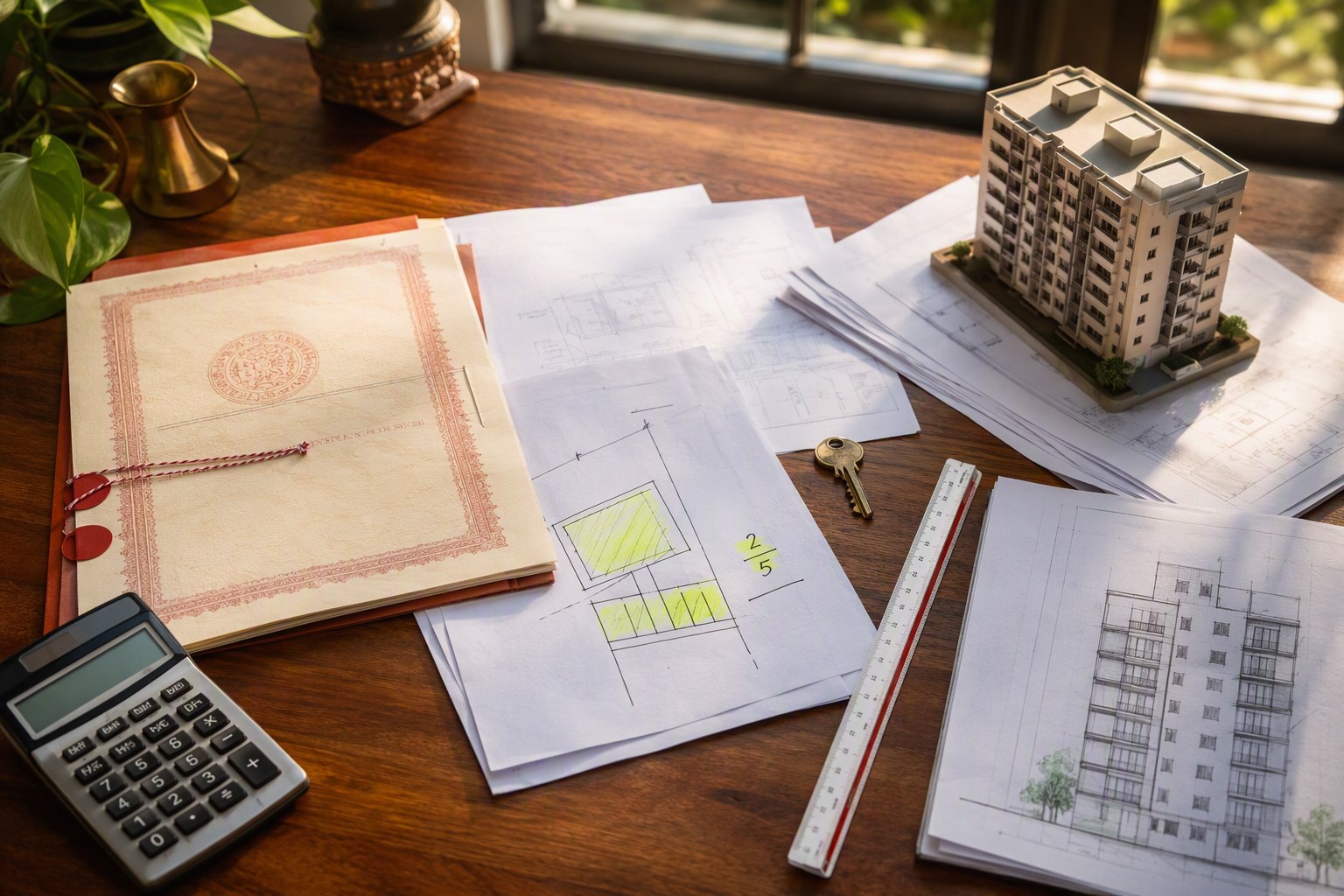
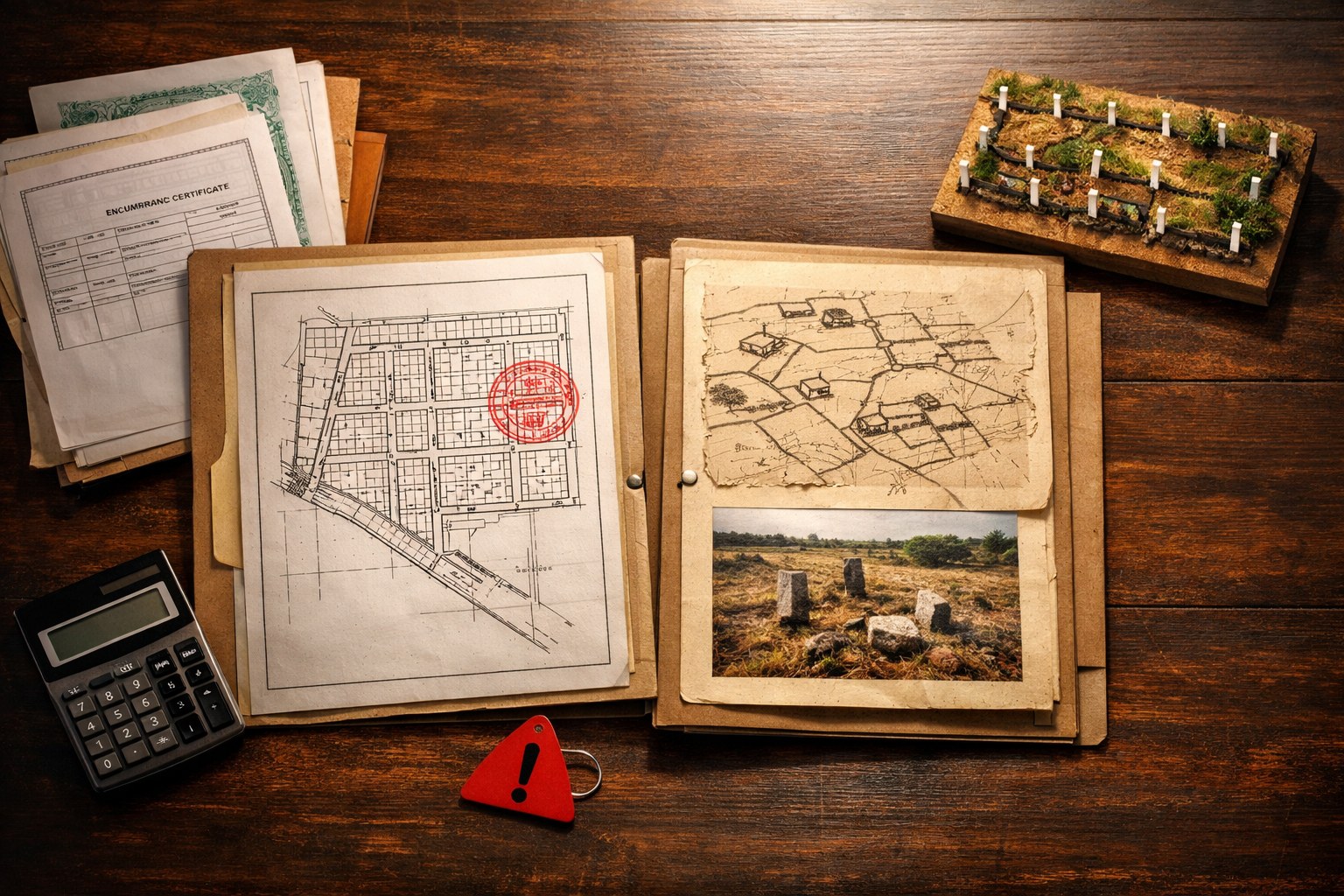
HMDA-approved plot vs Panchayat plot in Hyderabad is not just a price comparison. It is a risk comparison. An HMDA-approved plot usually comes with layout permission, defined roads, open space, and clearer registration readiness. A Panchayat plot may look cheaper, but the buyer has to check land conversion, layout approval, survey number status, EC, SRO jurisdiction, land use, and whether the land falls under Section 22-A restrictions. Telangana has 1,47,934 prohibited properties flagged under Section 22-A, so one missed check can block registration or resale.
Our short answer: if both plots are in similar location and budget, the HMDA-approved plot is usually the safer buy. A Panchayat plot can still be a good purchase, but only after strict document verification and land-use checks.
HMDA-Approved Plot vs Panchayat Plot in Hyderabad: Quick Comparison
| Point | HMDA-approved plot | Panchayat plot |
|---|---|---|
| Approval status | Layout approved by HMDA or relevant urban authority, with layout number and approved plan | May have only Gram Panchayat layout, old permissions, or no valid layout approval for current rules |
| Registration readiness | Generally easier, subject to EC, title, and prohibited property check | Can face objections at SRO if conversion, layout, survey number, or 22-A status is unclear |
| Roads and amenities | Approved internal roads, open space, and plotted layout norms are usually defined | Road width, access, drainage, and open space may vary widely |
| Bank loan comfort | Banks are usually more comfortable if title and approvals are clean | Many banks hesitate unless the file is very strong |
| Resale demand | Better resale in growth corridors like Kollur, Mokila, Shankarpally, Adibatla, Tukkuguda | Resale depends heavily on conversion, road access, and buyer confidence |
| Risk level | Lower, but not zero | Medium to high, depending on papers |
| Price | Usually costlier per sq yd | Usually cheaper, which is why buyers get tempted |
We have seen many Hyderabad buyers compare only rate per square yard. That is a mistake. A ₹28,000 per sq yd Panchayat plot near a village road may not be cheaper than a ₹38,000 per sq yd HMDA-approved plot if the first one needs legal work, conversion clarity, road disputes, or faces registration delay. In land buying, the final cost includes risk.
Why HMDA-Approved Plot vs Panchayat Plot in Hyderabad Matters More Now
The Hyderabad land market has moved far beyond the old city limits. Buyers are looking at Mokila in Shankarpally mandal, Kollur and Velimela in Ramachandrapuram side, Adibatla in Ibrahimpatnam mandal, Tukkuguda and Maheshwaram, Kandukur, Yacharam, Shadnagar, Chevella, Moinabad, Ghatkesar, Bibinagar and Medchal belt. Many of these areas have a mix of approved layouts, older village layouts, agricultural land parcels, and plotted ventures marketed in attractive brochures.
In our experience, the same locality can have three different realities. One venture may be HMDA-approved. The next one may have only Panchayat-level papers. A third parcel may still be agricultural land, sold through agreements or GPA-style arrangements. All three will be sold as “near ORR”, “near proposed road”, or “future growth location”. The buyer has to separate marketing from legality.
Indicative open-market asking rates also vary sharply. Around Mokila and Kollur, good plotted inventory often gets quoted in a wide band of roughly ₹40,000 to ₹90,000 per sq yd depending on exact approach road, approval, and development stage. Shankarpally side can range broadly from ₹25,000 to ₹60,000 per sq yd. Adibatla, Tukkuguda and Maheshwaram belts may see quotes from around ₹18,000 to ₹55,000 per sq yd, again depending on approval, road width and proximity to ORR, Srisailam Highway or Nagarjuna Sagar Road. These are market conversation bands, not government values. For registration planning, always check the official value using the Market Value / Guideline Value Search.
What Exactly Is an HMDA-Approved Plot?
An HMDA-approved plot is part of a layout sanctioned by the Hyderabad Metropolitan Development Authority. The layout should have a valid approval number, approved drawing, defined plot numbers, roads, open space, and compliance with planning norms. HMDA approval does not automatically mean the title is perfect, but it reduces planning-related uncertainty.
A proper HMDA layout file generally gives comfort on these points:
- Land is within the HMDA planning jurisdiction or relevant notified area.
- The layout has been examined against planning rules.
- Internal roads, plot sizes, open space and public utility areas are marked.
- The buyer can compare the plot on ground with the approved layout plan.
- Future building permission becomes more practical if road width and zoning support it.
Still, do not buy only by seeing the HMDA board at the site. Ask for the full layout proceedings, approved plan, link documents, latest EC, pattadar passbook history where relevant, mutation records, land conversion documents and tax receipts. Use the Property Verification Tool before paying a big advance.
What Is a Panchayat Plot in Hyderabad’s Outskirts?
A Panchayat plot usually means a plot in a village area where the seller claims approval or recognition from the Gram Panchayat. Some old layouts were formed before stricter planning controls expanded. Some may be regularised. Some may be informal divisions of agricultural land. This is where buyers must be careful.
Many Panchayat plots are sold in growth locations because they look affordable. A buyer may hear, “Sir, registration is happening. Houses are already there. Panchayat permission is enough.” That statement needs checking. Registration of a sale deed and legality of a plotted layout are not the same thing. The SRO may register certain transactions based on documents presented, but that does not cure every planning defect, title issue or land-use violation.
For Panchayat plots, verify these items before discussing final price:
- Is the land converted from agricultural to non-agricultural use?
- Is there any valid layout approval from HMDA, DTCP, municipality or other competent authority?
- Does the survey number match the physical plot location?
- Is the approach road shown in revenue and layout records?
- Is the plot inside a prohibited survey number or assigned land?
- Is the land in conservation zone, water body buffer, lake FTL, nala, forest or government land claim?
The Survey Number Finder, Land Use Zone Finder and Section 22-A Prohibited Property Check are useful starting points for this due diligence.
Registration Readiness: Where HMDA Plots Score Better
For a buyer, the biggest practical question is simple: can I register this plot cleanly and sell it later without drama? HMDA-approved plots usually score better because the layout approval reduces objections on plotting and development. The SRO can still ask questions if title documents are weak, if the survey number is blocked, or if there is a mismatch in extent.
With Panchayat plots, the risk is uneven. Some files are clean and old. Some are messy. We have seen cases where buyers paid token advance after seeing a low rate, then discovered one of these problems:
- The land was still agricultural and no proper conversion was available.
- The survey number appeared in a prohibited list.
- The seller had only an agreement of sale, not clear title.
- The plotted layout did not match the actual boundaries on ground.
- The road shown in brochure was not a legally recorded road.
- The land fell under a zoning restriction that affected building permission.
Before booking any plot, search the EC through the Encumbrance Certificate Search. Then confirm the correct registration office using Find Your SRO Office. Wrong SRO assumptions can delay planning, especially in border areas between mandals and districts.
The 1,47,934 Prohibited Properties Problem in Telangana
Telangana’s Section 22-A prohibited property list is not a small footnote. The database count of 1,47,934 prohibited properties shows the scale of land parcels where registration may be restricted or blocked. These can include government lands, assigned lands, endowment lands, Wakf claims, surplus lands, litigation-marked lands, and other restricted categories depending on the record.
This matters for both HMDA-approved and Panchayat plots. Approval and prohibition are separate checks. A buyer may think, “It is in a layout, so no issue.” Not always. If the underlying survey number has a restriction, the SRO can refuse registration or the buyer may face future title disputes.
For Panchayat plots, the 22-A check becomes even more critical because many such plots are carved out of larger survey numbers. If only a brochure plot number is given and survey number is hidden, treat it as a red signal. Ask for village, mandal, survey number, extent, passbook details where applicable, and link documents. Then run a check through the Section 22-A Prohibited Property Check.
Stamp Duty Planning: Do Not Calculate Only on Seller’s Quote
In Telangana, plot registration cost is usually planned around stamp duty, transfer duty and registration fee. Buyers often calculate the amount on the negotiated sale price, but the SRO will look at the higher of consideration value and government market value. That is why ready reckoner or guideline value matters.
For example, if you buy a plot in Shankarpally mandal for ₹45 lakh but the government value is higher, registration charges may be calculated on that higher value. If the value is lower, the sale consideration may become the base. This is why one should not arrange funds at the last minute.
Use the Stamp Duty Calculator and Market Value / Guideline Value Search before signing the agreement. I would also keep a margin for documentation, legal opinion, bank processing if any, and post-registration mutation or municipal updates.
EC Checks: A Clean Encumbrance Certificate Is Necessary, Not Sufficient
An EC shows registered transactions for the selected property details and period. It helps identify sale deeds, mortgages, releases, gifts, partitions and some court-related entries if registered. For an HMDA-approved plot, EC can confirm whether the developer has clear sale history and whether the plot is mortgaged. For a Panchayat plot, EC can expose repeated agreement-style sales, old mortgages, family partitions and suspicious transfers.
But EC is not a full title certificate. It may not show unregistered family disputes, possession claims, boundary issues, pending civil suits not registered against the property, or physical encroachments. That is why buyers should combine EC with link document review, revenue records, Dharani details where applicable, pahani or old ROR references, site inspection, and local enquiry.
In our experience, a 30-year EC is preferable for land purchases, especially in old village areas. For fresh HMDA layouts, check the parent land EC too, not only the individual plot sale deed.
Road Width, Land Use and Building Permission
Many buyers purchase plots today with an idea of constructing a house after 3 to 5 years. That is where road width and land use become critical. A plot may be registered, but building permission can still become difficult if road access is narrow, zoning is wrong, or the plot does not match approved layout dimensions.
For HMDA-approved plots, the approved layout plan usually specifies road widths. Common internal roads may be 9 metres, 12 metres or wider depending on layout design. For Panchayat plots, buyers must physically measure the road and verify whether it is a legal road, not just a mud path left between parcels.
Before buying, check the road using the Road Width Check. If your plan is to build a duplex, villa or rental floors later, estimate permissible built-up area with the FSI/FAR Calculator. For larger plotted projects, open space reservation also matters; the OSR Calculator can help understand the development requirement.
Price Difference: Why Panchayat Plots Look Attractive
Panchayat plots are popular because the entry price is lower. In fast-growing corridors, the rate gap can be meaningful. Suppose an HMDA-approved plot near a good road in Maheshwaram is quoted around ₹35,000 per sq yd, while a Panchayat plot in a nearby village pocket is quoted around ₹22,000 per sq yd. For a 200 sq yd plot, that looks like a ₹26 lakh difference. Naturally, families get tempted.
But ask what you are saving. Are you saving developer margin and approval cost? Or are you taking title risk, layout risk and future permission risk? Both are not the same. A discounted price is fair only when the risk is understood and priced in.
For end-use buyers, especially families planning to build a house, I prefer approved plots unless the Panchayat plot has exceptionally strong documents. For pure investors, risk appetite may be higher, but exit liquidity should be considered. A buyer who wants a bank loan or quick resale will usually ask the same questions you are asking today.
HMDA-Approved Plot vs Panchayat Plot in Hyderabad: Buyer Checklist
For HMDA-approved plots
- Verify HMDA layout approval number and approved plan.
- Match plot number, dimensions and boundaries on ground.
- Check parent land title and developer ownership.
- Run EC for the plot and parent survey numbers.
- Check Section 22-A prohibited status.
- Confirm SRO, market value and stamp duty estimate.
- Check whether any plots are mortgaged to the authority or bank.
- Verify road width and land-use zone.
For Panchayat plots
- Ask for survey number first, not only plot number.
- Check land conversion and layout approval status.
- Verify Dharani, pahani, ROR and link documents.
- Check whether the land is assigned, government, endowment, Wakf, ceiling or disputed land.
- Run Section 22-A check before paying advance.
- Confirm road access in records and on ground.
- Take a local legal opinion from an advocate who handles land in that mandal.
- Do not rely only on Panchayat tax receipts or electricity connections.
Which Is Safer for NRIs and First-Time Buyers?
For NRIs and first-time buyers, HMDA-approved plots are usually safer because the documentation is easier to verify from a distance. A Panchayat plot may require repeated visits to the village, mandal office, SRO, local surveyor, and sometimes revenue officials. If the buyer is not present in Hyderabad, that risk increases.
NRIs should be extra careful with GPA purchases, family representative payments and cash components. Pay through banking channels. Mention full consideration in the agreement. Keep copies of EC, sale deed draft, approval plan, seller KYC, PAN, market value calculation and stamp duty challans. If the plot is for long-term investment, track changes through the Property Change Tracker.
Our Opinion: Safer Buy Depends on Purpose, But HMDA Wins for Most Buyers
If you ask me as a Hyderabad real estate professional, I would choose a clean HMDA-approved plot over a cheaper Panchayat plot in most cases. The premium is not just for roads and a board at the entrance. It is for lower uncertainty. It helps during registration, bank funding, resale and future construction.
That said, I will not dismiss every Panchayat plot. Some old village plots in areas like Moinabad, Chevella, Shamirpet, Keesara, Ghatkesar or Shadnagar can be sensible buys if title is clear, land use is acceptable, and the plot has proper access. But the buyer must verify more deeply and negotiate the price for that risk.
The worst purchase is not a Panchayat plot. The worst purchase is an unclear plot bought in a hurry because someone said the rate will increase next week. Hyderabad land will always have another opportunity. Your money should not get stuck in a survey number that fails a basic SRO or 22-A check.
Final Buying Formula
Use this simple formula before deciding between an HMDA-approved plot and a Panchayat plot:
- For peace of mind: choose HMDA-approved, after title and EC verification.
- For lower budget: consider Panchayat only after land conversion, survey number, SRO, EC, land-use and 22-A checks.
- For bank loan: HMDA-approved usually has better acceptance.
- For future house construction: check road width, zoning and building permission route before purchase.
- For investment: compare resale liquidity, not just purchase rate.
Before paying advance, run at least these checks: Section 22-A Prohibited Property Check, Encumbrance Certificate Search, Market Value / Guideline Value Search, and Stamp Duty Calculator. These four checks can save a buyer from many avoidable mistakes.
Frequently Asked Questions
Is an HMDA-approved plot always safe to buy?
No. HMDA approval reduces planning risk, but you still need to verify title, EC, survey number, seller ownership, mortgage status, SRO jurisdiction and Section 22-A prohibited property status.
Can a Panchayat plot be registered in Hyderabad outskirts?
Some Panchayat plots may get registered depending on documents and SRO checks, but registration alone does not prove layout legality or future building permission. Verify conversion, land use, road access and approval status.
What is the biggest risk in buying a Panchayat plot?
The biggest risk is unclear legality of the plotted layout or underlying land. Problems can include agricultural status, assigned land, 22-A restriction, weak road access, wrong survey number or lack of valid layout approval.
How do I check if a plot is under Section 22-A?
Use the survey number, village and mandal details to check prohibited property status. Do this before paying token advance, because Telangana has 1,47,934 prohibited properties recorded under Section 22-A.
Which is better for resale: HMDA-approved plot or Panchayat plot?
HMDA-approved plots usually have better resale demand because buyers, banks and legal advisors are more comfortable with approved layouts. Panchayat plots can resell well only when documents are strong and location is attractive.