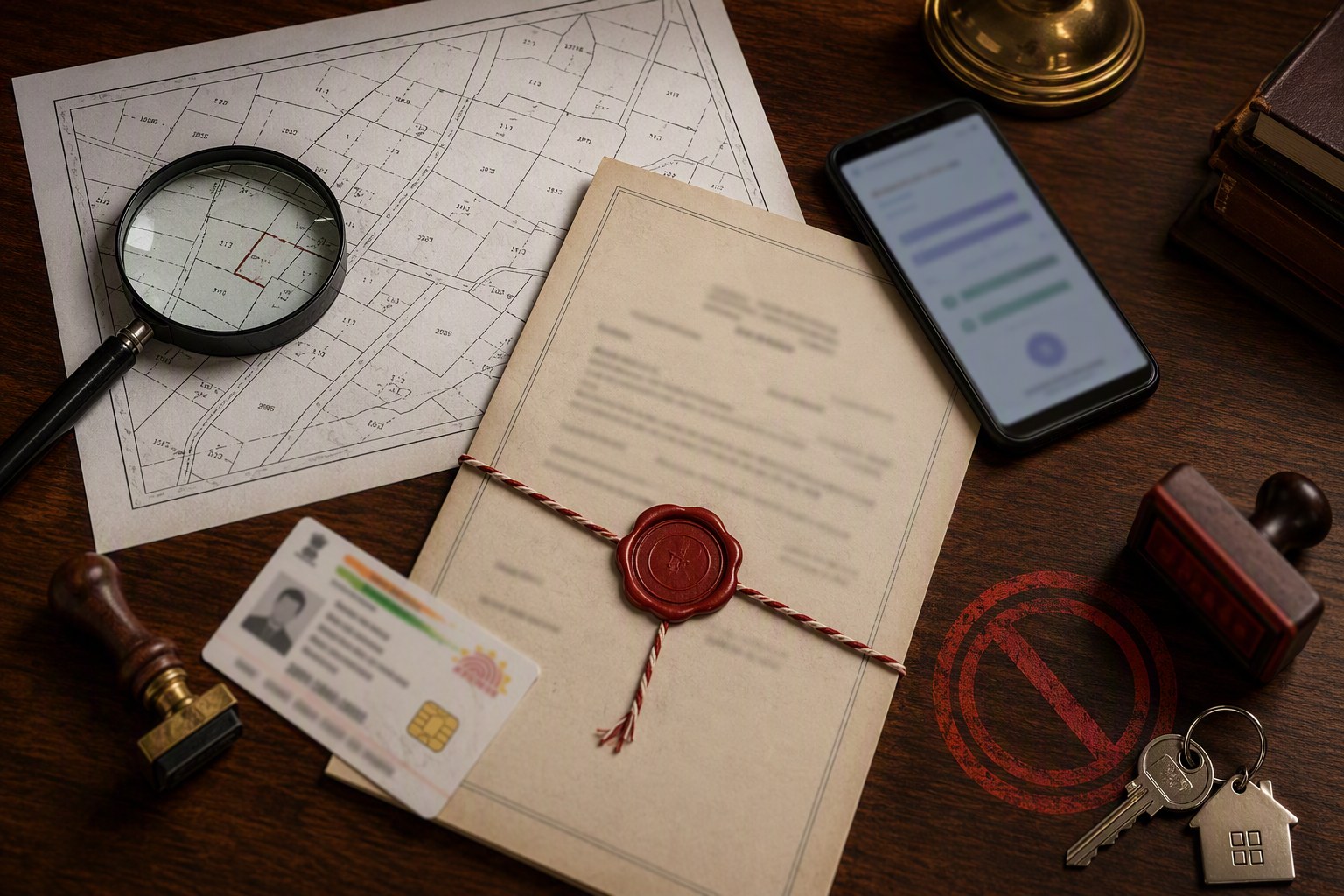



Dharani Record vs Registered Deed: the short answer for buyers
Dharani Record vs Registered Deed is not an either-or question. For Telangana land, especially around Hyderabad, trust the registered deed for the legal history of transfer, and trust Dharani for the current revenue record — but buy only when both are matching on owner name, survey number, extent, land classification and village details. If they do not match, treat it as a red flag, not as a small clerical issue.
In our experience, buyers get into trouble when they believe one document blindly. A seller may show a sale deed and say, “Registration ayindi, no problem.” Another seller may show Dharani passbook and say, “Name is online, why worry?” Both statements are only half-correct. Registration and revenue mutation serve different purposes. For a safe land purchase in Telangana, you need to read them together.
My practical rule: if the deed tells one story and Dharani tells another, pause the deal. Do not pay token advance until the mismatch is explained with documents from the concerned SRO, Tahsildar office or Dharani records.
Dharani Record vs Registered Deed: side-by-side comparison
| Point | Dharani Record | Registered Deed |
|---|---|---|
| What it mainly shows | Current revenue record such as pattadar name, survey number, extent and land nature | Legal transaction document showing how ownership was transferred |
| Where it is relevant | Revenue administration, agriculture land mutation, pattadar passbook, land classification checks | Title chain, sale, gift, partition, settlement, mortgage release and other registered transactions |
| Who maintains it | Revenue department through Dharani-related records | Registration department through the Sub-Registrar Office, commonly called SRO |
| Best used for | Checking present revenue entry and classification | Checking title flow and transaction validity |
| Common mismatch | Name spelling, extent variation, survey sub-division, classification issue | Old survey details, missing link document, unclear boundaries, unregistered family arrangement |
| Can it alone prove safe title? | No | No, not always |
| Buyer action | Match it with deed, pahani, passbook and prohibited property status | Match it with EC, link deeds, Dharani, land use and possession |
Why Dharani Record vs Registered Deed confusion is common in Telangana
Telangana buyers deal with two systems at the same time: registration records and revenue records. The registered deed is created when a transaction is registered at the SRO. Dharani, on the other hand, reflects revenue entries for agricultural land and related records. Both are official in their own space, but they are not the same document.
This confusion is very common in areas where agricultural land is getting converted into plotted layouts or villa projects. Think of Shankarpally, Mokila, Kollur, Nandigama, Kothur, Maheshwaram, Adibatla, Yacharam, Ghatkesar, Medchal, Shamirpet and Chevella side. A land parcel may have old pahanis, old sale deeds, family partitions, layout permissions, conversion proceedings and Dharani entries. If one link is weak, the buyer may face mutation problems later.
For flats in areas like Kondapur, Narsingi, Manikonda, Tellapur, Bachupally, Miyapur or Uppal, the issue is slightly different. The buyer usually deals with an apartment sale deed, development agreement, link documents and approvals. But the root land still matters. If the project land has a mismatch in survey number, classification or prohibited status, a flat buyer can also face risk.
Before paying advance, use basic checks like Property Verification Tool, Encumbrance Certificate Search and Section 22-A Prohibited Property Check. These do not replace a lawyer, but they help you ask sharper questions.
What a registered deed actually proves
A registered deed proves that a document was presented, admitted and registered before the registration department. It records parties, schedule of property, consideration, boundaries, survey details and the nature of transaction. For title verification, the deed is the starting point.
But a registered deed is not magic. It does not automatically cure earlier defects. If the seller’s vendor had no proper title, or if a family member’s share was wrongly sold, registration alone will not solve it. We have seen many cases where the latest sale deed looks clean, but the older link document has a problem.
When reading a registered deed, focus on these parts:
- Executant and claimant names: Check whether the person selling has acquired title through a proper document.
- Schedule of property: Survey number, sub-division, extent, village and mandal must be clear.
- Boundaries: In land matters, boundaries often save the buyer when survey numbers have changed.
- Nature of document: Sale deed, gift deed, partition deed and settlement deed have different legal effects.
- Link documents: Do not look only at the latest deed. Check earlier transfers also.
- SRO jurisdiction: Confirm whether the document was registered in the correct SRO area. You can use Find Your SRO Office for this.
In Hyderabad outskirts, many lands moved from agricultural ownership to developer agreements and then to plotted sales. In such cases, a buyer must check the development agreement, GPA, layout approval, land conversion and the owner’s title chain. A single sale deed from the developer is not enough.
What a Dharani record actually proves
Dharani record is a revenue record. It can show the current pattadar, extent, survey number, village, land classification and related revenue details. For agricultural land in Telangana, Dharani is highly relevant because mutation and passbook entries are routed through the revenue system.
But Dharani entry is not always equal to final civil title. Revenue records are strong supporting evidence, but title disputes are decided based on documents, possession, inheritance, court orders and other legal facts. If a name appears in Dharani, it is a good sign. If the title deed chain supports that name, it becomes stronger. If the deed chain does not support it, you must investigate.
Use Dharani-related checks mainly for:
- Current pattadar name
- Survey number and sub-division details
- Extent as per revenue record
- Land classification such as agricultural, government, assigned or other categories
- Mutation history, wherever available through official process
- Prohibited property status under Section 22-A
One number should make every buyer cautious: according to the database context available to us, prohibited properties under Section 22-A stand at 3,076,153. That is why a prohibited property check is not a formality. If land is hit by Section 22-A, registration may be blocked or seriously disputed depending on the category and record status.
Dharani Record vs Registered Deed: when names do not match
Name mismatch is one of the most common problems. Sometimes it is harmless, like initials expanded differently. Sometimes it is serious, like the deed standing in the father’s name while Dharani shows one son’s name after mutation. In villages around Moinabad, Shamirpet, Kandukur or Ibrahimpatnam, family succession entries can create confusion if legal heirs have not properly documented partition or release.
If the seller’s name in the deed and Dharani record do not match, ask for the bridge document. That may be a registered partition deed, legal heir certificate, succession-related order, gift deed, release deed, court order or mutation proceedings. Oral explanations are not enough. “Family lo settle ayindi” is not a title document.
For example, if Dharani shows the mother’s name but the son is selling, the son must show how he got authority. Is there a registered gift deed? Is there a registered GPA? Is the mother alive and signing? Are all legal heirs joining? These questions may feel uncomfortable, but they protect your money.
Dharani Record vs Registered Deed: when extent does not match
Extent mismatch needs careful handling. A deed may mention a certain extent, while Dharani shows a different extent due to resurvey, subdivision, acquisition, road widening, family partition or earlier sale of a portion. In fast-growing belts like Patancheru, Sangareddy side, Tukkuguda, Maheshwaram and Medchal, land extents often change across documents over the years.
Do not accept a casual answer like “system lo wrong undi.” Ask for:
- Old pahanis and latest pahani entries
- Mutation proceedings
- Survey sketch or FMB, wherever applicable
- Registered link documents for every sale or partition
- Physical measurement by a licensed surveyor
- Village map and road impact check
If you are comparing acres, guntas, square yards and square metres, use Area Unit Converter. Many disputes begin with simple unit confusion. A seller says “half acre equivalent,” a layout plan says square yards, and the registration schedule says something else. Convert everything into one unit and then compare.
Dharani Record vs Registered Deed: when survey numbers do not match
Survey number mismatch is more serious than spelling mismatch. In Telangana land, survey number is the backbone of identification. If the deed says one survey number and Dharani shows another, do not proceed until you understand why.
Possible reasons include subdivision, old survey number to new survey number mapping, wrong entry in deed schedule, layout carved out from multiple survey numbers, or sale of a neighbouring parcel by mistake. In localities like Mokila, Velimela, Kollur and Tellapur, projects may sit across multiple survey numbers. A buyer must know exactly which portion is being sold.
Use Survey Number Finder as an early check, then verify with village records and a physical site inspection. Do not rely only on Google pin location or a broker’s boundary stones. Boundary stones can be moved. Survey records are harder to ignore.
Dharani Record vs Registered Deed: when land classification does not match
Land classification mismatch can damage a transaction even when owner name and extent look correct. A deed may describe land as private patta land, while revenue record may carry a classification that restricts transfer. In some cases, land may be assigned, government, endowment, wakf, forest-related, ceiling surplus, or covered by another restriction. Each category has a different consequence.
This is where Section 22-A checks matter. If a property is included in the prohibited list, the registration department may refuse registration. If it has already been registered in the past, that does not automatically make the risk disappear. Buyers should check the latest position before payment, not after registration slot booking.
For layout and apartment buyers, also check land use. A project may be marketed as residential, but the master plan and permissions must support that use. Use Land Use Zone Finder and, where applicable, RERA Project Lookup. In HMDA and DTCP areas, approval trail is as important as title trail.
How to read both documents together before paying advance
Here is the buyer workflow we prefer in Telangana land deals:
- Start with the latest deed: Identify seller, property schedule, survey number, extent and SRO.
- Pull EC: Use Encumbrance Certificate Search or the official process to see registered transactions for the property.
- Check link documents: Trace title backwards through sale, gift, partition or settlement deeds.
- Compare Dharani: Match pattadar name, survey number, extent, village and mandal.
- Check Section 22-A: Use Section 22-A Prohibited Property Check before token payment.
- Verify SRO and village: Use SRO Village Directory and confirm jurisdiction.
- Check guideline value: Use Market Value / Guideline Value Search to understand the government value basis.
- Calculate duty: Before final agreement, use Stamp Duty Calculator so that registration cost is clear.
- Take legal opinion: A local property lawyer should review the entire bundle, not just the latest sale deed.
For plotted layouts, add layout approval, road width, open space and conversion checks. For flats, add building permission, occupancy status, RERA registration if applicable, UDS calculation and landowner-developer agreement review.
Red flags buyers should not ignore
Some warning signs repeat across Hyderabad and surrounding districts. We have seen them in premium corridors also, not only in low-priced lands. Be alert if you see any of these:
- Seller refuses to share link documents before advance
- Dharani name and deed name are different without a registered bridge document
- Extent in deed is higher than revenue record
- Survey number is changed in handwritten correction without proper support
- Land is shown as agricultural but marketed as immediate villa plot without conversion trail
- EC shows mortgage, agreement, court attachment or old pending entry
- Property falls in prohibited category or seller says it will be “managed”
- Broker pushes for cash token before document verification
- Boundaries on ground do not match deed schedule
- Seller says old documents are lost but has no certified copies or public notice trail
One more practical point: never depend only on screenshots. Ask for certified copies, downloadable official records, EC, passbook details and original documents for inspection. Screenshots can be old, cropped or misleading.
Which should you trust more: Dharani or registered deed?
If you are asking which document is stronger, my answer is: for title flow, the registered deed chain carries more weight; for present revenue status, Dharani carries strong practical value. But for buying, neither should be trusted alone.
A clean deal usually has alignment across these records:
- Latest registered deed
- Previous link deeds
- Encumbrance certificate
- Dharani or revenue record
- Pahani and mutation record, where relevant
- Physical possession and boundaries
- Land classification and Section 22-A status
- Layout, conversion and building approvals, if applicable
When all these speak the same language, buyer risk comes down. When they speak differently, slow down. Hyderabad real estate rewards speed only after verification. Before verification, speed is costly.
Final buyer checklist for Telangana land
Before you sign an agreement of sale in Telangana, keep this checklist ready:
- Seller’s name matches across deed, ID proof and Dharani or revenue record
- Survey number and sub-division match across deed, EC and revenue record
- Extent is consistent or the difference is explained with documents
- Land classification permits the proposed transaction
- Property is not blocked under Section 22-A records
- EC does not show unresolved mortgage, attachment or conflicting transaction
- All legal heirs or co-owners are properly joining, wherever required
- SRO jurisdiction is correctly identified
- Guideline value and stamp duty are checked before registration
- Lawyer has reviewed certified copies and not just WhatsApp images
In our experience, the safest buyers are not the ones who know every legal section. They are the ones who compare documents patiently. Dharani record and registered deed are like two witnesses. If both say the same thing, you can move ahead with more confidence. If they contradict each other, make them explain before your money moves.
Frequently Asked Questions
Is Dharani record enough to buy land in Telangana?
No. Dharani record is a key revenue record, but you should also verify registered deeds, link documents, EC, pahani, land classification and Section 22-A status before buying.
What if the registered deed name and Dharani name are different?
Do not proceed based on verbal explanation. Ask for the bridge document such as registered partition, gift, release deed, legal heir-related record, court order or mutation proceedings.
Can a registered deed be valid if the property is in Section 22-A prohibited list?
A prohibited property entry is a serious red flag. Registration may be refused or disputed depending on the record category. Check the latest status before paying any advance.
Which document is better for title verification, EC or Dharani?
They serve different purposes. EC shows registered transactions and encumbrances. Dharani shows revenue status for relevant land records. For safe verification, read both along with link deeds.
Should flat buyers also check Dharani records?
Yes, at least for the project’s root land. Flat buyers should check land title, development agreement, approvals, RERA status where applicable, EC and land classification.