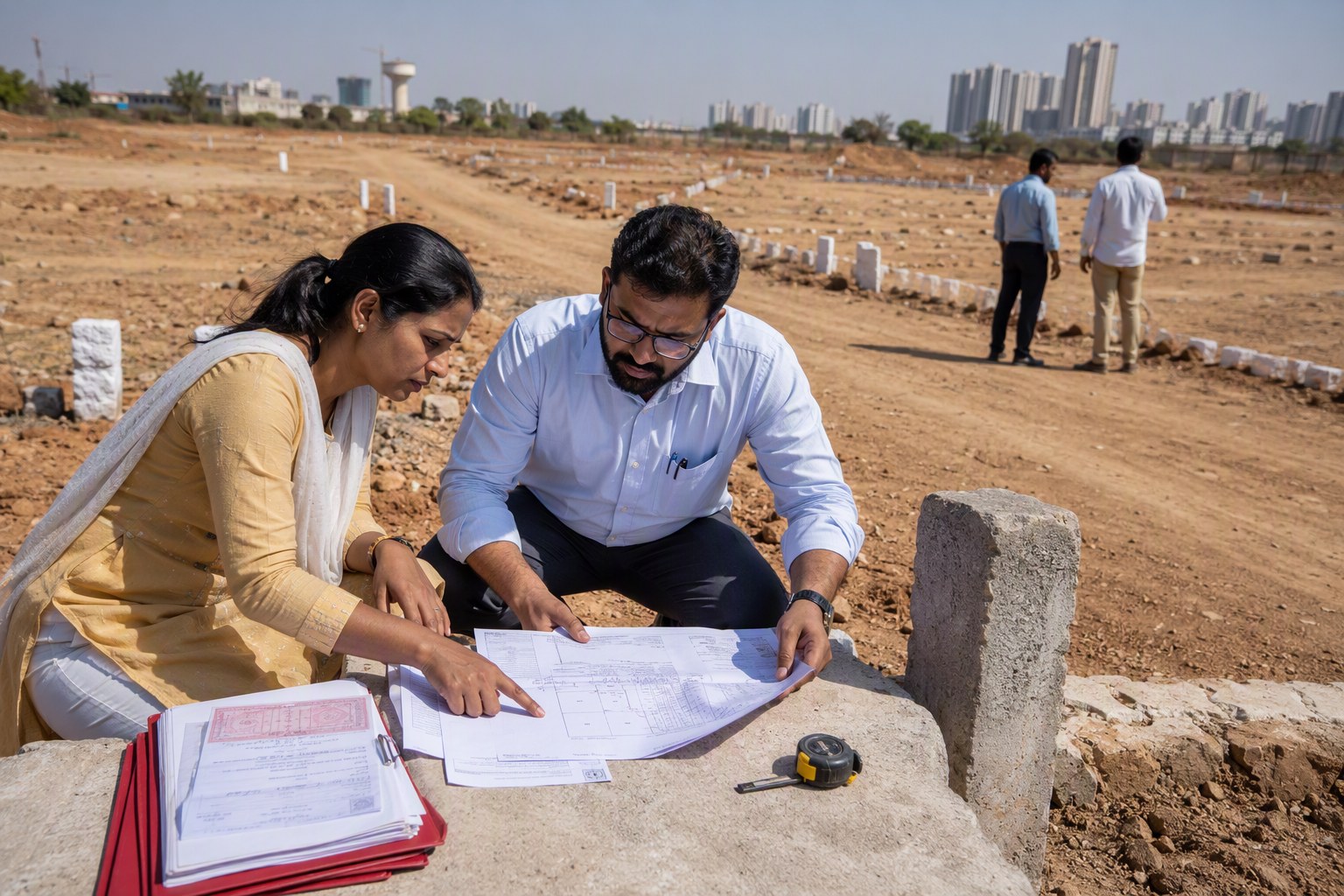
Telangana launch plans may soon start giving 22-A vetting the same seriousness as layout approval, RERA filing and marketing permissions. Across Hyderabad’s active project corridors, developers are realising that buyers no longer accept only glossy brochures and bhoomi pooja photos. Before a pre-launch announcement, many serious builders may now have to show whether the land parcel is clean under Section 22-A prohibited property records.
As per latest IGRS data, Telangana has 3,076,153 prohibited properties recorded under Section 22-A. That one number explains why land-title screening is moving up the project timeline. Earlier, some developers checked deeper title issues only after aggregation, conversion or layout work had started. Now, in our experience, buyer-facing developers in areas like Kokapet, Narsingi, Tellapur, Kollur, Mokila, Bachupally and Ghatkesar cannot afford that delay.
22-A Vetting Before Bhoomi Pooja: Why Launch Strategy Is Changing
Section 22-A is not a small clerical item. If a survey number is reflected as prohibited from registration, the SRO will not casually proceed with registration. For a buyer, that means the project may look attractive on paper, but the apartment or villa booking can get stuck later if the underlying land has a restriction, government claim, endowment issue, assigned land concern or another entry requiring clarification.
That is why 22-A vetting before bhoomi pooja is becoming a practical launch discipline. A developer planning a premium gated community in Narsingi or a plotted layout near Shankarpally mandal will not want hundreds of enquiries turning into one uncomfortable question: “Is the survey number in prohibited property list?”
We’ve seen Hyderabad buyers become sharper after multiple land-title disputes in the wider market. They ask for survey numbers. They check EC. They compare guideline values. They ask which SRO handles the village. They want to know whether the land sits in a residential zone, whether approach road width supports the proposed project, and whether RERA registration is actually available. This is healthy pressure.
For a launch team, the new order may look like this: first survey-number verification, then 22-A check, then pahani and Dharani review, then EC review, then land-use and access checks, then RERA filing, and only after that, bhoomi pooja or expression-of-interest campaign. That is slower than the old pre-launch style, but it protects credibility.
22-A Vetting And Telangana’s Prohibited Property Burden
The size of the prohibited property database is the real story. With 3,076,153 properties appearing in Telangana’s Section 22-A prohibited records as per latest IGRS data, developers cannot treat this as a rare edge case. The risk is not limited to faraway agricultural land. It can touch fast-growing peri-urban mandals where old revenue classifications, assigned land entries, lake buffer concerns, ceiling land notings or government land references may still sit in records.
Hyderabad’s growth has pushed project launches into mixed-title belts. In the west, Gandipet mandal and surrounding pockets near Kokapet and Narsingi have seen intense buyer interest. Tellapur and Kollur have become apartment-heavy corridors. Mokila and Shankarpally side have drawn villa and plotted development interest. On the north and east, Bachupally, Kompally, Medchal, Ghatkesar, Pocharam and Adibatla have their own title histories. Every micro-market has a different land story.
That is why a single legal opinion is not enough if it only reads sale deeds and skips government datasets. Section 22-A status, EC trail, SRO jurisdiction, Dharani entries, pahani history and market value classification all have to speak to each other. If they do not, the buyer’s advocate will catch it at the worst possible time — after booking, after token payment, or near agreement signing.
My view is simple: a builder who checks 22-A status before marketing is not being overcautious. He is respecting the buyer’s money and his own brand.
What Developers May Do Before Announcing A Telangana Launch
For serious developers, pre-launch due diligence is now becoming more public. Buyers may not receive the full legal file on day one, but they will increasingly expect a clean summary. A launch note may soon carry basic land details: village, mandal, survey numbers, SRO, nature of title, conversion status, EC availability, RERA stage and whether the property has been screened against Section 22-A.
Here is the practical checklist many Hyderabad developers should keep before announcing bhoomi pooja, soft launch or booking collection:
- Survey number mapping: Confirm every survey number involved in the project boundary. Even a small missed extent can create trouble later.
- Section 22-A check: Screen the land against prohibited property records before accepting public bookings.
- EC review: Read the encumbrance history and not just the latest sale deed. Old mortgages, court notings or settlement deeds can matter.
- SRO confirmation: Verify the correct Sub-Registrar Office for the village and mandal. Wrong assumptions delay registration planning.
- Dharani and pahani review: Match revenue records with title deeds, especially where land was earlier agricultural.
- Guideline value review: Compare government market value classification with proposed transaction structure.
- RERA timing: Do not confuse land availability with project approval. Buyers must separately check project registration.
For self-checking, buyers can use Verified.RealEstate tools such as the Section 22-A Prohibited Property Check, Encumbrance Certificate Search, RERA Project Lookup, Market Value / Guideline Value Search and Find Your SRO Office. These checks will not replace a lawyer, but they help buyers ask better questions.
How This Affects Buyers In Kokapet, Tellapur, Kollur And Beyond
For buyers, 22-A vetting before bhoomi pooja means fewer surprises. It does not mean every project becomes risk-free. It means the first layer of land risk is addressed before public excitement begins. In high-demand localities like Kokapet, Narsingi, Financial District fringes, Tellapur, Kollur and Bachupally, launches move fast. Good units get blocked quickly. That speed should not stop due diligence.
Buyers should ask for the survey number and village name before paying any non-refundable booking amount. If the sales team says the survey number will be shared only after payment, treat that as a warning sign. A genuine project team should be able to give at least basic land identifiers and RERA status, where applicable.
Another point buyers miss: Section 22-A status must be checked against the exact survey number and village. Similar village names exist. Mandal boundaries and SRO jurisdictions can confuse first-time buyers. If you are buying in a developing belt, use the Survey Number Finder and SRO Village Directory before assuming the land belongs to a particular registration office.
Apartment buyers also need to look beyond the flat number. The flat is only as safe as the land and approvals below it. A tower launch in a popular corridor may have excellent amenities, but if the land parcel has unresolved title restrictions, future registration, home loan processing or resale can become painful.
22-A Vetting Will Also Change Builder Marketing Language
Until recently, pre-launch marketing in Telangana often focused on location, price positioning, club house size, possession promises and neighbourhood growth. Now, clean-title signalling may become a selling point. We may see phrases like “22-A screened land”, “EC verified”, “survey-number due diligence completed” and “RERA filing in process” appearing in buyer presentations.
That is not a bad trend, provided the claims are backed by documents. Buyers should not accept a WhatsApp message as proof. Ask for documentary evidence or at least a written clarification from the developer’s legal team. If the project is already RERA registered, cross-check it through the RERA Project Lookup. If you are evaluating land value, use the Stamp Duty Calculator and guideline value search to understand the registration side better.
For plotted developments, the scrutiny may be even higher. A plotted layout near Shabad, Yacharam, Maheshwaram, Shankarpally or Ghatkesar may involve agricultural-to-non-agricultural conversion, layout permissions, road access, open space requirements and survey-boundary clarity. Section 22-A is only one part of the file, but it is a part that can block registration directly.
What A Clean Pre-Launch File Should Contain
A buyer-friendly pre-launch file need not be a hundred-page legal bundle. But it should contain enough material for a first-level review. In our experience, the following documents reduce confusion:
| Document Or Check | Why It Matters |
|---|---|
| Survey number list | Shows the exact land parcel behind the project promise. |
| Section 22-A status | Helps identify whether registration restrictions exist. |
| EC extract | Shows transaction history, mortgages and recorded encumbrances. |
| Pahani / Dharani record | Helps compare revenue entries with title claims. |
| SRO details | Confirms where registration-related verification will happen. |
| RERA details | Confirms project registration status where applicable. |
Developers who prepare this file before bhoomi pooja will look more credible. Buyers will also save time. Instead of asking vague questions like “Is the title clear?”, they can ask sharper questions: “Has this survey number been checked under 22-A?”, “Which SRO covers this village?”, “Is the EC available for the full title chain?” and “Does the RERA filing match the same land extent?”
The Bottom Line For Telangana Project Launches
Telangana’s launch market is maturing. Buyers are not only chasing early-bird pricing; they are asking whether the land can actually support a clean registration and future resale. With 3,076,153 prohibited properties in the Section 22-A dataset as per latest IGRS data, title screening cannot sit at the end of the process.
My advice to buyers is direct: do not attend a bhoomi pooja emotionally and book blindly the same day. Take the survey number, check 22-A status, review EC, confirm RERA, identify the SRO and speak to a property lawyer if the ticket size is meaningful for your family. A good project will survive these questions. A weak one will get uncomfortable very quickly.
Frequently Asked Questions
What is 22-A vetting in Telangana real estate?
22-A vetting means checking whether a land parcel or survey number appears in Telangana’s prohibited property records under Section 22-A. If it is listed, registration may be restricted unless the issue is clarified or resolved through the proper government process.
Why should developers check 22-A status before bhoomi pooja?
Checking 22-A status before bhoomi pooja helps developers avoid launching a project on land that may later face registration obstacles. It also gives buyers more confidence before they pay booking amounts.
Can a buyer check Section 22-A status independently?
Yes. A buyer can use the survey number and village details to run a prohibited property check. It is also sensible to review EC, SRO jurisdiction, Dharani or pahani records and RERA details before paying.
Is RERA approval enough to prove land title is clean?
RERA registration is useful, but buyers should not treat it as the only title check. Section 22-A status, EC history, revenue records and legal title documents should also be reviewed.
Which Hyderabad areas need extra land-title caution?
Fast-growing belts such as Kokapet, Narsingi, Tellapur, Kollur, Mokila, Bachupally, Shankarpally, Ghatkesar and Adibatla need careful survey-number level checks because land histories can vary from village to village.