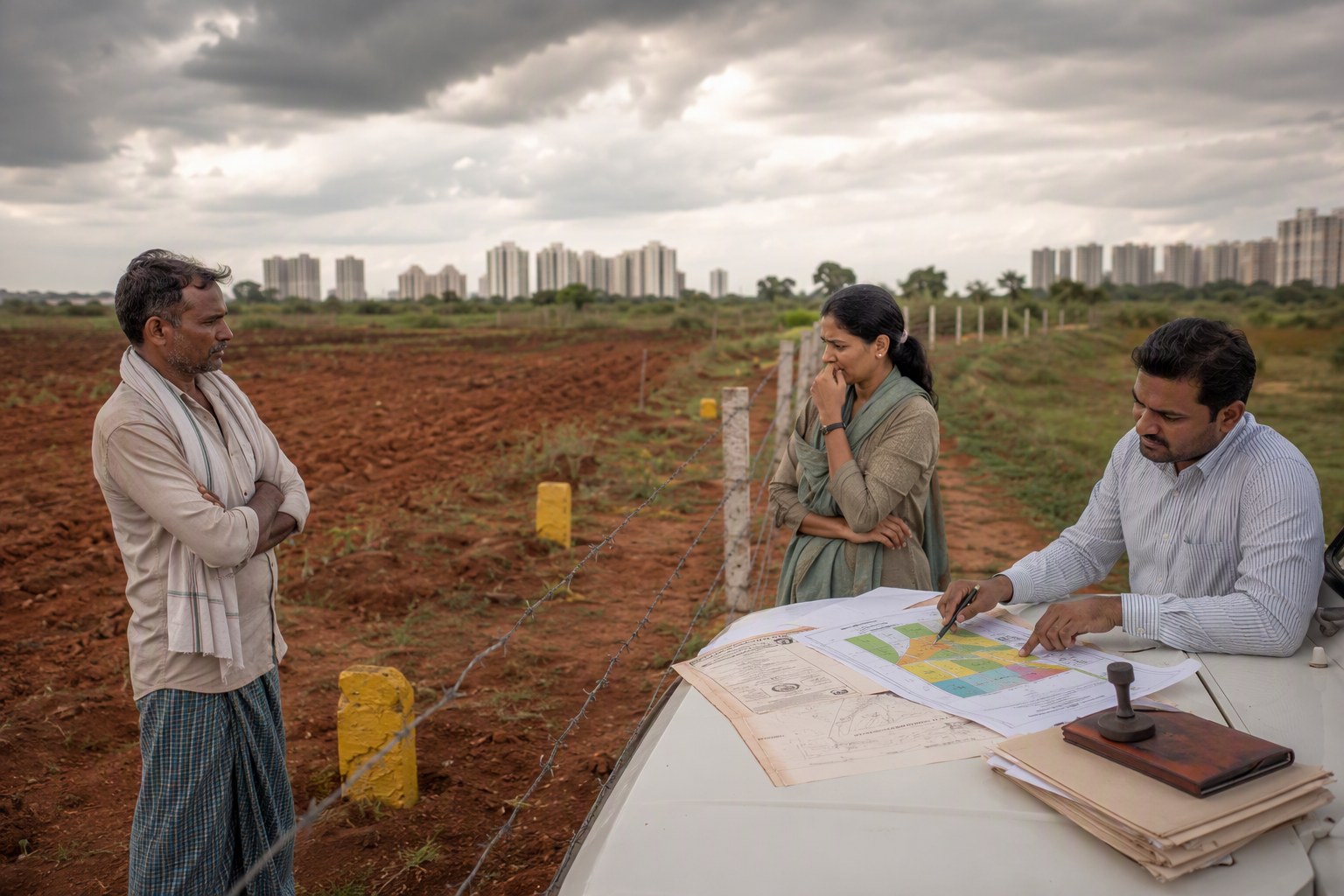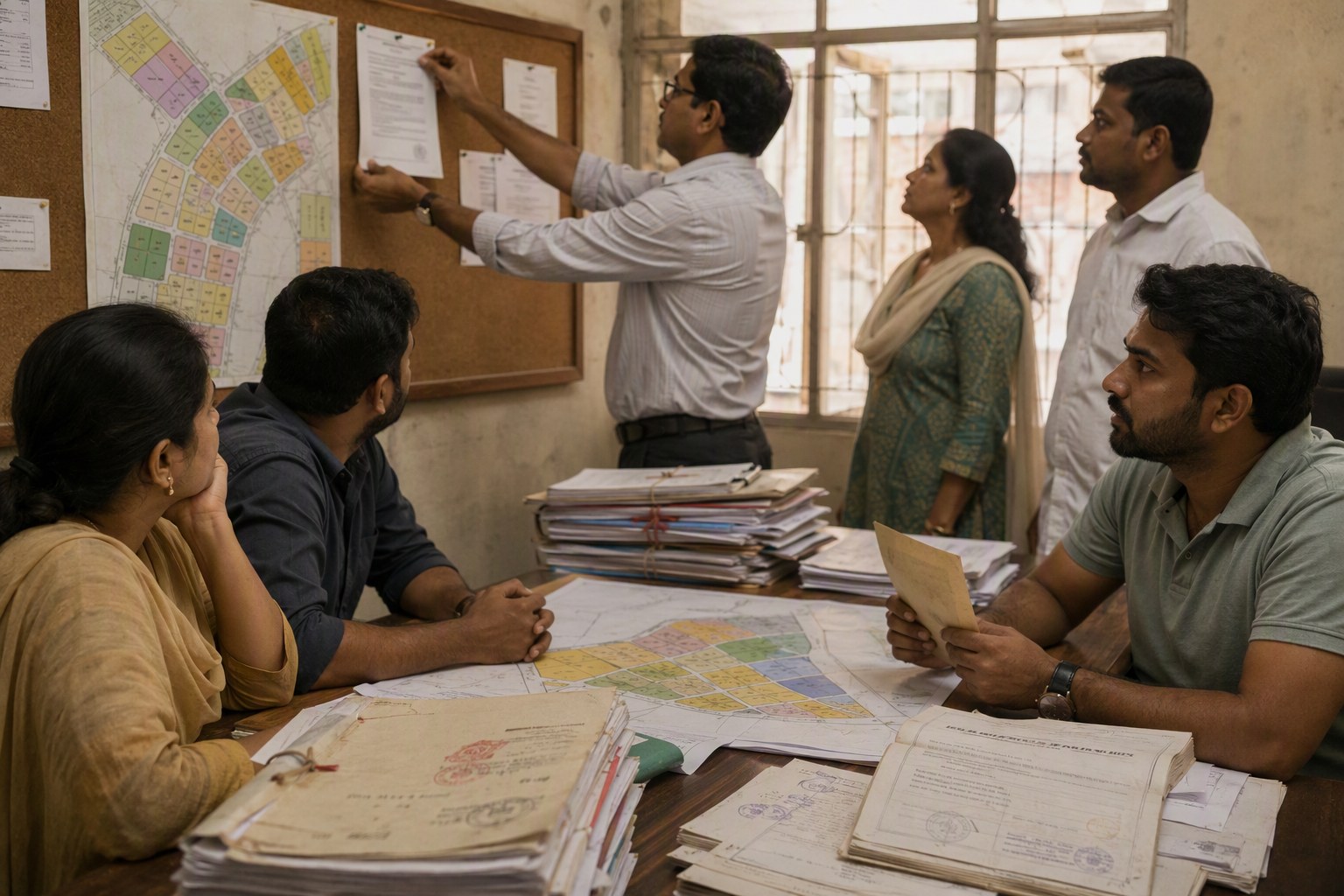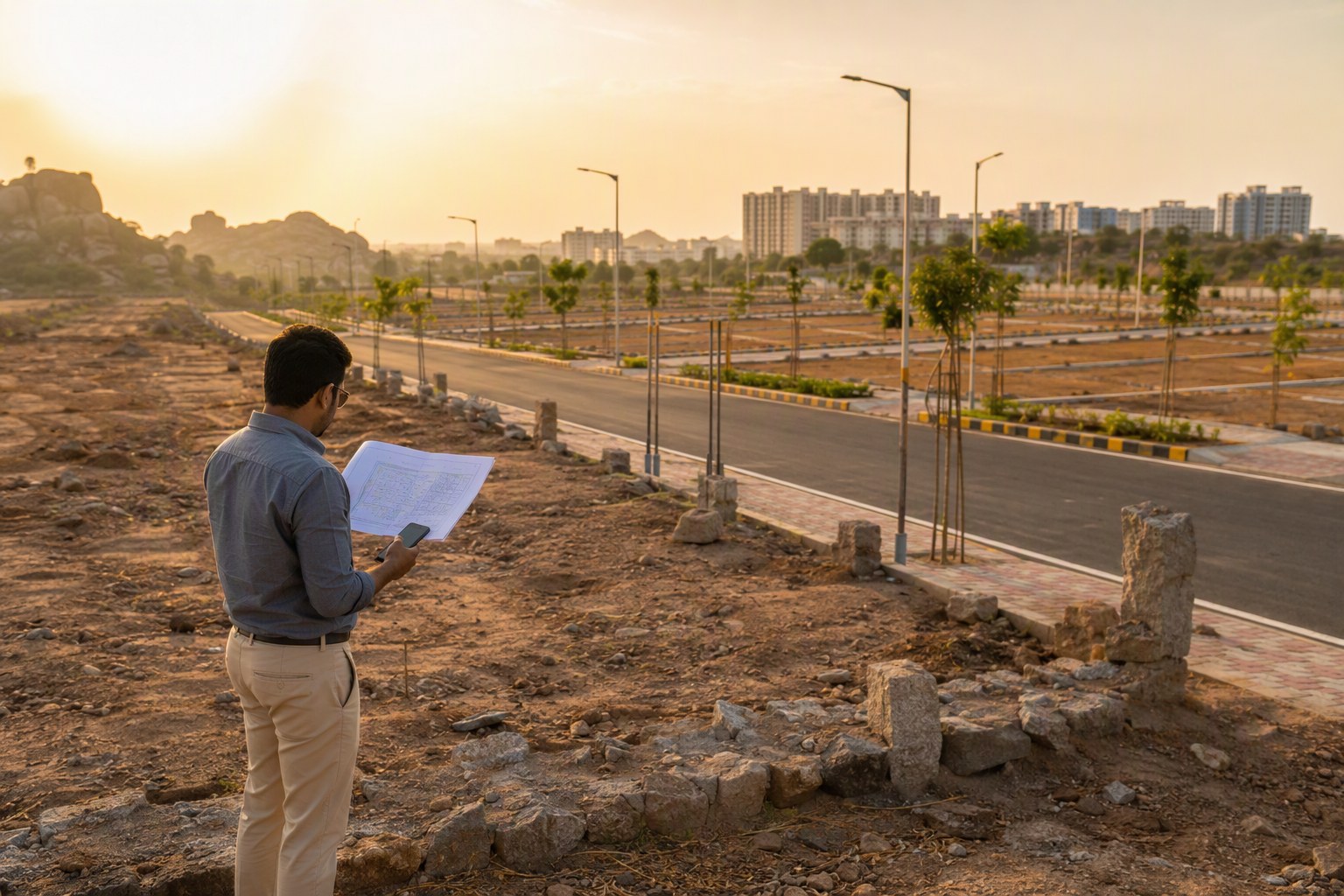
Telangana Boundary Buyers May Check Neighbouring 22-A Plots before fixing plot prices, especially where layouts touch government land, assigned land, tank beds, endowment land, wakf land, forest edges or old village boundaries. As per latest IGRS data, Telangana has 3,076,153 prohibited properties under Section 22-A. That is a large enough count to change buyer behaviour, broker due diligence and valuation conversations across Hyderabad’s expanding land market.
The immediate market signal is simple: buyers are no longer checking only their own survey number. In our experience, serious buyers in areas like Mokila, Shankarpally, Kollur, Nandigama, Maheshwaram, Ibrahimpatnam, Ghatkesar, Medchal and Shamirpet are now asking one extra question before token advance: what is sitting next to my boundary?
That question matters because a clean-looking plot can still face pricing pressure if neighbouring survey numbers carry a 22-A entry, boundary dispute, pending correction, road alignment confusion or mismatch between pahani, Dharani entry and SRO records. It may not always stop registration of the buyer’s own plot, but it can reduce confidence, slow bank valuation and make resale harder.
Telangana Boundary Buyers May Check Neighbouring 22-A Plots Before Price Negotiation
Section 22-A prohibited property records are meant to restrict registration of certain categories of properties. In Telangana, the count of such entries stands at 3,076,153 according to government records. For land buyers, that number is not just a legal statistic. It is now a pricing input.
Earlier, many plot transactions were negotiated mainly on road width, HMDA/DTCP layout status, distance from ORR, approach road and local market quote. Those points still matter. But we are seeing a sharper focus on boundary-linked verification, particularly in fast-moving mandals where agricultural land has rapidly moved into plotted development conversations.
For example, a buyer looking at a plotted parcel near Shankarpally mandal may verify the target survey number, but the wiser approach is to check adjacent survey numbers also. Same logic applies in Maheshwaram mandal, where village-level land categories can change sharply across a boundary line. In Ghatkesar or Keesara side also, old revenue records, layout approvals and ground possession do not always tell the same story at first glance.
Our view is that boundary risk is becoming a discount factor. A plot may be legally transferable, but if the neighbouring land has unresolved 22-A issues, buyers will demand clarity or reduce their offer.
Why Telangana Boundary Buyers May Check Neighbouring 22-A Plots Around Survey Lines
In land transactions, the survey number is the starting point, not the full story. A plotted development may be carved out from a parent survey number. Internal plot numbers may look neat in a brochure, but the real legal identity sits in revenue records, village maps, mutation history and registration documents.
This is where neighbouring 22-A plots become relevant. If a prohibited entry exists in an adjacent survey number, buyers should ask whether the boundary is physically marked, whether the compound wall follows revenue sketch lines, and whether any part of the access road passes through restricted land. A good broker will not get offended by these questions. A weak broker will say, “Sir, all clear, registration ayipotundi,” without showing papers.
Before agreeing on price, buyers can run a first-level check using the Section 22-A Prohibited Property Check. They should also identify the exact survey details through the Survey Number Finder and compare available values through the Market Value / Guideline Value Search. These tools do not replace legal opinion, but they help buyers ask better questions before paying advance.
What boundary-linked verification should include
- Target survey number and neighbouring survey numbers on all sides.
- Pahani, Dharani status and mutation trail wherever applicable.
- Prohibited property check under Section 22-A.
- Old link documents and EC trail from the relevant SRO.
- Village map, FMB/sketch and physical boundary matching.
- Access road ownership and road width position.
- Layout approval status, if the property is sold as a plotted layout.
For registration-side clarity, buyers can identify jurisdiction through the Find Your SRO Office tool and then study transaction history with the Encumbrance Certificate Search. If the EC has many entries, an EC Analyzer review can make the chain easier to understand.
Effect on Brokers, Valuers and Plot Pricing
The large 22-A prohibited property count is also changing how brokers pitch land. In premium Hyderabad outskirts, a broker cannot simply say “near ORR” and expect a buyer to close. The buyer now wants survey-level confidence.
Valuers are also likely to be more careful. A plot touching a disputed or prohibited land parcel may need closer inspection, even if the subject property itself has clean papers. Banks and private lenders usually prefer clarity in title, access and boundaries. If any of these points are weak, the valuation conversation becomes conservative.
There is also a local market reality. In places like Kollur, Tellapur and Kokapet belt, demand is backed by infrastructure and office corridor sentiment. In other pockets such as Yacharam, Kandukur, Mucherla side, Maheshwaram, Kadthal and Ibrahimpatnam, future growth stories are strong but land records need careful reading village by village. The same mandal can have clean pockets and complicated pockets.
We have seen buyers walk away from attractive-looking plots because the approach road touched questionable land. We have also seen deals revive after sellers produced FMB, link documents, EC and proper boundary clarification. So, the issue is not panic. The issue is paperwork discipline.
Neighbouring 22-A Plots Can Affect Perception Even When Your Plot Is Clean
A clean title is the main requirement, but market perception decides price. If a plot is surrounded by clean residential development, buyer comfort improves. If one side touches a 22-A listed survey number, tank buffer confusion, assigned land claim or government land entry, buyers may ask for a discount or extended due diligence period.
This is especially relevant for boundary buyers: people buying corner plots, edge plots of layouts, plots abutting village roads, plots beside open land and parcels close to nala, cheruvu, hillock or revenue boundary lines. Edge plots can be attractive because of openness and future road potential. They can also carry higher verification burden.
For plotted layout buyers, do not rely only on the layout marketing map. Ask for the parent document, layout approval copy, LRS/HMDA/DTCP status where relevant, and the boundary schedule. If the project is under RERA, check it through RERA Project Lookup. If it is only a standalone open plot transaction, take a separate legal opinion and check the property through the Property Verification Tool.
Buyer checklist before paying token advance
| Check | Why it matters |
|---|---|
| 22-A status | Confirms whether the property or nearby survey numbers are restricted in registration records. |
| EC and link documents | Shows transaction chain, mortgages, releases and ownership movement. |
| Boundary sketch | Helps match paper boundaries with ground reality. |
| SRO jurisdiction | Ensures registration and record checks are done in the correct office. |
| Guideline value | Gives a government reference point before negotiating market price. |
What Sellers Should Do If Their Plot Borders A 22-A Entry
Sellers should not hide boundary issues. In Hyderabad’s current market, buyers usually find out during verification. Hiding it delays the deal and damages trust. If the seller’s own plot is clean but a neighbouring survey number has a 22-A entry, the seller should keep supporting documents ready.
Useful papers include registered sale deed, link documents, latest EC, tax receipts where applicable, approved layout plan, pahani or Dharani extract, mutation details and boundary sketch. If any correction has been made in revenue records, keep the official order copy. If the land is part of an approved layout, show how the plot boundary sits within the approved plan.
From a pricing angle, transparency can protect value. A buyer may accept the price if the seller can clearly prove that the prohibited entry does not affect the subject plot, access road or layout boundary. Without proof, even a genuine seller may face bargaining pressure.
Market Takeaway For Telangana Boundary Buyers May Check Neighbouring 22-A Plots
The market update is clear: Section 22-A checks are moving from a last-minute registration formality to an early-stage pricing tool. With 3,076,153 prohibited properties recorded as per latest IGRS data, Telangana buyers should widen their verification from “my plot” to “my plot plus surrounding survey numbers”.
For Hyderabad and peri-urban land, this shift is healthy. It may slow down casual deals, but it improves price discovery. Genuine sellers with clean records will benefit. Buyers will avoid unpleasant surprises. Brokers who understand mandal-level records, SRO process and ready reckoner references will stand out from pure marketing agents.
Our practical advice is straightforward: before finalising plot price, check 22-A status, EC, SRO jurisdiction, guideline value and boundary records. Then negotiate. In Telangana land buying, the boundary line is often where the real story starts.
Frequently Asked Questions
Why should Telangana boundary buyers check neighbouring 22-A plots?
Because an adjacent prohibited survey number can affect buyer confidence, valuation, access road clarity and resale comfort, even when the buyer’s own plot appears clean.
How many prohibited properties are recorded under Section 22-A in Telangana?
As per latest IGRS data, Telangana has 3,076,153 prohibited properties under Section 22-A.
Can a clean plot be affected by a neighbouring 22-A entry?
Legally, the clean plot may still be transferable. But market price, bank valuation and buyer comfort can be affected if the boundary, road access or survey demarcation is unclear.
Which records should buyers verify before paying advance for a plot?
Buyers should verify 22-A status, EC, link documents, SRO jurisdiction, survey number, pahani or Dharani record where applicable, boundary sketch and layout approval status.
Should brokers disclose neighbouring prohibited property issues?
Yes. Good brokers should disclose known boundary-linked risks and share documents early. It saves time and helps serious buyers take a fair pricing call.