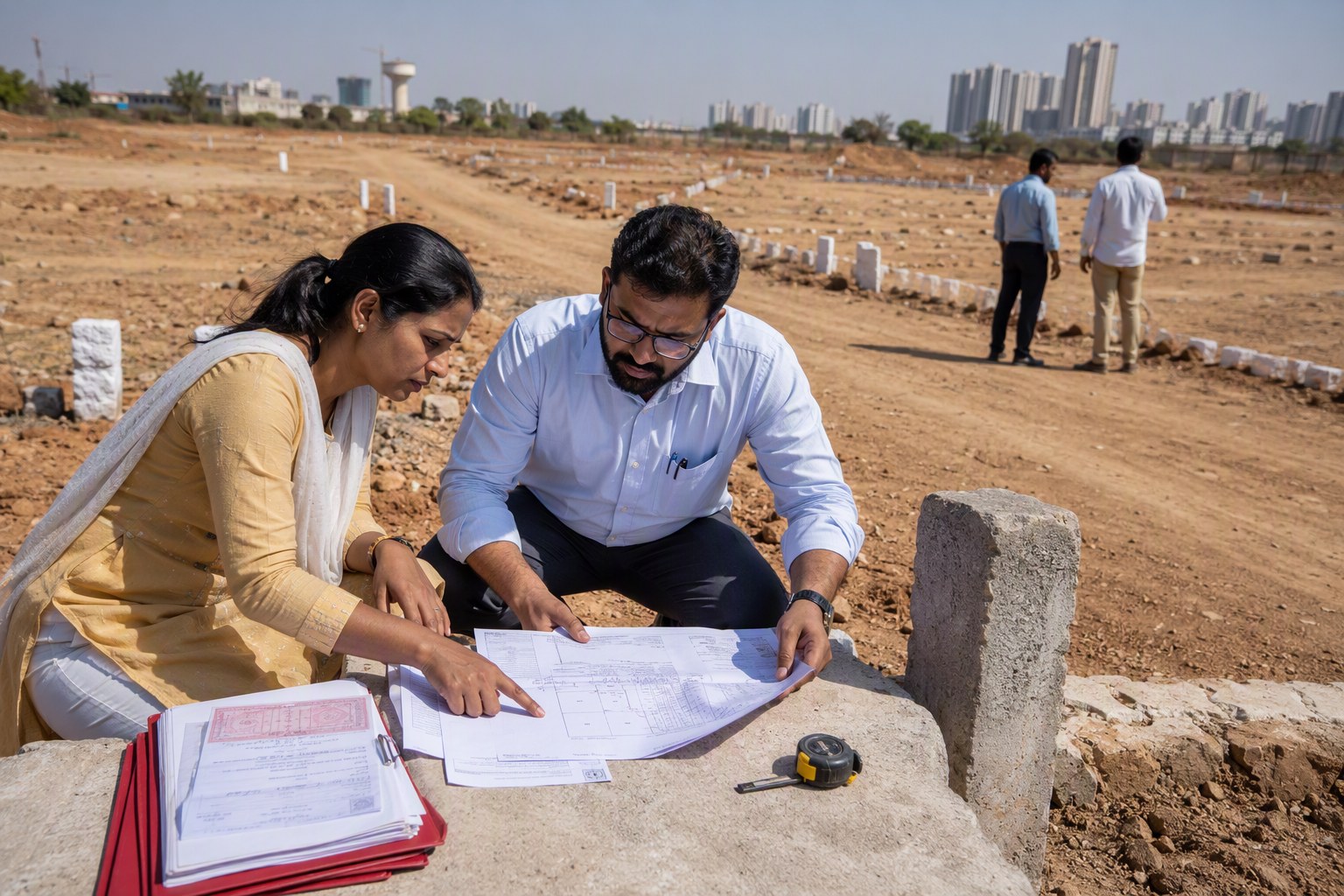
Hyderabad Project Launches Bring Title Rooms to Site Offices as a direct response to a very practical buyer fear: is the land clean enough to book today, or will the file get stuck later at the SRO? With Telangana showing 30,3,076,153 prohibited properties under Section 22-A as per latest IGRS data, developers at new launches are increasingly keeping title papers, EC copies, RERA details, sanctioned plan references and survey-level checks ready inside the site office itself.
This is not just a branding exercise. In our experience, Hyderabad buyers have become sharper after seeing friends and relatives struggle with prohibited-property entries, old pattadar disputes, missing link documents and registration objections. At launches in Kokapet and Narsingi in Gandipet mandal, Gachibowli in Serilingampally mandal, Mokila in Shankarpally mandal, and the Tellapur-Kollur belt, the first serious question is no longer only about amenities. Buyers are asking: show me the land papers first.
Hyderabad Project Launches Bring Title Rooms to Site Offices: Why This Is Happening Now
The trigger is simple. Section 22-A risk has moved from a legal backroom topic to a front-desk sales topic. Telangana’s prohibited-property database is large, with 3,076,153 entries recorded as per latest IGRS data. A buyer may not understand every legal term in a sale deed, but he or she now knows one line very clearly: if a property is prohibited, registration can become a headache.
That is why some launch site offices now have what brokers casually call a title room. It is usually a desk or enclosed area where a project team keeps copies or digital access to land documents. The better-run offices do not merely display a glossy brochure. They show the parent document flow, latest EC, RERA registration details, approval status, survey number references, land conversion papers where applicable, and the SRO under which the property falls.
We have seen this shift especially in premium and mid-premium project launches where token amounts are large and buyers come with their own advocates. Earlier, many developers would say, “Book now, papers will be shared later.” That line does not work so easily now. Hyderabad buyers, particularly NRIs and IT employees buying in the western corridor, are asking for document access before paying the booking amount.
What A Title Room Usually Contains At Hyderabad Project Launches
A proper title room should not be treated like a decoration corner. It should help the buyer connect three things: land identity, legal history and approval trail. If the site team cannot explain these in plain language, the room is only for show.
| Document or check | Why buyers ask for it | What to verify |
|---|---|---|
| Survey number and village details | To confirm the exact land parcel | Village, mandal, survey/sub-division number and extent |
| Encumbrance Certificate | To see registered transactions and charges | Sale deeds, mortgages, releases and gaps in history |
| Section 22-A status | To avoid prohibited-property registration issues | Whether the land appears in prohibited categories |
| RERA registration | To check project-level disclosure | Promoter name, project name, approvals and timelines |
| Sanctioned plan reference | To compare promised layout with approval | Towers, floors, setbacks, open space and usage |
| SRO details | To understand registration jurisdiction | Correct SRO office and village mapping |
Before walking into a launch, buyers can do their own first-level checks through Verified.RealEstate tools. Start with the Section 22-A Prohibited Property Check, then cross-check the project on the RERA Project Lookup. For registered document history, use the Encumbrance Certificate Search. If you are unsure about jurisdiction, the Find Your SRO Office page is also useful.
Hyderabad Project Launches Bring Title Rooms to Site Offices, But Buyers Still Need Checks
My view is clear: a title room is a good sign, but it is not a substitute for independent verification. A developer may provide documents, but the buyer must still verify whether the shown papers match the actual project land. A mismatch in survey number, village name or mandal can change the entire legal picture.
For example, a buyer looking at a flat near Kokapet should not casually accept “Gandipet side project” as land identity. Kokapet, Narsingi, Puppalguda and surrounding pockets may be marketed under one broad location name, but documents work on village and survey details. The same applies to Tellapur, Osman Nagar, Kollur and Velimela. Marketing geography and revenue geography are not always the same.
In Telangana, the pahani, Dharani-linked land record, old sale deeds, layout permissions and municipal approvals must talk to each other. If one paper says one survey number and another paper points to a different land parcel, the buyer should slow down. Site-office explanations are useful, but written documents matter more.
Our advice to buyers is simple: appreciate transparency, but do not get carried away by a neat document room. Ask for copies, verify the survey number, check Section 22-A status, read the EC and take legal opinion before payment milestones become binding.
Why Section 22-A Has Become A Launch-Day Topic
Section 22-A entries cover categories of properties where registration is prohibited or restricted under government records. For a flat buyer, the risk may appear indirect because the apartment itself is yet to be registered. But the project sits on land. If the base land has unresolved issues, buyers may face delays, objections or resale concerns later.
The number 30,76,153 is what has changed the mood. It tells buyers that prohibited-property checking is not a niche legal exercise. It is now part of basic due diligence in Telangana. Even if a project is in a prime Hyderabad locality, the question still needs to be asked. Location value does not automatically clean up title.
Developers who understand this are using document rooms to reduce anxiety during pre-booking. They are also trying to reduce back-and-forth with buyer advocates by keeping commonly requested papers ready. This helps serious buyers move faster, but it also puts pressure on weaker projects where the team cannot answer title questions properly.
What Buyers Should Ask Inside The Site-Office Title Room
Do not feel shy inside a launch office. You are not asking for a favour. You are checking the property you may fund for years. A good developer will respect serious questions.
- What is the village, mandal and survey number of the project land?
- Which SRO has jurisdiction for registration?
- Is the land free from Section 22-A prohibited-property entries?
- Can I see the latest EC and earlier link documents?
- Is the RERA registration in the same promoter or project name being marketed?
- Does the sanctioned plan match the tower count and floor count shown in the brochure?
- Are there any mortgages, development agreements or pending releases to be completed?
Buyers should also check government guideline value before planning stamp duty and registration cost. Use the Market Value / Guideline Value Search and estimate payable charges through the Stamp Duty Calculator. If the land extent or unit size is confusing, the Area Unit Converter helps when documents mention acres, guntas, square yards or square metres.
What This Means For Developers In Hyderabad
For developers, the title room is becoming a trust signal. It says: we are ready for scrutiny. This matters in launch markets where several projects compete on location, clubhouse size and payment plans. When two projects look similar, the one that explains title better often wins the serious buyer.
But there is a risk too. If the title room is poorly handled, it can damage confidence faster than not having one at all. Sales teams should not give casual legal answers. They should keep a document checklist, allow buyers to note references, and direct technical questions to the legal team. A buyer who asks about pahani, EC or SRO mapping is not being difficult. That buyer is simply doing what Hyderabad’s current property market demands.
We expect more launches in western Hyderabad, ORR-growth corridors and emerging mandals to adopt this practice. Not because buyers love paperwork, but because clean paperwork has become part of the product. In the Hyderabad market, title transparency is now an amenity in its own right.
Frequently Asked Questions
What is a title room at a Hyderabad project launch?
It is a dedicated desk or room at the site office where the developer keeps key land and approval documents for buyer review. It may include EC copies, survey details, RERA information, sanctioned plan references and Section 22-A checks.
Why are buyers asking for Section 22-A checks before booking?
Telangana has 30,3,076,153 prohibited properties as per latest IGRS data. Buyers want to know whether the project land has any prohibited-property issue before paying a token amount or signing booking forms.
Is RERA registration enough to prove clean title?
No. RERA registration is useful and should be checked, but buyers must still verify land title, EC, survey number, SRO jurisdiction, approvals and Section 22-A status separately.
Should I rely only on documents shown at the site office?
No. Treat site-office documents as a starting point. Take copies or document references, check them independently and consult a property lawyer before making major payments.