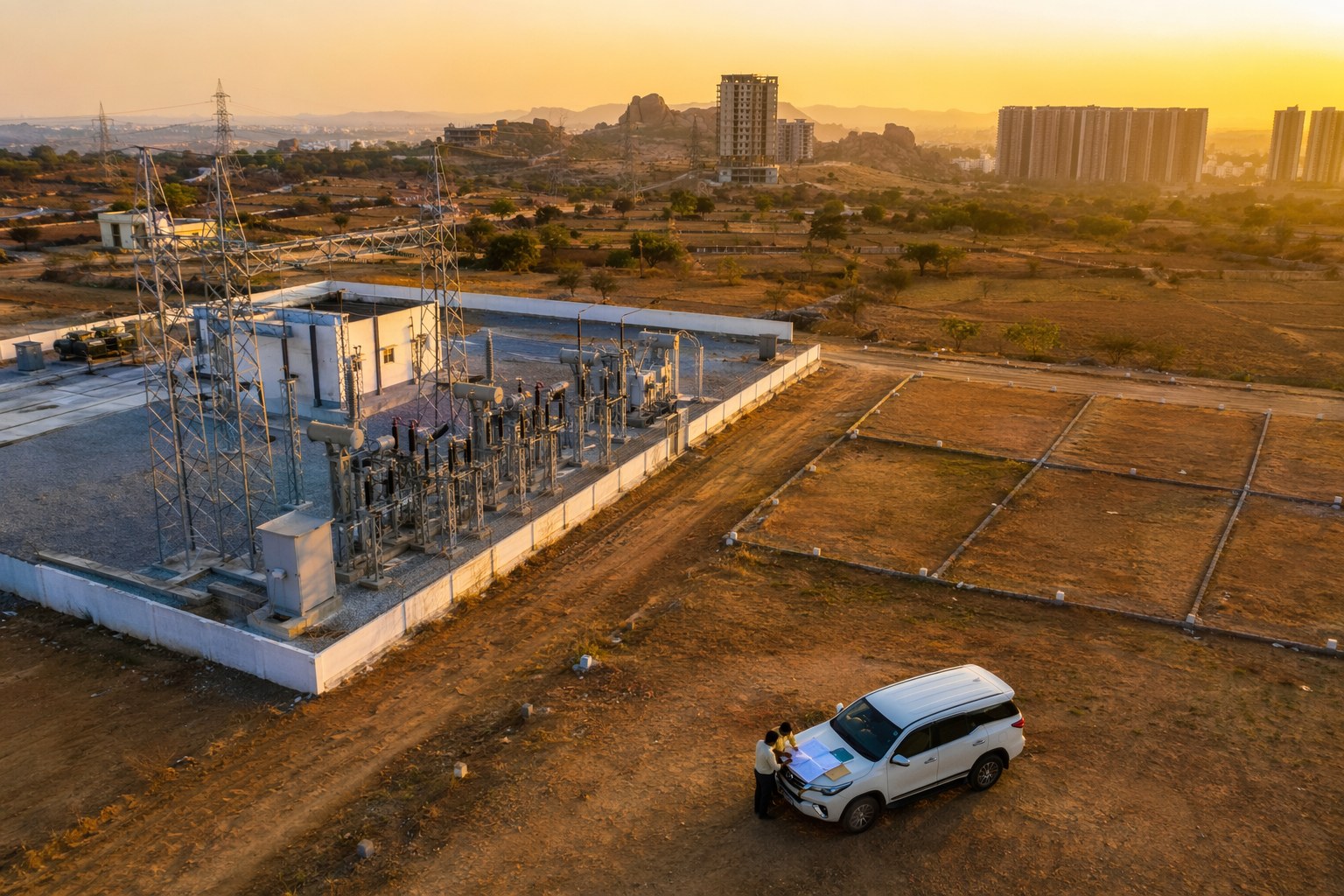



Hyderabad Developers Eye Aggregated Plots as 22-A Risks Bite
Hyderabad Developers Eye Aggregated Plots is becoming a clear transaction trend as Telangana’s Section 22-A overhang makes small, fragmented land buying slower and riskier. With 147,934 prohibited property entries sitting in the state’s 22-A database, developers, land bankers and family offices are showing stronger preference for bundled land parcels where title, access, revenue records and registration risk are cleaned up before the cheque is written.
The shift is being felt across Hyderabad’s growth corridors: Mokila-Shankarpally, Tellapur-Kollur, Tukkuguda-Maheshwaram, Adibatla-Ibrahimpatnam, and parts of Medchal-Malkajgiri. Instead of buying five or ten scattered plots from different owners, serious buyers now want one aggregated block with matching survey numbers, clear pahani trail, Dharani consistency, clean Encumbrance Certificate and no 22-A surprise at the SRO counter.
In our experience, the market is not short of buyers. It is short of land parcels that can survive a proper title audit.
Hyderabad Developers Eye Aggregated Plots as 22-A risk changes deal behaviour
Section 22-A of the Registration Act allows certain properties to be kept out of registration. These may include government lands, assigned lands, endowment lands, wakf lands, court-disputed properties and other notified categories. If a survey number or part of a survey number is hit by 22-A, the Sub-Registrar Office may refuse registration unless the issue is corrected or clarified by competent authorities.
For a retail buyer, this is painful. For a developer assembling 10 acres from 25 pattadars, it can be a deal-breaker. One problematic sub-division can hold up the entire site plan, lender due diligence and investor approval. That is why clean aggregation is gaining value.
Developers are asking for land packs where the seller or aggregator has already checked the Section 22-A Prohibited Property Check, verified survey numbers through the Survey Number Finder, pulled the Encumbrance Certificate Search, and matched market value using the Market Value / Guideline Value Search. This is no longer back-office paperwork. It is now deal pricing.
Hyderabad Developers Eye Aggregated Plots in these active corridors
The strongest demand is visible where large formats still make sense: villas, plotted developments, warehousing, data-adjacent land, and mixed residential projects. Western Hyderabad still commands the highest investor comfort, but southern and eastern belts are seeing faster land assembly because parcel sizes are larger and entry prices are comparatively lower.
| Corridor | Key mandals and localities | Recent quoted resale band | Why aggregation matters |
|---|---|---|---|
| West Hyderabad | Shankarpally mandal: Mokila, Kondakal, Shankarpally | About ₹45,000 to ₹75,000 per sq yd for plotted resale pockets | Villa and plotted project demand is strong, but revenue record mismatch can delay registration |
| Financial District extension | Ramachandrapuram and nearby belts: Tellapur, Kollur, Osman Nagar | About ₹80,000 to ₹1.50 lakh per sq yd in better-located plotted pockets | High-value deals need clean EC, road access and layout approval trail |
| South Hyderabad | Maheshwaram mandal: Tukkuguda, Mansanpally, Maheshwaram | About ₹28,000 to ₹55,000 per sq yd depending on HMDA layout status and road width | Large land banks are possible, but buyers are stricter on 22-A and land-use checks |
| East Hyderabad | Ibrahimpatnam mandal: Adibatla, Bongloor, Kongara Kalan side | About ₹25,000 to ₹45,000 per sq yd in active plotted and investment pockets | Aerospace, ORR and institutional demand are driving bigger block enquiries |
| North Hyderabad | Dundigal Gandimaisamma, Medchal, Kompally side | About ₹35,000 to ₹80,000 per sq yd depending on access and approvals | Industrial-residential mix needs careful land-use and road verification |
These are market conversation bands, not official guidance values. Before paying token advance, buyers should cross-check the ready reckoner value, stamp duty impact and SRO jurisdiction through the Stamp Duty Calculator and Find Your SRO Office.
Why small plot buying is getting slower
Fragmented plot buying looks simple on paper: identify a 200 sq yd or 300 sq yd plot, pay token, verify documents, register. In practice, Hyderabad buyers are now facing four common delays.
- Survey number confusion: Plot numbers in a layout do not always match cleanly with the parent survey number in pahani, Dharani or old manual records.
- 22-A overlap: Even if only part of a survey number is prohibited, SRO-level registration can get stuck until clarification is produced.
- Layout approval gaps: Buyers often confuse gram panchayat layouts, DTCP/HMDA approvals and regularised plots. Banks do not treat all of them equally.
- Access and land-use issues: A plot may look attractive, but if road width, master plan land use or approach rights are weak, resale and development value suffer.
For a developer, each of these issues becomes a cost. Legal teams spend weeks chasing link documents, family trees, pattadar passbooks, mutation entries, old sale deeds and EC gaps. Aggregated land parcels reduce this friction if the aggregator has done the hard work properly.
Clear-title aggregation may command a premium
Clean land is now being priced like a finished product. In some micro-markets, we are seeing sellers of well-documented aggregated parcels asking a 5% to 15% premium over comparable scattered land. Developers may grumble, but many still prefer paying that premium over losing three months in legal and revenue verification.
This is especially true for parcels above 3 acres. Once a buyer is planning villas, a plotted community, a school, a warehouse or a low-rise apartment cluster, the focus shifts from per-square-yard bargain hunting to certainty. Can the land be registered? Is the title traceable for 30 years? Is it under 22-A? Is the land use compatible? Is the road wide enough? What FSI can be achieved?
For development feasibility, teams are also using the Land Use Zone Finder, Road Width Check and FSI/FAR Calculator before signing term sheets. A cheaper parcel with weak access can become costlier than a premium parcel with clean road frontage.
What this means for investors and landowners
For investors, the message is direct: do not buy only because a broker says the area is booming. Check the survey number first. Pull EC. Check 22-A. Check SRO. Check market value. If the seller says everything is clear, ask for proof, not confidence.
For landowners, this market offers an opportunity. Families holding agricultural land near ORR exits, regional ring road influence zones, Pharma City belt, Shankarpally belt or Medchal side can improve deal value by cleaning up documents before approaching developers. Mutation corrections, missing link deeds, family consent, conversion status and title opinions can materially change buyer response.
Land aggregators also have to be more disciplined. Earlier, many aggregators worked on informal advance agreements and political comfort. That model is getting tested. Institutional buyers want document rooms, not verbal assurances. They want GIS markings, certified copies, Dharani screenshots, pahanis, EC, passbooks, layout feasibility and legal opinion. We have seen several promising transactions slow down simply because one small extent inside the proposed block had unclear classification.
RERA and end-buyer confidence
Once a developer converts an aggregated land parcel into a plotted layout, villa project or apartment project, RERA compliance becomes another layer. Buyers should check project registration through the RERA Project Lookup. A clean land purchase by a developer does not automatically mean the final project is approved for sale. Layout sanction, building permission, RERA registration and mortgage releases still matter.
For high-value buyers, our opinion is simple: spend on verification before spending on registration. A small legal fee and a proper Property Verification Tool check can save years of stress. Hyderabad land has created wealth for patient investors, but the easy-money phase is over. Documentation is now part of the asset value.
The 147,934 entries in Telangana’s 22-A prohibited property list are not just a government statistic. They are influencing how land is negotiated, bundled, discounted and financed. That is why Hyderabad developers eye aggregated plots with more seriousness than before. In this market, a clean parcel is not just land. It is time saved, risk reduced and capital protected.
Frequently Asked Questions
Why are Hyderabad developers preferring aggregated plots now?
Developers prefer aggregated plots because one clean land block is easier to verify, finance and develop than many small parcels with separate owners, survey records and registration risks.
What is Section 22-A in Telangana property registration?
Section 22-A covers properties that may be barred from registration, such as certain government, assigned, endowment, wakf or disputed lands. Telangana has 147,934 prohibited property entries in this category.
How can a buyer check if a plot has 22-A risk?
Buyers should verify the survey number, check prohibited property status, pull the Encumbrance Certificate and confirm SRO jurisdiction before paying advance or signing an agreement.
Do aggregated land parcels cost more?
Often, yes. Clean aggregated parcels in active Hyderabad corridors can command a premium because they reduce legal, registration and development uncertainty for builders and investors.
Which Hyderabad areas are seeing strong aggregation demand?
Mokila, Shankarpally, Tellapur, Kollur, Tukkuguda, Maheshwaram, Adibatla, Ibrahimpatnam, Kompally and Medchal-side locations are seeing active interest for larger clear-title land parcels.