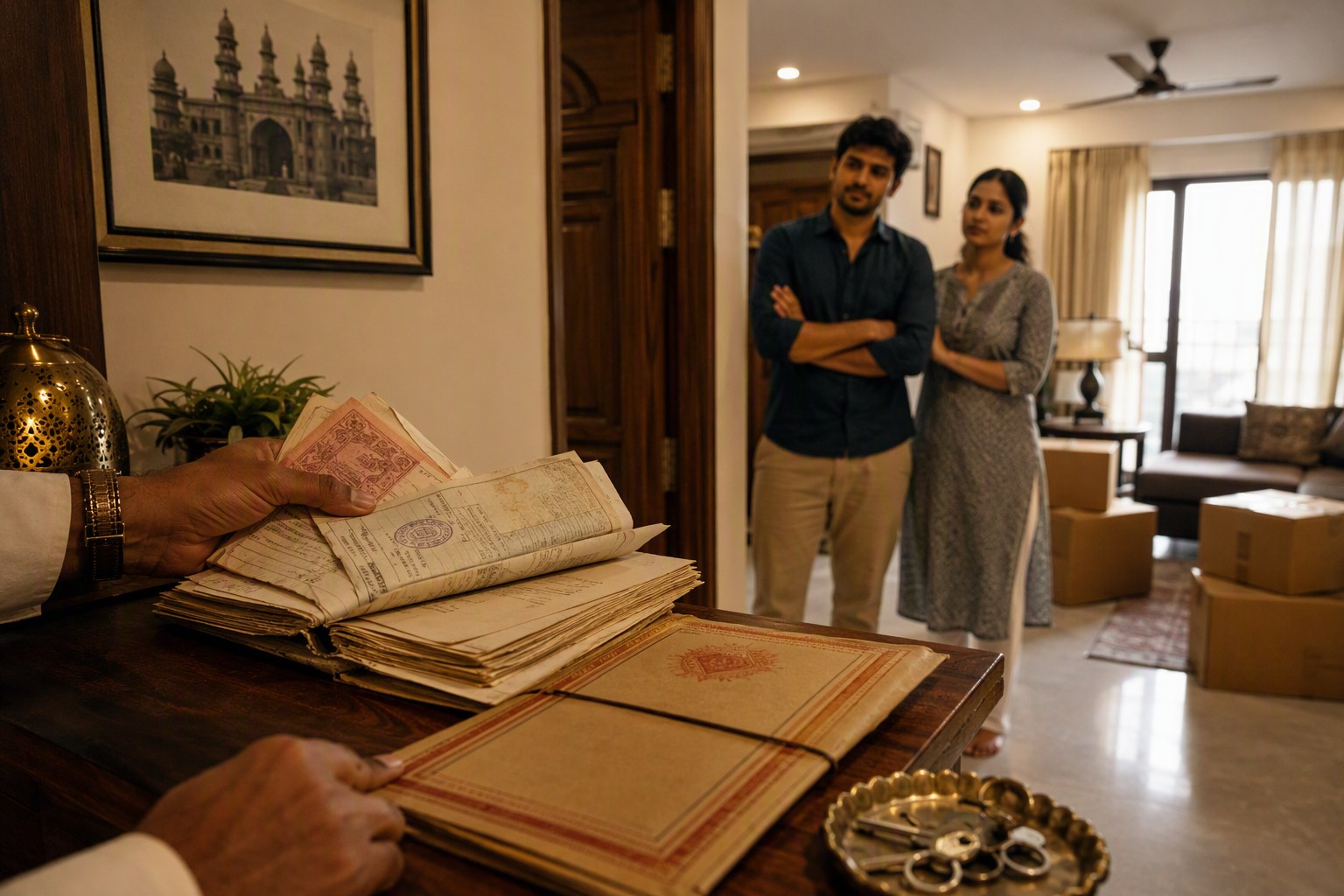



Telangana Sellers: Can Draft Deed Errors Delay Closing?
Telangana Sellers: Can Draft Deed Errors Delay Closing? Yes, very easily. A spelling mismatch, wrong survey number, old door number, incorrect SRO, missing link document, or a wrong stamp duty calculation can push a clean property sale into a messy last-minute correction exercise. In Hyderabad and across Telangana, registration day is not the right day to discover deed errors. By then, the buyer has arranged funds, the seller has planned handover, and both sides are standing near the SRO counter with tension on their faces.
We have seen this happen in Kondapur flats, Kokapet villa plots, Tellapur apartments, Bachupally layouts, and even small open plots in Maheshwaram mandal. The property may be genuine. The buyer may be ready. But the draft sale deed may still create doubt because it does not match the title documents, Dharani record, EC, mutation entry, sanctioned plan, or ready reckoner value used for registration.
My straight advice to Telangana sellers: treat the draft sale deed like a title document, not like a typing formality. Read it before registration day. Ask questions before the buyer asks them at the SRO.
Telangana Sellers: Can Draft Deed Errors Delay Closing? The short answer
Yes. Draft deed errors can delay closing in three ways. First, the SRO staff may ask for correction if party names, property description, boundaries, market value, or schedule details are not matching the supporting documents. Second, the buyer or buyer’s bank may pause payment if the draft creates title doubt. Third, the registration slot itself can be wasted if the deed needs re-drafting, fresh stamp duty calculation, fresh challan, or fresh witness coordination.
In Telangana, sale deed registration is a document-heavy event. For a regular sale, the usual charges are 4% stamp duty, 1.5% transfer duty, and 0.5% registration fee, making it 6% in many standard sale transactions. The amount is usually calculated on the higher of the sale consideration and the government market value. So, if the deed uses an outdated or wrong value, the registration team may not allow you to proceed smoothly.
Before fixing the registration date, sellers should cross-check the government value using the Market Value / Guideline Value Search and estimate charges through the Stamp Duty Calculator. This simple step prevents many arguments around who pays the shortfall if the value is higher than expected.
Telangana Sellers: Can Draft Deed Errors Delay Closing at the SRO?
At the SRO, the sale deed is not read like a casual agreement. It is checked against identity proofs, link documents, EC, property schedule, boundaries, survey numbers, flat number, extent, undivided share, and market value. If the draft deed says Sy.No. 120/E but the pahani, passbook, or earlier sale deed says Sy.No. 120/EE, you may think it is a small typing issue. For registration, it can become a major mismatch.
This is especially common in fast-moving areas where land parcels have gone through repeated plotting, HMDA approvals, apartment development, and resale. Take Narsingi in Gandipet mandal, Tellapur near Ramachandrapuram, or Tukkuguda in Maheshwaram mandal. Old agricultural survey numbers, new plot numbers, villa numbers, municipal door numbers, and layout phase names often get mixed up in draft deeds.
In our experience, the most dangerous draft errors are not dramatic. They look harmless: one missing initial, one wrong father’s name, one old pincode, one incorrect built-up area, or one boundary copied from an earlier draft. But when the buyer’s advocate compares it with the EC or link documents, the question comes immediately: Is this the same property?
Why sellers should not leave deed drafting only to the buyer’s side
Many sellers assume the buyer’s lawyer or document writer will prepare the sale deed properly. That is a risky assumption. The buyer’s side may prepare the draft from the documents they have, not from the full title history you know. If you sold a flat in Madhapur after getting it through a gift deed, or inherited a plot in Shamirpet after a family partition, the sale deed must reflect that chain correctly.
A seller has better practical knowledge of the property: whether the door number changed after GHMC assessment, whether the flat has a parking slot, whether the land is in a gram panchayat or municipality, whether mutation is complete, whether the project has an old approval number, and whether any rectification deed exists. If this information is not in the draft, the buyer may suspect suppression even when there is none.
For flats, check the sale deed schedule against the builder sale deed, occupancy certificate, share of land, parking allotment, and association records. For plots, check survey number, sub-division, plot number, extent in square yards, layout approval, road width, and boundaries. For agricultural or converted lands, check Dharani details, pattadar name, passbook, pahani history, conversion order if applicable, and whether the land falls in any restricted category.
Common draft sale deed errors Telangana sellers must catch early
| Draft deed error | Why it worries the buyer or SRO | Seller’s practical fix |
|---|---|---|
| Wrong seller or buyer name spelling | Mismatch with Aadhaar, PAN, passport, old deed, or bank loan papers | Use the exact spelling from ID proofs and title deed. Keep affidavits only where genuinely needed. |
| Incorrect survey number or sub-division | Creates doubt on property identity, especially in plots and land parcels | Verify through Dharani, pahani, link deeds, and the Survey Number Finder. |
| Wrong SRO mentioned | Registration may be routed to the wrong office or delayed for jurisdiction check | Use the Find Your SRO Office tool before booking the slot. |
| Old or vague boundaries | Neighbouring owners, roads, and open lands may have changed | Update boundaries from the latest physical position and approved layout plan. |
| Market value wrongly taken | Stamp duty challan may be short or deed may need correction | Check ready reckoner value and use the Stamp Duty Calculator. |
| Missing link document reference | Buyer’s bank may hold disbursement until title chain is clear | Mention all key acquisition documents in the recitals. |
| Wrong UDS or flat area | Common in apartments; affects title and future resale | Match with builder deed, sanctioned plan, and association records. |
| Section 22-A status ignored | Registration can be refused if property is prohibited | Run a Section 22-A Prohibited Property Check before finalising. |
The Section 22-A problem: one check that sellers should never skip
Telangana has a large number of prohibited properties listed under Section 22-A. The database figure stands at 147,934 prohibited properties. That is not a small number. These may include government lands, assigned lands, endowment lands, Wakf-related entries, ceiling surplus lands, and other restricted categories depending on the record.
For sellers, this matters even if the property was purchased years ago. A buyer’s lawyer may run the check just before registration. If your land or plot survey number appears in a prohibited list, or if part of the parent survey number has a flagged entry, the buyer will not proceed casually. Banks also become cautious.
This is why sellers in areas like Shamshabad, Maheshwaram, Adibatla, Shankarpally, Moinabad, and Shamirpet should be extra careful with land and plotted properties. Many of these corridors have seen agricultural land conversion, layout development, and multiple resales. One old revenue entry can create a present-day closing issue.
Use the Section 22-A Prohibited Property Check and save the result with your sale file. If there is a mismatch or confusion, handle it before accepting a token advance or fixing a registration date.
Encumbrance Certificate errors can shake buyer confidence
The Encumbrance Certificate is one of the first documents a serious buyer checks. If the draft sale deed does not reflect the EC history properly, the buyer may ask why a mortgage release, rectification deed, gift deed, partition deed, or previous sale deed is missing from the recital.
For example, a seller in Gachibowli may have purchased the flat through a registered sale deed, later taken a home loan, and closed it after a mortgage release deed. If the draft sale deed mentions only the original purchase and ignores the release deed, the buyer’s bank may ask for clarification. Not because the property is bad, but because the deed is incomplete.
Run an Encumbrance Certificate Search before sending the draft for buyer approval. Check names, document numbers, dates, SRO names, and the nature of each registered document. If the EC shows an old mortgage that is already closed but not released, do not wait till closing day. Get the release deed or bank closure proof sorted.
How wrong ready reckoner value creates payment fights
In Telangana registrations, stamp duty and registration charges are linked to the government market value, often called the ready reckoner value in common speech. If your sale agreement says Rs 85 lakh but the SRO market value works out to Rs 92 lakh, registration cost may be calculated on Rs 92 lakh. If the buyer came prepared for a lower amount, the difference can trigger an argument at the worst moment.
This is seen often in premium localities like Kokapet, Financial District, Narsingi, Madhapur, and Kondapur, where transaction values move quickly and buyers are already stretching budgets. It also happens in developing corridors like Patancheru, Kollur, Kompally, Bachupally, and Tukkuguda, where guideline values may differ by village, road access, property type, and classification.
Before signing the agreement of sale, sellers should check the guideline value and discuss registration charges clearly. If the buyer is paying charges, say it in writing. If any differential duty is to be borne by buyer or seller, record it in the agreement. Do not keep this verbal.
Apartment sellers: draft deed checks are different from plot sellers
Flat resale in Hyderabad has its own pattern of errors. The draft may correctly mention the flat number but miss the undivided share of land. Or it may mention the super built-up area but not the carpet area. In older apartments at Ameerpet, Himayatnagar, Kukatpally, Dilsukhnagar, and Tarnaka, door numbers and municipal assessment numbers may have changed after GHMC updates. In newer gated communities at Nanakramguda, Nallagandla, Tellapur, and Manikonda, tower names, phase names, parking numbers, and block numbers must be written carefully.
If the property is in an under-construction or recently completed project, sellers and buyers may also check the project’s status on the RERA Project Lookup. RERA details do not replace title due diligence, but they help confirm project registration, promoter details, and timelines where applicable.
For apartments, the sale deed should clearly capture the flat number, floor, block, tower, built-up or super built-up area as per earlier deed, UDS, parking rights if registered or allotted, association transfer process, and maintenance dues position. If there are pending corpus amounts, clubhouse dues, or transfer charges, settle them before closing or write the responsibility clearly.
Plot and land sellers: survey number mistakes are costly
For plots, the schedule is everything. One wrong survey number can make a buyer feel the registered deed is not for the plot shown on ground. This is a bigger risk in layouts around Shadnagar, Kandukur, Yacharam, Moinabad, Shankarpally, Kadthal, and Chevella, where agricultural survey numbers have been divided into layout plots over time.
The draft sale deed should match the layout approval, plot number, extent, road number, boundaries, and parent survey number. If the plot is part of an HMDA or DTCP layout, mention approval details correctly. If LRS is relevant, keep those papers ready. If the land has changed from agricultural to non-agricultural use, keep conversion details available.
Sellers should also check road width and land use before marketing land as residential or commercial. The buyer may verify it using tools like Road Width Check and Land Use Zone Finder. If your sales pitch says 40 feet road but the plan shows 30 feet, the issue may come up during drafting or loan processing.
What should a Telangana seller verify in the draft sale deed?
Here is the checklist I use when reviewing a seller-side draft. It is practical, not academic.
- Party details: Seller and buyer names, age, father or spouse name, PAN, Aadhaar reference, address, and marital status where relevant.
- Title recital: How the seller got the property: sale, gift, partition, inheritance, release, settlement, or builder allotment.
- Document chain: Previous document numbers, dates, book number if applicable, and SRO details.
- Property schedule: Flat number, plot number, survey number, mandal, village, municipality, district, boundaries, area, UDS, and parking.
- Consideration: Sale value, advance received, balance payable, payment mode, cheque or RTGS details.
- Possession: Date and condition of handover, keys, vacant possession, tenant status if any.
- Taxes and dues: Property tax, electricity, water, maintenance, mortgage, association NOC, and bank loan closure.
- Stamp duty value: Government market value and calculation of charges.
- Declarations: No litigation, no acquisition notice, no unpaid mortgage, no third-party claim, and no prohibited property issue.
- Witness details: Correct names, addresses, and ID availability on registration day.
If any of these points are unclear, pause. A one-day delay before registration is better than a rectification deed later.
When does a draft error need a rectification deed?
If the error is found before registration, you can correct the draft and proceed. If the error is found after registration, the parties may need a rectification deed. This is common for spelling errors, boundary mistakes, area mismatch, wrong survey number, or missing schedule details. But a rectification deed needs both parties to cooperate. If the buyer resells the property or shifts abroad, correction becomes harder.
That is why sellers should not think, We can correct later. Later means extra cost, another SRO visit, fresh documentation, and sometimes buyer hesitation during future resale. In strong markets like Hyderabad West, buyers may tolerate small delays. In slower micro-markets, one draft error can give the buyer a reason to renegotiate.
Seller’s pre-registration timeline: what to do and when
| Time before registration | Seller action |
|---|---|
| 10 to 15 days before | Collect title deed, link documents, EC, tax receipts, loan closure papers, approvals, and ID proofs. |
| 7 to 10 days before | Check guideline value, SRO jurisdiction, Section 22-A status, and survey details. |
| 5 to 7 days before | Review draft deed line by line with buyer and document writer. |
| 3 to 5 days before | Finalise stamp duty challan, payment schedule, bank disbursement conditions, and witness availability. |
| 1 day before | Reconfirm original documents, identity proofs, photographs if required, and vacant possession plan. |
For higher-value deals, especially villas in Kokapet, apartments in Financial District, plots in Tellapur, and land near ORR exits, I would not wait for the buyer to manage everything. Sellers should maintain their own document file and use a verification checklist. The Property Verification Tool is useful for land and plot due diligence before the buyer raises objections.
My view: draft deed review is a seller’s negotiation protection
A clean draft deed gives confidence. It tells the buyer that the seller is organised and the title story is clear. A messy draft does the opposite. It gives the buyer’s side room to delay payment, ask for fresh documents, push for price reduction, or insist on keeping part of the amount on hold.
We have seen sellers lose valuable time because a buyer’s bank asked for one missing link document two days before registration. We have also seen buyers back out when the property schedule in the draft did not match the EC and earlier deed. Sometimes the seller was not at fault. The document was just badly prepared. But in property transactions, perception matters.
In Telangana, where Dharani records, SRO registrations, municipal records, EC entries, and physical possession may all tell parts of the same story, the sale deed must tie everything together. That is the seller’s closing document. Do not allow it to be treated like a copy-paste job.
Final seller checklist before saying yes to the registration slot
- Run EC and compare it with the deed recital.
- Check Section 22-A status, especially for plots and land.
- Confirm SRO jurisdiction and market value.
- Match survey number, plot number, flat number, UDS, and boundaries.
- Check all names against Aadhaar, PAN, and earlier documents.
- Clarify stamp duty, transfer duty, registration fee, and who pays what.
- Close or disclose loans, tenants, maintenance dues, and tax dues.
- Share draft deed with the buyer at least a few days before registration.
- Keep originals ready and avoid last-minute document hunting.
If you are selling property in Telangana, your aim is simple: no surprises at the SRO. A well-checked draft sale deed can save your closing date, protect your price, and keep the buyer’s confidence intact.
Frequently Asked Questions
Can a spelling mistake in the sale deed delay registration in Telangana?
Yes. If the name does not match Aadhaar, PAN, previous deed, or bank documents, the SRO or buyer’s bank may ask for correction before registration.
Should Telangana sellers check Section 22-A before selling?
Yes, especially for plots and land. Telangana has 147,934 prohibited properties in the database, and a flagged survey number can stop or delay registration.
Who should verify the draft sale deed, buyer or seller?
Both should verify it. The seller must check title history, property schedule, boundaries, dues, and possession details because the buyer’s side may not know the full background.
What if an error is found after registration?
The parties may need to execute a rectification deed. This requires cooperation from both buyer and seller, so it is better to correct errors before registration.
How early should a seller review the draft deed?
Ideally 5 to 7 days before registration. For land, inherited property, mortgaged property, or high-value Hyderabad deals, start even earlier.