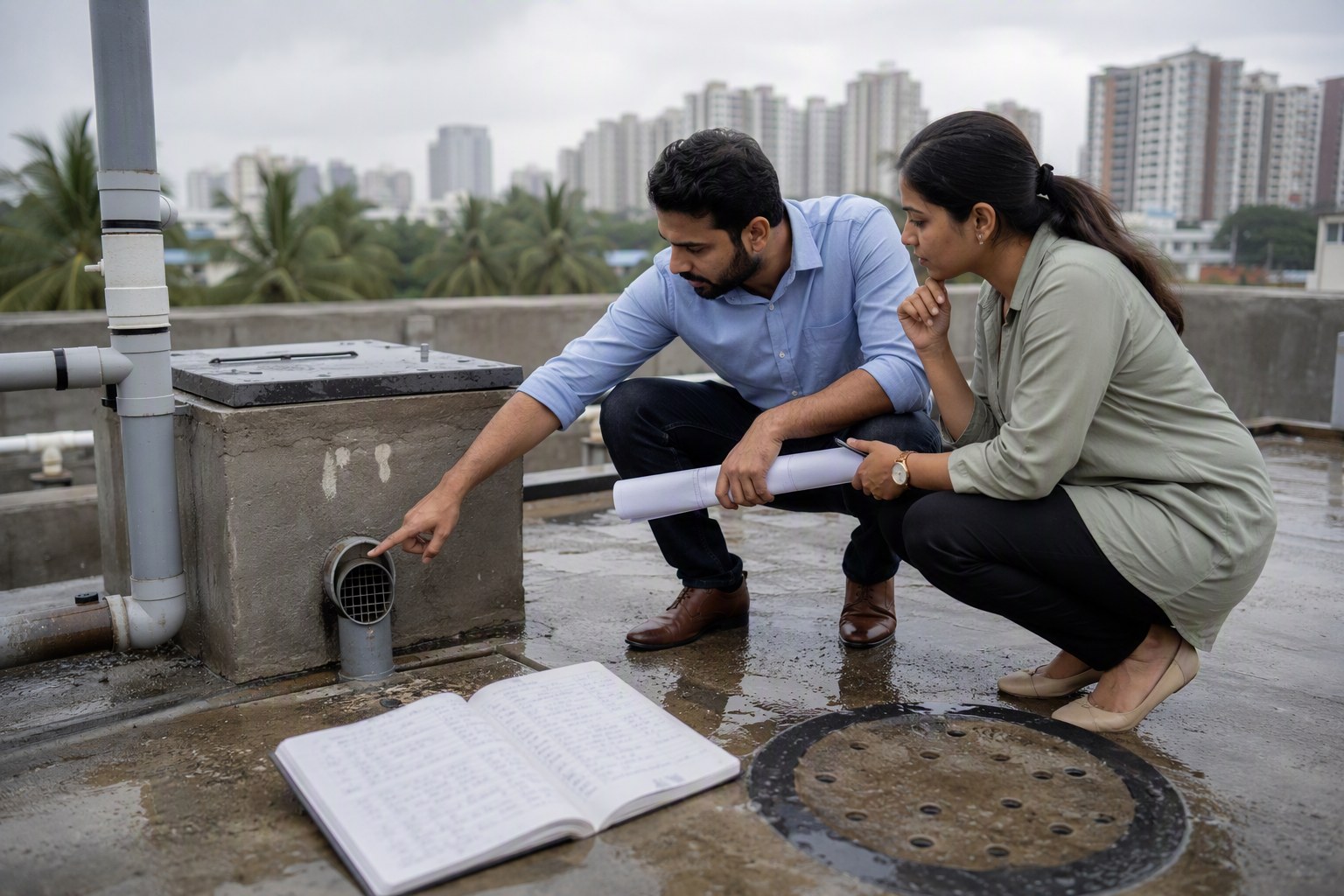



Solar Rooftop vs Solar-Ready Flat: What Buyers Must Check
Solar Rooftop vs Solar-Ready Flat is not just a green-home choice. In Hyderabad, it can affect your roof rights, maintenance bills, society permissions, electricity metering, resale story and even the way you read the sale deed. A flat with an installed solar rooftop system is a running asset, if documents and access are clean. A flat marketed as solar-ready is only a promise of future use, unless the builder has made legal and technical arrangements in writing.
We have seen buyers in Gachibowli, Kokapet, Narsingi, Tellapur, Miyapur, Uppal and Kompally getting impressed by a terrace full of panels or a brochure line saying “solar-ready homes”. Both can be good. Both can also be badly documented. The difference is in the file, not only on the roof.
Solar Rooftop vs Solar-Ready Flat: The Short Answer for Hyderabad Buyers
If the project already has a working solar rooftop system, first check who owns it, who can access the terrace, how power benefit is shared, whether net metering or common-area consumption adjustment is documented, and who pays for repairs. If the flat is only solar-ready, check whether there is reserved terrace space, cable routes, inverter space, sanctioned electrical load planning and society-level approval mechanism.
My practical view is simple: do not pay a green premium only for marketing language. Pay only when the benefit is measurable, transferable and written into the apartment documents, RERA disclosures, association bye-laws or builder handover file.
Before getting attracted by any green tag, also do the normal property checks. Telangana has 3,076,153 prohibited properties under Section 22-A as per the available database context. That number is a reminder that sustainability claims cannot replace title verification. Use the Section 22-A Prohibited Property Check, Encumbrance Certificate Search and RERA Project Lookup before you get into price negotiation.
Solar Rooftop vs Solar-Ready Flat: What Is the Real Difference?
| Point | Installed Solar Rooftop System | Solar-Ready Flat |
|---|---|---|
| Meaning | Panels, inverter, wiring and metering arrangement are already installed or commissioned. | The building is claimed to be designed for future solar installation. |
| Buyer’s main risk | Unclear ownership, terrace access disputes, poor maintenance and unclear sharing of savings. | No guaranteed installation, no defined terrace allocation, no proof that future system is technically feasible. |
| Document to ask | Commissioning documents, invoices, warranty papers, net metering papers, society resolution. | Electrical drawings, terrace layout, shaft/cable route plan, builder undertaking and association rules. |
| Green premium test | Can be justified if benefit is clear and transferable. | Should be modest unless future rights are legally recorded. |
| Typical Hyderabad issue | Terrace treated as common area, but maintenance responsibility is vague. | Brochure says solar-ready, but sale deed and handover file stay silent. |
Check 1: Roof Access Rights Are More Important Than the Panels
In apartment projects, the terrace is usually a common area unless there is a legally valid and clearly disclosed arrangement. This is where buyers make mistakes. They see panels on the terrace and assume their flat will get direct benefit. Not always.
Ask these questions before you sign:
- Is the solar system installed for common-area loads like lifts, corridor lighting, pumps and clubhouse?
- Is any part of the solar output connected to individual flats?
- Who has physical access to the terrace — residents, facility team, vendor, builder or only association office bearers?
- Is the terrace access route shown in the approved plan and handover documents?
- Are panel areas blocking fire access, water tank maintenance or lift room access?
In high-rise projects around Financial District, Kokapet and Narsingi, roof space is already crowded with water tanks, lift machine rooms, telecom equipment, lightning arresters and services. Solar panels need space, shadow-free layout and maintenance clearance. A “solar-ready” claim without a roof layout is weak.
For plotted villas in areas like Shankarpally mandal, Moinabad mandal, Maheshwaram mandal and Medchal mandal, the roof-right issue is usually simpler because the owner controls the structure. In gated villa communities, however, the association may still regulate panel elevation, inverter placement, external wiring and common visual guidelines.
Check 2: Metering Decides Whether Solar Is a Real Saving or Just a Feature
A solar rooftop system must be connected to a metering arrangement that makes sense. In many apartment communities, solar is used for common-area electricity. That is fine, but then the benefit should reflect in common area maintenance calculations or association accounts.
For an installed system, ask for:
- Metering approval or utility-related papers available with the builder or association.
- Single-line electrical diagram showing how the solar system is connected.
- Monthly generation logs, if the system is already operating.
- Maintenance invoices and service records.
- Warranty details for panels, inverter and mounting structure.
For a solar-ready flat, ask what exactly is ready. Is it only conduit provision? Is there an inverter location? Is there space in the electrical panel? Is the sanctioned load planned for future installation? Has the builder left a route from terrace to electrical room?
In our experience, many buyers hear “solar-ready” and assume they can install panels later for their own flat. But in a multi-storey apartment, one individual owner may not be able to occupy terrace space without association approval. The society may decide to install a common system instead. Your private plan and the community’s plan may clash.
Check 3: Society Approval Must Be Written, Not Verbal
Solar in an apartment is not like buying an appliance. It sits on common property, touches the electrical network and needs periodic access. That means the apartment owners association or provisional society has a role.
If the builder says the project has installed solar, ask for the association resolution or handover note that records:
- Who owns the asset after handover.
- Who signs the annual maintenance contract.
- Who receives warranty claims.
- Who is responsible for cleaning panels.
- How replacement costs are shared later.
If the project is solar-ready, ask whether the association bye-laws allow installation later. A buyer in a Shaikpet or Jubilee Hills apartment may have a very different roof environment compared with a buyer in a low-rise project in Bachupally or Peerzadiguda. Shadow from adjacent towers, water tank location and access restrictions can change everything.
Verified.RealEstate view: A green feature is valuable only when the legal right, technical design and maintenance responsibility are aligned. Otherwise, it becomes one more item in the brochure.
Check 4: Maintenance Responsibility Can Become a Monthly Argument
Solar panels need cleaning, inverter checks, wiring inspection and occasional repairs. In Hyderabad’s dust conditions, panel cleaning is not a once-in-a-year activity. But I will not put a fixed cleaning frequency here because it varies by location, dust exposure, roof access and vendor recommendation.
What matters for the buyer is this: who pays, who supervises and who is answerable if the system stops working?
For an installed solar rooftop system, ask the seller or builder for the operations file. It should ideally contain vendor details, warranty cards, service schedule, safety instructions, electrical drawings and handover acknowledgement. If the seller is a resale owner, ask whether the association is maintaining the system and whether any dues are pending.
For a solar-ready flat, there may be no maintenance today. But future installation can create cost-sharing disputes. Suppose only some residents want solar and others do not. Can a group install panels? Can they use common terrace? Will all residents pay? Will only beneficiaries pay? These answers should not be left to WhatsApp group voting after possession.
Check 5: The Green Premium Must Be Tested Against Documents
Builders and sellers may quote a higher price for green features. Sometimes it is fair. A working solar rooftop system, energy-efficient common lighting, rainwater harvesting, STP reuse and better ventilation can reduce running costs and improve buyer interest. But the premium should be backed by evidence.
Do not accept a vague “eco-friendly project” line. Ask for the exact feature list and supporting documents. If the price looks higher than nearby resale units in Kondapur, Hafeezpet, Manikonda, Nanakramguda or Kukatpally, break the premium into parts. Is it because of location? Floor? view? club amenities? solar? brand? possession status? Only then you can judge the solar component.
Use the Market Value / Guideline Value Search to compare the ready reckoner angle, and the Composite Value Calculator to understand how land and building value may be viewed. For registration cost planning, keep the Stamp Duty Calculator handy. Solar claims should sit on top of proper valuation, not replace it.
Installed Solar Rooftop: Buyer Checklist Before Paying a Premium
If you are buying a resale flat or new flat in a project where solar is already installed, collect these before token advance:
- Ownership proof: Is the solar asset owned by builder, association, apartment owners collectively or a third-party vendor?
- Commissioning record: Ask for installation date, commissioning note and technical handover file if available.
- Metering file: Check whether the system is connected to common load or individual consumption.
- Association record: Minutes, resolution or handover note should mention the solar system.
- Warranty papers: Panel, inverter and mounting structure warranty must be available.
- AMC details: Annual maintenance contract, vendor contact and last service record.
- Safety approvals: Electrical safety and fire access should not be compromised.
- Resale transfer: If the benefit is linked to the flat, see whether it transfers to the next buyer.
In a resale deal, also verify the chain of title and any loan charge. The EC Analyzer and CERSAI Charge Check are useful before you trust the seller’s file. If survey details are unclear for the underlying land, use the Survey Number Finder and then cross-check location records through the Property Verification Tool.
Solar-Ready Flat: Buyer Checklist Before Believing the Brochure
A solar-ready flat can be a sensible purchase if the builder has planned the building properly. But the word “ready” must be explained. Here is what I would ask in a site office:
- Terrace allocation: Is there dedicated solar zone marked in drawings?
- Structural provision: Has the roof been designed to take mounting structures without future disputes?
- Conduit route: Are cable pathways already provided from terrace to electrical room or flat meter area?
- Inverter space: Is there a safe, ventilated and accessible location?
- Association rule: Will the future society permit individual systems, common system or both?
- Shadow study: Has the builder considered shadows from towers, parapets, tanks and neighbouring buildings?
- Handover promise: Will the builder include solar-readiness documents in the possession file?
- RERA disclosure: Is the green feature reflected in project documents or only in sales talk?
This is especially relevant in dense corridors like Kondapur–Gachibowli, Nanakramguda–Kokapet and Kukatpally–Miyapur. Tower placement and roof congestion can reduce practical usefulness. In more open layouts towards Adibatla, Tukkuguda, Patancheru and Shankarpally, future planning may be easier, but legal permissions still matter.
Mandals and Localities Where Buyers Should Be Extra Careful
Solar questions are not the same across Hyderabad. Local planning pattern, building height and association culture matter.
- Serilingampally mandal: Gachibowli, Kondapur, Miyapur and Hafeezpet have many high-rise and mid-rise apartments. Roof access and common-area metering are key.
- Gandipet mandal: Kokapet and Narsingi have premium gated communities. Read the sale agreement carefully because amenities and common assets can be heavily structured.
- Shaikpet mandal: Shaikpet, Film Nagar side and nearby premium apartments may have limited terrace space due to services and elevation design.
- Uppal mandal: Uppal and Ramanthapur buyers should check older building wiring and society records in resale flats.
- Quthbullapur and Medchal side: Kompally, Suchitra, Jeedimetla and nearby villa/apartment projects may offer more roof potential, but association rules still decide usage.
- Maheshwaram and Shamshabad belt: Villa and plotted developments may look easy for solar, but title, land use and permissions need proper checking.
If you are unsure of the SRO for a locality, use Find Your SRO Office. For zoning doubts around fast-growing outskirts, the Land Use Zone Finder and Road Width Check can save you from bigger mistakes than the solar decision itself.
Sale Deed and Agreement Clauses to Read Carefully
The sale agreement should not only talk about carpet area, undivided share and payment schedule. For a green-home purchase, read the clauses on common areas, terrace rights, utilities, maintenance and association handover.
Look for these points:
- Whether the terrace is clearly treated as common area.
- Whether the builder reserves any right over terrace equipment.
- Whether solar equipment is listed as a common asset.
- Whether the buyer gets any direct electricity benefit or only indirect common-area benefit.
- Whether future installation needs association approval.
- Whether maintenance costs can be added to monthly charges.
For drafting or reviewing basic property document formats, the Legal Document Generator can help you organise clauses, though a local advocate should review the final document. If Telugu terms like pahani, khata, dharani, link document or mutation confuse you, keep the Telugu-English Property Terms Dictionary open while reading the file.
When Is an Installed Solar Rooftop Better?
An installed solar rooftop is better when it is already working, properly handed over and financially visible in society accounts. It is also better when the apartment association is active and transparent. If the solar system reduces common-area electricity burden, residents should be able to see the impact through accounts, not just hear it in annual meetings.
I would rate an installed system positively when:
- The system is less of a sales gimmick and more of a managed community asset.
- All documents are available with the association.
- The terrace is accessible for maintenance without conflict.
- Safety and electrical routing are neat.
- Buyers understand whether the benefit is direct or indirect.
In resale apartments, speak to two or three residents if possible. Security staff and facility managers often know whether the panels are actually maintained. A shiny system on possession day and a neglected system three years later are not the same thing.
When Is a Solar-Ready Flat Better?
A solar-ready flat can be better if you are buying early in a well-planned project and do not want the builder to install a low-quality system just for marketing. Some buyers prefer the association to decide later, after occupancy stabilises. That can be sensible.
But solar-ready should mean real readiness. It should not mean “you can discuss later with society”. If the builder has provided cable shafts, roof zones, safe access and clear handover drawings, the future option has value. If not, treat it as a soft promise.
For buyers in under-construction projects, RERA checking is non-negotiable. Use the RERA Project Lookup and compare what is promised in sales material with what is filed. If there is a gap, ask the builder to write it into the agreement or official annexure.
Final Opinion: Do Not Buy the Solar Tag, Buy the Rights
Solar is welcome. Hyderabad homes need more sensible green design, especially in large gated communities where common-area power usage is significant. But as a buyer, your job is not to reward a brochure. Your job is to buy clear rights, clear documents and clear maintenance responsibilities.
Between an installed solar rooftop and a solar-ready flat, I prefer the installed system only when documents, metering and association handover are clean. Otherwise, a properly planned solar-ready project may be safer than a poorly managed installed system. The best deal is where the builder is transparent, the society rules are practical and the title file is clean.
Start with property verification, then evaluate the green feature. A solar panel cannot cure a bad title, unclear terrace rights or a weak agreement.
Frequently Asked Questions
Is an installed solar rooftop system always better than a solar-ready flat?
No. An installed system is better only if ownership, metering, maintenance and terrace access are clearly documented. A solar-ready flat with proper roof planning and written future rights can be safer than a poorly documented installed system.
Can an individual flat owner install solar panels on an apartment terrace in Hyderabad?
Usually not without association approval, because the terrace is normally a common area. The buyer must check the sale deed, association bye-laws and project handover documents before assuming any private roof right.
What documents should I ask for when buying a flat with solar rooftop?
Ask for commissioning papers, invoices, warranty documents, metering details, electrical drawings, association resolution, maintenance contract and handover records. In resale, also check EC, CERSAI charge and Section 22-A status.
Should I pay extra for a solar-ready flat?
Pay extra only if solar-readiness is backed by terrace layout, cable routes, inverter space, electrical planning and written association rules. If it is only a brochure line, treat the premium with caution.
Does solar rooftop benefit individual electricity bills in apartments?
Not always. Many apartment solar systems are connected to common-area loads such as lifts, pumps and corridor lighting. The benefit may show indirectly in maintenance accounts rather than in each flat’s electricity bill.