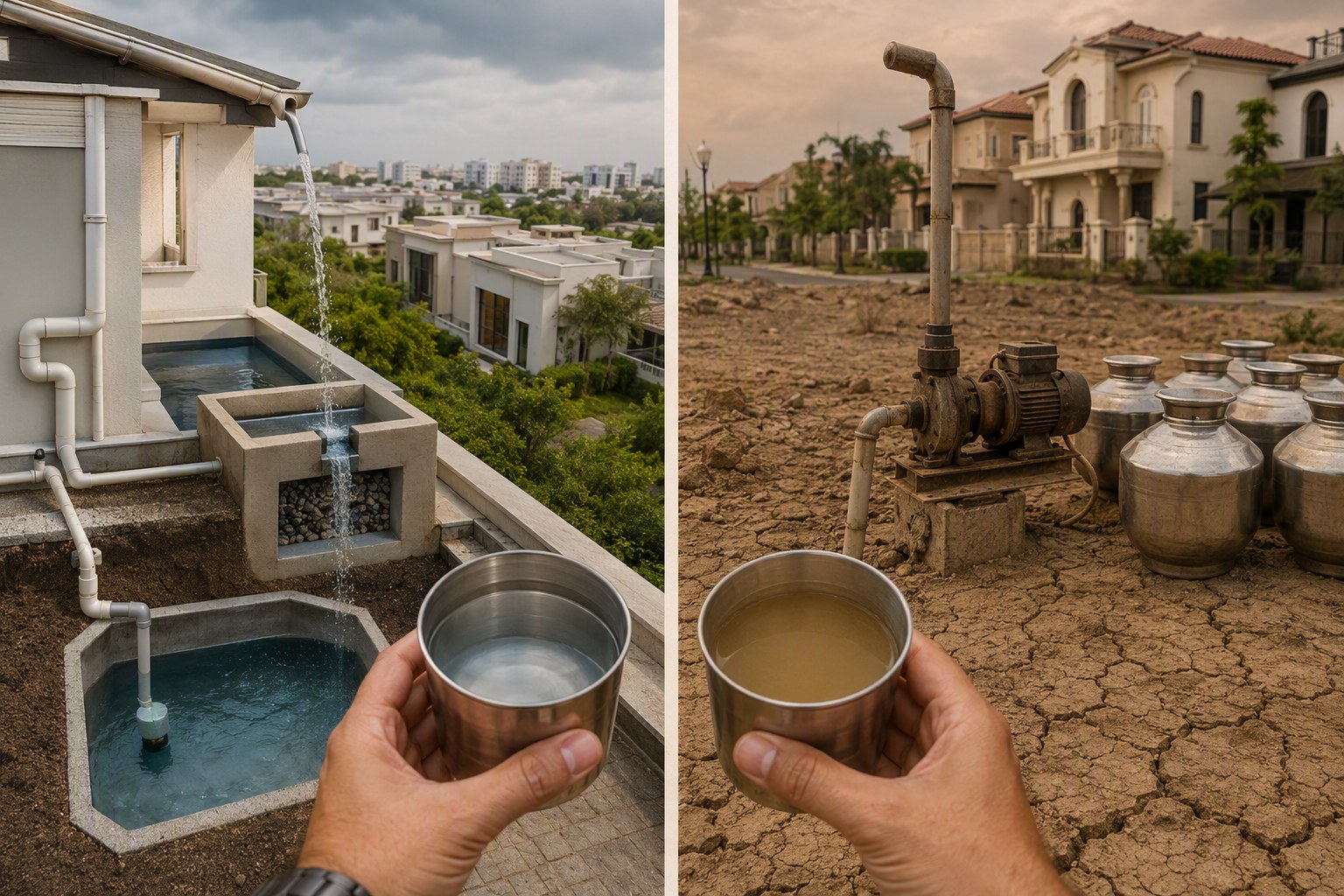
Greywater Recycling in Homes is now being used as a serious selling point in Hyderabad’s green housing market, especially in gated communities, villas and premium apartments. The claim sounds attractive: reuse bath, basin and laundry water for flushing or landscaping, reduce fresh-water demand, and live in a more responsible way. But for buyers, the real question is not whether the brochure says “greywater recycling”. The question is whether the system is approved, correctly designed, maintainable and backed by clean property documents.
We’ve seen this pattern in Kokapet, Tellapur, Narsingi, Kollur, Mokila, Bachupally and parts of Gachibowli. Sustainability features are no longer small footnotes. They are being placed next to clubhouses, EV charging points, rainwater harvesting, solar lighting and low-flow fixtures. In our experience, that is a positive shift. Hyderabad badly needs better water discipline. But a green claim should never become a shortcut around due diligence.
A buyer should treat greywater recycling like any other property feature that affects daily use: ask for drawings, approvals, operating responsibility, cost sharing and written commitments before paying a major amount.
Greywater Recycling in Homes: Why It Is Suddenly in the Sales Pitch
In the western corridor of Hyderabad, water security has become a boardroom-level discussion for builders and a dining-table discussion for families. High-rise apartments in Nanakramguda, Financial District, Gopanpally and Tellapur depend on a mix of municipal supply, borewells, tankers and internal treatment systems. Villa layouts near Shankarpally, Mokila, Kollur and Adibatla face a different problem: larger landscaped areas and private usage patterns can make water management harder after handover.
This is where greywater recycling enters the marketing story. Greywater generally refers to wastewater from showers, wash basins and laundry, excluding sewage from toilets. When separately collected and treated, it can be reused for non-potable purposes such as flushing, gardening or common-area landscape use. The idea is sensible. But the execution decides whether it is a useful facility or just a line in the brochure.
For buyers, the risk is not only technical. A weakly documented project can have multiple layers of trouble: unclear approvals, mismatch between sanctioned drawings and site execution, missing maintenance plan, disputed land title, or a survey number that falls under restrictions. Telangana government records show 3,076,153 prohibited properties under Section 22-A. That number alone should remind every buyer that document verification and technical verification must go together.
Before shortlisting a project, buyers can run basic checks through the RERA Project Lookup, verify land and document red flags using the Property Verification Tool, and check restrictions through the Section 22-A Prohibited Property Check. These checks do not replace legal advice, but they help you ask sharper questions during negotiation.
Greywater Recycling in Homes: What Buyers Must Verify First
The first verification point is simple: is the greywater system part of the approved project design, or is it only a sustainability add-on claimed by the sales team?
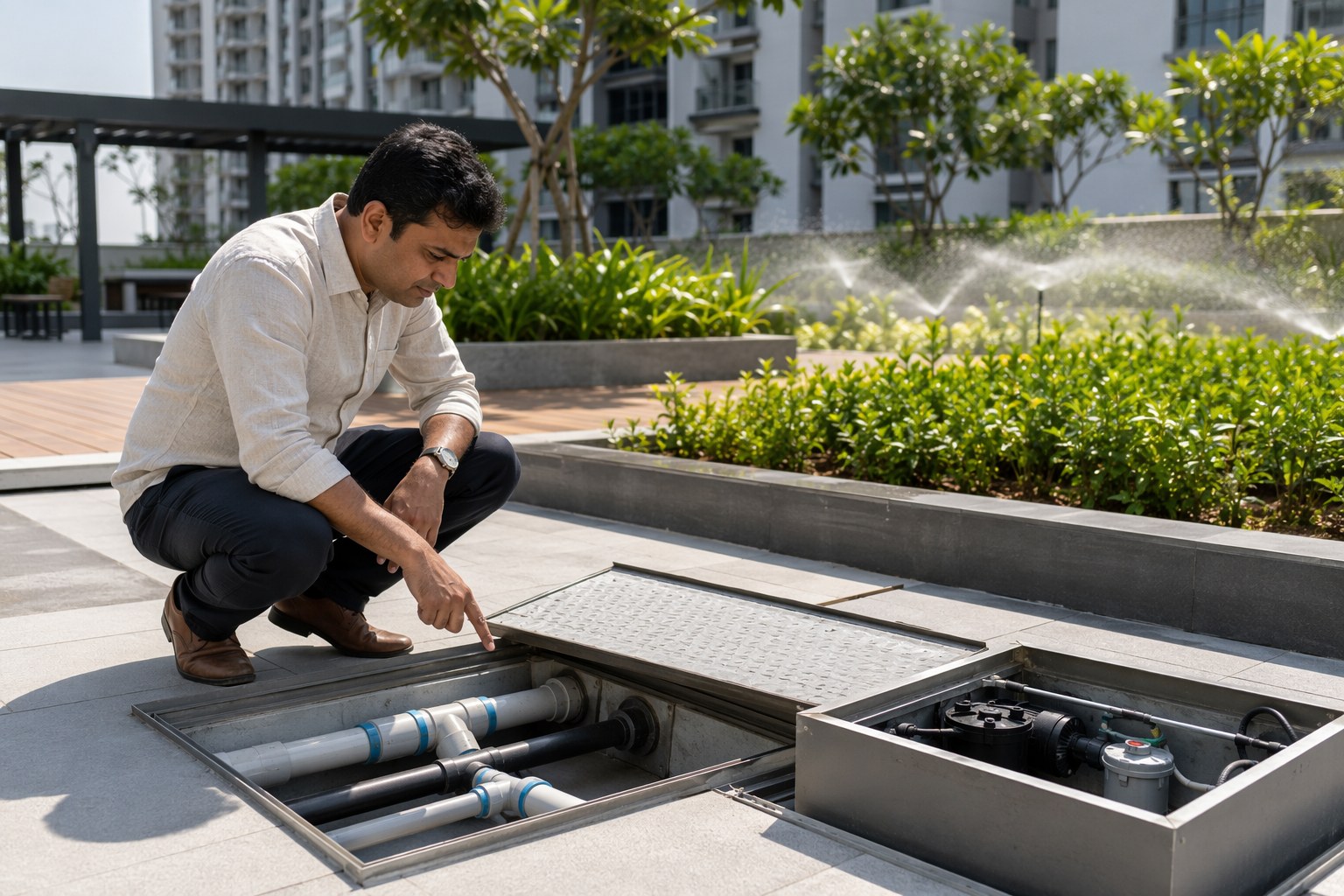
Ask for the latest approved plans, plumbing schematic, STP or greywater treatment design, and common-area service layout. In an apartment project, the system should not be explained only through a sales brochure. The builder should be able to show how greywater is collected, where it is treated, where it is stored, and how it is reused. In villa communities, the question becomes sharper because individual plumbing, common service lines and landscape reuse may be split between the unit owner and association.
In Hyderabad and surrounding HMDA areas, buyers often focus on UDS, carpet area, amenities and possession date. Those are critical, no doubt. But a water recycling feature can affect monthly maintenance, odour control, pumping systems, garden quality, and even resident disputes after handover. If the recycling plant stops working, who pays? If pipes are wrongly connected, who fixes it? If the treated water quality is poor, can residents reject the system?
These questions should be answered in writing before agreement. A verbal assurance from a channel partner or site sales executive is not enough.
Approval Trail: Do Not Accept a Green Feature Without Paper
A well-designed greywater recycling system should have a paper trail. Buyers should ask whether the facility is shown in the sanctioned building plan, environmental documents where applicable, project specifications, RERA disclosures and the draft sale agreement. If the project has a separate sewage treatment plant, understand whether greywater is separately treated or mixed with other wastewater and then treated.
In larger apartment projects in Serilingampally mandal, Gandipet mandal, Rajendranagar mandal and Medchal side growth areas, buyers should be careful about the difference between “STP available” and “greywater recycling available”. These are not the same statement. STP means sewage treatment. Greywater recycling needs source separation or a clearly defined treatment and reuse process. If the builder says both are available, ask for the flow diagram.
Look for these documents:
- Approved building plan and relevant service drawings.
- Plumbing layout showing separate greywater lines, if claimed.
- Treatment plant design or technical specification.
- Location of tanks, pumps and reuse points.
- RERA project details and declared specifications.
- Draft association handover plan for operation and maintenance.
- Agreement clause mentioning sustainability features, if they are part of the promised amenities.
If the project is still under construction, ask whether the final executed system will be certified or handed over with commissioning records. A buyer does not need to become an engineer, but must insist on traceable documents.
Plumbing Design: The Hidden Issue Behind Greywater Claims
The most common weak point in greywater recycling is not the treatment tank. It is the plumbing design. Greywater has to be collected separately from toilet discharge if the project is claiming true source-level recycling. If the pipes are mixed, then the project may still treat wastewater through an STP, but the claim should be worded correctly.
In a high-rise, wrong connections can create long-term maintenance headaches. Residents may face odour, backflow, staining in toilet fixtures, higher pumping costs or poor reuse quality. In villas, owners sometimes alter bathrooms, utility areas or gardens after handover. If the layout does not control such changes, the recycling system can fail over time.
Buyers should ask the site engineer, not only the salesperson, these questions:
- Which fixtures are connected to the greywater line?
- Are kitchen sink lines included or excluded?
- Is treated water used for flushing, landscaping or both?
- Is there a separate tank for treated water?
- What happens if the treatment plant is shut for repair?
- Is there any manual bypass, and who controls it?
- Will residents get a maintenance manual at handover?
Kitchen wastewater can contain oil and food waste, so buyers should not assume every non-toilet line is suitable for simple recycling. The design must be explained clearly. If the builder avoids technical answers, treat it as a warning sign.
Maintenance Responsibility: The Cost Nobody Wants to Discuss
Greywater systems are not self-running magic boxes. Pumps need power. Filters need cleaning. Tanks need periodic maintenance. Sludge or residue must be handled properly. Staff need training. If the treated water is used for landscaping, gardeners and facility managers should know the limits of use.
In Hyderabad gated communities, this responsibility usually shifts to the owners’ association after handover. That is where disputes start. Some residents may ask why they should pay for a system they do not understand. Others may complain if flushing water has smell or colour. Villa owners may resist common maintenance charges if the reuse benefit is mostly visible in landscaping.
So, before buying, ask for the projected maintenance responsibility in writing. Not a random monthly figure unless officially disclosed; ask for the structure. Who will operate the system before association formation? Who will train the association? Is there an annual maintenance contract? Is the system covered under defect liability? Are consumables part of common maintenance?
In our experience, buyers who ask these questions early are taken more seriously. Builders also realise that the buyer is not impressed by green labels alone.
Title and Land Checks Matter Even for Sustainable Homes
A clean-looking eco-friendly project can still sit on land with legal complications. Sustainability does not cure title defects. A greywater recycling claim should never distract buyers from pahani, mutation, link documents, survey number match, land conversion, development permission and SRO records.
This is especially relevant in fast-growing belts like Kollur, Tellapur, Patancheru, Shankarpally, Tukkuguda, Maheshwaram and Kompally. Land parcels may have moved from agricultural use to plotted development, villas or apartments. In such cases, a buyer should check whether the survey number, extent, owner name and transaction history are consistent across records.
Use the Survey Number Finder to start mapping the land identity. Then check the registration trail through the Encumbrance Certificate Search and study the EC using the EC Analyzer. For value cross-checking, the Market Value / Guideline Value Search helps buyers understand the ready reckoner value used for registration purposes.
If you are close to signing, locate the right registration office using the Find Your SRO Office and estimate statutory registration outgo through the Stamp Duty Calculator. These are basic steps, but many buyers skip them because the sample flat looks impressive.
How to Test the Claim During a Site Visit
A site visit should not be only about balcony view, clubhouse model and tile finish. If greywater recycling is part of the sales pitch, make it part of the site visit checklist.
| Buyer Check | What to Ask | Why It Matters |
|---|---|---|
| Approval status | Is the system shown in approved drawings or RERA specifications? | Prevents brochure-only promises. |
| Plumbing design | Are greywater lines separate from toilet sewage lines? | Confirms whether the claim is technically sound. |
| Reuse purpose | Will treated water be used for flushing, gardening or common areas? | Shows daily impact and resident benefit. |
| Maintenance plan | Who operates and pays after handover? | Avoids future association disputes. |
| Document clarity | Are land title, EC, survey number and approvals matching? | Protects the buyer beyond sustainability claims. |
During the visit, ask to see the plant location or planned service area. If the project is still at early construction stage, ask for the layout marking. In a completed project, ask whether the system is operational. If possible, speak to existing residents or facility staff. They often give a more practical answer than the sales office.
Agreement Clauses: Put the Green Promise in Writing
The sale agreement should not be silent if the builder is using greywater recycling as a major selling point. Buyers can request a written specification annexure. It should state the nature of the system, whether it is part of common amenities, and the responsibility for operation before and after association handover.
Do not accept vague wording such as “eco-friendly features may be provided” if the feature influenced your purchase decision. Better wording will identify the facility and its intended use. Of course, every agreement is different, and buyers should take legal review before signing. But the principle is simple: if it is promised as a value feature, it should be documentable.
Also check whether the project’s RERA page reflects the same specifications being sold at site. The RERA Project Lookup is useful here. If the site team promises one thing and public project details say something else, pause and ask for clarification.
Locality View: Where Buyers Should Be Extra Careful
In premium apartment clusters such as Kokapet, Nanakramguda and Financial District, builders may package greywater recycling as part of a larger green-living narrative. Buyers there should focus on whether the system can handle high-rise occupancy and whether maintenance teams are equipped.
In villa belts like Mokila, Shankarpally, Kollur and Tellapur, the issue is different. Private gardens, larger bathrooms, staff rooms, utility changes and owner-level modifications can disturb water reuse planning. Buyers should ask how the community will control post-handover alterations.
In developing corridors like Tukkuguda, Adibatla, Maheshwaram and Patancheru, document clarity becomes just as critical as engineering. Check land conversion, layout approval, road access, survey number continuity and prohibited property status. A green feature cannot compensate for weak title or unclear permissions.
For plots and villas, buyers should also check land use through the Land Use Zone Finder and access conditions through the Road Width Check. These details affect long-term usability and resale confidence.
Our View: Good Feature, But Not a Blind Trust Feature
Greywater recycling in homes is a welcome direction for Hyderabad real estate. I would rather see builders discuss water reuse than only imported marble, double-height lobbies and theme-based clubhouses. But the buyer’s approach must be firm: appreciate the green intent, verify the execution, and record the promise.
The strongest projects will not hesitate to share drawings, approvals, maintenance structure and handover process. The weaker ones will keep the conversation at brochure level. That difference is easy to spot if you ask the right questions.
For a serious buyer, the order should be clear. First, verify title and approvals. Next, verify RERA and SRO-linked documents. Then test the sustainability claim. Only after that should you compare amenities, payment schedule and possession comfort.
Green homes are good for Hyderabad. Verified green homes are better for buyers.
Frequently Asked Questions
Is greywater recycling in homes useful for Hyderabad buyers?
Yes, it can be useful, especially in apartments and villas where non-potable water demand is high. But buyers should verify the design, approvals and maintenance plan before treating it as a real benefit.
What documents should I ask for if a builder claims greywater recycling?
Ask for approved service drawings, plumbing layout, treatment system specification, RERA disclosures, handover plan and agreement clauses mentioning the feature. A brochure statement alone is not enough.
Is STP the same as greywater recycling?
No. STP refers to sewage treatment. Greywater recycling usually means separate collection and treatment of water from baths, basins or laundry for reuse. Some projects use treated STP water for reuse, so the builder must explain the exact system.
Can a green feature hide property document problems?
It should not, but buyers can get distracted by sustainability claims. Always check survey number, EC, RERA details, SRO records, land use and Section 22-A prohibited property status before committing.
Who maintains greywater recycling after handover?
In most gated communities, the owners’ association eventually takes over maintenance. Buyers should ask who operates it before handover, whether training is provided, and how repair or operating costs will be shared.