


Rooftop Solar in Apartments has become a new selling line across Hyderabad’s apartment market, from Kokapet and Narsingi to Miyapur, Tellapur, Kompally, Uppal and Pocharam. The buyer alert is simple: do not pay token money only because a brochure says “solar-ready terrace” or “future solar provision”. First check who owns the terrace, who can sign the net-metering application, who will maintain the panels, and whether the promise is written into your sale documents.
We’ve seen this issue come up often in gated communities and smaller standalone apartments. A sales team may speak confidently about reduced common-area electricity bills, EV charging readiness, green living and sustainability. But when residents later ask for installation, the terrace may be treated as a common area, a builder-retained space, a telecom lease zone, a water-tank/service area, or a place already earmarked for amenities and maintenance access.
Buyer alert: In an apartment, solar is not only an electrical decision. It is a title, permission, association, safety, and billing decision. Check it before token, not after registration.
Rooftop Solar in Apartments: why terrace ownership is the first check
In Hyderabad apartments, the terrace usually sits in a sensitive legal category. Most buyers assume that because they own a flat, they also have equal right to the terrace. That may be broadly true where the terrace is declared as common area. But common area does not mean any one flat owner can install panels privately. It means the association or society has to decide, document and manage the usage.
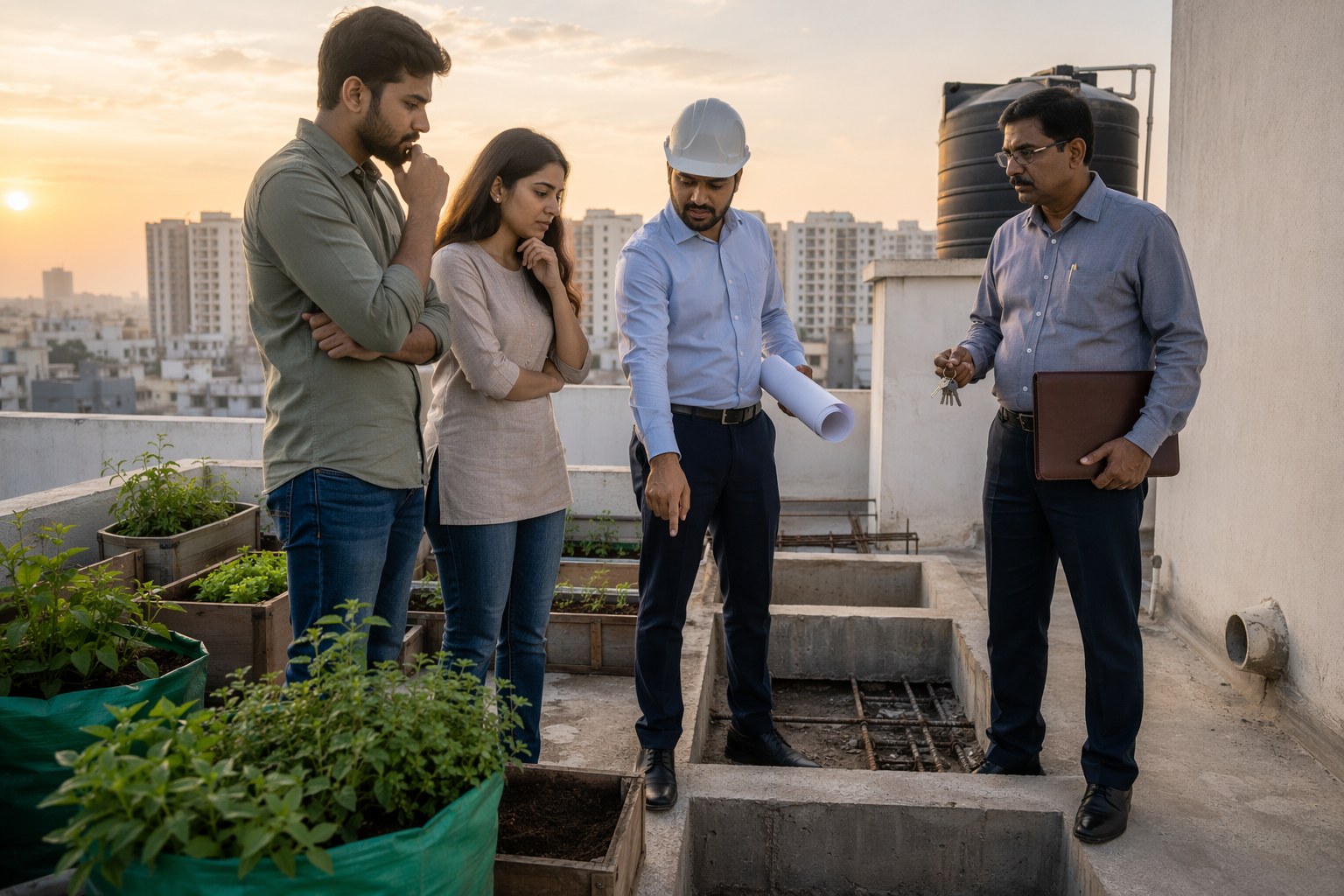
The first document to read is the Agreement of Sale or Sale Deed. Look for words like terrace rights, common areas, exclusive rights, undivided share of land, club house roof, service terrace, water tank zone, lift machine room and maintenance access. In some projects, the builder may reserve certain rights over terraces for signage, services, communication equipment or future facilities. In our experience, this is where solar disputes start.
If a salesperson says the flat comes with “solar access”, ask whether it is exclusive access for your flat or general provision for the whole building. The difference is huge. Exclusive terrace rights for one buyer in an apartment block must be clearly written and legally supportable. General solar provision only means the building may be suitable for a common-area solar system later.
Buyers in Gachibowli, Manikonda, Kondapur, Chandanagar, Bachupally and LB Nagar should be extra careful with high-rise or mid-rise communities where terrace space is already under pressure. Water tanks, fire safety access, lift rooms, lightning arresters, HVAC equipment, dish antennas and telecom installations can all compete for the same roof space. A neat solar layout shown in a sales presentation may not match the final terrace condition.
Rooftop Solar in Apartments: the token-money checklist
Before paying even a small token, ask for written answers. Verbal comfort is not enough. If the builder is genuine, these questions should not irritate them. They are basic buyer due diligence.
- Who owns or controls the terrace? Builder, association, society, all flat owners jointly, or one specific unit?
- Is solar promised for individual flats or only common loads? Common loads usually mean lifts, corridor lights, pumps and club-house usage.
- Who will apply for net-metering? The electricity consumer name matters. Individual flat meter and common-area meter are different cases.
- Is the sanctioned building plan solar-friendly? Check whether panels can be placed without blocking fire movement, maintenance access or mandated open space.
- Will the promise appear in the Agreement of Sale? If not, treat the claim as marketing talk.
- Who pays for maintenance, cleaning, inverter replacement and insurance? Solar is not a one-time decorative item.
For any land or project-level check, use the Property Verification Tool before you get emotionally locked into the deal. If the project is registered, cross-check it through the RERA Project Lookup. For location and registration-office clarity, especially in fast-growing mandals, use Find Your SRO Office.
What “solar-ready” should mean in a Hyderabad apartment
A proper solar-ready apartment should have more than one empty pipe running to the terrace. At minimum, the builder should be able to explain cable routing, sanctioned load, structural loading assumptions, inverter location, earthing, lightning protection, common-meter arrangement and access for cleaning staff.
In new projects around Tellapur in Ramachandrapuram mandal, Narsingi in Gandipet mandal, Kollur in Ramachandrapuram side growth belt, and Adibatla in Ibrahimpatnam mandal, we hear the phrase “future-ready” very often. It sounds good, but buyers should ask: ready for what exactly? Ready for common-area solar? Ready for individual flat connections? Ready only because the terrace is open? Each answer creates a different legal and technical path.
Common-area solar is generally easier for apartment communities because the Residents Welfare Association, Apartment Owners Association or society can take one collective decision. The power generated can be adjusted against common electricity consumption, subject to the applicable distribution company process. Individual rooftop solar for one flat owner inside a multi-storey apartment is trickier. The owner needs space, wiring access, safety clearance, association consent and net-metering feasibility.
Small buildings in areas like Alwal, Sainikpuri, Dilsukhnagar, Attapur and Malkajgiri sometimes operate informally. One owner may put panels on a portion of terrace with verbal consent from others. That can work peacefully for years, or it can become a dispute when another owner wants the same space, when leakage starts, or when the building is painted and terrace access is blocked. Written consent is the safer route.
Net-metering paperwork: do not leave it for after registration
Net-metering is where many apartment solar claims slow down. The buyer hears that solar will reduce bills. But whose bill? The flat owner’s bill? The association’s common meter? A builder-held temporary connection? A commercial meter for amenities? Without clarity on consumer number and applicant name, the promise remains incomplete.
Ask the builder or seller for the exact proposed model:
- Individual model: One flat owner installs and connects to that flat’s electricity meter, subject to permissions and feasibility.
- Common-area model: The association installs solar for lifts, pumps, lighting and other shared loads.
- Builder-installed model: The builder installs before handover and includes responsibilities in project documents.
- Third-party model: An external vendor owns or maintains the system under a service arrangement.
The model should match the sale agreement, association bye-laws and electricity paperwork. A mismatch can create avoidable stress. For example, if a builder says solar is included but the common electricity meter is not yet transferred to the association, buyers should ask when that transfer will happen and who will complete the distribution company documentation.
Also check whether the solar system is part of promised amenities. If yes, it should appear in project disclosures, specifications or written annexures. For RERA-registered projects, buyers should review disclosed documents and compare them with marketing claims using RERA Project Lookup. A brochure alone is weak protection.
Terrace rights, UDS and common areas: the legal angle buyers miss
Many Hyderabad buyers focus on carpet area, built-up area, undivided share and parking, but ignore terrace language. That is a mistake. Terrace rights can affect solar usage, dish antennas, drying area, water tank access, structural repairs and future disputes.
In an apartment sale, your undivided share of land does not automatically give you personal control over every common space. It gives a share in the underlying land and common rights as defined in the documents. If the terrace is common, decisions must usually be taken through the association as per bye-laws and applicable apartment laws. If the terrace is reserved, you need to know exactly what has been reserved and in whose favour.
For resale flats, ask for the registered sale deed, link documents, association NOC if available, latest maintenance dues position and any written terrace-use resolution. Also run an encumbrance check through Encumbrance Certificate Search. Where the property history looks confusing, the EC Analyzer can help you read transaction patterns more sensibly.
Telangana’s registration ecosystem has a large prohibited-property dataset. As per latest IGRS data available in our database, Section 22-A prohibited properties count stands at 3,076,153. That number is not about rooftop solar directly, but it reminds buyers of a bigger point: property verification cannot be skipped just because a project has attractive green branding. Use the Section 22-A Prohibited Property Check where land status needs extra care.
Maintenance responsibility: the silent cost after installation
Solar panels need periodic cleaning, inverter checks, cable inspections and safety monitoring. Hyderabad dust, pigeon movement, construction activity nearby and water quality can affect output and upkeep. In areas with ongoing construction like Financial District extensions, Kokapet-Neopolis side, Puppalaguda, Tellapur and Bachupally, dust settlement on panels is a practical issue residents should plan for.
Before paying token, ask who will maintain the system after handover. If the builder installs solar for common areas, will the maintenance contract be transferred to the association? What is the warranty paperwork? Who has the vendor contact? Are inverter rooms accessible? Is the system insured? Who bears damage caused by leakage, drilling or storm impact?
Apartment associations should also decide whether maintenance cost is part of regular monthly maintenance or a separate sinking fund item. Solar looks attractive when presented as savings, but buyers must budget for cleaning, replacement parts and administrative work. A system without owner responsibility becomes nobody’s responsibility.
Safety and structural checks before panels go up
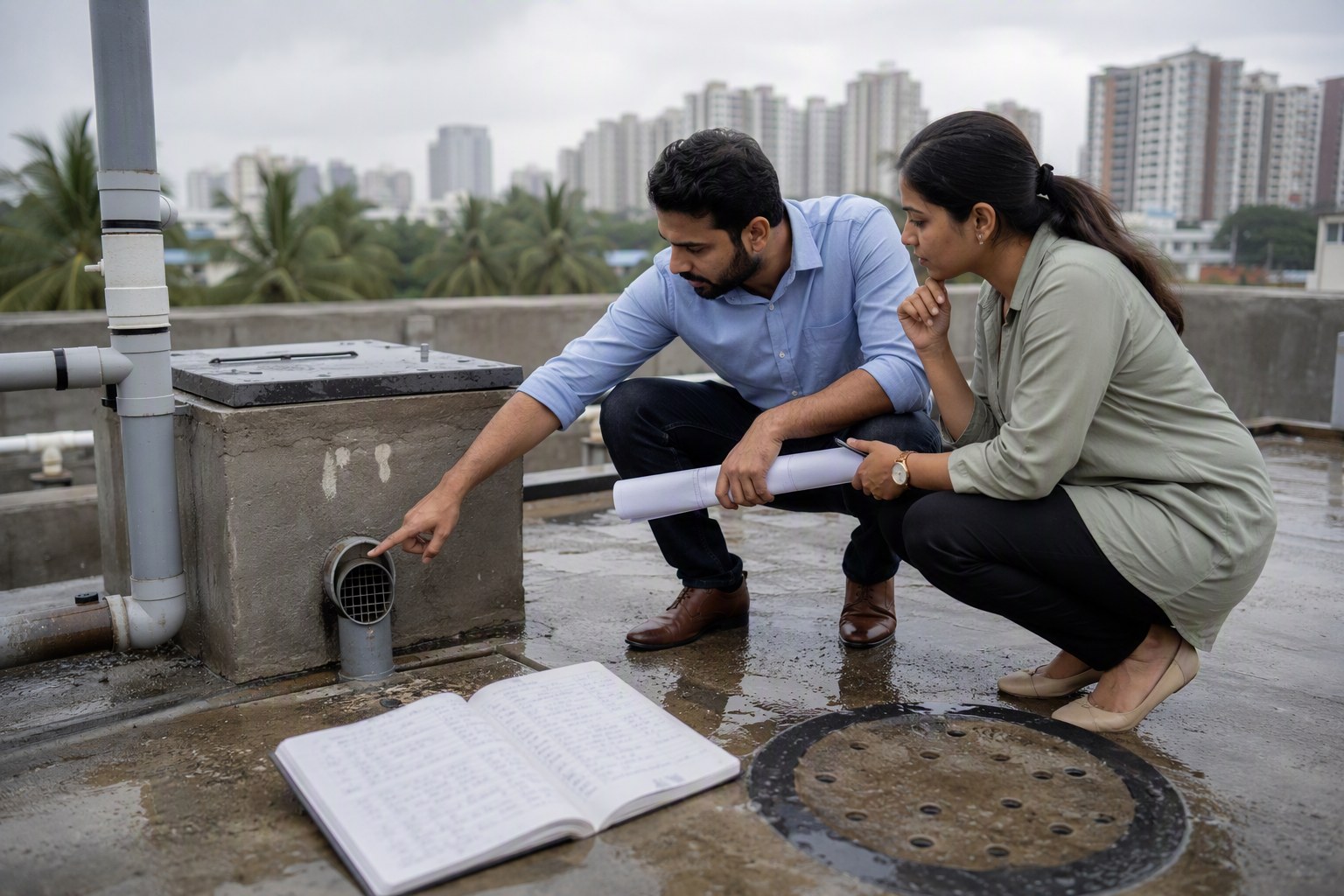
A roof is not just empty space. It carries water tanks, waterproofing layers, parapet walls, lift structures and service lines. Any solar installation must respect structural safety and waterproofing. Random drilling can create leakage that later affects top-floor flats. In older apartment blocks in Himayatnagar, Begumpet, Ameerpet, Tarnaka or Mehdipatnam, residents should be even more cautious because terrace waterproofing may already be aged.
Ask for a structural confirmation from a competent professional, especially for larger systems. Check panel mounting design, wind resistance, earthing and lightning safety. Keep walking paths open. Fire and rescue access should not be blocked. The association should maintain a terrace layout plan so that future repairs do not turn into arguments.
For new projects, buyers can also look at planning basics. Site shape, road width, open space and building massing affect how usable the terrace becomes. Tools like Road Width Check, FSI/FAR Calculator and Land Use Zone Finder are useful when you want to understand the project setting beyond the sales office pitch.
How to put solar promises into your sale documents
If rooftop solar is one reason you are choosing a flat, do not leave it outside the paperwork. Ask for a written clause or annexure. The wording should cover the exact nature of the promise, not a vague line like “green features as applicable”.
A useful clause should answer these points:
- Whether solar is included at handover or only provision is made.
- Whether the system serves individual flats or common-area load.
- Installed location and access rights on the terrace.
- Approximate equipment description without overpromising output.
- Who completes electricity-board and net-metering documentation.
- Who maintains the system after handover.
- What happens if permissions are refused or delayed.
For drafting or reviewing basic property clauses, buyers may use the Legal Document Generator as a starting point, then get a Telangana property lawyer to review the final version. Do not sign a blank or one-sided addendum in a hurry.
If you are still comparing the transaction cost of two flats, check the Stamp Duty Calculator and the Market Value / Guideline Value Search. Sustainable features are welcome, but they should not distract you from registration value, SRO jurisdiction, title flow and loan security.
Builder, association or flat owner: who should sign?
The signing authority depends on the project stage. Before handover, the builder usually controls construction decisions and utility coordination. After association formation and transfer of common areas, the association normally becomes the practical decision-maker for common terrace use. For individual installations, the flat owner may be the applicant, but only after getting permissions that the distribution company, association and building rules require.
In under-construction projects, insist that the builder gives the commitment in writing. In ready-to-move projects, speak to the association office-bearers, not only the resale seller. In newly handed-over projects, ask whether the association is formally registered and whether common meters, maintenance accounts and documents have been transferred.
For resale purchases, I would not rely only on a seller saying “society will allow”. Ask for minutes of meeting, written NOC or at least an email from the association. If the building already has solar, inspect whether it is functional and who is paying the maintenance bills.
Red flags in solar-ready apartment claims
- The brochure says solar-ready, but the sale agreement is silent.
- The terrace is shown as common area, but one flat is promised exclusive panel space.
- The builder cannot say whether solar connects to common meter or flat meter.
- The association has not been formed, but future permissions are casually promised.
- No one knows who will maintain panels after handover.
- Panels are proposed over water tanks, lift rooms or fire-access paths.
- The project land or title documents are not being shared for verification.
- Sales staff says “sir, all approvals will come later” without any written process.
One red flag alone may not mean the project is bad. But two or three together should slow you down. Token money is psychologically powerful. Once paid, many buyers feel committed and stop asking hard questions. Do the opposite. Ask harder questions before token.
Practical due diligence flow before you pay token
Here is the process we suggest to apartment buyers across Hyderabad, Rangareddy, Medchal-Malkajgiri and Sangareddy growth corridors:
- Shortlist the flat based on location, layout, budget and commute.
- Ask for project documents, RERA details where applicable, draft Agreement of Sale and sanctioned plan extracts.
- Read terrace and common-area clauses carefully.
- Ask the builder for the solar model in writing.
- Check whether the project land has any visible risk using verification tools and professional review.
- Speak to the association if it is a ready or resale apartment.
- Confirm net-metering applicant, consumer category and documentation responsibility.
- Put the final solar understanding in the agreement or annexure.
- Only then pay token.
This may sound slow, but it saves bigger friction later. Hyderabad buyers are becoming smarter about title, EC, Dharani records, pahani history, SRO jurisdiction and ready reckoner values. Solar claims deserve the same seriousness.
Our view: buy green, but buy documented
I like rooftop solar. For apartment communities, it can reduce common-area dependence on grid power and create a more responsible maintenance culture. But the benefit comes only when the ownership and paperwork are clean. A terrace dispute can spoil the whole idea.
For a buyer, the best position is simple: “I am happy to pay for a greener project, but show me the document.” If the builder has genuinely planned rooftop solar, they will have answers. If the claim is only a sales hook, your questions will expose it quickly.
In Hyderabad real estate, the terrace has always been a sensitive space. Solar has made it even more valuable. Before paying token for a solar-ready apartment, check ownership, permissions, net-metering path and maintenance responsibility. That one hour of document reading can save years of association arguments.
Frequently Asked Questions
Can I install rooftop solar for my own flat in an apartment?
Possibly, but only if terrace access, association permission, wiring route, safety clearance and electricity paperwork support it. In many apartments, common-area solar is easier than one flat owner using terrace space privately.
Is a solar-ready claim in a brochure legally enough?
No. Ask for the promise in the Agreement of Sale, sale deed annexure, specifications sheet or association handover documents. A brochure line is weak if a dispute comes later.
Who gives permission for rooftop solar after apartment handover?
Usually the apartment association or society controls common terrace decisions after handover. The exact authority depends on the sale documents, bye-laws and how common areas were transferred.
What should I ask before paying token for a solar-ready flat?
Ask who owns the terrace, whether solar is for your flat or common loads, who applies for net-metering, who maintains the system, and whether all this will be written into the sale documents.
Should I verify land and title even if the project has green features?
Yes. Green features do not replace title due diligence. Check RERA details where applicable, EC, SRO jurisdiction, prohibited-property status and core ownership documents before committing money.