Hyderabad Native Garden Homes: the attractive promise and the legal checklist
A buyer I met recently at a gated community near Kollur was almost sold before he saw the clubhouse. What caught his eye was not Italian marble or a glass balcony. It was a quiet native garden with kanuga, neem, hibiscus, tulasi patches, rain lilies, red soil beds and no thirsty carpet lawn. The sales team called it a low-maintenance Hyderabad Native Garden Homes concept. It looked sensible, local and cheaper to maintain. My first reaction was positive. My second reaction was the one I give every buyer: check whether the green story sits cleanly on approved layout plans, common-area rights, water permissions and title papers.
Hyderabad Native Garden Homes can be a genuine green upgrade when the developer has planned open spaces properly and handed them over correctly. They can also become a hidden risk when landscaping is used to dress up disputed land, buffer zones, road-widening areas, nala margins or land that residents cannot legally use as they were promised.
Our opinion: a native garden is a good feature, but it is not a substitute for land verification. In Hyderabad, the prettiest open space still needs a clean survey number, approved layout, clear common-area declaration and non-prohibited title.
Hyderabad Native Garden Homes: why buyers are suddenly paying attention
For many Hyderabad families, the old idea of luxury was a big lawn, palm trees and bright seasonal flowers. That model needs heavy watering, constant trimming and higher maintenance staff. In areas like Kokapet, Narsingi, Tellapur, Kollur, Mokila, Bachupally and Shankarpally, buyers are now asking a different question: why not plant local species that survive Hyderabad heat and use less water?
We have seen this shift especially in villa communities and plotted layouts on the western growth belt. In Gandipet mandal, Serilingampally mandal, Ramachandrapuram, Patancheru, Shankarpally and Moinabad, developers are using terms like native forest, Miyawaki patch, biodiversity garden, edible landscape and water-wise community. Some are doing good work. Others are simply converting the required open space into a marketing photo point.
Native planting itself is not the issue. In fact, it usually makes more sense than exotic grass lawns in Telangana. The risk starts when buyers assume that a green-looking area is automatically approved, owned by the association, free from mortgage, outside any prohibited list and protected for future use.
Hyderabad Native Garden Homes need approval checks, not just site visits
When you visit a project, the garden is visible. The legal status of that garden is not. That is why every buyer should ask: where exactly is this native garden shown in the approved plan?
In HMDA, GHMC and municipal layout approvals, open spaces are not casual areas. They are marked with purpose and dimensions. In plotted layouts, open space reservation and roads carry specific treatment. In apartment projects, common areas, amenities, setbacks, driveways and landscape pockets must match sanctioned drawings. If the sales brochure shows a forest walk where the sanctioned plan shows future road, transformer yard or utility area, the buyer has a problem waiting.
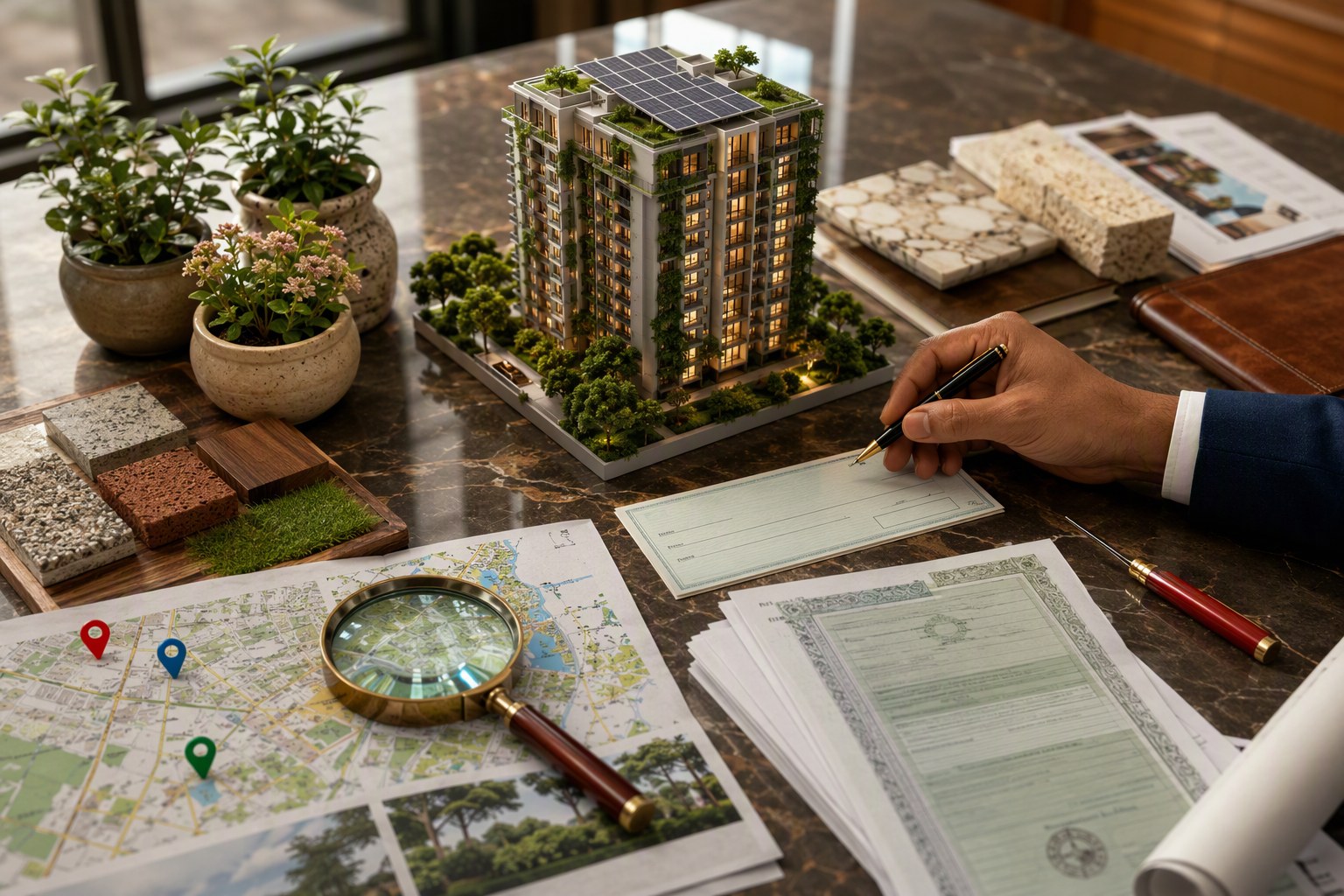
Use the project documents, not only the brochure. Ask for the sanctioned layout, building permission, RERA registration details, development agreement and land schedule. Then compare the garden location with survey numbers, block boundaries and common-area declaration. If the native garden is being shown on land outside the approved project boundary, treat it as a red flag.
What to ask the sales team at the site
- Is the native garden part of the approved layout or only a temporary landscaped area?
- Which survey numbers cover the garden portion?
- Is it common area, open space reservation, amenity area or private land retained by the landowner?
- Will the association get legal rights over it after handover?
- Is any part of it under mortgage to a bank or financial institution?
- Is the garden in a buffer zone, nala margin, lake FTL area or road-widening strip?
Before token advance, run the project through the RERA Project Lookup. RERA details should match the land extent, promoter name, approvals and development plan. For survey number clarity, use the Survey Number Finder and map the land parcel before getting carried away by landscaping.
The Section 22-A risk: green cover cannot cure prohibited land
Telangana has a serious prohibited property issue. As per the database fact available with us, there are 147934 prohibited properties under Section 22-A. That is not a small number. If any project land, approach road portion, open space or amenity-linked land falls under a prohibited category, registration can become difficult or impossible. A beautiful native garden will not fix that.
Section 22-A entries can include government land, assigned land, endowment land, wakf-related land and other notified categories. In Hyderabad and surrounding districts, buyers should be careful in older village revenue limits where agricultural land was converted over time into plotted layouts and gated communities. This is common in Rangareddy, Sangareddy, Medchal-Malkajgiri and Vikarabad growth corridors.
Do not check only the flat number or villa plot. Check the mother survey numbers. If the project land has multiple survey numbers, each one needs review. A garden is often placed at the edge of the layout, and edge parcels are where boundary disputes usually appear. Use the Section 22-A Prohibited Property Check before you pay a large booking amount.
Common-area rights: who will own the garden after handover?
This is where many buyers get trapped. The sales team says residents can use the native garden. But the sale deed may not say the same. The association may later discover that the developer retained ownership of an amenity parcel, gave only licence-based access, or clubbed the garden with a commercial component.
In an apartment community, the undivided share of land, common areas and facilities must be clear. In a villa community, the position can be more complicated. The internal roads, parks, clubhouses, STP area, water tanks and landscape zones may be transferred to an owners association, retained by the developer, or governed through a maintenance agreement. Buyers must read this carefully.
In our experience, residents often wake up only when maintenance charges rise. Native gardens are marketed as low-maintenance, but they still need gardeners, composting, pruning, pathway repairs, lighting, pest control and irrigation during dry months. If the association does not legally control the area, it may be paying for land it does not own.
Documents that should mention common-area rights
- Agreement of sale
- Registered sale deed
- Declaration of common areas and facilities
- Approved layout or building plan
- Association bye-laws
- Maintenance agreement
- RERA disclosures and project specifications
If the garden is a major selling point, insist that its legal status appears in writing. Oral promises at the model flat are not enough.
Water use rules: low-maintenance does not mean no water
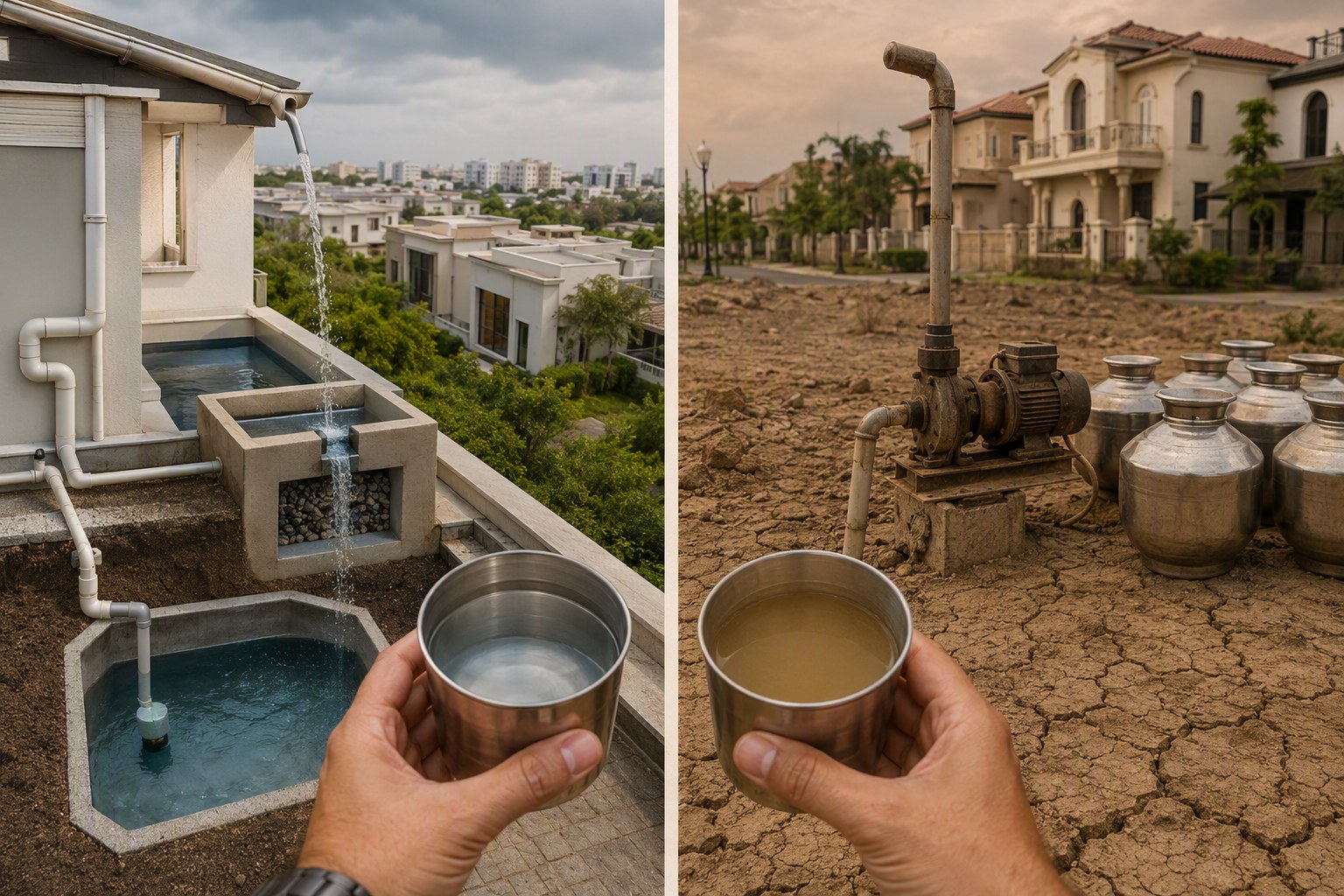
A native garden usually consumes less water than a large lawn, but Hyderabad buyers should still ask where the water comes from. Groundwater dependence is a sensitive issue in many outer-ring locations. During summer, tanker costs can disturb monthly maintenance budgets. In areas like Tellapur, Nallagandla, Kollur, Mokila and Bachupally, water planning is no longer a small operational matter.
Ask whether the garden uses treated water from the STP, harvested rainwater, borewell water or municipal supply. For larger communities, STP quality and reuse design matter. If treated water is used for landscaping, the developer must show proper pipelines, storage and maintenance arrangements. If borewells are the main source, buyers should be cautious, especially in rocky terrain and fast-growing layouts.
Native species reduce pressure, but they do not remove the need for a water budget. A good project will have rainwater harvesting pits, recharge wells, mulching, drip irrigation and seasonal planting plans. A weaker project will have a green launch-phase garden that slowly dries after handover.
Layout approvals and OSR: when the garden is not really an amenity
In many Hyderabad projects, the landscaped area shown to buyers may actually be open space reservation, setback, buffer or mandatory green area. That is not automatically bad. But buyers should know what it is, because each category carries different rights and restrictions.
For plotted layouts, open space is part of the approval framework. For larger developments, OSR calculations can affect usable land and amenity planning. If a developer sells the OSR visually as an exclusive club-like garden, residents may later face restrictions. The OSR Calculator can help buyers understand whether the open-space claim broadly aligns with project land extent, though final confirmation must come from sanctioned plans.
Similarly, road width, setbacks and land use zoning can affect whether promised landscape edges can remain as shown. A garden along a master plan road may shrink when road widening happens. A green strip next to a nala may be protected buffer, not a picnic lawn. Check road and zoning conditions through the Road Width Check and Land Use Zone Finder.
Price premium: are Hyderabad Native Garden Homes worth paying more for?
Yes, but only when the legal and maintenance structure is clean. A well-designed native garden can improve shade, reduce heat, support birds and pollinators, cut lawn maintenance and create a more liveable community. In villa clusters around Mokila, Shankarpally and Velimela, mature trees can make a serious difference to daily comfort. In apartment communities in Narsingi, Puppalaguda and Kondapur, shaded walking paths are more useful than decorative water fountains that stop working after two summers.
But I would not pay a premium only for the word native. I would pay for documented planning. The buyer should compare the project price with local market value and registration cost. In Telangana, typical property registration charges include 4% stamp duty, 1.5% transfer duty and 0.5% registration fee, making it 6% in many regular sale cases. Exact charges depend on property type and transaction nature, so calculate before budgeting.
Use the Market Value / Guideline Value Search to check official value, and the Stamp Duty Calculator to estimate registration outflow. If a developer is charging a green premium, the numbers should still make sense against nearby resale rates, ready reckoner value, carpet area, UDS and amenities.
Title clarity: native garden buyers should read the land history
Green homes often sit on converted agricultural lands in the Hyderabad periphery. That means the title trail may include old pahanis, Dharani records, pattadar passbooks, conversion proceedings, development agreements, GPA documents and partition deeds. Each link matters.
Take a simple example. A villa project in Shankarpally mandal may have multiple landowners. The developer may be building under a development agreement-cum-GPA. If one owner has family disputes, one survey number is under court case, or one portion is prohibited, buyers may face risk even if the garden and villas look ready.
Check the Encumbrance Certificate through the Encumbrance Certificate Search. Identify the correct SRO using the Find Your SRO Office. For a wider first-level check, use the Property Verification Tool. These tools do not replace a lawyer, but they help you ask sharper questions before you spend money on legal opinion.
Land records to review for peripheral projects
- Mother deed and link documents for at least 30 years where available
- Dharani status and pattadar details for land parcels
- Pahani or adangal history, especially before conversion
- NALA conversion or land-use conversion orders
- HMDA, DTCP, GHMC or municipality permissions
- RERA registration and sanctioned plan references
- EC for all survey numbers, not only the built unit
- Section 22-A prohibited property status
A practical site-visit checklist for Hyderabad Native Garden Homes
During the site visit, do not reject the emotional appeal of a nice garden. Homes are not bought only on Excel sheets. Shade, air, walking paths and community spaces matter. But carry a verification mindset.
| What you see | What you should verify | Why it matters |
|---|---|---|
| Native garden at project entrance | Approved layout boundary and ownership | Entrance land may include road-widening or access disputes |
| Forest walk or biodiversity patch | Common-area declaration and survey number | Residents need legal rights after handover |
| Rainwater harvesting pits | Sanctioned drainage and recharge plan | Bad drainage can flood basements and lower plots |
| Low-maintenance claim | Maintenance budget and water source | Native plants still need care in summer |
| Large open green parcel | OSR, buffer, FTL, nala and zoning status | Some green land may not be usable as an amenity |
| Premium pricing | Guideline value, resale rates and registration cost | Green premium should not hide overpricing |
One more point: ask who designed the landscape. A credible project will usually have a landscape architect, irrigation plan and species list. If the answer is vague, the garden may be only a sales-stage installation.
Red flags I would not ignore
- The brochure shows a garden, but the sanctioned plan does not mark it clearly.
- The developer refuses to share survey numbers or land schedule.
- The garden lies outside the compound wall or beyond the approved project boundary.
- Sales staff says the area is common, but the agreement is silent.
- There is no RERA match for promised amenities.
- Water source is only borewell, with no STP reuse or rainwater plan.
- The land has unclear Dharani status or old family disputes.
- Any survey number appears under Section 22-A or other restriction.
- Open space is being marketed as exclusive private amenity when approval treats it differently.
My view on green claims in Hyderabad real estate
I like the native garden trend. Hyderabad badly needs shade, better soil treatment and less ornamental water waste. Communities that plant neem, pongamia, jamun, peepal in suitable locations, flowering shrubs, medicinal plants and hardy ground cover are doing something sensible. Children get better outdoor spaces. Seniors get cooler walking loops. Maintenance teams spend less time fighting dying lawns.
But buyers should separate sustainability from sales language. A project is genuinely green only when its land, approvals, water system and long-term maintenance are aligned. Otherwise, it is just landscaping over legal uncertainty.
If you are evaluating Hyderabad Native Garden Homes in Kokapet, Tellapur, Kollur, Mokila, Bachupally, Narsingi, Shankarpally or any fast-growing Hyderabad edge, follow this order: verify land first, approval next, common rights after that, water plan after that, and only then discuss price premium. That order has saved many buyers from expensive mistakes.
A native garden can be a strong reason to choose one project over another. Just make sure the garden is not sitting on weak paperwork.
Frequently Asked Questions
Are Hyderabad Native Garden Homes legally safer than regular projects?
No. Native landscaping does not change title risk. You still need to check survey numbers, RERA details, sanctioned plans, EC, Dharani records and Section 22-A status before purchase.
How do I know if the native garden is part of the approved layout?
Ask for the sanctioned layout or building plan and locate the garden area on it. Match it with the land schedule, survey numbers and common-area declaration. Do not rely only on brochure images.
Can a developer sell open space as a garden amenity?
A developer can landscape approved open space, but buyer rights depend on the approval category and sale documents. OSR, setbacks, buffers and private retained land have different legal treatment.
What water checks should I do before buying a green home in Hyderabad?
Ask whether landscaping uses STP-treated water, rainwater harvesting, drip irrigation or borewell water. Also check summer maintenance costs, tanker dependence and handover responsibilities.
Which tools help verify a Hyderabad green housing project?
Use RERA lookup, EC search, guideline value search, Section 22-A prohibited property check, survey number finder, OSR calculator and land-use zone finder before paying a token advance.