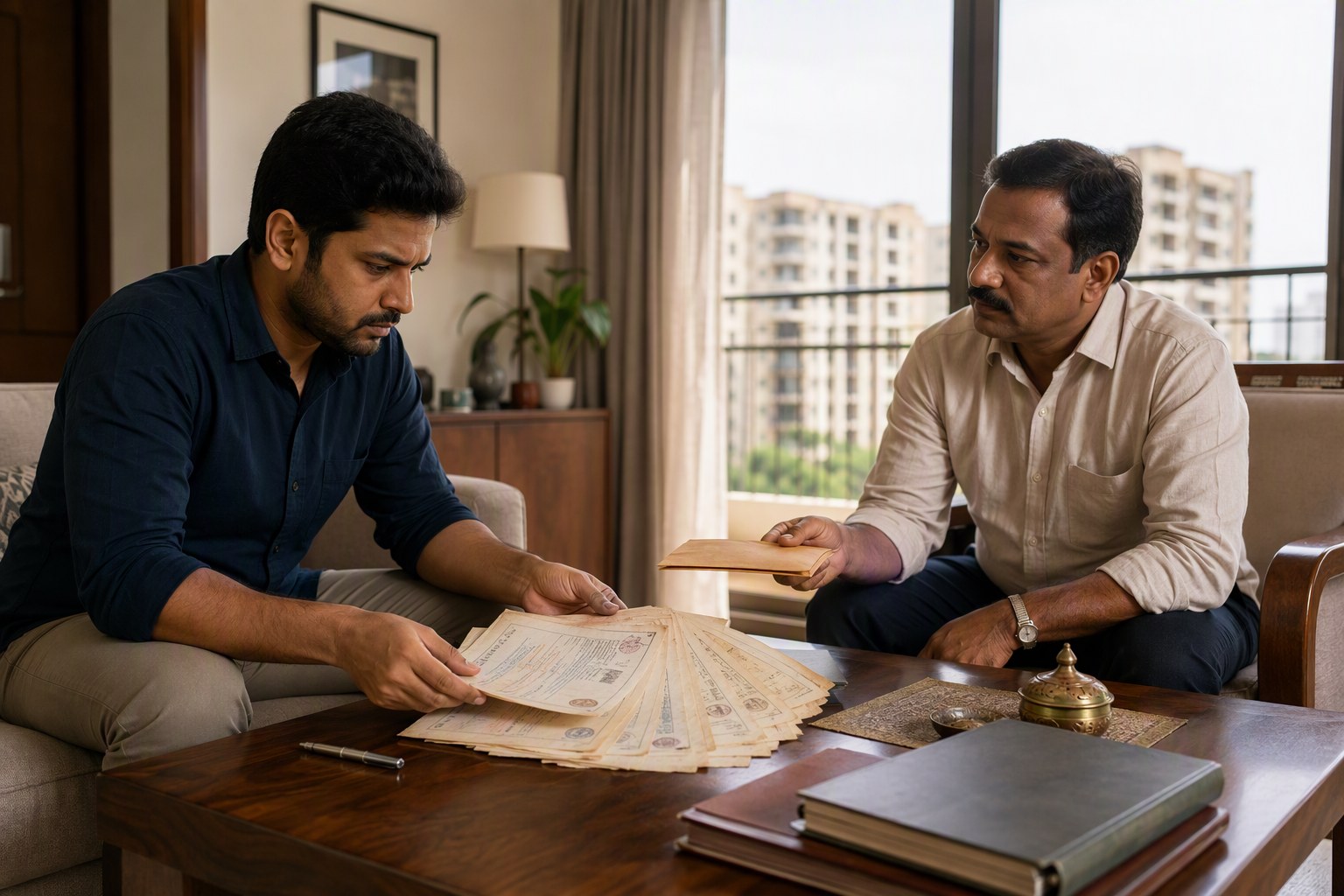



Mutation Records Become a Closing-Day Test for Sellers
Mutation Records have become one of the first files buyers, bankers and document writers are asking for before a Hyderabad property sale moves to registration. The old style of keeping mutation, pahani, khata and SRO records pending till the last week is now risky. If the seller name in revenue or municipal records does not match the link documents, Aadhaar, PAN, EC or family partition papers, the buyer can stop payment, the bank can hold the loan file, and the SRO visit can get postponed.
Our view is simple: sellers should treat mutation clean-up as a pre-sale task, not a closing-day headache. In Telangana, the title story must match across Dharani, pahani, municipal tax records, EC, link documents and any bank charge records.
This is becoming sharper in Hyderabad growth corridors such as Kokapet in Gandipet mandal, Tellapur around Ramachandrapuram and Sangareddy side, Mokila in Shankarpally mandal, Gachibowli in Serilingampally mandal, Bachupally, Patancheru, Maheshwaram, Shamshabad, Medchal and Uppal. Buyers are paying careful attention because land values, loan exposure and resale expectations are high. Banks are also not comfortable with loose ownership trails, especially where a property has moved from agricultural to layout, from ancestral holding to sale deed, or from plotted land to apartment share.
Before fixing the sale price, sellers should check market value, EC and SRO mapping. Use the Market Value / Guideline Value Search, Encumbrance Certificate Search and Find Your SRO Office before promising a registration date to the buyer.
Mutation Records are now checked before money changes hands
Earlier, many sellers treated mutation as a buyer-side issue. The common line was: take the sale deed first, mutation you can do later. That approach may still work in a simple cash sale between known families, but it is not how serious urban transactions are moving now. In our experience, buyers in Hyderabad are asking for a cleaner document packet before paying the major advance.
The practical reason is not hard to understand. Mutation does not create ownership by itself. A registered sale deed, gift deed, partition deed, release deed or court order carries the main title value. But mutation shows whether the revenue or municipal record has accepted that ownership change for day-to-day administration. When the mutation column shows an old owner, a deceased family member, a spelling variation, a missing survey sub-division or a wrong extent, the buyer starts asking: what else is pending?
For agricultural land and former agricultural parcels, the check usually begins with Dharani, pattadar details, pahani and survey number history. For municipal properties, the buyer looks at property tax mutation, door number, assessment number, building permission papers, occupancy documents where applicable, and the chain of registered deeds through the SRO. In apartments, the focus shifts to undivided share, link deeds, builder land title, RERA registration where relevant, society or association records, and the seller's loan closure papers.
That is why a mutation mismatch has become a closing-day test. It is not a small clerical issue when the buyer's bank says the name in the revenue record and the name in the proposed sale deed do not speak the same language.
Mutation Records and the Telangana title trail: what sellers must align
A Telangana property sale is rarely judged from one document alone. Buyers and lenders compare multiple records. If the same owner, same survey number, same extent and same property description appear consistently, confidence improves. If every document tells a slightly different story, the file slows down.
For sellers, the title trail should be checked across these records:
- Registered link documents: sale deed, gift deed, partition deed, settlement deed, release deed, development agreement or GPA where applicable.
- Encumbrance Certificate: SRO record of registered transactions, mortgages, releases and other registered interests.
- Mutation entry: revenue or municipal record showing change of owner after the registered transaction.
- Pahani or Dharani details: relevant for agricultural and converted land parcels, especially in mandals around Hyderabad expansion zones.
- Property tax record: GHMC, municipality or gram panchayat assessment where the property is built-up or plotted in a local body area.
- Layout or building approvals: HMDA, DTCP, municipal permissions and occupancy-related papers where applicable.
- Bank charge records: loan closure, release deed and CERSAI charge status for mortgaged properties.
- Section 22-A status: whether the property appears in prohibited property records.
As per the latest database available to Verified.RealEstate, prohibited properties under Section 22-A stand at 3,076,153. Sellers should not ignore this check, especially for land parcels, assigned land history, government land boundaries, endowment-related lands, wakf-related claims or old village records. A clean sale conversation starts with a basic prohibited property check through the Section 22-A Prohibited Property Check.
Mutation Records problems we are seeing in Hyderabad deals
Hyderabad's property market has a special mix: old village land, new layouts, high-rise apartments, HMDA corridors, gram panchayat legacy approvals, ORR-side investments and family-held ancestral land. This mix creates document mismatches that sellers often discover only after accepting an advance.
| Mismatch seen by buyer or bank | Where it often appears | Why it delays closing |
|---|---|---|
| Seller name differs between mutation record and sale deed | Older houses in Uppal, LB Nagar, Secunderabad and core city colonies | Bank asks for proof of name change, legal heir flow or correction record |
| Survey number or extent differs from pahani and registered deed | Mokila, Shankarpally, Moinabad, Maheshwaram, Shamshabad and Medchal side parcels | Buyer fears boundary, sub-division or shortfall risk |
| Old owner still appears in property tax record | Villas and independent houses in Narsingi, Manikonda, Bachupally and Yapral | Buyer wants municipal mutation before final payment or soon after registration |
| EC shows mortgage but seller claims loan is closed | Apartments in Gachibowli, Kondapur, Miyapur, Kukatpally and Nallagandla | Bank insists on registered release or clear closure proof |
| Layout approval name differs from present seller chain | Plotted layouts around Patancheru, Shadnagar, Adibatla and Hayathnagar belt | Document writer may ask for parent deed and developer link papers |
The fastest first scan is the Property Verification Tool. For survey-level checks, sellers can also use the Survey Number Finder. For loan-related doubts, use the CERSAI Charge Check. These tools do not replace legal opinion, but they help sellers identify the weak spot before the buyer's lawyer finds it.
Mutation Records are not title, but buyers treat them as risk signals
One common mistake is to argue that mutation is only a revenue entry, so the buyer should not ask about it. Legally, that statement has some truth. Practically, it does not win the deal.
A buyer putting family savings into a flat in Kondapur or a plot in Kollur wants a file that looks clean. A bank funding the purchase wants enforceable security. A document writer preparing the sale deed wants the property description to match with earlier documents. The SRO staff will look at the registration file from the point of stamp duty, property identity, parties and prohibited status. Each person is looking from a different angle, but a mutation mismatch gives everyone a reason to pause.
We have seen sellers lose negotiation strength because they delayed basic corrections. Once the buyer identifies a defect, every discussion becomes defensive. The buyer may ask for retention money, lower the price, delay the balance payment, or demand that the seller complete mutation first. In premium pockets like Jubilee Hills, Film Nagar, Kokapet, Financial District and Tellapur, even a small doubt can become a large negotiation point because ticket sizes are high and bank scrutiny is strict.
The better approach is to prepare a pre-sale title packet. Include the latest EC, parent documents, mutation extract, property tax receipt, approved plan where relevant, loan closure papers and ID name consistency proof. If the property is land, add pahani, Dharani details, survey sketch where available and local body approval papers. If it is an apartment, add sale deed, link land papers shared by builder, occupancy or completion-related records where applicable, association NOC if required by the society, and maintenance dues proof.
Mutation Records clean-up before fixing the registration date
Do not wait for the sale agreement to start correction work. Some corrections are simple; some need family consent, legal heir documents, local body mutation, revenue application or SRO-level support documents. A seller who starts early controls the timeline. A seller who starts after advance receipt may get trapped between buyer pressure and government processing time.
Here is a practical pre-sale workflow we recommend for Telangana sellers:
- Pull the latest EC: Use Encumbrance Certificate Search and compare every transaction with your physical document set.
- Check guideline value: Use Market Value / Guideline Value Search for the exact village, ward, survey number or locality category. Do not rely on WhatsApp ready reckoner screenshots.
- Confirm SRO jurisdiction: Use Find Your SRO Office, because wrong SRO assumptions waste time during deed preparation.
- Verify Section 22-A status: Use Section 22-A Prohibited Property Check before taking a serious advance.
- Check survey identity: For land, compare sale deed schedule with pahani and field identity using Survey Number Finder.
- Check bank charge: If there was any loan, verify closure support and use CERSAI Charge Check.
- Track future changes: For longer negotiations, monitor unexpected changes through Property Change Tracker.
- Estimate duty and cost: Before signing the agreement, run numbers through the Stamp Duty Calculator.
For apartments under an active or recently completed project, buyers may also ask for project registration details. Sellers can use the RERA Project Lookup where relevant. For older resale flats, the key focus is usually title chain, EC, loan release, undivided share and municipal records.
Mutation Records and ready reckoner value: why sellers should not guess
One area where Hyderabad sellers still make mistakes is stamp duty planning. They hear a market rate in Kokapet, Nallagandla, Bachupally or Mallampet and assume the registration value will be easy to estimate. But guideline value depends on the exact property classification, village or ward, road, land use and SRO records. The ready reckoner value is not the same as the final negotiated market price.
A seller may agree to a price with the buyer and later discover that the registration value conversation needs better clarity. That can affect stamp duty planning, TDS discussion, capital gains estimate and buyer loan structure. We are not quoting locality-wise rupee rates here because a wrong rate is worse than no rate. Sellers should verify the live government market value for the exact property and then discuss the sale agreement.
For tax planning, use the Capital Gains Tax Calculator. For built-up properties where land and structure value both matter, the Building Value Calculator and Composite Value Calculator can help prepare a cleaner discussion with your accountant and buyer.
How sellers should handle name, extent and inheritance mismatches
Name mismatch is the most common issue. It may be as small as initials appearing differently, or as serious as a deceased owner still appearing in the record. For simple spelling differences, keep identity proofs, affidavits where advised and supporting records ready. For inherited property, do not assume that one family member can sell just because he is managing the property tax. Buyers will ask for legal heir flow, family settlement, release deed, partition deed or other valid transfer documents.
Extent mismatch is more sensitive. If the sale deed says one extent and the pahani or layout record shows another, get proper professional advice before marketing the property. In areas such as Shankarpally, Moinabad, Chevella, Maheshwaram and Shamshabad, old agricultural extents, sub-divisions and layout carving can create confusion. A buyer's lawyer may ask for survey support, conversion details or approval chain.
Boundary mismatch also deserves early attention. A deed schedule with old landmarks like neighbour's field, cart track or nala may not satisfy a modern buyer without updated supporting records. If the land is near a road widening zone, lake buffer, nala, ORR service road, conservation belt or industrial zone, check planning restrictions before giving assurances. Tools like Road Width Check and Land Use Zone Finder can help start that review.
Mutation Records checklist before you accept the advance
Sellers should not wait for the buyer's advocate to prepare this checklist. Keep it ready before the first serious site visit:
- Latest registered title deed in the seller's name.
- Parent documents and link documents in readable copies.
- Latest EC covering the relevant transaction history.
- Mutation record, pahani or municipal tax mutation as applicable.
- Property tax receipt or local body assessment details.
- Dharani details for agricultural land or former agricultural land.
- Approved layout, building permission or occupancy-related papers where applicable.
- Loan closure letter, release deed and CERSAI status if the property was mortgaged.
- Legal heir, release, partition or family settlement papers for inherited property.
- Section 22-A prohibited property status check.
- Guideline value and SRO jurisdiction confirmation.
After this, prepare the sale agreement carefully. Use the correct property schedule, payment stages, responsibility for pending mutation or tax dues, original document handover date and loan closure steps. Sellers can generate draft support through the Legal Document Generator, but a property lawyer should review the final agreement before signing.
Our seller-side opinion on Mutation Records
Clean mutation does not guarantee a perfect title. A bad sale deed cannot become good merely because a revenue entry was changed. Still, mutation is a strong comfort document in the real market. It shows that the ownership change has travelled beyond the SRO record into the day-to-day land or municipal system.
If you are selling in Hyderabad, treat mutation like a front-door document. Keep it in the first file, not the last file. Buyers are becoming sharper. Banks are becoming stricter. SRO-side checks are more system-driven than before. And with 3,076,153 prohibited property entries under Section 22-A in the latest database available to Verified.RealEstate, no seller should assume that old village records will never come up.
The strongest sellers are not always the ones with the highest asking price. They are the ones who can answer document questions calmly, show matching records, and give the buyer confidence that registration will not collapse at the last counter.
Frequently Asked Questions
Do Mutation Records prove ownership in Telangana?
No. Mutation Records do not create title by themselves. Registered deeds, court orders and valid transfer documents carry the main title value. But mutation supports the ownership trail and is closely checked by buyers and banks.
Can I sell my Hyderabad property if mutation is still in the old owner name?
It depends on the title chain and buyer comfort. Many buyers and banks will ask you to correct the record or provide strong supporting documents before registration. It is safer to clean it up before accepting a major advance.
Which records should match before selling land near Hyderabad?
The sale deed, EC, mutation record, pahani or Dharani details, survey number, extent, boundaries, Section 22-A status and SRO jurisdiction should be checked together. For layout plots, approval and local body records also matter.
Why are banks strict about mutation and EC mismatches?
Banks fund the buyer against the property as security. If the seller name, mortgage release, survey identity or ownership trail is unclear, the bank may hold the file until proper proof is submitted.
What should sellers check before fixing the registration date?
Check the latest EC, mutation record, property tax record, guideline value, SRO office, loan closure papers, CERSAI charge and Section 22-A status. Resolve mismatches before the buyer books the registration slot.