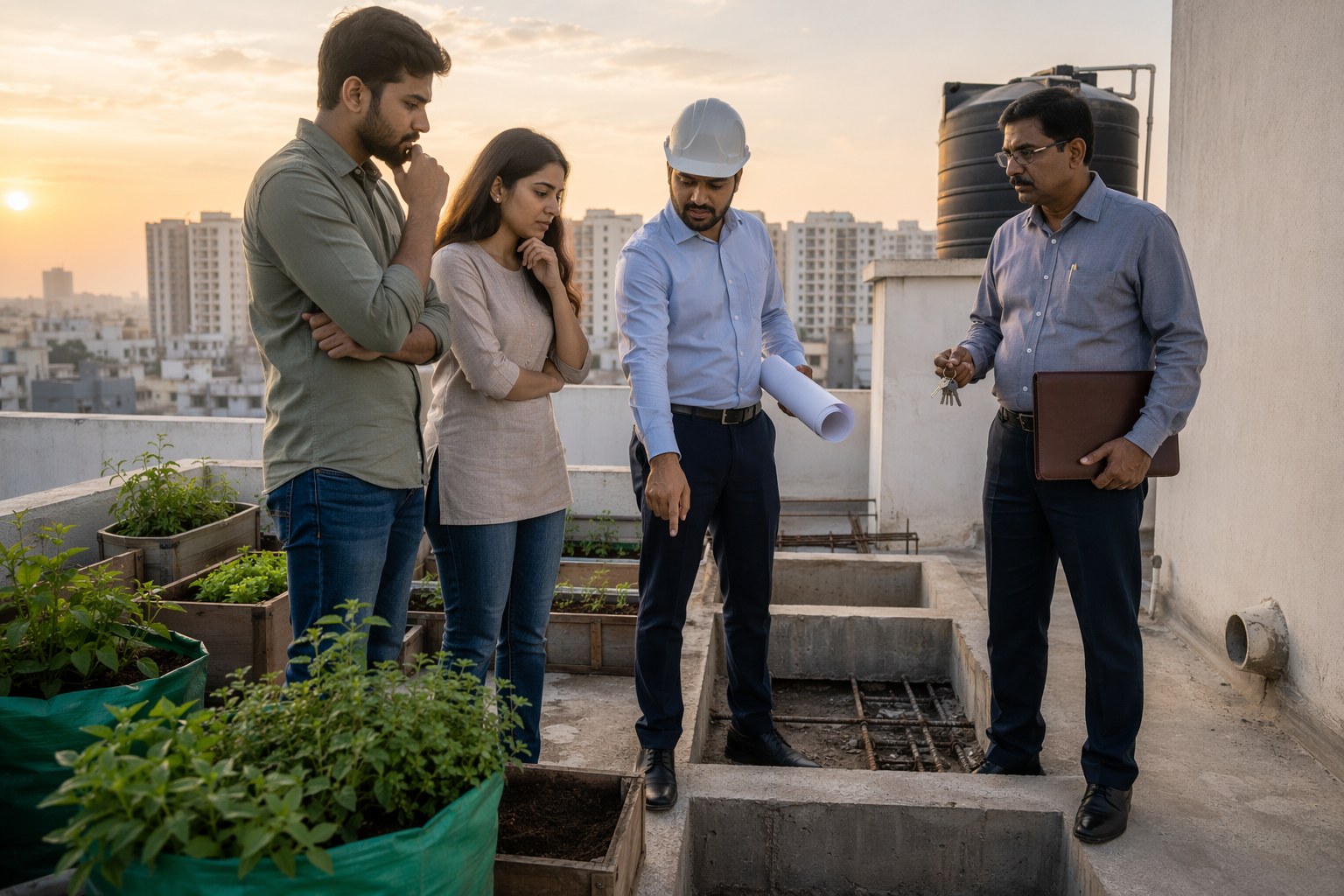



Hyderabad Heat Pump vs Solar Geyser is no longer a small appliance debate. For many homeowners in Kondapur, Kukatpally, Nallagandla, Manikonda, Tellapur and Mokila, hot water systems are becoming part of the larger green home story. My short answer: solar geysers are excellent for independent houses with usable terrace rights, while heat pump water heaters usually make better sense for apartments where terrace access, pipe routing and association approvals are tricky.
Both can reduce electricity use compared with a regular electric geyser. But the right choice depends on your house type, family size, bathroom layout, terrace control, maintenance comfort and even future resale positioning. In Hyderabad, where summer heat is strong, winters are mild and apartments dominate the western corridor, the decision is more practical than emotional.
In our experience, a green upgrade sells better when it is documented, easy to maintain and does not create a dispute with the apartment association. Buyers like savings, but they dislike confusion over terrace rights.
Hyderabad Heat Pump vs Solar Geyser: quick verdict
| Factor | Heat pump water heater | Solar geyser | Hyderabad verdict |
|---|---|---|---|
| Best fit | Apartments, villas with shaded terraces, homes with utility balconies | Independent houses, villas, farmhouses, low-rise buildings | Heat pump wins in apartments; solar wins in independent homes |
| Typical 200-litre system cost | ₹75,000 to ₹1.25 lakh | ₹35,000 to ₹65,000 | Solar is cheaper upfront |
| Approx daily electricity use for 200 litres | 1.8 to 2.5 units | 0 to 2 units depending on sun and backup heater use | Solar is cheapest on sunny days; heat pump is more predictable |
| Space needed | 4 to 8 sq ft, needs ventilation | 20 to 40 sq ft terrace area for 200 LPD | Heat pump saves terrace space |
| Apartment permission | Usually easier if noise, drainage and placement are handled | Difficult unless terrace rights and common area use are clear | Heat pump is society-friendly |
| Maintenance | Filter cleaning, compressor check, descaling in hard-water zones | Tube cleaning, tank check, scaling, plumbing leaks | Both need annual service |
| Resale appeal | Good for premium apartments and tech-corridor buyers | Strong for villas and standalone houses | Depends on buyer profile |
If you live in a 2 or 3 BHK apartment in Gachibowli, Miyapur, Bachupally or Nanakramguda, I would first check whether a heat pump can sit in the utility balcony with proper air circulation. If you own an independent house in Kompally, Shankarpally, Mokila, Tukkuguda or Adibatla, I would first check terrace direction and sunlight for a solar geyser.
Hyderabad Heat Pump vs Solar Geyser running cost in rupees
Let us take a common Hyderabad family setup: 4 members, two bathrooms, 200 litres of hot water per day, water temperature rise of around 25°C. A normal electric storage geyser may consume roughly 6 to 8 units a day depending on usage discipline, thermostat setting and inlet water temperature. At higher domestic consumption slabs, many Hyderabad households effectively feel electricity at around ₹7 to ₹9 per unit after energy charges, fixed charges and monthly usage pattern are considered.
Here is a practical cost comparison.
| System | Likely units per day | Monthly units | Approx monthly running cost at ₹8/unit |
|---|---|---|---|
| Regular electric geyser | 6 to 8 units | 180 to 240 units | ₹1,440 to ₹1,920 |
| Heat pump water heater | 1.8 to 2.5 units | 54 to 75 units | ₹432 to ₹600 |
| Solar geyser with electric backup | 0 to 2 units | 0 to 60 units | ₹0 to ₹480 |
On pure running cost, solar geyser wins during sunny months. Hyderabad has long spells of strong sun, so a well-placed 200 LPD solar water heater can run with very little backup for much of the year. But December mornings, cloudy spells and shaded terraces will increase backup heater use.
A heat pump is not zero-electricity. It uses electricity to move heat from surrounding air into water. But because Hyderabad air is warm for most months, it performs well. A coefficient of performance around 3 means it can deliver about 3 units of heat for every 1 unit of electricity consumed. In plain Indian English, you get electric-geyser comfort at a much lower monthly bill.
Upfront cost and payback period in Hyderabad homes
For a 200-litre family system, solar geysers usually cost less to buy. A basic evacuated tube collector system may start near ₹35,000, while better tanks, pressure pumps, branded fittings and flat plate collectors can take it towards ₹65,000 or higher. Heat pump water heaters are costlier, commonly around ₹75,000 to ₹1.25 lakh for branded 150 to 300-litre systems.
Payback changes with your current geyser usage. A family using hot water daily in two bathrooms may save ₹900 to ₹1,400 a month over a regular electric geyser. At that rate, a solar geyser may recover its cost in 3 to 5 years. A heat pump may take 5 to 7 years, though premium apartments may value the upgrade beyond bill savings.
For rented flats, I would not recommend either unless the landlord agrees to share cost or increase lease tenure. For self-occupied homes, the calculation is different. If you plan to live there for at least five years, both options deserve serious consideration.
Terrace space: the point where solar geysers lose many apartment buyers
Solar geysers need open terrace area. A 200 LPD setup can occupy around 20 to 40 sq ft including tank, collector angle and service movement. That sounds manageable for a villa in Narsingi or Bandlaguda Jagir. But in a 15-floor gated community in Kokapet or Financial District, terrace is a common area. You cannot simply place your private tank there because your bathroom needs hot water.
Apartment associations usually worry about four things:
- Common terrace access and fairness between residents
- Waterproofing damage due to drilling and pipe supports
- Pipe shaft routing from terrace to individual flats
- Structural load, leakage complaints and future maintenance responsibility
Even if the builder has provided solar hot water lines, check whether it is centralised for all flats or only for top floors. We have seen cases in Serilingampally mandal where owners assumed solar connection was available, but the builder had only left a provision without full working infrastructure.
Heat pumps do not need large terrace panels. They need a ventilated balcony, service area, terrace corner or utility space. A compact unit may take 4 to 8 sq ft. The catch is air circulation. If you lock it inside a closed utility shaft, performance drops and compressor life suffers. The unit also releases cool air and condensate water, so drainage must be planned properly.
Apartment permissions: heat pump is easier, but not automatic
In Hyderabad apartments, permission is often the real decision-maker. For solar geysers, you need society approval for terrace usage, pipeline changes and sometimes external elevation changes. For a heat pump, you may still need approval if the unit is visible from the facade, fixed to external walls or placed near another flat's bedroom window.
Noise levels for modern heat pump water heaters are often around 45 to 55 dB, similar to a quiet outdoor AC unit. But in dense apartment blocks at HITEC City, KPHB, Chandanagar or Puppalaguda, even small machine noise can become a WhatsApp group issue. Place it sensibly, use anti-vibration pads and ensure condensate does not drip onto the flat below.
Before spending money, ask the association for written permission. Not a casual nod from the security supervisor, not a verbal okay from a committee member. Get an email or signed approval. This matters during resale too. Buyers may ask whether the equipment is permitted and transferable.
Water quality in Hyderabad: do not ignore scaling
Hyderabad water quality changes sharply by locality and season. HMWS&SB supply, borewell water and tanker water have different hardness levels. In areas like Manikonda, Nallagandla, Tellapur, Bachupally and parts of LB Nagar, many homes depend partly on bore or tanker water. Hard water means scaling inside tanks, pipes, heat exchangers and solar tubes.
Solar geysers are exposed to direct heating and can accumulate scale faster if water treatment is poor. Heat pumps also need descaling, especially in the heat exchanger and storage tank. If your home already has white deposits on bathroom fittings, budget for annual maintenance. A small water softener or anti-scale system may save money over time.
My opinion: do not buy the cheapest system just because the brochure says 200 LPD. Ask about tank material, warranty terms, service network in Hyderabad, pressure compatibility, safety valve, anode rod and hard-water support. A good installer is more valuable than a fancy catalogue.
Which is greener for Hyderabad: solar or heat pump?
Solar geyser is greener when sunlight is available and the system is correctly installed. It directly uses solar heat, so daily electricity draw can be close to zero. For villas and independent houses, that is hard to beat.
Heat pump is greener than a normal electric geyser because it cuts electricity consumption by roughly 60% to 70% in many household patterns. It is also more flexible. If your apartment already has rooftop solar for common areas or you have green power sourcing in the future, a heat pump becomes even cleaner.
For a Hyderabad apartment owner, I would rather see a well-installed heat pump than an illegal solar geyser sitting on a common terrace. Sustainability should not start a property dispute. The better green choice is the one that works for ten years without annoying the association, damaging waterproofing or becoming dead equipment.
Resale appeal: what buyers notice in Hyderabad
Green upgrades are slowly entering resale conversations in Hyderabad. In premium flats at Gachibowli, Kokapet, Narsingi, Nanakramguda and Jubilee Hills, buyers do ask about monthly maintenance, power bills, EV charging, solar provisions, insulation and water systems. A heat pump water heater can signal that the flat is thoughtfully upgraded. It is neat, measurable and apartment-compatible.
For villas in Mokila, Shankarpally, Kollur, Tellapur, Kompally and Tukkuguda, solar geysers still carry strong appeal. Villa buyers expect terrace utility. They also like visible, practical upgrades such as solar hot water, rooftop solar power, rainwater harvesting and kitchen garden space.
But green equipment cannot repair weak title. Telangana has 147,934 prohibited properties listed under Section 22-A. That number should remind every buyer that legal verification comes first, then fittings and finishes. Before buying a resale home with green upgrades, check the ownership trail, permissions and property status. Start with our Section 22-A Prohibited Property Check, then use the Encumbrance Certificate Search to see registered transactions. If you are comparing sale price with official values, the Market Value / Guideline Value Search is useful.
For new apartments, also check the project on the RERA Project Lookup. If you are calculating total acquisition cost, including stamp duty and registration, use the Stamp Duty Calculator. In our work, buyers who do these checks early negotiate better and avoid last-minute shocks at the SRO.
Locality-wise recommendation: Hyderabad Heat Pump vs Solar Geyser
| Locality type | Examples | Better option | Why |
|---|---|---|---|
| High-rise apartment clusters | Kokapet, Nanakramguda, Gachibowli, KPHB | Heat pump | Limited terrace rights and easier balcony placement |
| Mid-rise gated communities | Miyapur, Bachupally, Chandanagar, Nallagandla | Heat pump or central solar if builder provided | Depends on association rules and utility balcony size |
| Independent houses | Uppal, Alwal, Dilsukhnagar, Vanasthalipuram | Solar geyser | Terrace control and good sun exposure |
| Villas and plotted developments | Mokila, Kollur, Tellapur, Kompally, Tukkuguda | Solar geyser, with heat pump backup in premium homes | Large terrace, higher hot water use and resale appeal |
| Shaded or compact homes | Dense lanes in old city areas, narrow plots in core zones | Heat pump | Sun exposure may be poor |
One more practical point: west Hyderabad apartments often have small utility balconies already filled with washing machine, gas pipeline, RO outlet and AC outdoor units. Measure before you buy. A heat pump needs service access, not just space for installation day.
Buyer checklist before installing either system
For heat pump water heaters
- Check whether the utility balcony has enough ventilation.
- Confirm electrical load and MCB rating with an electrician.
- Ask the association about facade, drainage and noise rules.
- Keep clearance for service technicians.
- Check warranty on compressor and tank separately.
- Ask installer about performance during winter mornings.
For solar geysers
- Confirm terrace ownership or common-area permission in writing.
- Check south-facing or open-sky exposure without lift-room shadow.
- Verify waterproofing method before drilling.
- Confirm whether the system is pressurised or non-pressurised.
- Use insulated hot water piping to reduce heat loss.
- Plan descaling if borewell or tanker water is hard.
If you are buying a property mainly because it has green home features, do not stop at appliance checks. Use the Property Verification Tool for a wider title review and the Find Your SRO Office tool if you need to trace registration jurisdiction. For plotted homes, survey identity also matters; our Survey Number Finder can help you begin that check.
Final opinion: which one should you choose?
For most Hyderabad apartments, I would choose a heat pump water heater. It is costlier upfront, but it respects apartment living better. No terrace fight, no long pipe runs from the top floor, no waterproofing drama, and predictable savings over a regular electric geyser.
For independent houses and villas, I would choose a solar geyser first. Hyderabad sun is a free asset, and a good 200 or 300 LPD solar system can serve a family very well. If the home has premium bathrooms, rainfall showers or higher morning demand, combine solar with a smart electric backup or heat pump support.
The greener upgrade is not the same for every home. In Serilingampally mandal high-rises, heat pump wins. In Shankarpally and Gandipet villas, solar often wins. In older core-city houses with shaded terraces, heat pump may again come back into the race. Match the system to the building, not to the sales pitch.
Frequently Asked Questions
Is a heat pump water heater better than a solar geyser in Hyderabad apartments?
Usually yes. Heat pumps need less space and do not depend on common terrace rights. You still need proper ventilation, drainage and society permission if the unit affects facade or neighbours.
Does a solar geyser work well in Hyderabad winters?
Yes, on most sunny days it works well because Hyderabad winters are mild. During cloudy days or early mornings, you may need electric backup, especially for larger families.
What is the running cost difference between heat pump and solar geyser?
A 200-litre heat pump may use about 54 to 75 units a month. A solar geyser may use 0 to 60 units depending on sunlight and backup use. Solar is cheaper on sunny days; heat pump is steadier across seasons.
Will these green upgrades increase resale value?
They can improve buyer interest, especially in premium apartments and villas. But documentation, association approval and property title matter more. Always verify EC, RERA status and Section 22-A risk before purchase.
Which system is better for hard water areas like Manikonda or Bachupally?
Both need maintenance in hard-water locations. Solar tubes and tanks can scale, and heat pump heat exchangers also need care. Choose a system with good local service and plan annual descaling.