

Green Home vs Regular Flat in Hyderabad: The Straight Comparison
Green Home vs Regular Flat in Hyderabad: What Changes? Quite a lot, but not always in the way sales brochures suggest. A green home can reduce monthly electricity and water bills, improve indoor comfort, and attract better resale interest in areas like Gachibowli, Kokapet, Narsingi, Tellapur and Kondapur. A regular flat may cost less upfront and offer wider choices. But one point does not change: whether the flat is green-rated or not, buyers must verify title, EC, RERA, SRO records and Section 22-A status before paying serious money.
In our experience, Hyderabad buyers are now asking sharper questions. Earlier, the main discussion was carpet area, floor rise, clubhouse and UDS. Now, families are asking about solar backup, heat reduction, STP water reuse, EV charging, rainwater harvesting, low-VOC paint, natural ventilation and maintenance charges. This is a good sign. But I’ll say it plainly: a green building certificate cannot cure a title defect. Telangana has 147934 prohibited properties listed under Section 22-A. That number alone should make every buyer slow down and check documents properly.
My practical view: buy a green home if the numbers make sense, but buy only after the legal file is clean. Savings are useful. Clear title is non-negotiable.
Green Home vs Regular Flat in Hyderabad: Side-by-Side Table
| Factor | Green Home in Hyderabad | Regular Flat in Hyderabad | Buyer Takeaway |
|---|---|---|---|
| Upfront price | Usually 3% to 8% higher in premium projects, depending on features and certification | Usually lower entry price, especially in mid-market standalone apartments | Do not compare only base price. Compare 10-year ownership cost. |
| Electricity bills | Lower if design includes solar common-area power, efficient lighting, better insulation and natural ventilation | Can be higher in west-facing, poorly ventilated units with high AC usage | Savings are real only when design and usage support it. |
| Water management | Rainwater harvesting, STP reuse, dual plumbing and low-flow fixtures are common in better projects | Often basic borewell plus municipal or tanker dependency, depending on location | In Manikonda, Narsingi, Tellapur and Kompally, water planning matters a lot. |
| Comfort | Cooler interiors, better daylight, cross-ventilation, cleaner common areas | Comfort depends fully on layout, orientation and material quality | Visit the site at noon, not only in the evening. |
| Maintenance charges | Can be slightly higher due to STP, solar, sensors and professional facility management | Can be lower initially, but repairs and water costs may rise later | Ask for maintenance breakup, not just per sft amount. |
| Resale value | Better acceptance among IT, NRI and end-use buyers if location and title are strong | Depends more on location, builder name, age and society condition | Green features help resale, but location still leads. |
| Legal risk | Same legal risk if EC, land conversion, approvals or Section 22-A are ignored | Same legal risk | Always verify. Green label is not a legal certificate. |
Green Home vs Regular Flat in Hyderabad: What You Actually Save
Let us take a realistic example. A 1,600 sft 3BHK in Kokapet, Financial District side, Narsingi or Nanakramguda may have monthly electricity usage of 350 to 650 units for a working family, depending on AC usage. In a better-designed green home, you may save 10% to 25% on energy through efficient lighting, better glass, shade, solar support for common areas and lower heat gain. That can mean roughly ₹700 to ₹2,500 per month for many households. In peak summer, the difference feels bigger because AC load reduces.
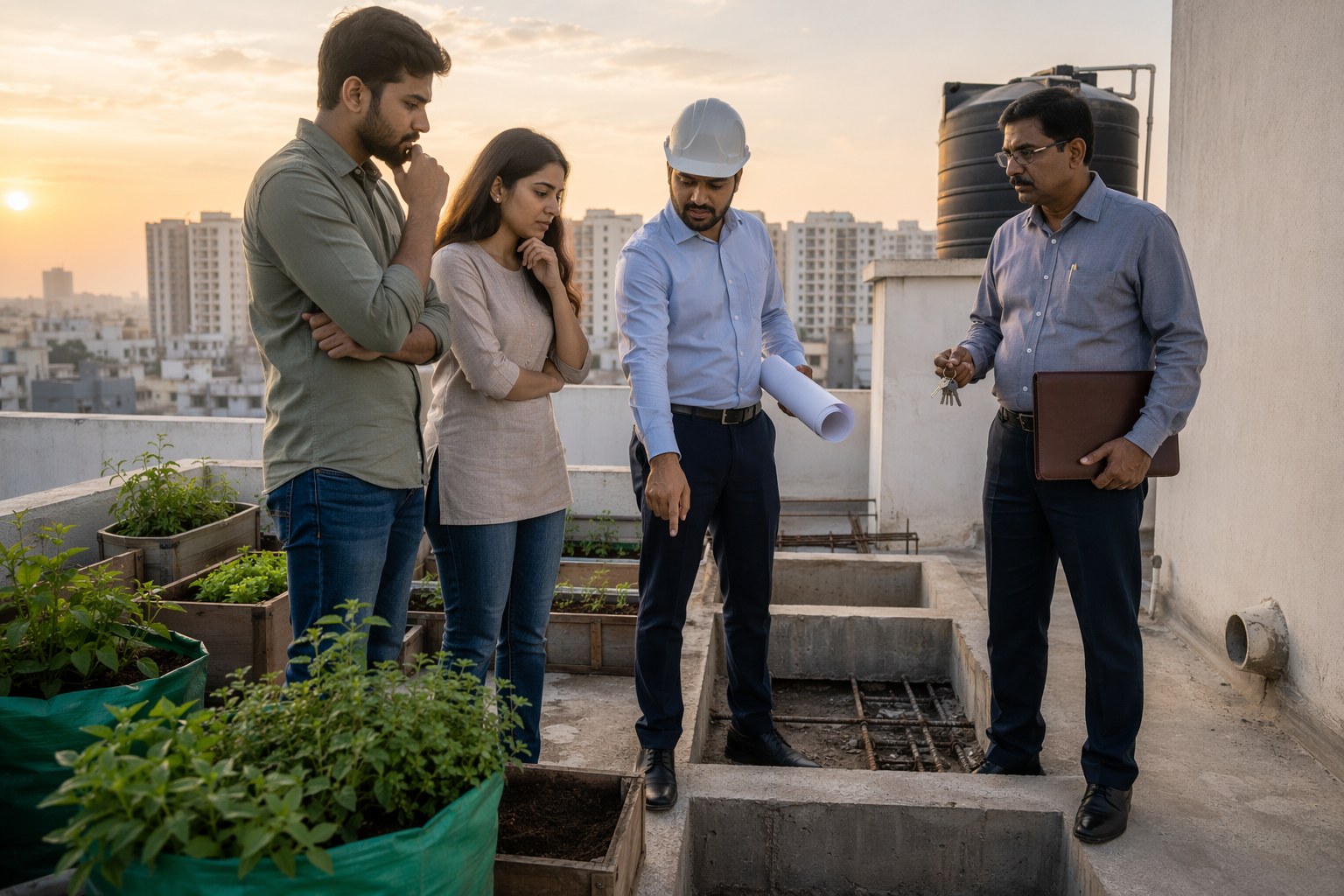
Water savings are harder to calculate, but they are equally important. In western Hyderabad, especially around Narsingi, Tellapur, Mokila, Kollur and Kokapet, tanker dependency has been a recurring concern in some pockets. A project with working STP, rainwater harvesting pits, treated water reuse for landscaping and clear water metering can reduce wastage. It may not make water free, but it protects the community from panic purchases during dry months.
For common-area costs, solar power can reduce society electricity bills for lighting, pumps and clubhouse areas. But buyers should ask one simple question: is solar power only shown in the brochure, or is capacity clearly mentioned in the sale documents and facility plan? A 20 kW system and a 200 kW system are not the same. Many buyers miss this detail.
Green Home vs Regular Flat in Hyderabad: Comfort Is the Quiet Benefit
The biggest benefit of a green home is not always visible in the invoice. It is comfort. A well-planned flat in Gachibowli, Miyapur, Tellapur or Uppal with proper orientation can feel cooler, brighter and less stuffy. You use lights less during daytime. Your balcony is usable. Bedrooms do not become ovens by 4 pm. Children and elders feel the difference.
Regular flats are not automatically bad. Some older apartments in Jubilee Hills, Begumpet, Himayatnagar, Sainikpuri and Tarnaka were built with better setbacks and ventilation than many new dense towers. I have seen non-certified buildings that feel more liveable than certified ones. So the certificate is useful, but your eyes and common sense are also useful.
When you visit a site, check these points:
- Does the flat get cross-ventilation, or only one-side airflow?
- Is the west-facing wall exposed without shade?
- Are corridors naturally ventilated or fully dependent on exhaust systems?
- Is there enough distance between towers?
- Is basement ventilation proper?
- Are STP and waste areas placed sensibly, away from active family zones?
In high-density corridors like Kondapur, Gachibowli, Nallagandla and Miyapur, these small planning points affect everyday living more than a large entrance arch or imported lobby tiles.
Price Difference in Hyderabad Localities
Green projects are usually seen more in the organised apartment market, particularly in western and northern growth corridors. In Kokapet, Narsingi, Financial District, Nanakramguda and Gachibowli, premium apartment pricing commonly moves in a wide band because tower quality, builder brand, land title and project stage vary sharply. In Tellapur, Osman Nagar, Kollur and Mokila, buyers compare larger gated communities with villa plots and upcoming high-rise supply. In Kompally, Suchitra, Bachupally and Miyapur, the conversation is more price-sensitive, but green features are now being used to differentiate better projects.
Do not assume a green home is always costly. Sometimes a regular flat with poor energy design becomes more expensive over time due to AC bills, tanker costs and high repairs. On the other hand, do not blindly pay a premium just because the brochure says sustainable. Ask for proof: green rating certificate, energy model, solar capacity, water reuse plan, STP capacity, waste management process and past maintenance estimates from completed projects by the same builder.
Before comparing prices, check the government value also. Telangana registration value and market asking price are not the same. Use the Market Value / Guideline Value Search to get a base reference. Then estimate registration outgo using the Stamp Duty Calculator. This helps you compare total acquisition cost, not just the builder’s quoted rate per sft.
Resale Value: Will a Green Home Sell Better?
Yes, a good green home can sell better, especially when the project is in a strong employment corridor and the society is well maintained. Buyers from the IT and financial services crowd in Hitec City, Gachibowli, Nanakramguda and Raidurg are increasingly aware of power bills, EV charging, water security and indoor air quality. NRIs also ask about sustainability because they are used to energy ratings abroad.
But resale value depends on four things before green features: location, title, builder credibility and society condition. A green-rated apartment with a weak access road in an uncertain layout will not beat a legally clean, well-connected regular flat near a metro corridor. Similarly, a regular flat near Ameerpet, Begumpet, Kukatpally or LB Nagar metro can hold value strongly because daily convenience is excellent.
In resale, documents become even more critical. The next buyer’s bank will ask for EC, link documents, building permission, occupancy certificate, society documents and tax receipts. If there is any issue in the land chain, your green features will not save the deal. Use the Encumbrance Certificate Search before you advance to agreement stage.
Green Home vs Regular Flat in Hyderabad: Legal Checks Do Not Change
This is where many buyers make a costly mistake. They think a large gated community, a branded builder or a green certification means the land file is automatically safe. That is not how property works in Telangana. You still have to verify land title, approvals, survey numbers, mutation history, EC entries, RERA details, SRO jurisdiction and prohibited property status.
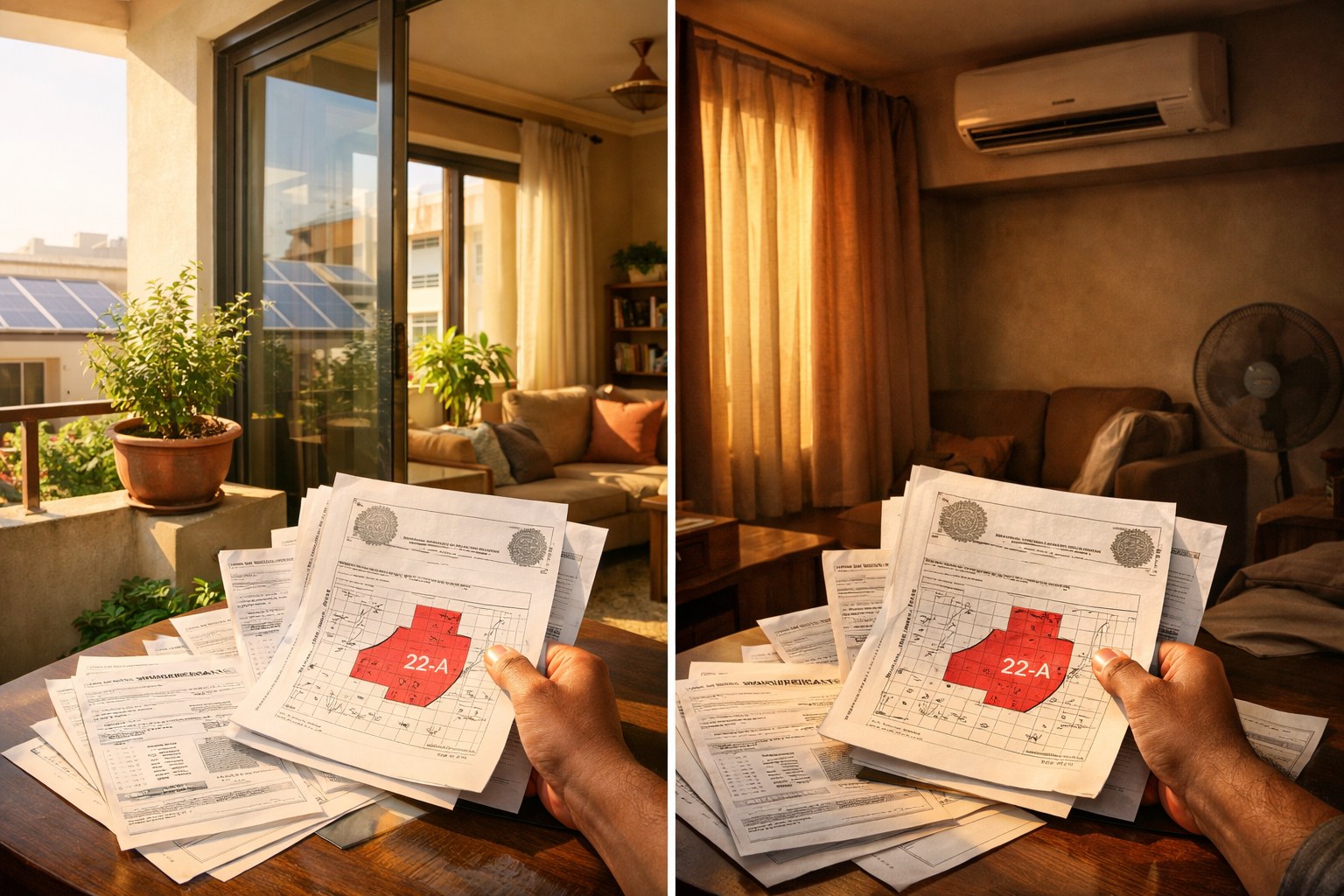
Section 22-A is especially serious. Telangana has 147934 prohibited properties listed. These may include government lands, assigned lands, endowment lands, wakf-related entries, ceiling surplus lands and other restricted categories. If the property or survey number falls under a prohibited list, registration can be blocked or legally unsafe. Before you fall in love with the model flat, run the survey number through the Section 22-A Prohibited Property Check.
For land-based projects around Shankarpally mandal, Moinabad mandal, Gandipet mandal, Maheshwaram mandal, Kandukur mandal, Patancheru mandal and Medchal mandal, survey number verification is even more important. Apartment buyers should also ask the builder for parent land details. You can use the Survey Number Finder and then cross-check with Dharani, SRO records and available link documents.
For ongoing projects, RERA is not optional. Search the project using the RERA Project Lookup. Check sanctioned plan, proposed completion date, project status, litigation disclosures and promoter details. If the marketing name and RERA name are different, ask why. It may be harmless, but it should be explained.
What to Check in a Green Home Brochure
A green brochure should have measurable claims. If it only says “eco-friendly living” without numbers, treat it as marketing. Ask for details that can be verified.
- Solar power: capacity in kW, connected load and whether it supports common areas or individual units.
- STP: capacity in KLD, treated water usage and maintenance agency.
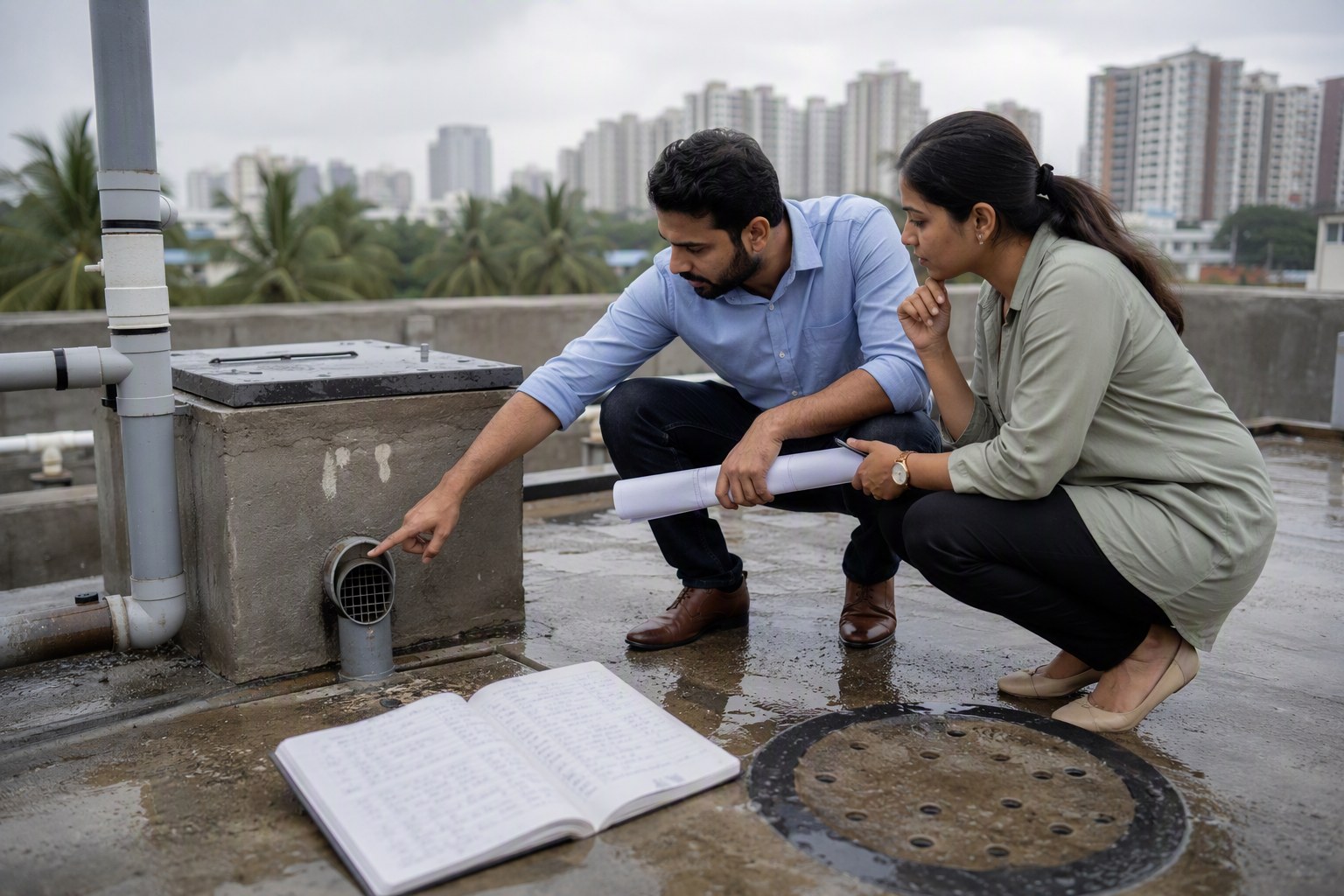
- Rainwater harvesting: number of pits, recharge design and stormwater plan.
- Materials: low-VOC paints, fly ash blocks, reflective roof treatment, efficient glass and insulation.
- Energy: common-area lighting design, sensors, efficient pumps and lift specifications.
- EV charging: number of charging points, load approval and billing method.
- Waste: wet waste processing, dry waste segregation and space for collection.
In a regular flat, you should still check many of these points. The difference is that a green home promises them as part of the product. So the builder must be ready to show proof.
Which Buyer Should Choose a Green Home?
A green home makes strong sense if you plan to live there for at least five to seven years. The longer you stay, the more you benefit from lower operating costs and better comfort. It also suits families with children, senior citizens, work-from-home professionals and buyers who want a better-maintained society.
It also makes sense in localities where utility pressure is visible. For example, in Tellapur, Kollur, Osman Nagar and Mokila, the growth is strong but infrastructure is still catching up in parts. A project with serious water planning and energy management has an advantage. In dense western pockets like Kondapur and Gachibowli, heat, traffic and density make design quality very important.
A regular flat may be the smarter choice if your budget is tight, the location is excellent, the documents are clean and the society is already functioning well. A ready-to-move regular flat near Metro access in Kukatpally, Miyapur, Ameerpet, Tarnaka or LB Nagar may serve a family better than a faraway green tower with uncertain possession timelines.
Cost Calculation: Do Not Forget Registration and Taxes
Many buyers compare only the builder’s sft price. That is incomplete. You must include floor rise, amenities, corpus fund, GST if applicable, registration charges, stamp duty, legal charges, parking, maintenance advance and interior costs. For resale property, also consider repairs, transfer charges and possible capital gains angle for the seller.
Use the Composite Value Calculator when you want to compare built-up value with land share and amenities. If you are selling an older flat to buy a green home, the Capital Gains Tax Calculator can help you estimate tax exposure before you commit.
Also identify the correct registration office. Hyderabad buyers often assume the nearest SRO is the right one. Not always. Use Find Your SRO Office before planning registration. Wrong assumptions waste time during agreement and loan processing.
My Verdict on Green Home vs Regular Flat in Hyderabad
If the budget allows, I prefer a properly designed green home over a regular flat, especially in high-growth corridors like Kokapet, Narsingi, Tellapur, Gachibowli, Nallagandla, Kondapur and Kompally. The comfort and long-term savings are meaningful. But I would not pay a blind premium for a green tag. I want numbers, working systems, clean approvals and a builder who has delivered similar promises before.
For a buyer, the best property is not just green. It is legally clean, financially sensible, liveable in summer, manageable in maintenance and saleable after ten years. That combination is what you should chase.
Before paying token advance, do this minimum checklist:
- Check EC for the land and flat using Encumbrance Certificate Search.
- Verify project registration through RERA Project Lookup.
- Check Section 22-A status through Section 22-A Prohibited Property Check.
- Compare government value using Market Value / Guideline Value Search.
- Estimate registration cost using Stamp Duty Calculator.
A green home can reduce bills. A regular flat can offer value. But only a verified property gives peace of mind. In Hyderabad’s current market, that is the difference between buying a house and buying a long-term asset.
Frequently Asked Questions
Is a green home in Hyderabad always more expensive than a regular flat?
Usually it costs slightly more upfront, especially in premium gated communities. But if energy savings, water management and resale value are strong, the long-term cost may be better than a cheaper regular flat.
Does green certification mean the property title is safe?
No. Green certification relates to building design and sustainability. It does not replace EC, RERA, link document, SRO and Section 22-A verification. Always check the legal file separately.
Why is Section 22-A check important for Hyderabad buyers?
Telangana has 147934 prohibited properties listed under Section 22-A. If a survey number or property falls in this list, registration may be blocked or legally risky. Check before paying advance.
Which Hyderabad areas are seeing more green home demand?
Kokapet, Narsingi, Financial District, Gachibowli, Tellapur, Nallagandla, Kondapur, Kollur, Kompally and Bachupally are seeing stronger buyer interest in green features.
What documents should I verify before buying a green home?
Check EC, RERA registration, approved building plan, occupancy certificate if ready, land link documents, survey number, mutation records, tax receipts, SRO jurisdiction and Section 22-A status.