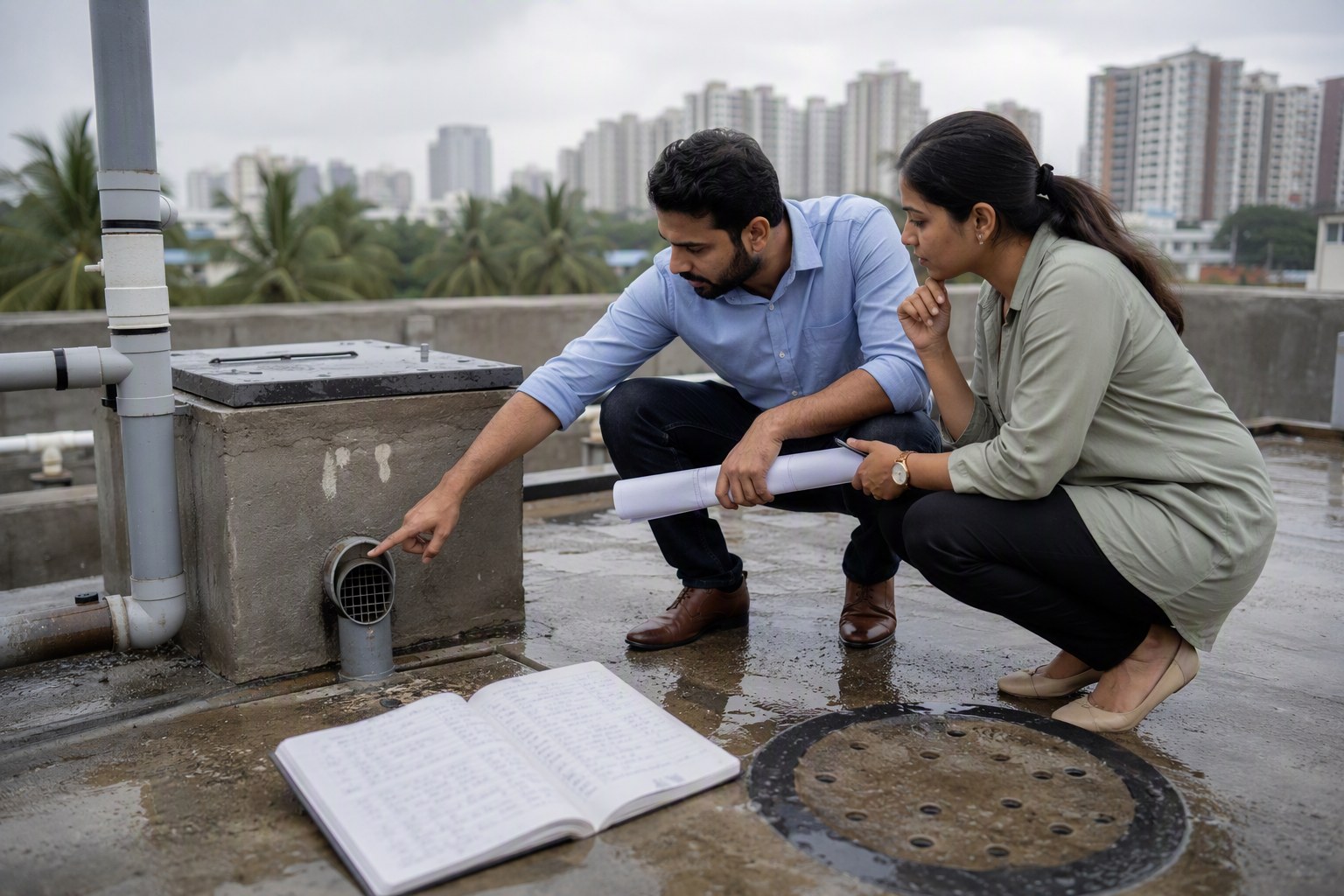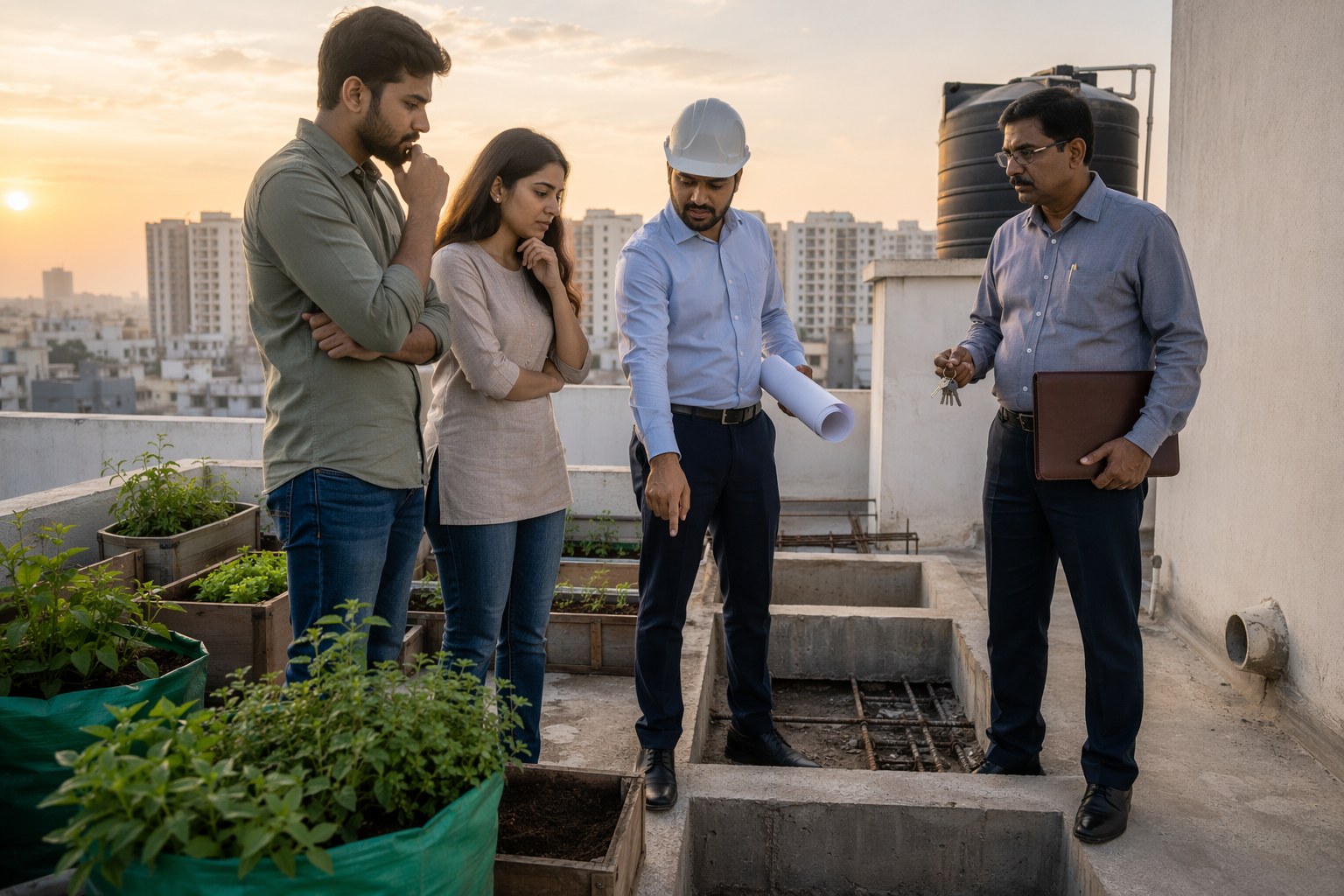



Hyderabad homebuyers should treat Green Home Certification Claims as document-based claims, not brochure language, before paying any token amount. That is the straight news from the field. Across Kokapet, Narsingi, Tellapur, Gachibowli, Bachupally, Uppal and Adibatla, builders are increasingly using words like solar-ready, low-VOC paint, rainwater harvesting, energy-efficient design and green-certified campus in their sales pitch. Some claims may be genuine. Some may be partial. Some may only be planned. The buyer’s job is simple: ask for proof before money moves.
In our experience, many disputes start because the buyer hears one thing in the sales office and signs another thing in the agreement. Green features are no different. If the certification is real, there will be a certificate, registration number, rating agency record, consultant declaration, design drawings, approval references and handover-level specifications. If the claim is only a marketing promise, you will usually see vague wording and no verifiable document.
A green claim is not automatically false. But until it is linked to a certificate, sanctioned drawing, specification schedule, RERA filing or handover obligation, it is only a claim.
Green Home Certification Claims Need Proof Before Token Payment
The first mistake buyers make is paying a token amount after seeing a model flat and a glossy green brochure. Token payment looks small compared to the flat cost, but legally and practically it changes the buyer’s position. Once payment is made, the builder’s team may push for booking form, allotment letter, agreement draft and payment schedule. At that stage, negotiating missing green documents becomes harder.
This is especially true in high-demand corridors. In Kokapet and Narsingi under Gandipet mandal, buyers often move fast because inventory is limited in certain gated communities. In Gachibowli and the Financial District belt, many purchasers are working professionals who rely heavily on sales presentations. In Tellapur and Kollur side, buyers may compare multiple large projects in one weekend and make decisions quickly. In Adibatla under Ibrahimpatnam mandal, buyers may be attracted by future-growth positioning. In all these places, the same rule applies: verify first, pay later.
Start with the project’s legal identity. Check the RERA number using RERA Project Lookup. Confirm whether the project name, promoter name, survey numbers, village, mandal, sanctioned plan details and completion status match what the sales team is saying. If the green certification claim is material to your purchase decision, ask whether it is disclosed in the RERA filing, project brochure, agreement schedule or annexure.
Then verify the land and title side. Use Encumbrance Certificate Search and, where needed, EC Analyzer to understand registered transactions and possible charges. Check if the land is in any restricted category. Government records list 3,076,153 prohibited properties under Section 22-A. That number should remind every buyer that title and land status cannot be assumed just because a project looks premium. Use Section 22-A Prohibited Property Check before going ahead.
Green Home Certification Claims: What Counts As Real Evidence?
Not every eco-friendly feature is a certification. A project may have a few green features without being certified by a recognised rating body. That is not wrong if the builder states it clearly. The problem starts when marketing words create the impression of formal certification without a certificate.
Here is how I separate genuine documentation from sales talk.
| Claim heard in sales office | Document to ask for | What buyer should check |
|---|---|---|
| Green certified project | Certificate or pre-certification letter from rating agency | Project name, phase, tower coverage, validity, rating level and registration reference |
| IGBC, GRIHA, LEED or similar rating | Agency-issued document, not only builder brochure | Whether it is pre-certified, final certified or only applied-for status |
| Solar power provision | Electrical drawings, rooftop allocation, common-area power plan | Whether solar is for common areas, individual flats or only future provision |
| Rainwater harvesting | Sanctioned plan, plumbing drawings, site photographs, maintenance plan | Capacity, recharge pits, stormwater connection and handover responsibility |
| STP and treated water reuse | Environmental approvals, STP design, O&M plan | Whether treated water is reused for landscaping, flushing or only shown as a facility |
| Energy-efficient homes | Specification sheet, glass details, lighting plan, appliance rating commitments | Whether feature is inside each flat or limited to common areas |
A proper certificate will usually mention the exact project or phase. This matters in Hyderabad because large projects are often developed in phases. A buyer in Tower A may assume the entire community is certified, while the certificate may apply only to a club house, one phase, or an intended future phase. Ask for phase-wise clarity.
Pre-certification also needs careful reading. It means the project has been assessed on proposed design. Final certification usually comes after completion and verification. Pre-certification is not useless. It can be a good sign. But it should not be sold as completed certification unless the final certificate exists.
Where Green Claims Can Mislead Hyderabad Buyers
Green marketing can become confusing because many features sound technical. A buyer may hear air quality, natural ventilation, heat-resistant glass, water conservation, zero discharge, organic waste converter and native landscaping in the same presentation. Some are measurable. Some are design choices. Some depend on long-term maintenance after the association takes over.
We’ve seen buyers in Serilingampally mandal ask the right question only at handover: “Where is the promised solar output?” By then, the agreement may only say that solar panels are provided for selected common-area lighting. That is very different from reducing every flat owner’s electricity bill. Similarly, rainwater harvesting may exist on paper, but the buyer should see whether it is part of approved drawings and whether the pits are accessible for maintenance.
Another common issue is the difference between a sample flat and agreement specifications. The model flat may show energy-efficient fixtures, special windows or branded fittings. The agreement may say equivalent make or standard specification. If the green feature influenced your decision, put it in writing. Do not rely on verbal assurance.
In locations like Bachupally mandal and Ameenpur side, water management claims deserve special attention because large gated communities depend heavily on borewell, municipal supply, tankers, STP reuse and rainwater systems. In Uppal mandal and LB Nagar side, buyers should also look at road width, drainage connection and land-use compatibility. Use Road Width Check and Land Use Zone Finder for basic location-level checks.
Check The Project, Land And Approvals Along With The Green Certificate
A green certificate does not cure title defects, mortgage issues, SRO mismatch, wrong survey number or prohibited land status. This is where many buyers get carried away. A project can have attractive sustainability features and still require normal legal verification.
Before token payment, collect the project name, promoter name, RERA number, survey numbers, village, mandal, SRO jurisdiction and sanction references. If you are not sure about the survey number, use Survey Number Finder. To understand SRO jurisdiction, use Find Your SRO Office or SRO Village Directory.
For apartments, ask whether the undivided share of land, built-up area, carpet area, common area and amenity obligations are clearly stated. For villas and plotted layouts marketed as eco-friendly communities, check the land conversion, layout approval, road widths, open space, utility areas and whether the green amenities are part of the approved layout or only club-house marketing.
Use Property Verification Tool for a broader verification view. If the builder quotes land value or registration impact, cross-check with Market Value / Guideline Value Search and estimate registration costs through Stamp Duty Calculator. I am deliberately not quoting a random Kokapet, Tellapur or Bachupally rate here because ready reckoner values and market values change by village, survey, property type and SRO record. A wrong number is worse than no number in property due diligence.
Green Home Certification Claims And RERA: What To Compare
RERA is not a green certification agency. Still, RERA filings are useful because they record key project details. Compare the green brochure with RERA details in four areas.
1. Project name and phase
The certificate should match the RERA project or clearly explain the phase covered. If the sales brochure uses a township brand name and RERA uses a different phase name, ask for a written mapping.
2. Amenities and common facilities
If the green promise includes STP, solar lighting, waste management, EV charging, water reuse or landscaping, ask whether these are shown in project documents and amenity schedules. EV charging, for example, may be full infrastructure, limited points or only electrical provision. The difference matters.
3. Completion and handover timing
Some features are promised at final handover, not at your flat handover. In large projects, amenities may come in later phases. Ask when the green facilities will be operational and who will maintain them until the association takes over.
4. Agreement wording
The sale agreement should not dilute the claim. If the brochure says certified green homes but the agreement says amenities may be modified at promoter discretion, get legal advice before signing. Marketing material and signed contract should speak the same language.
What Buyers Should Ask The Sales Team In Writing
Verbal answers are not enough. Send an email or WhatsApp message and ask for documents. Keep the response. If the builder is confident, they will share at least the key proof, or they will clearly say what is still under process.
- Is the project green certified, pre-certified, applied for, or only designed with green features?
- Which agency has issued the certificate or pre-certificate?
- Does the certificate cover the full project, selected phase, selected towers or only common amenities?
- What is the certificate registration number or reference?
- Which green features are part of the flat specifications?
- Which features are part of common amenities?
- Are solar, STP, rainwater harvesting and waste systems shown in approved plans?
- Will these features be written into the agreement or annexure?
- Who maintains these systems before and after association handover?
- What happens if final certification is not received?
That last question is useful. A genuine promoter may say final certification is subject to completion audit. Fair enough. But then the agreement should not give the impression that final certification is already secured.
Red Flags In Green Home Certification Claims
Buyers should slow down if they see these warning signs:
- The brochure says certified, but the sales team says certificate will come later.
- No one can name the rating agency clearly.
- The certificate is shown on a phone screen but not shared by email.
- The certificate name does not match the RERA project name.
- The claim covers the full community, but the document covers only one phase.
- The builder says all features are subject to change and refuses to list them in the agreement.
- Solar or water-saving claims are made without drawings or capacity details.
- Green features are included in the price pitch but excluded from the legal schedule.
- The project land or survey number cannot be matched with Dharani, pahani, EC or SRO records.
A strong project will withstand questions. A weak claim will usually become vague when you ask for documents.
Document Checklist Before Paying Token
For a Hyderabad buyer, I would keep this checklist ready before paying even a small booking amount:
- RERA project page and registration details from RERA Project Lookup.
- Green certificate, pre-certificate or agency application acknowledgement.
- Written clarification on whether certification is final, provisional or proposed.
- Project brochure version shared by builder.
- Draft sale agreement and specification annexure.
- Sanctioned plan references for STP, rainwater harvesting and solar areas, where applicable.
- EC review using Encumbrance Certificate Search.
- Section 22-A check using Section 22-A Prohibited Property Check.
- Survey number confirmation using Survey Number Finder.
- Guideline value check through Market Value / Guideline Value Search.
For villa plots and farm-style eco communities, also ask for land conversion, layout approval, road access and open space details. Sustainability branding should never distract from basic land due diligence.
My View: Good Green Projects Should Welcome Verification
Hyderabad needs better buildings. Lower heat gain, efficient water reuse, proper waste handling, good ventilation and responsible landscaping are not luxury items anymore. They are practical requirements in a city that is growing across the western, northern, eastern and southern corridors.
But buyers should not reward vague claims. A builder who has invested in certification will usually be proud to share documents. A buyer asking for proof is not being difficult. He or she is being sensible.
Before token payment, remember this order: verify RERA, verify land, verify SRO and survey details, verify green certification, then verify agreement wording. If all five line up, the project deserves serious consideration. If one of them does not line up, pause and get professional advice.
Green homes can be valuable, but only when the promise survives paperwork. In Telangana real estate, documents speak louder than hoardings.
Frequently Asked Questions
Should I pay token amount if the builder says green certification is under process?
Pay only after getting written clarity. Ask whether it is applied for, pre-certified or awaiting final certification. If the claim matters to your decision, make sure the agreement records the status and obligation clearly.
Is a pre-certified green project the same as a fully certified project?
No. Pre-certification usually relates to proposed design and documents. Final certification generally comes after completion-level verification. Both can be useful, but they should not be presented as the same thing.
Can RERA confirm whether a Hyderabad project is green certified?
RERA is mainly for project registration and disclosure, not green rating. Still, you should compare the RERA project name, phase, amenities and specifications with the green certificate and builder brochure.
What if the brochure promises solar power but the agreement does not mention it?
Ask the builder to include the exact solar-related obligation in the specification schedule or annexure. If they refuse, treat the brochure claim as non-binding marketing unless your lawyer advises otherwise.
Do green features remove the need for land verification?
No. Always verify title, EC, survey number, SRO jurisdiction, RERA details and Section 22-A status separately. A green claim cannot fix a land or approval problem.