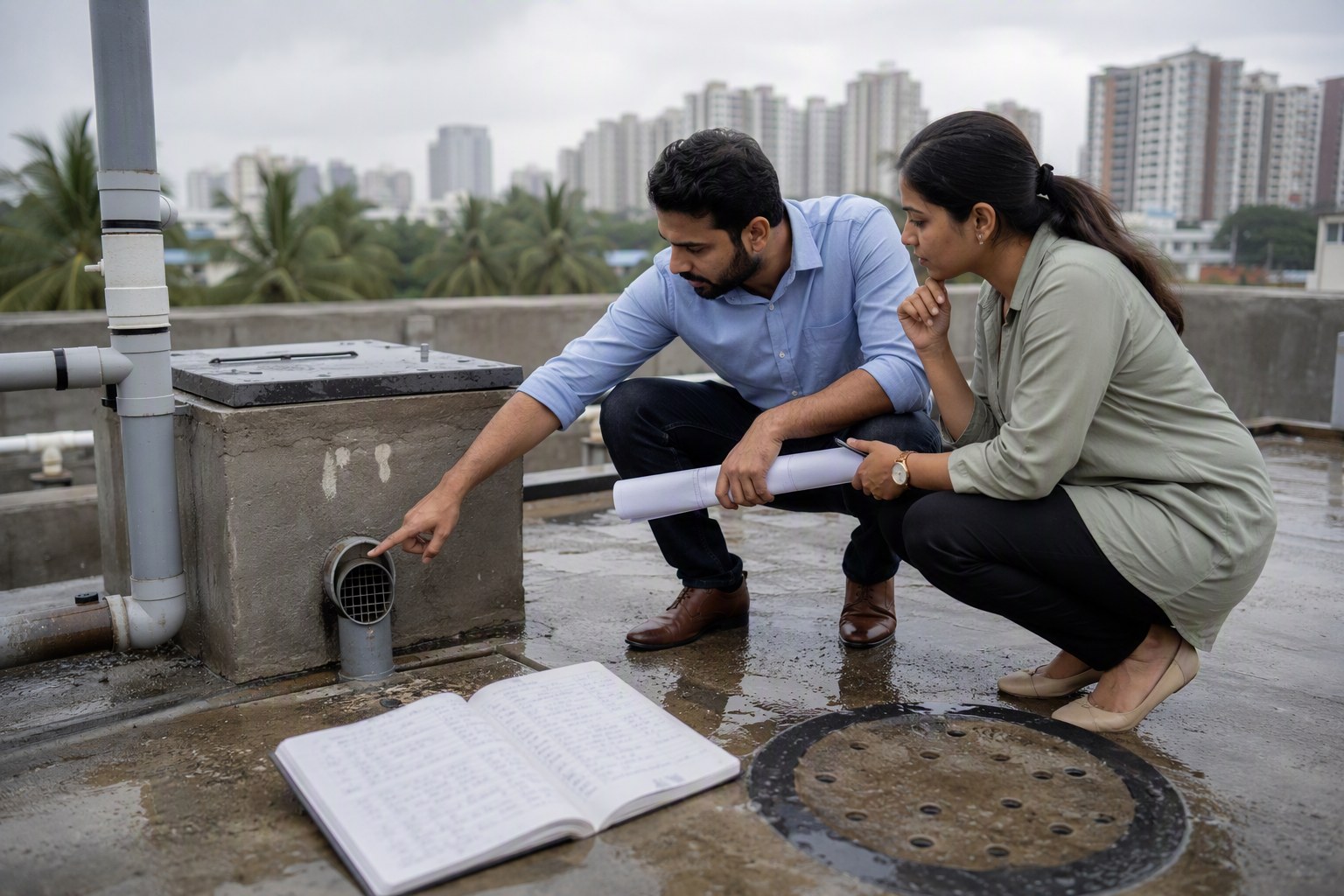



EV-Ready Flat vs Solar-Ready Flat: the buyer’s first filter
EV-Ready Flat vs Solar-Ready Flat sounds like a simple green-home comparison, but in Hyderabad’s apartment market the verification work is very different. EV readiness is about electrical load, parking rights, cabling, safety and future billing. Solar readiness is about terrace rights, sanctioned drawings, structural space, DISCOM permissions and society control over common areas. If a builder is charging extra for either feature, don’t accept the brochure line at face value.
In our experience across Gachibowli, Kokapet, Narsingi, Tellapur, Miyapur, Bachupally, Kompally, Uppal and Adibatla, buyers often ask the wrong question: “Is charging available?” or “Is solar provided?” The better question is: “Can this feature legally, technically and practically work for my flat after registration and handover?”
My view is clear: EV-ready flats need stronger technical verification before you pay a premium. Solar-ready flats need stronger ownership and common-area verification. Both can become expensive promises if the agreement is vague.
EV-Ready Flat vs Solar-Ready Flat: quick comparison for Hyderabad buyers
| Point to verify | EV-ready flat | Solar-ready flat | Buyer risk |
|---|---|---|---|
| Main dependency | Transformer capacity, connected load, parking wiring, charger policy | Terrace rights, roof access, solar panel area, DISCOM process | EV risk is hidden inside electrical design; solar risk is often hidden inside documents |
| Most critical document | Electrical single-line diagram, load approval, parking allotment terms | Sale deed, common area schedule, terrace usage clause, sanctioned plan | Brochure wording is not enough for either |
| Flat-level issue | Dedicated or shared charger point, metering method, parking bay tagging | Whether solar benefit comes to the flat or only to common-area electricity | Buyer may assume personal benefit where none is promised |
| Society-level issue | Charger rules, fire safety, common area cabling, load upgrade cost | Maintenance of panels, roof access, inverter space, sharing of savings | Future disputes can start after the owners’ association takes over |
| Best pre-payment check | Ask for approved load, charger specification and parking-linked wiring confirmation | Ask for terrace/common area declaration and solar system scope in writing | Pay premium only when the feature is written into the agreement annexure |
Why EV-ready flats need tougher verification
An EV charger is not just a plug point near your car. In a high-rise at Nanakramguda, Kokapet, Financial District, Miyapur or Kompally, it touches the project’s transformer sizing, common area electrical shafts, earthing, cable routing, parking allocation, fire safety and monthly billing. If the builder has only left a conduit without load planning, the flat is not truly EV-ready.
Ask whether your marked parking bay has a dedicated cable path from the electrical panel. Ask whether the project has planned load for multiple chargers, not just one demo charger near the clubhouse. In many premium projects, the sample flat marketing deck shows “EV charging provision”, but the agreement says “subject to society norms” or “at additional cost”. That wording shifts the burden to the buyer later.
For flats in Serilingampally mandal, Gandipet mandal, Bachupally mandal and Uppal side gated communities, basement parking layouts can be complex. If your parking is in a different block or basement level, future cabling may need core cutting, tray extension and permissions from the association. Once residents move in, such work becomes difficult.
EV-ready flat checklist before paying extra
- Get the charger capacity and type mentioned in the specification sheet, not only in the brochure.
- Check whether EV wiring is linked to your individual meter, a prepaid meter, or common area billing.
- Ask for the approved connected load and whether future load enhancement cost will be borne by builder, association or individual flat owners.
- Confirm that your parking bay is final and not “tentative allotment”. EV readiness without a confirmed parking bay is weak.
- Ask whether the fire safety consultant has signed off charger placement in basement or stilt parking.
- Check if the project has space for charger management panels, isolation switches and safe cable trays.
- Put the EV provision in the agreement of sale as a deliverable with location, scope and cost clarity.
One practical tip: if the sales team says “all flats can install chargers later”, ask them to show the electrical drawing. A confident builder will not hesitate. A vague answer means you are being sold an idea, not an installed provision.
Why solar-ready flats need document-level scrutiny
Solar readiness is a different animal. For a flat buyer, the roof is usually a common area unless the sale deed and sanctioned documents say otherwise. A builder may say “solar-ready project”, but the panels may only support common area lighting, lifts or clubhouse loads. That is useful, but it may not reduce your individual electricity bill.
In Tellapur, Kollur, Narsingi, Kokapet, Mokila, Pocharam and Adibatla, many projects use sustainability language because buyers like lower maintenance and greener living. Fair enough. But you must check the exact benefit. Is the project giving rooftop solar for common area power? Is it leaving conduits for future solar? Is it providing solar water heating? Is it allocating solar generation credits to flats? These are not the same thing.
Solar-ready also depends on roof availability. Terrace space may already be used for overhead tanks, lift rooms, refuge areas, HVAC equipment, telecom equipment and common services. If the remaining roof area is small or shadowed by higher towers, panel output may not match the marketing pitch. Do not pay a premium unless the system scope is clearly written.
Solar-ready flat checklist before paying extra
- Check whether solar panels are actually included or only future provision is promised.
- Ask whether the benefit is for common area electricity or individual flat consumption.
- Verify terrace rights in the draft sale deed and common area schedule.
- Ask for panel location, inverter location, cable routing and maintenance access.
- Check if the sanctioned plan leaves the roof for common use and services.
- Ask how solar maintenance cost and savings will be accounted in monthly maintenance.
- Insist that the agreement annexure mentions the solar scope, not just “green features”.
Solar-ready claims deserve extra attention in projects where the builder keeps control over terrace-related commercial rights. If the terrace is treated like a private revenue space later, the association may struggle to expand or maintain solar systems.
EV-Ready Flat vs Solar-Ready Flat: which premium is safer?
If the builder has already installed chargers, provided clear metering and tagged the provision to your parking, an EV-ready premium can be easier to justify. If the project only says “future EV provision”, I would be cautious. Future provision can mean anything from a proper cable tray to an empty promise.
Solar-ready premium is safer only when the agreement explains who owns the system, who maintains it and who receives the benefit. For example, “solar power for common area lighting” is a project-level benefit. It may reduce association expenses, but it is not the same as giving each flat a solar power credit. Buyers must not mix these two.
My working rule: pay for installed, documented features. Negotiate hard on “ready” features unless the technical drawings and legal documents support the claim.
Hyderabad locality angle: why the same claim means different things
In a dense high-rise near Gachibowli or Financial District, basement parking and electrical load planning matter more for EV charging. In plotted-villa style communities around Mokila, Shankarpally side or outskirts near Maheshwaram, solar readiness may be easier because roof control is clearer for independent homes. But for apartments, terrace rights remain sensitive.
In Kokapet and Narsingi under Gandipet mandal, many projects are large towers with multi-level parking. EV charging has to be planned at the design stage. In Miyapur and Hafeezpet under Serilingampally mandal, older apartment stock may not have spare electrical capacity for every resident to add chargers. In Bachupally and Kompally, where mid-size gated communities are common, the association’s future charger policy becomes very important.
For solar, Uppal, Pocharam and Adibatla projects may have more open surroundings in some pockets, but shadow and roof-service congestion still need checking. A buyer should not assume that an outer growth corridor automatically means better solar output.
Do title, RERA and EC checks still matter for green homes?
Yes. Green features do not cure title defects. A beautiful EV-ready or solar-ready flat is still a risky purchase if the underlying land has disputes, mortgage issues or restrictions. Telangana’s prohibited property records are not a small matter. According to government records, Section 22-A prohibited property data contains 3,076,153 entries. That is why land and project verification should come before feature comparison.
Before booking, use RERA Project Lookup to check project registration details and declared specifications. Use Encumbrance Certificate Search or EC Analyzer to review transaction history and charges. If you are checking the land parcel behind a project, Property Verification Tool and Section 22-A Prohibited Property Check are useful starting points.
Buyers should also compare the quoted price with government market value using Market Value / Guideline Value Search. For registration planning, the Stamp Duty Calculator helps you estimate duty based on the transaction value. If you are unsure about the registration jurisdiction, use Find Your SRO Office.
Agreement clauses buyers must insist on
The agreement of sale is where green claims either become enforceable or disappear. Sales teams may promise many things verbally, but registration documents and annexures decide your rights. Ask for a specification annexure that separately lists EV and solar scope.
For EV-ready flats, include these points
- Whether charger point is installed or only conduit is provided.
- Parking bay number linked to the EV provision.
- Metering method and billing responsibility.
- Maximum charger capacity permitted for the flat or parking bay.
- Who pays for future load enhancement, if required.
- Safety standards, isolation switch and maintenance responsibility.
For solar-ready flats, include these points
- Whether solar panels are installed before handover.
- Total scope described as common area use or flat-level benefit.
- Terrace access and ownership treatment as common area.
- Maintenance cost sharing mechanism.
- Whether savings will reduce maintenance bills or go into association accounts.
- What happens if panels need replacement after handover.
Do not accept a generic line like “project will have sustainable features”. That line may look attractive in a brochure, but it is weak during a dispute.
Builder questions that separate genuine readiness from marketing
Here are the questions I would ask in a site office before paying token advance:
- Can you show the approved electrical load and EV charger plan?
- Is my parking bay fixed now, or will it be allotted at handover?
- Will EV charging be billed to my meter or common meter?
- How many chargers can operate at the same time in this block?
- Is solar generation for common areas or individual flats?
- Where exactly are the solar panels and inverters located?
- Is the terrace fully common area under the sale deed?
- Are these features declared in RERA filings and agreement annexures?
If the answer is “we will confirm later”, don’t treat it as a minor issue. In Hyderabad, once a project moves from builder control to association control, small uncertainties become long meetings, cost sharing arguments and delayed installations.
Final buyer view on EV-Ready Flat vs Solar-Ready Flat
EV-Ready Flat vs Solar-Ready Flat is not about which feature sounds greener. It is about which promise survives document review and handover. EV readiness needs hard technical proof: load, wiring, parking linkage, safety and billing. Solar readiness needs clear legal and operational proof: terrace rights, installed scope, association benefit and maintenance.
If you are buying in Hyderabad’s western corridor, especially Kokapet, Narsingi, Gachibowli, Tellapur or Miyapur, ask for drawings and written clauses before you pay a green premium. If you are buying in emerging corridors like Adibatla, Pocharam, Bachupally or Kompally, check the same points with equal seriousness. A green home is valuable only when the promise is registered, usable and maintainable.
Frequently Asked Questions
Is an EV-ready flat better than a solar-ready flat?
Not automatically. An EV-ready flat is better if the parking bay, wiring, load and billing are clearly provided. A solar-ready flat is better if terrace rights and solar benefits are properly documented.
What is the biggest risk in buying an EV-ready flat in Hyderabad?
The biggest risk is vague electrical planning. If the builder has not planned transformer load, cable routing, metering and parking-linked charging, the buyer may face extra cost after handover.
Does solar-ready mean my flat electricity bill will reduce?
Not always. Many apartment projects use solar power only for common areas. Ask whether solar benefit is for your individual flat or only for lifts, lighting, pumps and clubhouse services.
Which documents should I check before paying extra for green features?
Check the agreement of sale, specification annexure, RERA details, sanctioned plan, terrace/common area clauses, parking allotment terms, EC and property title documents.
Should I verify land records even if the flat has EV or solar features?
Yes. Green features do not reduce title risk. Check RERA, EC, Section 22-A status, SRO jurisdiction and market value before booking or registration.