


When a Buyer Asks for PTIN: Seller’s Closing Guide
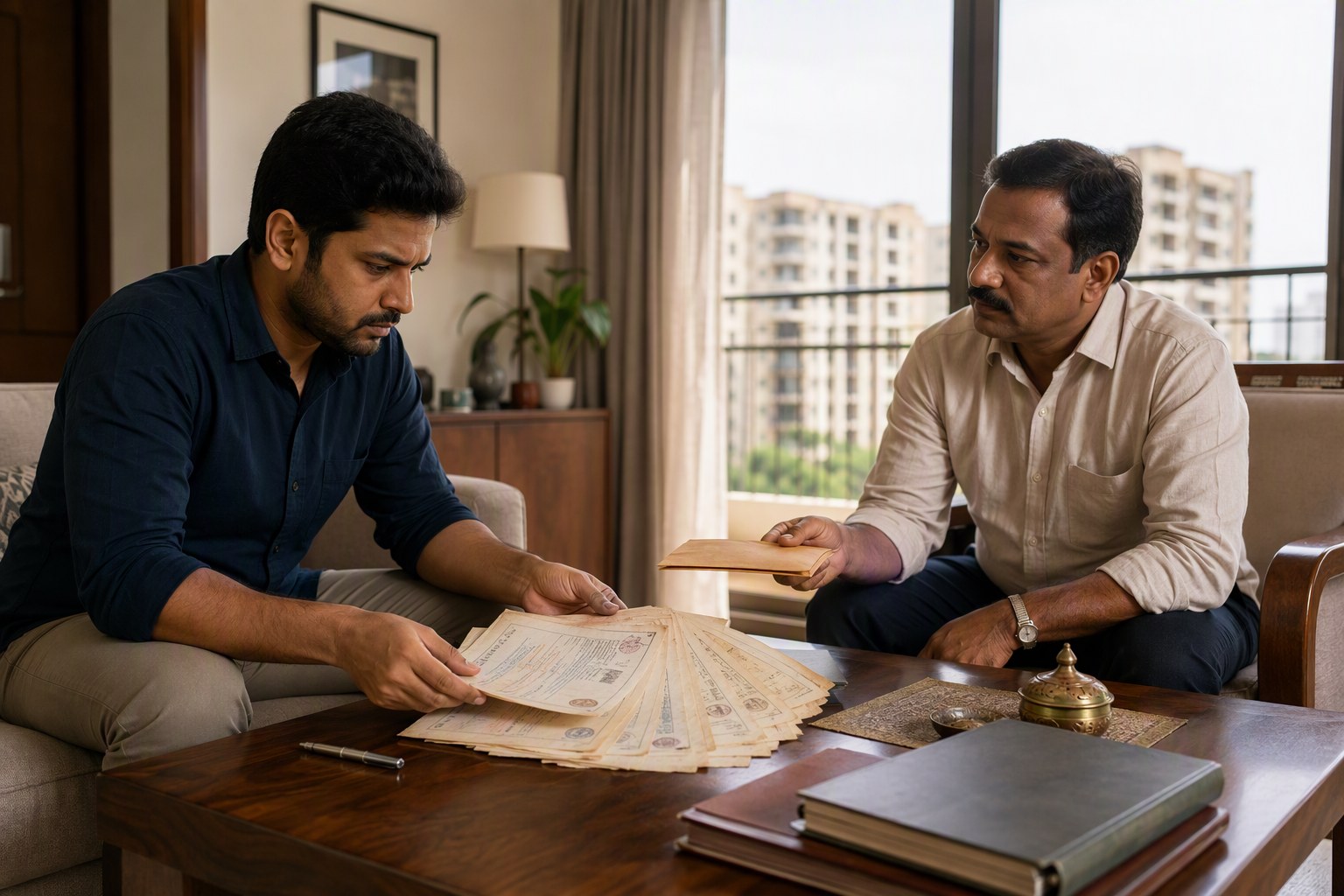
The deal was almost done. A seller from Kondapur had agreed on the final price, token was paid, and the buyer’s family had even fixed a registration week at the SRO. Then one small question came on WhatsApp: “Sir, please share PTIN and latest property tax receipt.” That PTIN request changed the mood of the closing. Not because the property was bad, but because the seller had not kept municipal records ready.
Here is the straight answer: when a buyer asks for PTIN, treat it as a serious closing-stage verification item, not as a small formality. PTIN, property tax receipts, mutation status, door number consistency, EC, SRO jurisdiction, and Section 22-A checks together decide how quickly trust converts into registration.
In our experience, a clean PTIN trail does not increase the legal title by itself. But it reduces doubt. In Hyderabad property deals, reduced doubt often means faster payment, less bargaining, and fewer last-minute excuses.
PTIN seller closing guide: what exactly is the buyer asking for?
PTIN usually means Property Tax Identification Number. In GHMC and many urban local bodies, it is the municipal identity used for property tax assessment. For a flat, independent house, villa, commercial unit, or mixed-use property, the buyer may ask for:
- PTIN number
- Latest property tax paid receipt
- Previous tax receipts, if available
- Mutation or assessment copy in the seller’s name
- Door number or municipal number proof
- Occupancy certificate or building permission copy, where applicable
- Electricity and water bill matching the same premises
A buyer asking for PTIN is not being difficult. Usually, they are checking whether the property exists in municipal records, whether tax is paid up to date, and whether the seller’s name appears correctly. For a buyer taking a home loan, the bank’s legal team may ask for the same papers. For resale flats in Madhapur, Gachibowli, Nallagandla, Kukatpally, Miyapur, Uppal, Nagole, Sainikpuri, and LB Nagar, this request is now quite common.
One practical point: PTIN is not the same as title. A property can have tax receipts and still have title issues. A property can also have a clean title but delayed municipal mutation. So, sellers should not overclaim. Present PTIN as municipal tax proof, then support the sale with EC, link documents, sale deed, sanctioned plan, and SRO records.
Why PTIN can suddenly affect negotiation and closing speed
Many sellers think negotiation ends after price agreement. It does not. In Hyderabad, the real negotiation often restarts after document review. If PTIN is missing, the buyer may say, “We will hold back part payment till tax proof comes.” Some buyers ask for an undertaking. Some ask the seller to clear dues before registration. Some simply slow down.
We have seen this pattern in Serilingampally mandal deals around Kondapur and Nallagandla, in Shaikpet and Khairatabad side apartments, and in Rajendranagar and Gandipet belt villas. The property may be perfectly marketable, but poor paperwork gives the buyer a bargaining handle.
What the buyer is trying to confirm
- Identity: Does the municipal door number match the sale deed, possession letter, and utility bills?
- Tax discipline: Are property tax dues cleared till the latest demand?
- Possession trail: Does the seller appear as the taxpayer or assessed owner?
- Building legitimacy: Is the property assessed as residential, commercial, or mixed use?
- Closing risk: Will any municipal objection come after registration?
If the seller answers these points with documents, the deal moves. If the seller says, “Broker will manage,” the buyer’s confidence drops. Hyderabad buyers have become sharper, especially after hearing cases involving unauthorised layouts, wrong survey numbers, pending loans, and prohibited land entries.
PTIN seller closing guide for Hyderabad resale flats
For a resale flat, PTIN handling depends on the project and municipal assessment pattern. In some apartment complexes, each flat has its own assessment. In some older buildings, the tax record may still show a broader property assessment or builder-side details. Before promising anything to the buyer, first check what is actually available.
A seller should keep these ready:
- Registered sale deed in seller’s favour
- Link document or mother deed copies
- Latest property tax receipt linked to the flat or property
- Society NOC, if the apartment association gives one
- Maintenance dues clearance letter, if applicable
- Electricity bill and customer number
- Water bill or CAN details, where applicable
- Latest Encumbrance Certificate
For the EC, sellers can use the Encumbrance Certificate Search. If the EC has many entries or old mortgage releases, the EC Analyzer is useful for reading the chain more calmly before the buyer’s advocate raises questions.
If the project is an ongoing or recently completed apartment project, a buyer may also ask for RERA details. Sellers can check the project using RERA Project Lookup. For older standalone buildings in areas like Himayatnagar, Ameerpet, West Marredpally, Dilsukhnagar, Chikkadpally, and Vidyanagar, RERA may not apply, but tax and municipal records still matter.
When the PTIN is not in the seller’s name
This is one of the most common resale problems. The sale deed may be in the seller’s name, but the property tax assessment may still show the previous owner or builder. Many owners complete registration and never update municipal mutation. Years later, at resale time, the buyer asks for PTIN and the gap becomes visible.
Does this kill the deal? Not always. But the seller must handle it honestly. Share the registered sale deed, tax receipts, and mutation application status if already applied. If mutation is pending, say so clearly. A buyer may accept it if the title chain is clean and tax is paid. Hiding it creates unnecessary suspicion.
My opinion is simple: before listing the property, sellers should check municipal mutation. Do not wait for the buyer’s legal team. A small correction in the tax record may take time, and closing deadlines do not wait politely.
How to explain it to the buyer
A calm explanation works better than defensive talk. Say: “The property is registered in my name as per sale deed. The PTIN tax receipt is available. Municipal mutation is pending / applied / updated. I will share the proof.” This type of answer keeps the discussion factual.
If the buyer wants a document clause, let the advocate draft it properly. Do not sign random handwritten promises about tax, municipal penalties, or future permissions without legal review.
PTIN, EC, SRO and Section 22-A: do not mix them up
PTIN belongs to municipal taxation. EC belongs to registration records. SRO tells you the registering office and document trail. Section 22-A relates to prohibited properties where registration may be blocked or restricted. A seller closing a Telangana property deal should keep these tracks separate but ready.
As per Verified.RealEstate database records, Section 22-A prohibited property entries stand at 3,076,153. That number alone should tell sellers why buyers are more cautious now. Even if you are selling a flat in a known locality, the buyer may still want to check whether the underlying land, survey number, or village record has any restriction.
For land parcels, open plots, farm land near Shankarpally, Mokila, Kollur, Adibatla, Maheshwaram, Medchal, Ghatkesar, Keesara, and Hayathnagar, Section 22-A checks become even more sensitive. Sellers can use Section 22-A Prohibited Property Check and Survey Number Finder before entering final negotiation.
To identify the right registration office, use Find Your SRO Office. For village and SRO mapping, SRO Village Directory can help avoid confusion, especially in border areas where one side of the road falls under a different jurisdiction.
Seller’s document checklist when buyer asks for PTIN
| Document | Why buyer asks | Seller’s action |
|---|---|---|
| PTIN / property tax receipt | To confirm municipal assessment and tax payment | Share latest receipt and clear pending dues before registration |
| Registered sale deed | To verify ownership | Give scanned copy and keep original ready for inspection |
| EC | To check mortgages, sales, releases, and encumbrances | Pull latest EC and explain old entries with supporting papers |
| Link documents | To verify title flow | Arrange previous sale deeds, partition deeds, gift deeds, or release deeds |
| Building permission / OC | To check building approval status | Share available approvals; do not make claims without papers |
| Utility bills | To match address and occupation | Give electricity and water bill copies if available |
| Society NOC | To check maintenance dues and transfer process | Take dues clearance before final payment |
This table may look basic, but it saves time. When a buyer receives all papers in one folder, the tone changes. They stop asking the same questions repeatedly. Their advocate also works faster.
What if property tax dues are pending?
If dues are pending, clear them before registration unless your agreement clearly states another arrangement. Most genuine buyers will not object to a property having old dues if the seller clears them. They object when the seller avoids the topic.
For independent houses in areas like Alwal, Bowenpally, Tarnaka, Vanasthalipuram, Champapet, Attapur, and Manikonda, old property tax records can be messy. Door numbers may have changed. Assessment categories may have shifted. In some cases, family transfers happened but municipal records were not updated. This is why sellers should start tax verification before fixing the registration date.
Do not assume that a paid tax receipt proves the entire land extent. For houses built on plots, the buyer may still check plot dimensions, road width, land use, and building value. Sellers can use Road Width Check, Land Use Zone Finder, and Building Value Calculator for internal preparation.
How PTIN connects with price discussion
PTIN does not decide market price directly. But it affects buyer confidence, and confidence affects the final payable price. If two similar flats are available in Nanakramguda or Kukatpally, the one with cleaner papers will usually close with less friction. Buyers do not mind paying fair value when the document trail is neat.
For pricing sanity, sellers should check registration department market value or guideline value. The Market Value / Guideline Value Search helps compare the government value used for registration. Stamp duty planning can be checked through the Stamp Duty Calculator. If the sale involves an older property with tax implications, use the Capital Gains Tax Calculator before spending the sale proceeds.
Ready reckoner value is not the same as open market value. A flat in a prime gated community at Gachibowli will not behave like an old building unit in the same broad area. But guideline value is still a useful anchor for registration cost, bank review, and buyer discussion.
PTIN seller closing guide for plots and houses
For open plots, the buyer may not ask for PTIN unless there is a structure or municipal tax assessment. They may instead ask for survey number, layout approval, LRS/BRS status where relevant, pahani or land records, mutation, Dharani details for agricultural land, and SRO records.
For independent houses, PTIN becomes more relevant because the structure is assessed for tax. In places like Narsingi, Puppalaguda, Bandlaguda Jagir, Peerancheru, Boduppal, Meerpet, and Kompally, sellers should keep both land-side and building-side papers ready. The buyer will check the land title and the municipal assessment separately.
If the property is agricultural land converted for non-agricultural use, or if it falls near expanding urban limits, do not depend only on tax receipt. Check land classification, survey number, prohibited status, and registration history. The Property Verification Tool is a good starting point for sellers who want a broader pre-sale review.
Common seller mistakes after buyer asks for PTIN
- Saying “PTIN is not needed” without checking: The buyer may still need it for tax and address verification.
- Sharing only a screenshot: Give proper receipt copies wherever possible.
- Ignoring name mismatch: If tax record is in an old owner’s name, explain and support it with sale deed.
- Promising instant mutation: Government updates take their own time. Be realistic.
- Mixing survey number and PTIN: Survey number identifies land parcel; PTIN identifies municipal tax assessment.
- Not checking EC before buyer does: Sellers should know their own document history first.
- Leaving society dues till last day: This can delay key handover and final payment.
One more mistake: assuming the broker will answer document questions. A good broker can coordinate, but the seller owns the paperwork. At closing stage, vague answers are costly.
How to respond on WhatsApp when buyer asks for PTIN
Keep your reply short and professional. For example:
“Yes, I will share the PTIN and latest property tax paid receipt today. I am also sharing the sale deed, latest EC, and electricity bill for address matching. If your advocate needs any specific municipal paper, please send the list in one message so I can arrange it.”
This type of response shows control. It also prevents random, repeated requests. Ask the buyer to send one consolidated checklist from their advocate or bank legal team. Then track each item.
If something is pending, say it plainly:
“The municipal mutation is still showing the previous owner, but the sale deed is in my name and tax has been paid. I have attached the supporting papers. We can include a suitable clause if your advocate advises.”
Honesty at this stage protects both sides. Buyers respect a seller who knows the file.
Final seller checklist before registration day
- PTIN and latest property tax receipt shared
- Property tax dues checked and cleared, if any
- Sale deed originals located
- EC downloaded and reviewed
- Loan closure and release deed ready, if property was mortgaged
- CERSAI charge checked for loan-related properties using CERSAI Charge Check
- SRO confirmed through Find Your SRO Office
- Guideline value and stamp duty discussed
- Society dues and NOC handled
- Handover date, keys, deposits, and utility transfer terms written clearly
For sellers, PTIN is a small number with a big closing impact. It will not replace legal title verification, but it tells the buyer that the property is visible in municipal records and that the seller is organised. In Hyderabad’s resale market, that matters. A neat file can save days of follow-up and protect your agreed price from last-minute cuts.
Frequently Asked Questions
Is PTIN proof of property ownership in Telangana?
No. PTIN is mainly a municipal property tax identification number. It supports tax and address verification, but ownership must be checked through registered sale deed, link documents, EC, and SRO records.
Can I sell my flat if PTIN is still in the previous owner’s name?
It may still be possible if your registered title is clear, but disclose the mismatch to the buyer. Share your sale deed, tax receipts, and mutation status. Many buyers will ask for a clause or proof of mutation application.
Should the seller clear property tax before registration?
Yes, in most resale deals the seller clears property tax dues up to the agreed handover or registration date. If buyer and seller agree differently, put it clearly in the sale agreement.
Does a buyer need PTIN for an open plot?
Usually PTIN is relevant when there is a municipal tax assessment, commonly for houses, flats, and buildings. For open plots, buyers focus more on survey number, layout approval, land records, EC, SRO details, and Section 22-A status.
What documents should I share along with PTIN?
Share the latest property tax receipt, sale deed, link documents, EC, utility bills, society NOC if applicable, and any building approval or occupancy papers available for the property.