Adibatla Buyer Story: Checks Before You Trust the Growth Buzz
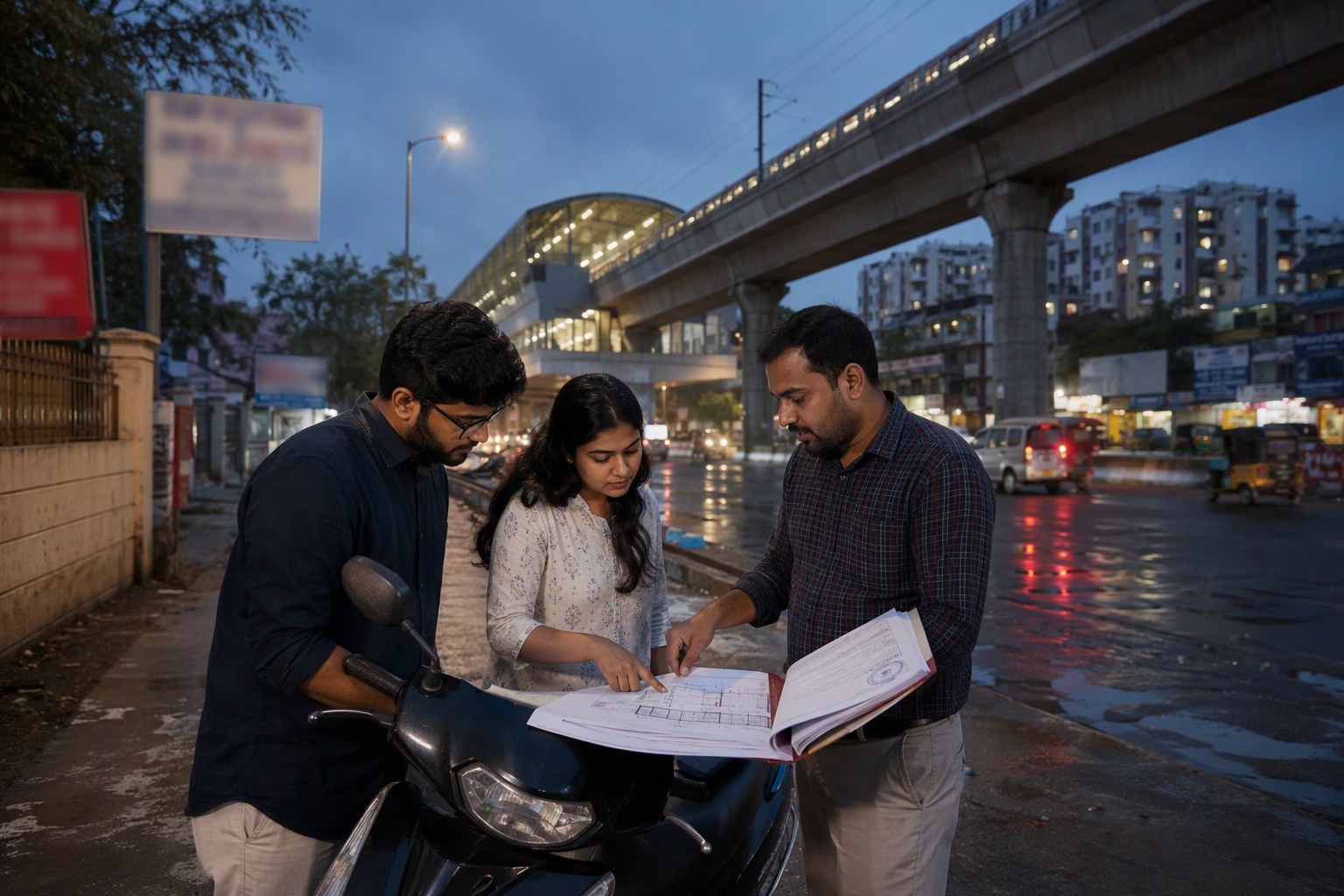
Ravi, a software employee from Uppal, first looked at Adibatla because every second person in his circle had the same line: airport side is growing, ORR access is good, land will not remain at this price. His cousin had bought a plot near the Ibrahimpatnam belt earlier. His office friend was pushing a venture close to Adibatla with urgency. The broker was saying only two east-facing plots were left. Classic Hyderabad property pressure, no?
Ravi liked the location. I also understand why buyers like Adibatla. It has a strong growth story, especially for people who want to stay connected to the south-east side of Hyderabad. But growth buzz and title safety are two separate matters. A locality can have genuine long-term potential and still carry individual plots, survey numbers or layouts that need careful checking.
The reason I am using Ravi’s story is simple. Verified.RealEstate’s prohibited-property database context currently carries 3,076,153 entries. That number is not an Adibatla count. It is a reminder that Telangana property buyers cannot treat a brochure, WhatsApp location pin or broker assurance as proof of clean title. Before token payment, one small verification can save years of stress.
My view: in Adibatla, the first question is not whether the area will grow. The first question is whether the exact property you are buying is legally saleable, traceable and matching on paper.
Why Adibatla attracts serious buyers
Adibatla is no longer spoken about only as an outskirts village. Buyers connect it with the airport-side corridor, access towards ORR, nearby work zones, and the general expansion of Hyderabad towards the south and south-east. For many middle-class families, Adibatla feels like a compromise between price, future potential and distance from the city.
Ravi’s requirement was typical. He did not want a luxury villa. He wanted a legally clean open plot where he could build after a few years. He was okay with a developing neighbourhood, but he was not okay with litigation or unclear documents. That second part is where most buyers become casual. They inspect roads, compound walls, arch, clubhouse promise and facing. They do not inspect survey number history with the same seriousness.
In Adibatla and surrounding belts, you will see different property types: approved plotted layouts, older village lands, converted agricultural lands, gram panchayat-era plots, apartments, villa projects and resale plots. Each category has a different checking style. A flat buyer must check RERA, approvals, UDS and builder title. A plot buyer must go deeper into survey number, layout approval, land use, prohibited status, link documents and physical boundaries.
The first site visit: what Ravi saw and what he missed
The broker took Ravi on a Sunday morning. The road approach was decent. There were a few houses nearby. The layout had internal roads marked with stones, some plots had boards, and the venture name sounded polished. Ravi’s wife liked one corner plot because it had better ventilation. The broker immediately quoted a token amount and said he would block it for them till Monday evening.
This is the exact moment where buyers make mistakes. The property looks real because you are standing on it. But land fraud also happens on real land, not only on paper. The question is whether the seller has the right to sell that specific extent in that specific survey number, and whether the land is free from restriction.
Ravi called me for a second opinion. I asked him one thing: do not pay token today. Ask for documents first. A genuine seller may negotiate hard, but should not avoid basic documents. If the seller says documents will come after token, treat it as a warning sign.
Document set Ravi asked before token payment
For a plot in Adibatla, Ravi asked the broker and seller for scanned copies first. Not original documents over WhatsApp, not edited photos, but clear readable copies. The list was not fancy. It was basic due diligence.
- Sale deed of the current owner
- Link documents showing earlier transfers
- Layout approval copy, if it was a layout plot
- Survey number and sub-division details
- Marketable title documents
- Latest tax or land revenue-related papers where applicable
- Encumbrance certificate period details
- Identity details of seller for name matching
- Location sketch or plan showing plot number
- Any conversion or permission documents, if claimed
My suggestion to buyers is simple: if you are being asked to pay even one rupee as token, you are allowed to ask for documents. Token is not a friendship amount. It changes your negotiating position. Once paid, you may start emotionally justifying the purchase even when problems appear.
The prohibited-property check that changed Ravi’s mood
Ravi first ran the survey number through the Prohibited Property Check. This is the step many buyers skip because they assume prohibited properties are only temple lands or government lands somewhere far away. That assumption is risky. Prohibited-property restrictions can relate to different categories, and the exact survey number matters.
The tool result did not mean Ravi should panic. It meant he should verify carefully before moving ahead. A buyer should understand the result, cross-check the village name, survey number, extent and any matching restrictions. Sometimes confusion happens because of similar survey numbers, village boundaries, old records or wrong inputs. Still, it is better to find confusion before token than after registration slot booking.
In Ravi’s case, the check pushed him to ask sharper questions. Which revenue village does this land fall under? Is the layout in the same village name mentioned in the documents? Does the survey number on the brochure match the sale deed and approval plan? Is there any part of the survey number under restriction while another part is clear? These are not small doubts. These are the core questions.
Adibatla due diligence cannot stop at one check
One clean result does not prove everything. One doubtful result does not automatically kill a deal. Property verification is a chain. If one link is weak, the buyer must slow down. Ravi’s next step was to compare the seller’s documents with public-facing checks and professional review.
He used the Ec Search to review encumbrance history. Then he used the Ec Analyzer to read the flow more clearly. EC is useful, but buyers should not treat it like a full title certificate. EC can show registered transactions for the chosen period. It may not reveal every dispute, possession issue, family claim or unregistered arrangement.
For the village and SRO mapping, Ravi checked Find Your Sro and Sro Village Directory. This helped him understand where registration would fall and whether the document references were matching the expected jurisdiction. In Hyderabad’s expansion corridors, village names and mandal references can confuse first-time buyers. A wrong assumption at this level can spoil the rest of the verification.
The survey number test
In land transactions, the survey number is the backbone. Plot number is a layout identity. Survey number is the land identity. Ravi’s broker kept repeating plot number, facing and road width. Ravi kept asking for survey number. That shift changed the conversation.
He used the Survey Number Finder to support his document review. Then he compared the survey number in the sale deed, approval plan and seller statement. If you are buying in Adibatla, do not be shy here. Ask whether the plot falls fully inside the claimed survey number. Ask if there are sub-divisions. Ask if the total extent in the layout plan matches the title documents.
One common issue in developing localities is partial clarity. The seller may have title for a larger land parcel, but the plotted layout, road carving, open space allocation and sold plots may not be documented neatly. Buyers should not accept verbal mapping. Stand on the site, note the boundaries, compare with plan, and use professional help if needed.
RERA question: plot, villa or apartment?
Ravi’s first option was an open plot. His second option was a villa project nearby. That changed the checklist. For projects that require registration under applicable rules, buyers should check registration status on Rera. RERA details can help you see project identity, promoter details, approvals uploaded and declared timelines.
But do not use RERA as a sleeping pill. A RERA listing is not a personal legal opinion on your unit. You still need agreement terms, title flow, approvals, mortgage status, specifications and handover obligations checked. For plotted development too, ask what approval exists and who granted it. HMDA, DTCP, municipality or gram panchayat-style papers have different implications. Do not mix them casually.
Land use and road width: boring checks, big impact
Most buyers get excited about plot dimensions. Very few ask land use. Ravi checked the zone using Landuse Zone Finder. If you plan to build a house later, the land-use context matters. If the surrounding land is changing rapidly, zoning and permitted use become even more relevant.
He also checked the road width using Road Width Check. Road width can affect building permission, future usability and resale confidence. A 30-feet-looking road on ground and the sanctioned road in plan are not always the same story. Measure, verify and compare with the layout plan.
For buyers thinking of construction, tools like Fsi Calculator and Osr Calculator can help you understand planning basics. These tools do not replace permissions, but they make you ask better questions before you commit money.
Price sense: buzz is not valuation
Ravi’s broker used future growth as the main price argument. That is common in Adibatla. Growth may be real, but price still needs discipline. Do not compare your plot blindly with a gated community villa, a main-road commercial parcel or a distress resale somewhere else. Micro-location changes value.
Ravi checked government guideline value using Guideline Value. Guideline value is not the same as market value. Still, it gives a base reference for stamp duty and registration conversation. He also used the Composite Value tool to think through land and building value where relevant.
If you are budgeting, include stamp duty, registration charges, legal fee, mutation-related expenses, layout transfer charges where applicable, loan processing, compound wall, borewell, electricity, and future construction costs. Use the Stamp Duty Calculator before finalising your cash flow. Many buyers negotiate hard on price and then get surprised by transaction costs.
Loan and mortgage checks
Ravi was partly funding through savings and partly through a loan. The bank’s legal check is useful, but it is not your personal safety guarantee. Bank panels can reject or approve based on their internal policy and available papers. You should still understand what you are signing.
He ran a Cersai Check to see mortgage-related signals. For resale properties, this becomes even more useful. If the seller had taken a loan, insist on closure letter, loan statement, bank NOC and release of original documents. Do not pay large amounts directly to a seller without understanding loan closure mechanics.
For any agreement or sale deed draft, Ravi planned to use Document Generator only as a starting point, and then get a lawyer to review. That is the correct approach. Drafting is not just filling names. Payment schedule, default clause, document handover, possession, indemnity and refund terms matter.
Physical inspection beyond the layout arch
Ravi made a second site visit, this time without the broker’s running commentary. He checked access from the main road, neighbouring plots, drainage signs, electricity poles, nearby water flow, and whether anybody on ground was objecting to possession. He spoke to two locals. Local talk is not legal proof, but it often reveals practical issues.
He also reviewed environmental and location context using Geo Insights. Depending on the exact site, buyers can consider checks such as Quarry Zone Check, Burial Ground Check and Soil Type Detector. These may sound uncomfortable, but resale buyers will ask the same questions later. Better you ask first.
For land area confusion, especially when documents use acres, guntas, square yards and square metres, Ravi used Area Unit Converter. Telangana buyers often casually say one gunta here and there, but registration documents need exactness. Measurement mismatch can create trouble at mutation, resale or construction stage.
The comparison table Ravi made
After three days, Ravi had two properties on his shortlist. He made a simple table. This kind of table is more useful than ten broker calls.
| Check | Plot A | Plot B | Ravi’s decision rule |
|---|---|---|---|
| Prohibited-property status | Needed clarification | No immediate red flag from input checked | No token till survey number confidence |
| EC flow | Link document gap to be reviewed | Cleaner registered chain | Lawyer to verify both |
| Layout approval | Copy not shared fully | Readable plan shared | No approval copy, no advance |
| Road width | Looked wider on ground than plan | Matched better with plan | Plan matters, not just site look |
| Seller behaviour | Pressure for immediate token | Ready to share documents | Transparency gets preference |
Ravi did not reject Plot A only because of one doubt. He rejected it because doubts were increasing while the seller’s patience was decreasing. That combination is dangerous. Plot B was not automatically perfect, but the seller was willing to provide documents and wait for legal review. In real estate, seller behaviour is also data.
Red flags in Adibatla plot buying
Based on Ravi’s case and many similar buyer conversations, these are the red flags I would take seriously:
- Broker asks for token before sharing survey number
- Seller says approval copy is available only after agreement
- Village name differs across documents without explanation
- Plot number is clear, but survey number is vague
- EC period is too short for comfort
- Link documents are missing or unreadable
- Land-use claim is based only on brochure language
- Road width on ground does not match plan
- Seller name and document name do not match cleanly
- Urgency is created using another buyer story
A good property can withstand verification. A weak deal usually depends on hurry.
When should you pay token?
Pay token only after you have minimum comfort on title, prohibited status, seller identity, approval nature, price, refund terms and timeline. Put token terms in writing. Mention the property details clearly: plot number, survey number, extent, village, mandal, seller name and agreed price. Mention what happens if legal verification fails. If the seller refuses a written token receipt, that tells you enough.
I prefer a small refundable token after document review, not a large emotional advance on the first site visit. Buyers may disagree, brokers may get irritated, but your money is not a demo piece. Once a dispute starts, even genuine buyers spend months chasing refunds.
Adibatla buyer checklist before agreement
- Run the Prohibited Property Check using correct village and survey number inputs
- Review EC through Ec Search and understand the flow using Ec Analyzer
- Confirm SRO and village mapping through Find Your Sro
- Check survey number consistency using Survey Number Finder
- Verify RERA status for applicable projects through Rera
- Check land-use context with Landuse Zone Finder
- Understand road width through Road Width Check
- Estimate registration cost using Stamp Duty Calculator
- Track the property during your decision period with Property Tracker
- For full land review, use Verify My Land and take legal advice
What Ravi finally did
Ravi did not buy the first plot. He walked away politely. The broker called twice and dropped the urgency later, which itself showed the earlier pressure was a sales tactic. Ravi continued with the second option, but only after his lawyer reviewed the title chain and the seller agreed to written terms.
That is the mature way to buy in Adibatla. Do not insult the locality because one deal is doubtful. Do not trust every deal because the locality has growth talk. Keep both thoughts separate. Adibatla may suit your budget and long-term plan, but your exact plot must earn your trust document by document.
If you are a buyer, remember this line: area growth can increase interest, but clean paperwork protects ownership. Before token payment, verify. After token payment, your bargaining power reduces. Hyderabad real estate rewards patient buyers more than excited buyers.
Frequently Asked Questions
Is Adibatla a good location for buying a plot?
Adibatla has a strong growth narrative because of its corridor location and development activity around the south-east side of Hyderabad. Still, buy only after checking the exact survey number, title chain, approval status and prohibited-property status.
Why should I check prohibited-property status before token payment?
Because a token payment can lock you emotionally and financially into a deal. A prohibited-property check helps you identify whether the survey number needs deeper verification before you commit money.
Is an EC enough to prove that an Adibatla plot is safe?
No. EC is useful for registered transaction history, but it is not a full title opinion. You should also check link documents, survey number, layout approval, land use, seller identity, possession and legal restrictions.
Should I trust a broker who says documents will be shared after token?
Be careful. A genuine seller should be able to share basic documents before token. If documents are withheld until payment, treat it as a red flag and slow down.
What details should a token receipt for an Adibatla plot contain?
It should mention seller and buyer names, plot number, survey number, extent, village, mandal, agreed price, token amount, refund terms, verification condition and timeline for agreement or registration.