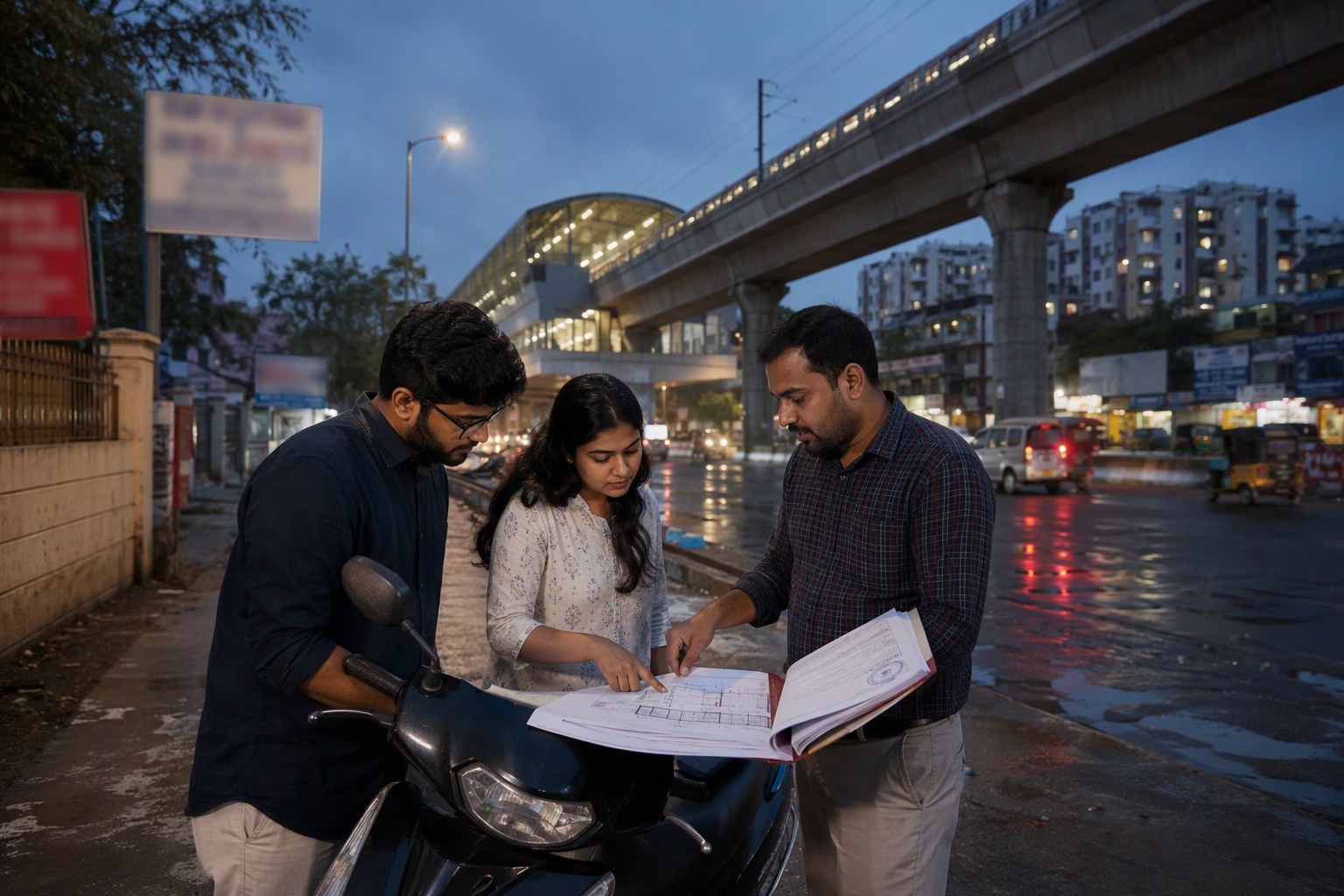
Patancheru Property Guide: the west-side market is being driven by jobs, ORR access and cautious buying
Patancheru Property Guide buyers are no longer only factory workers or old Hyderabad families shifting towards BHEL and RC Puram. The market now includes IT employees from Gachibowli and Financial District, business families, investors chasing plots, and end-users who want larger homes without paying central-west Hyderabad prices. But the same growth has also brought a familiar Telangana warning: before paying token advance, verify the EC, survey number, layout approval, SRO details, dharani entries, and Section 22-A risk.
Patancheru sits in Sangareddy district, on Hyderabad’s western growth belt. It benefits from industrial employment, access towards the Outer Ring Road side, and spillover demand from Chandanagar, Miyapur, Beeramguda, Ameenpur, Tellapur and Kollur. In our experience, this is not a luxury-first market. It is practical. People buy here because the commute can work, schools and hospitals are improving, plot sizes are still more sensible than inner Hyderabad, and rental demand has a base from both industrial and office-going tenants.
The risk is also practical. Many land parcels around the broader Patancheru belt have old agricultural histories, family partitions, GPA transactions, conversion issues, layout gaps, nala and road reservations, and sometimes government land complications. Telangana’s prohibited properties database under Section 22-A contains 3,076,153 records as per the available database context. That number alone should make every buyer slow down and check before signing.
Our view: Patancheru is a good market for disciplined buyers. It punishes buyers who rely only on broker talk, photocopy documents and verbal promises.
Patancheru Property Guide: why demand is staying active
The main reason Patancheru has stayed on the buyer radar is employment. The industrial belt around Patancheru, Isnapur, Pashamylaram, BHEL, RC Puram and nearby areas has supported housing demand for years. This is old demand, not a sudden trend. Families connected to pharma, manufacturing, engineering, logistics, public sector units and service businesses already understand this region.
The second driver is spillover from the west. Chandanagar, Madinaguda, Miyapur and Serilingampally became expensive and crowded for many middle-income buyers. Ameenpur and Beeramguda absorbed a lot of that demand. As those markets matured, buyers started checking Patancheru, Isnapur, Rudraram and the Sangareddy-facing side for plots, independent houses and apartment projects.
The third driver is road access. Patancheru has routes towards the ORR side and towards major west Hyderabad employment centres. For a buyer working in Gachibowli, Kokapet, Financial District or Tellapur, the decision depends on exact office location, shift timing and tolerance for traffic. For someone working in BHEL, RC Puram, Pashamylaram, Isnapur or local industry, Patancheru can be a very practical base.
But one thing must be said clearly. Patancheru is not one uniform market. A flat near an established residential pocket, a plot inside an approved layout, a gram panchayat-era layout, a converted agricultural parcel, and a land parcel near an industrial pocket will all behave differently. The locality name may be the same, but the legal and resale quality can vary sharply.
Patancheru Property Guide for flats, plots and independent houses
Buyers usually enter Patancheru through three property types: apartments, plotted layouts, and independent houses. Each has a separate checking method.
Apartments
Apartment buyers should start with RERA status wherever applicable. Check the builder name, project name, sanctioned plan, promised specifications, carpet area details and completion commitments. Do not stop at brochure checking. Use the RERA Project Lookup and match the project details with what the sales team is giving you.
For ready-to-move flats, ask for the link document chain, building permission, occupancy-related documents if applicable, latest EC, property tax details, mutation status and association-level pending issues. In Patancheru, we have seen buyers get attracted by a lower quote and ignore parking allocation, UDS clarity, deviation risk and water source. These small things become resale headaches later.
Plots
Plot buyers need more discipline. First identify whether the layout is approved by the correct planning authority or is only a local layout being marketed with fancy gate, compound wall and road markings. Check the survey number, village, mandal, land extent, conversion status, layout approval, road width, open space reservation and whether the plot falls in any restricted category.
Use the Survey Number Finder to start your survey-level check, then run a Section 22-A Prohibited Property Check before any payment. If the seller says “sir, registration is happening for all plots”, still verify. Registration of one nearby plot does not automatically make your plot clean.
Independent houses
Independent houses in Patancheru, Beeramguda, Ameenpur and nearby areas can be attractive for families wanting more space. But the underlying plot title must be checked like any land transaction. Many houses sit on older layouts, family lands or plots that changed hands several times. You need EC, link documents, building permission, property tax, water and electricity connection history, road access and boundary clarity.
If the house has a bank loan, ask for loan closure process and CERSAI status. If it is self-funded, do not assume that title is clean. A self-funded old house can still have missing link documents or family claim risk.
Connectivity: where Patancheru works and where it becomes tiring
Patancheru works best for buyers whose daily life is aligned to the west and north-west belt. If your office is in BHEL, RC Puram, Pashamylaram, Isnapur, Sangareddy side or nearby industrial areas, the location logic is strong. If your office is in Gachibowli, Nanakramguda, Kokapet, Tellapur or Financial District, the location may still work, but you must test the route during your actual office timing.
We advise buyers to do one simple exercise. Visit the property on a weekday morning, a weekday evening and a Sunday. The same road can feel very different depending on factory shift movement, school traffic, rain and local market congestion. Do not rely only on the Sunday site visit arranged by the seller.
For families, connectivity is not only office travel. Check school bus routes, hospital access, grocery options, public transport availability, cab reliability, and whether elderly parents can manage daily errands. Patancheru’s established pockets already have basic social infrastructure, while some developing layouts may still depend on nearby localities for daily needs.
Jobs and rental demand: Patancheru is a functional market
Patancheru’s rental story is different from premium IT corridors. The tenant base includes industrial employees, small business owners, service staff, office commuters, teachers, healthcare workers and families connected to BHEL and RC Puram side. This gives the market a stable everyday demand, though rents and tenant profiles vary by exact micro-location and building quality.
Apartment investors should not buy only because a sales executive promises high rent. Visit nearby completed projects and speak to residents or local brokers about actual occupancy. Check lift maintenance, water tanker dependency, association charges and approach road condition. A lower purchase price is not useful if tenant demand is weak or maintenance is high.
Plot investors should be more patient. Patancheru-side plots can do well when documentation is clean, road access is proper and the area is not isolated. But resale depends heavily on layout approval, bank loan eligibility and buyer confidence. In our experience, a clean approved plot with boring marketing is often better than a flashy venture with unclear papers.
Land checks before paying advance in Patancheru
This is the heart of the Patancheru Property Guide. The west-side belt has many genuine sellers and good projects. It also has enough document traps. Your checking sequence should be methodical.
- Confirm village and mandal: Do not rely only on the marketing name. Ask for the exact village, mandal, survey number and plot number.
- Check EC: Use the Encumbrance Certificate Search and review the transaction history. For a faster reading of entries, use the EC Analyzer.
- Check Section 22-A: Run the survey or property details through the Section 22-A Prohibited Property Check. This is non-negotiable for land and plotted purchases.
- Check guideline value: Use the Market Value / Guideline Value Search before registration planning. Guideline value is not always market price, but it affects duty calculation and registration preparation.
- Find the correct SRO: Use Find Your SRO Office so you know where the document will be registered and which jurisdiction applies.
- Verify land use: Use Land Use Zone Finder if you are buying land for future construction or investment.
- Check road width: Use Road Width Check because road access affects building permission, resale and bank funding.
After these online checks, get a local legal opinion from an advocate who understands Telangana land records. For agricultural-origin land, ask for pahani, title deed, pattadar passbook details where relevant, mutation history and family tree if inherited property is involved. If any document is missing, do not accept “we will give after advance” as an answer.
Section 22-A risk: why Patancheru buyers must take it seriously
Section 22-A restrictions can block registration or create serious title concerns. The database context available with us shows 3,076,153 prohibited property records. This does not mean every Patancheru property is risky. It means the checking culture must be strict.
Common risk areas include government land, assigned land, endowment land, wakf-related entries, ceiling surplus issues, road or public purpose reservations, and other categories where registration may be restricted. Sometimes the seller may not even understand the issue fully. Sometimes the broker may push the deal by saying “only small technical problem”. A small technical problem in land can become a large financial problem.
When a survey number or part of a survey number appears in a restricted list, do not proceed casually. Get clarity from the SRO, revenue office, legal counsel and official records. If the property is in a layout, confirm that the particular plot is not affected by the restricted portion of the survey number. Partial survey-number issues are common in Telangana land due diligence.
Registration cost and ready reckoner checks
Before finalising a flat, plot or house, buyers should understand the registration cost based on government value and transaction structure. Use the Stamp Duty Calculator to estimate duty and fee outgo. Use the Market Value / Guideline Value Search to check the ready reckoner value applicable to the property.
Do not confuse market value with guideline value. Market value is what buyer and seller agree based on demand, location, access, development and negotiation. Guideline value is the government-notified value used for registration calculation. If there is a large gap between the quoted price and the local market, ask why. A distress sale, family settlement, litigation risk or document weakness can all show up as a “very good deal”.
For flats, also check composite value using Composite Value Calculator where relevant. For landowners or investors selling an older asset to buy in Patancheru, the Capital Gains Tax Calculator can help with tax planning before the transaction moves too far.
Micro-location view: Patancheru, Beeramguda, Ameenpur, Isnapur and Rudraram
Patancheru town and established residential pockets suit families who want daily convenience. You get better access to shops, schools, hospitals, public transport and local services compared to far-out layouts. The trade-off is traffic, denser streets and older mixed-use surroundings.
Beeramguda and Ameenpur attract many apartment and independent house buyers who want a residential feel with access towards Miyapur, Chandanagar and BHEL. These areas have seen strong end-user interest, but buyers must still check building permissions, lake buffer issues where relevant, drainage, road width and water supply.
Isnapur and Rudraram appeal more to plot buyers, industrial employees and investors looking towards the Sangareddy growth side. Some pockets may offer better entry pricing compared to established zones, but documentation and layout status become even more critical. A plotted venture far from daily services should be bought only after checking holding capacity and resale route.
Kollur and Tellapur influence Patancheru indirectly. When prices in those west-side corridors rise or inventory becomes unsuitable for budget buyers, some demand shifts towards Patancheru and nearby Sangareddy-side pockets. This spillover is real, but it does not lift every property equally. Clean title, access and liveability still decide value.
What I would check before buying in Patancheru
| Buyer type | Best fit | Main checks |
|---|---|---|
| End-user buying flat | Established residential pocket with daily services | RERA, building permission, EC, UDS, parking, water source |
| Plot buyer | Approved layout with clear access | Survey number, layout approval, 22-A, land use, road width |
| Independent house buyer | Clear-title plot in liveable colony | Link documents, tax, permissions, boundaries, loan charge |
| Investor | Growth corridor with clean papers | Exit demand, bank loan eligibility, SRO record, guideline value |
My personal checklist starts with the survey number and EC, not with the model flat or venture entrance. If the title is weak, granite flooring and a grand arch will not save the deal. If the title is clean and the locality is liveable, Patancheru can be a sensible west-side bet.
Final view on Patancheru Property Guide for 2026 buyers
Patancheru is not a speculative story alone. It has jobs, roads, established communities, and a clear role in Hyderabad’s western expansion. It suits buyers who want value and practicality over brand glamour. It can work for end-users, especially those connected to west and north-west Hyderabad. It can also work for plot investors who insist on clean title and approved layouts.
The caution is equally clear. Do not buy Patancheru land or plotted property without EC, dharani/revenue checks, layout approval review, SRO confirmation and Section 22-A screening. Do not accept vague answers on mandal, village, survey number or link documents. Use the available tools, speak to local officials where needed, and take proper legal opinion before advance payment.
In our experience, the best Patancheru purchases are boring on paper: clear EC, proper approval, correct SRO, accessible road, sensible seller, and no drama in the document chain. That is the kind of property that lets you sleep peacefully after registration.
Frequently Asked Questions
Is Patancheru good for buying a house?
Yes, Patancheru can be good for buyers who work in west or north-west Hyderabad and want practical pricing, larger options and access to industrial employment zones. Choose the exact pocket carefully and verify title documents before paying.
What documents should I check before buying a plot in Patancheru?
Check EC, link documents, survey number, village and mandal details, layout approval, land conversion where applicable, road width, land use, SRO jurisdiction and Section 22-A status. For inherited land, also check family tree and mutation history.
Is Section 22-A check needed for Patancheru properties?
Yes. Telangana’s prohibited property database has 3,076,153 records as per the available database context. A Section 22-A check is especially needed for plots, agricultural-origin lands and older layouts.
Should I buy a flat or plot in Patancheru?
Buy a flat if you need immediate use, easier maintenance and rental potential. Buy a plot only if the layout is properly approved, the title is clean, access is clear and you can hold the asset patiently.
How do I know the correct SRO for a Patancheru property?
Use the Find Your SRO Office tool and confirm the village, mandal and property details. The correct SRO matters for registration, EC search and document verification.