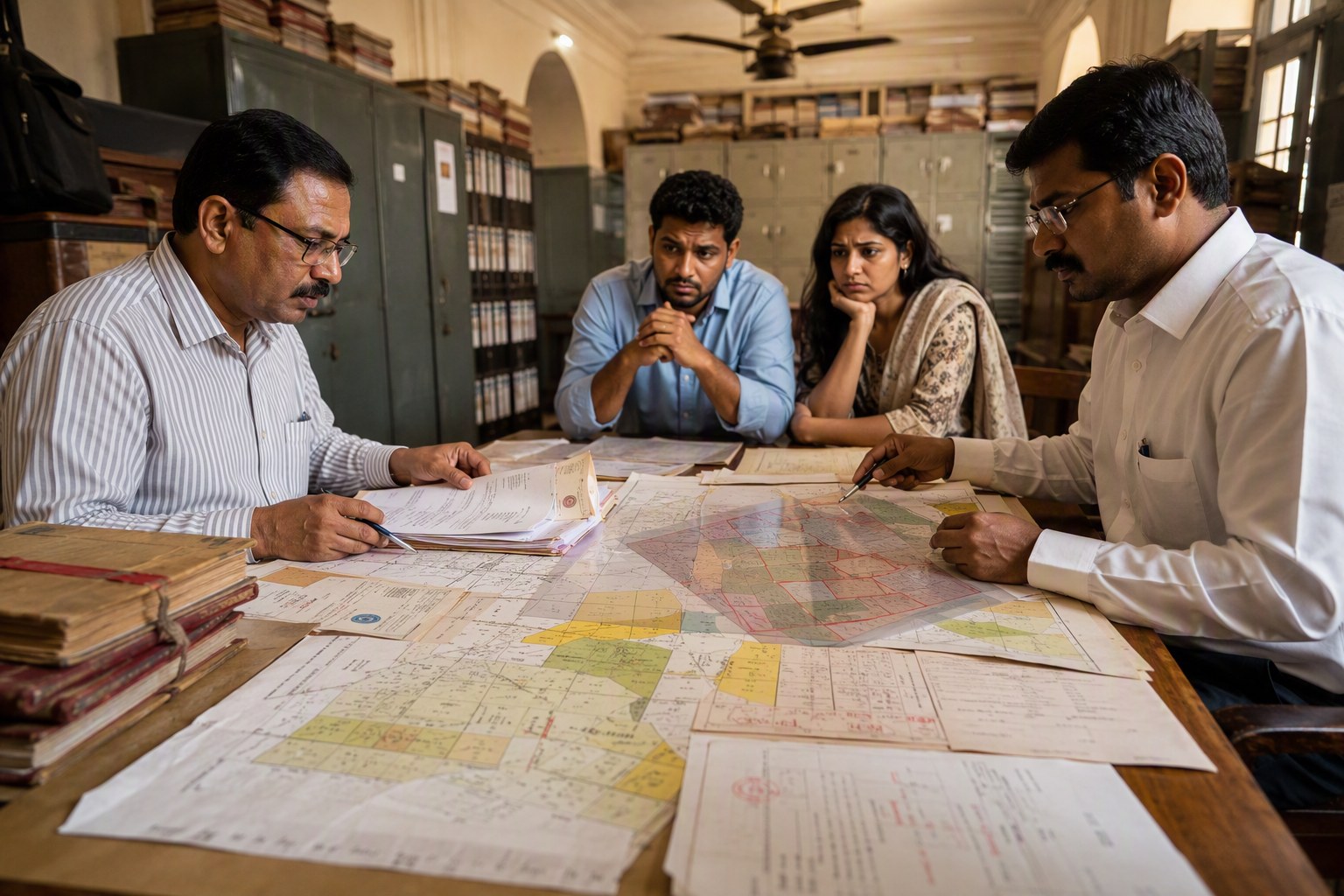



Telangana Partition Deeds May Draw 22-A Screening at SROs
Telangana Partition Deeds between family members and co-owners may now face closer checking at Sub-Registrar Offices when any linked survey number appears in the state’s Section 22-A prohibited properties list. The issue is simple at the counter but serious for owners: even if the deed is only a family partition and not an open-market sale, the SRO can pause or refuse registration if the land record is flagged as prohibited.
As per latest IGRS data available with Verified.RealEstate, Telangana has 3,076,153 prohibited property records under Section 22-A. That is a very large universe of survey numbers, sub-divisions and property references. So families dividing ancestral land in Gandipet, Shankarpally, Shamshabad, Maheshwaram, Serilingampally, Bachupally or Medchal cannot assume that a partition deed will pass only because there is no buyer involved.
Our view is clear: before drafting a partition deed, check the survey number, village, mandal and SRO mapping. A 22-A flag is not a small clerical issue at registration time; it can stop the document itself.
Telangana Partition Deeds and 22-A: what SROs are likely to examine
A partition deed records how joint owners divide property among themselves. In Hyderabad and surrounding districts, we usually see it in three situations: brothers and sisters dividing inherited land, co-owners separating plotted land, or family members allocating shares after a legal heir settlement.
The problem starts when the property is tied to a survey number that appears in the 22-A list. Section 22-A of the Registration Act allows the government to notify properties where registration is prohibited or restricted. The list may include government land, assigned land, endowment land, wakf land, ceiling surplus land, certain court-disputed properties and other notified categories, depending on the record.
At the SRO counter, the officer is not merely looking at the heading of the deed. The system and the officer will look at the underlying property identity. That means:
- Survey number and sub-division number
- Village and mandal name as per revenue records
- SRO jurisdiction
- Extent being partitioned
- Link documents and previous registered deeds
- Pahani, Dharani details, mutation record and possession evidence
- Any 22-A entry or government objection linked to that land
This is why a family partition in Mokila of Shankarpally mandal, a plotted holding in Narsingi of Gandipet mandal, or an old agricultural parcel near Shamshabad can get stuck even when all family members are present and consenting.
Why Telangana Partition Deeds are not automatically safe from 22-A checks
Many owners believe partition is only an internal arrangement, so the SRO should not object. In practice, the registration department sees a partition deed as a document that creates separate, defined rights in immovable property. Once registered, it can become the base document for future sale, gift, mortgage, development agreement or layout conversion.
That is why SROs are cautious. If the survey number is flagged, registering a partition deed may indirectly help parties create marketable title over land that the government says cannot be registered. No SRO wants that file coming back as an audit objection, court matter or vigilance complaint.
We have seen this risk more often in the Hyderabad growth belt, especially where old agricultural survey numbers have later become villas, farm plots or layout plots. Places like Tellapur, Kokapet, Manikonda, Kollur, Moinabad, Adibatla and Tukkuguda have many older title chains. Some are perfectly clean. Some need deeper revenue verification. The problem is that buyers and families often look only at the last sale deed, not the original survey history.
Where the 22-A flag hurts families the most
The pain is highest when the family has already finalised the settlement. Stamp papers are bought, legal heirs have travelled to Hyderabad, and the deed writer has prepared the document. Then the SRO check throws up a prohibited property warning.
At that point, the family may have to collect clarifications from the revenue department, verify old pattadar passbooks, obtain updated Dharani extracts, trace missing link documents or approach the competent authority for correction. If there is a court order, NOC or government clarification, the SRO will want it in proper form. Oral explanations rarely help at the registration desk.
| Situation | Likely SRO concern | Practical next step |
|---|---|---|
| Ancestral agricultural land in a flagged survey number | Whether the land is prohibited, assigned or government-recorded | Check Dharani, pahani and 22-A status before deed drafting |
| Open plot carved from old survey land | Whether the parent survey number has a 22-A entry | Verify layout approvals, link deeds and SRO records |
| Family partition after succession | Whether legal heirs can divide land that has a registration restriction | Confirm title, heirship and restriction status with documents |
| Land in urbanising mandals like Gandipet or Shankarpally | Mismatch between old revenue record and present property use | Cross-check village, mandal, survey and sub-division details |
Checks to finish before presenting a partition deed at the SRO
Do not start with the stamp duty calculation alone. Start with property identity. In our experience, most rejected or delayed partition registrations begin with one of three errors: wrong survey sub-division, wrong SRO assumption, or ignoring the 22-A list till the last day.
Owners should first verify the survey number using the Survey Number Finder. Then run a prohibited property check through the Section 22-A Prohibited Property Check. If the property is in a fast-changing area, use the Find Your SRO Office tool so the deed is prepared for the correct registration office.
After that, check the past transaction history with the Encumbrance Certificate Search and compare the government value using the Market Value / Guideline Value Search. For stamp duty planning, use the Stamp Duty Calculator. If you want one consolidated risk review, start with the Property Verification Tool.
What documents should families keep ready?
For a clean partition deed, families should keep the paperwork boringly complete. That is the safest approach in Telangana registration matters.
- Original link documents and previous registered deeds
- Latest EC for the relevant period
- Pattadar passbook or Dharani record, wherever applicable
- Latest pahani or revenue extract
- Family member identity proofs and PAN details, where needed
- Legal heir certificate, succession papers or family tree, depending on facts
- Approved layout copy, if the property is a plotted land parcel
- Any NOC, court order or government clarification related to 22-A status
- Sketch showing how the property is being divided
For apartments in areas like Kondapur, Gachibowli, Miyapur or Kukatpally, the issue may be less about agricultural survey identity and more about link documents, undivided share and building approvals. Still, if the land beneath the project has any 22-A history, the partition or family settlement can become sensitive.
Telangana Partition Deeds: what owners should do if the SRO raises a 22-A objection
If the SRO raises a 22-A objection, do not argue emotionally at the counter. Ask what exact entry or survey number is causing the problem. Sometimes the entire parent survey number is flagged though your share is a later sub-division. Sometimes the name of the village or mandal in old records does not match the current administrative mapping. Sometimes the property genuinely needs government clearance.
The next step depends on the reason. If it is a data mismatch, revenue clarification may help. If it is assigned land or government land, the issue is far more serious. If there is a court order allowing registration, it must be presented properly. If the land was removed from the prohibited list but the registration system still reflects old data, you may need updated official confirmation.
My practical advice is simple: treat 22-A screening as a title issue, not a registration formality. A partition deed that clears after proper verification is a strong family document. A deed pushed through without checking can create trouble when the next generation tries to sell, mortgage or develop the land.
Hyderabad market impact: more caution in family land settlements
This issue matters because Hyderabad families are actively reorganising land holdings. Old joint family lands around Kokapet, Narsingi, Puppalaguda, Tellapur, Kollur, Mokila, Shamirpet, Medchal, Adibatla and Maheshwaram are no longer sleepy outskirts. These properties are now part of serious urban expansion. A clean partition deed can unlock planning, sale, development or inheritance clarity. A 22-A flag can freeze the plan.
For NRIs and outstation heirs, the risk is bigger. Many sign documents through GPA holders and rely on one local relative. That is not enough. Before booking travel for registration, check the survey number, SRO, EC and prohibited status. Spend time on verification first; it is cheaper than cancelling a registration slot after everyone has signed.
Telangana’s 22-A database is too large to ignore. With 3,076,153 prohibited property records as per latest IGRS data available to us, partition deeds will naturally receive closer attention wherever the survey number touches a restricted entry. Families should welcome that scrutiny when their title is clean. It protects the value of the property.
Frequently Asked Questions
Can a family partition deed be refused because of Section 22-A in Telangana?
Yes. If the linked survey number or property reference appears in the Section 22-A prohibited list, the SRO can refuse or pause registration until the issue is clarified through proper documents.
Does 22-A apply even when there is no sale to an outsider?
Yes, it can. A partition deed creates defined rights in property. So SROs may examine the underlying land record even if the document is only between family members or co-owners.
What should I check before drafting a Telangana partition deed?
Check the survey number, village, mandal, SRO jurisdiction, EC, Dharani or revenue record, pahani and Section 22-A status. Do this before buying stamp paper or fixing a registration date.
If my survey number is flagged under 22-A, is my title always bad?
Not always. Some flags may relate to parent survey numbers, old records or data mismatches. But you need official clarification, correction, NOC or legal order depending on the reason for the entry.
Which tool can help me check prohibited property risk?
Use the Section 22-A Prohibited Property Check on Verified.RealEstate, then cross-check EC, survey number and SRO details before presenting the partition deed for registration.