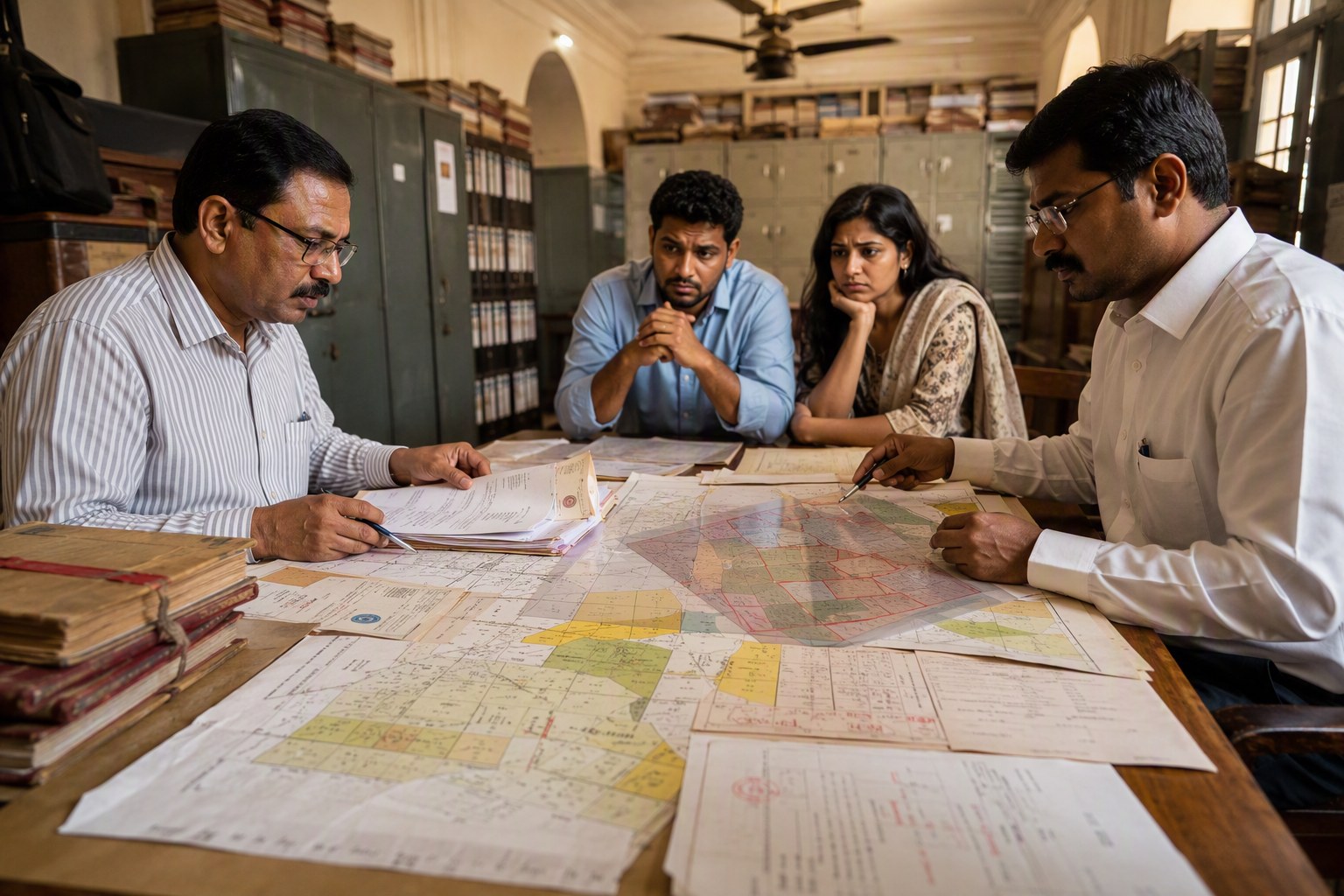
Telangana May Digitise 22-A File Trails for Faster Appeals could become a meaningful change for landowners, buyers and advocates dealing with Section 22-A prohibited property entries. The issue is simple: many people can see that a survey number is blocked, but they struggle to trace why it was blocked, who recommended it, and what file noting supports that entry.
As per latest IGRS data available with Verified.RealEstate, Telangana has 3,076,153 prohibited properties under Section 22-A. That is not a small compliance footnote. It touches agricultural lands, assigned lands, government land claims, endowment lands, court-disputed parcels and old revenue entries across Hyderabad’s expanding edges and district markets.
The proposed digitisation of the file trail behind 22-A entries, if taken up properly, can make appeal preparation far clearer. For a buyer in Mokila, a landowner in Shankarpally mandal, a family holding old pattadar passbooks in Ghatkesar mandal, or an advocate checking a village record in Maheshwaram mandal, the biggest pain is not only the prohibition. It is the missing chain of reasoning.
Telangana May Digitise 22-A File Trails for Faster Appeals: what changes for buyers?
Section 22-A entries are meant to stop registration of properties that the government considers prohibited for transfer. In practice, the entry at the SRO level often becomes the final visible point for the public. The earlier path — tahsildar report, collector proceedings, old pahani extracts, assignment details, court references, endowment claims, or government land classification — may not be easily available to the affected party.
That is where digitising the file history matters. If a citizen can see the underlying basis of a 22-A entry, appeal preparation becomes less guesswork and more document-driven. In our experience, many buyers reach the SRO only after paying advance, collecting EC, checking guideline value, and finalising a draft sale deed. Then the registration gets stopped because the land sits in the prohibited list.
Before paying any token amount, buyers should run a basic status check through the Section 22-A Prohibited Property Check, verify the old transaction chain using Encumbrance Certificate Search, and confirm the correct registering office through Find Your SRO Office. These checks will not replace legal due diligence, but they reduce blind spots.
Why the file trail behind Section 22-A matters
A 22-A prohibition is not always wrong. Some entries protect government lands, assigned lands and lands under statutory restrictions. But there are also cases where old revenue descriptions, survey sub-division confusion, village boundary changes, clerical carry-forward entries, or incomplete appeal records create hardship for genuine owners.
Take the Hyderabad growth belt. In areas like Kokapet in Gandipet mandal, Narsingi and Manikonda side of the western corridor, land records have gone through several market cycles, layout conversions and ownership changes. Around Adibatla, Tukkuguda and Maheshwaram, old agricultural survey numbers often sit next to plotted developments and industrial activity. On the northern side, Ghatkesar, Medchal, Shamirpet and Keesara mandals have their own mix of patta lands, assigned land questions and legacy revenue entries.
When a property is blocked, an appeal normally needs more than a sale deed copy. It may need old pahanis, sethwar, ROR extracts, mutation proceedings, Dharani transaction history, pattadar passbook details, layout approvals, court orders if any, and correspondence with revenue officers. If the original government file is digitised with a clear index, owners can identify exactly what they must answer.
Our view is that digitisation should not stop at showing “prohibited” or “not prohibited”. The useful reform is a readable file trail: date of entry, recommending authority, category of prohibition, survey number mapping, supporting document, and appeal status.
Telangana May Digitise 22-A File Trails for Faster Appeals, but clarity is the real test
The big question is not whether a PDF scan is uploaded. Telangana already has strong digital land record systems compared with many states, but citizens still face gaps when multiple departments are involved. For 22-A, the record may involve revenue, registration, endowments, wakf, forest, irrigation or municipal planning references. Unless these references are structured properly, digitisation can become a dump of unreadable scans.
A proper digital trail should ideally show:
- Property identity: district, mandal, village, survey number, sub-division and extent as per government records.
- Legal category: whether the entry relates to government land, assigned land, endowment, court restraint, ceiling, acquisition, or any other prohibited class.
- Source file: proceedings number, officer name or office, date of recommendation and supporting record.
- History of changes: whether the entry was modified, partly deleted, stayed, confirmed or kept pending after representation.
- Appeal route: where the owner must apply, what documents are required, and whether any prior appeal exists.
This is especially useful in family properties. We often see heirs trying to sell land inherited from parents or grandparents. The sale deed may look clean, the EC may show transactions, but the current registration system refuses to process the document due to 22-A. Without the file trail, the family cannot know whether the issue is a serious government claim or a curable classification error.
How buyers should handle a 22-A flagged property
If a property is flagged, do not treat it like a small technical objection. A 22-A entry directly affects registration. The buyer should first freeze the commercial discussion and ask the seller to provide the basis of title, latest pahani, Dharani details, mutation copies, old link documents and any past correspondence with revenue authorities.
For plotted lands and apartments, buyers should also separate land title from project approvals. A RERA-registered project is useful, but RERA registration does not automatically cure a prohibited land entry. Check project status using RERA Project Lookup, but also verify the underlying land with the Property Verification Tool. If the seller gives only layout brochures and avoids survey number discussion, that is a warning sign.
Guideline value also has a role, but not in the way many buyers assume. Ready reckoner value helps estimate stamp duty and registration cost; it does not prove that the land is free from prohibition. Use the Market Value / Guideline Value Search and Stamp Duty Calculator for cost planning, but keep legal verification separate.
| Buyer situation | What to check first | Why it matters |
|---|---|---|
| Open plot in a gram panchayat layout | Survey number, 22-A status, EC and layout approval | Layout sale papers may not reveal old revenue restrictions |
| Agricultural land in mandal limits | Pahani, Dharani record, pattadar details and prohibited list | Assigned land or government classification can block registration |
| Apartment in a large project | Land title, RERA status, EC and SRO jurisdiction | Flat approvals do not replace land-level due diligence |
| Inherited family land | Mutation history, succession papers and old revenue extracts | Legacy entries often need document-backed appeal |
What landowners need for a stronger appeal file
A digitised 22-A file trail can help landowners prepare a focused appeal instead of filing a bundle of unrelated papers. The appeal should answer the exact reason for prohibition. If the file says the land is treated as assigned land, the owner must produce material showing patta nature, alienability, old sale permissions if any, or later regularisation records. If the file refers to government land, the owner has to deal with classification, possession history and revenue entries.
Owners should maintain a clean document set: link documents, latest and old pahanis, Dharani extracts, mutation orders, tax receipts, survey sketch, court orders where applicable, and any earlier representation. If the land extent is confusing, use the Area Unit Converter to avoid mistakes between acres, guntas, square yards and square metres while preparing statements.
For advocates, the practical gain is sharper drafting. Instead of writing a broad request saying “delete my land from 22-A”, the representation can address the actual government file entry. That saves time for the owner and for the officer hearing the matter.
Verified.RealEstate view
Digitising 22-A file trails is a sensible move if it gives citizens access to reasons, not just status. Telangana’s land market is too active to run on half-visible records. From Tellapur to Kollur, from Ibrahimpatnam to Yadagirigutta-side villages, buyers are putting serious family savings into land and flats. A hidden prohibition can derail a transaction at the final stage.
We would like to see the digitised trail linked with SRO systems, Dharani references and appeal status. The system should also show whether a property is fully prohibited or only a portion of the survey number is affected. That one distinction can change the outcome for plotted developments and family partitions.
For now, the safest approach is simple: check early, ask for survey-level records, do not rely only on broker assurances, and treat any 22-A flag as a legal matter requiring written clarification. If Telangana makes the file history visible, both genuine landowners and cautious buyers will benefit.
Frequently Asked Questions
What is a Section 22-A prohibited property in Telangana?
It is a property restricted from registration under Section 22-A, usually due to government land claims, assigned land status, endowment issues, court restrictions or other statutory reasons recorded by authorities.
How will digitising 22-A file trails help landowners?
It can show the reason behind the prohibition, the authority that recommended it, and the documents relied on. That helps owners prepare a more focused appeal with relevant revenue and title records.
Can I register a property if it appears in the 22-A list?
Usually, registration will not proceed unless the prohibition is removed, modified or clarified by the competent authority. Buyers should not pay major advances until the issue is resolved in writing.
Does an Encumbrance Certificate show 22-A problems?
An EC shows registered transactions and encumbrances, but it may not fully explain a 22-A prohibition. You should check both EC and the prohibited property status before finalising a deal.
Is RERA approval enough for buying a flat on 22-A affected land?
No. RERA status is useful for project-level checks, but land title and Section 22-A status must be verified separately, especially in large layouts and apartment projects.