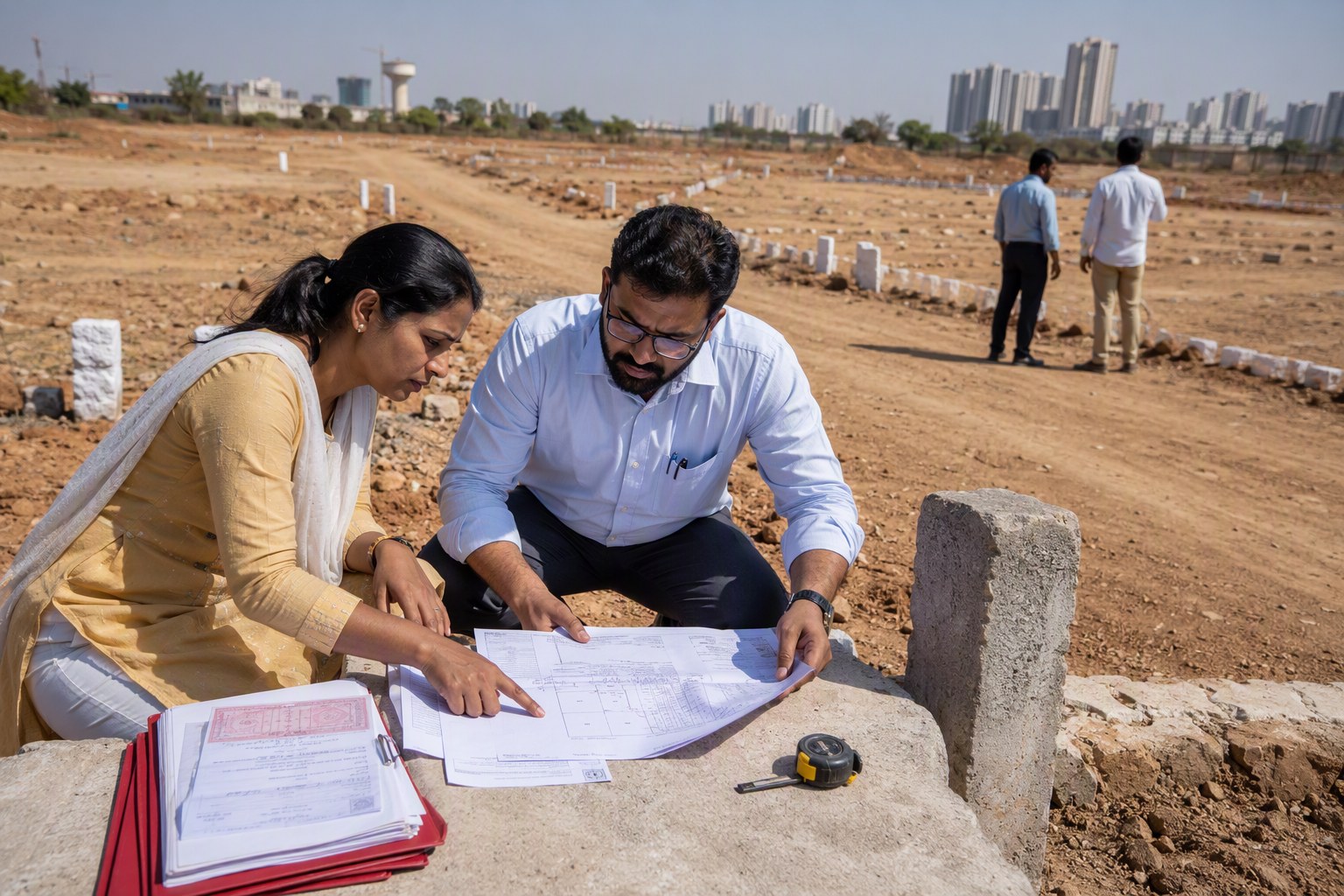
Hyderabad Gated Community Launches Add Land Status QR Codes is becoming the new sales-site talking point in the city’s apartment and villa market. At launch counters across Kokapet, Narsingi, Tellapur, Kollur, Mokila, Bachupally and Tukkuguda, developers are now being asked one straight question: can the buyer scan and see the land status, approvals and title papers before paying the booking amount?
The shift is not cosmetic. Telangana has 3,076,153 prohibited property entries under Section 22-A as per latest IGRS data available in our database. That one number is enough to explain why serious buyers are not satisfied with brochure promises, WhatsApp PDFs and glossy master plans anymore.
Our view is simple: a QR code at a launch site is useful only if it connects to verifiable land documents, not just a marketing folder. Scan is not equal to clean title.
Hyderabad Gated Community Launches Add Land Status QR Codes as buyer checks get sharper
In Hyderabad’s western corridor, gated community launches are no longer judged only by clubhouse size, elevation renders or pre-launch pricing. Buyers are asking for the survey number, village name, mandal, SRO jurisdiction, RERA registration, EC, link documents and Section 22-A status. We’ve seen this especially in Gandipet mandal, Serilingampally mandal, Ramachandrapuram mandal, Shankarpally mandal, Medchal side and Maheshwaram mandal.
The QR-linked board at the site usually sits near the sales office, model flat or project approval display. A buyer scans it and is taken to a page containing land-related documents. In a proper setup, that page should carry the RERA certificate, layout or building permission, survey number details, title flow, EC, Dharani or revenue references where applicable, and the SRO details.
For buyers, this is a welcome change. For developers, it is also a defensive move. A project launch today can lose credibility quickly if one buyer posts a missing approval, unclear survey number or 22-A doubt in a residents’ group or investor circle.
Hyderabad Gated Community Launches Add Land Status QR Codes, but what should the QR actually show?
A QR code has value only when it reduces doubt. If it opens a landing page with just a project video and amenities list, it is not land transparency. Hyderabad buyers should expect the QR page to show documents that can be cross-checked independently.
| Document or check | Why it matters | Buyer action |
|---|---|---|
| Survey number and village | Confirms the exact land parcel behind the project | Use the Survey Number Finder |
| Section 22-A status | Checks whether registration is restricted under prohibited property rules | Use the Section 22-A Prohibited Property Check |
| Encumbrance Certificate | Shows registered transactions, mortgages or claims as reflected in records | Use the Encumbrance Certificate Search |
| RERA registration | Confirms project registration and declared project details | Use the RERA Project Lookup |
| SRO and market value | Helps estimate stamp duty base and registration jurisdiction | Use Find Your SRO Office and Market Value / Guideline Value Search |
In our experience, the best QR pages are boring. They don’t try to impress. They show the raw basics: sale deed chain, development agreement where relevant, conversion records if applicable, building permission, fire NOC where required, RERA details, EC and a clear statement on pending approvals. That is what a careful buyer wants.
Why Section 22-A is sitting at the centre of this Hyderabad launch trend
Section 22-A prohibited property checks have moved from lawyer cabins to buyer conversations. Earlier, many apartment buyers assumed that a large brand or a high-ticket location meant the land was safe. That assumption is risky. The latest IGRS-linked prohibited property count in our database stands at 3,076,153, and that keeps scrutiny high across Telangana.
A prohibited property entry can relate to government land, assigned land, endowment land, Wakf-related issues, court-restricted properties or other notified categories. Not every doubt means the project is bad. But every doubt needs documentary closure before a buyer signs an agreement or transfers token money.
This matters more in fast-moving growth belts such as Kollur, Tellapur, Mokila, Velimela, Patancheru edges, Kompally, Dundigal, Shamshabad, Adibatla and Tukkuguda. These areas have seen a mix of agricultural-to-residential conversions, plotted layouts, apartment towers and villa communities. Land history can be layered. A QR code can help, provided the underlying documents are complete.
What buyers should verify beyond the QR code
My advice to buyers is direct: scan the QR, download the documents, then verify them outside the builder’s ecosystem. Do not stop at the first PDF.
- Match the project name with RERA: The name on the brochure, agreement draft and RERA record should not confuse you.
- Match survey numbers: Survey numbers on the title documents, permissions and revenue records should align. If there are sub-divisions, ask for the sub-division trail.
- Check the EC period: A short EC is not enough for serious purchase due diligence. Ask your lawyer what period is suitable for the land history.
- Check SRO jurisdiction: A project can be marketed with a popular locality name, but the registration may fall under a different SRO or village.
- Ask about mortgages: Project finance, land mortgage and release conditions matter, especially before registration of your undivided share.
- Confirm approval authority: GHMC, HMDA, municipality and gram panchayat histories must be understood based on the project location and approval date.
For cost planning, buyers should also use the Stamp Duty Calculator before assuming the final registration outgo. Ready reckoner values and actual consideration can affect planning, and the SRO will go by official rules, not by brochure language.
Hyderabad Gated Community Launches Add Land Status QR Codes: good move, but not a clean chit
The QR trend is healthy because it pushes developers to show land papers early. It also reduces the awkward back-and-forth where buyers keep asking the sales team for basic documents. But a QR code is not a government certificate by itself. It is only a doorway.
There are three weak spots buyers should watch. First, some QR pages may show selective documents. Second, the documents may be outdated. Third, the project page may not clearly connect each document to the exact land parcel being sold. A title document of nearby land is useless if it does not cover the project survey numbers.
Developers who are serious about transparency should keep the QR page live even after launch day. They should update RERA revisions, approvals, mortgage releases and phase-wise documents. In Hyderabad, many large gated communities are launched in phases. A buyer booking in a later tower should not rely only on old Phase 1 papers.
What developers should put on the QR page
If developers want buyer confidence, they should treat the QR page like a public due diligence room. The following items make sense for Hyderabad and Telangana projects:
- Project RERA registration details and declared phase boundaries.
- Survey numbers, village, mandal and SRO details.
- Land ownership or development rights summary.
- Registered title documents and link document index.
- Latest EC and explanation of any visible charge or mortgage.
- Building permission, layout approval or relevant sanction.
- Land conversion or land use documents, where applicable.
- Section 22-A status check reference.
- Contact details of the legal or compliance officer, not only sales staff.
Buyers can run a parallel check using the Property Verification Tool. If the QR document set and independent verification tell the same story, confidence improves. If they don’t match, pause the booking.
Locality impact: west Hyderabad will feel this first
Kokapet, Narsingi, Financial District edges, Tellapur and Kollur are likely to see this practice become common faster because ticket sizes are high and buyers are more document-aware. In these locations, even end-users ask lawyer-level questions now. NRIs are also pushing for scan-based document access because they cannot visit SRO offices or revenue offices easily.
On the other side of the city, Tukkuguda, Adibatla, Shamshabad and Maheshwaram mandal projects may also face sharper questioning due to land conversion and growth-corridor issues. North Hyderabad markets such as Kompally, Medchal and Dundigal are not far behind. The buyer mood is changing everywhere: amenities attract attention, but land papers close the deal.
The message to the market is clear. QR-linked land status boards are not a luxury feature. They are becoming a trust signal. In a state with 3,076,153 prohibited property entries in the database, every launch has to answer the land question upfront.
Verified.RealEstate take
We support QR-linked land status displays, but only when they are backed by verifiable records. The best developers will use this as a transparency tool. The weaker ones may use it as decoration. Buyers should know the difference.
Before paying a booking amount, scan the QR, save every document, verify survey numbers, check the EC, confirm RERA, run a Section 22-A check and speak to an independent property lawyer. That extra one day of checking can save months of stress later.
Frequently Asked Questions
Do QR-linked land documents prove that a Hyderabad gated community has clean title?
No. A QR code only gives access to documents. Buyers must verify those documents through RERA, EC, SRO records, survey number checks and Section 22-A status before making a payment.
Why are Hyderabad developers adding land status QR codes at launch sites?
Buyer scrutiny has increased, especially because Telangana has 3,076,153 prohibited property entries under Section 22-A in the available database. Developers are using QR pages to show approvals and land papers early.
Which documents should I expect after scanning the QR code?
You should expect RERA details, survey numbers, village and mandal details, EC, title flow, building or layout approval, SRO details and Section 22-A status reference.
Should I still take legal opinion if the builder provides all papers through QR?
Yes. A builder-provided QR page is useful, but independent legal verification is still needed. Your lawyer should match the documents with government records and the exact flat or villa being sold.