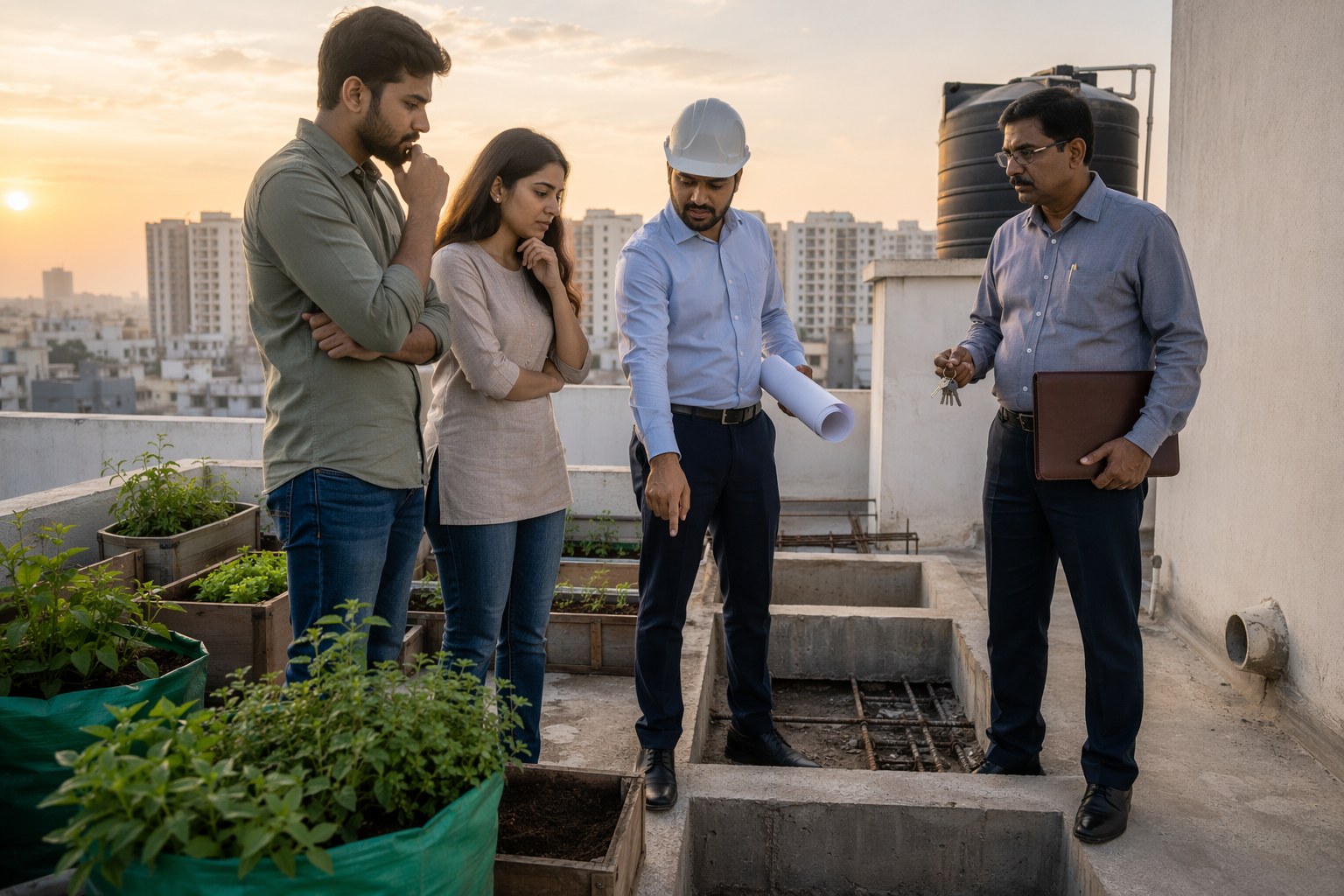



Answer first: This Narsingi Property Guide is for buyers who are being sold the usual lake-view, ORR-side, Financial District-nearby story. The location is genuinely attractive, no doubt. But the title check cannot be casual. Telangana has 30,76,153 Section 22-A prohibited property entries in the available prohibited property database. That number is not Narsingi-specific, but it tells us one hard truth: in Telangana, a beautiful location and a clean title are two separate matters.
Narsingi sits in the Gandipet side of Rangareddy district, close to Kokapet, Nanakramguda, Financial District, Gachibowli, Manikonda and Puppalaguda. This belt has become one of Hyderabad’s most watched residential markets. Buyers like the access to the ORR, the greenery around Osman Sagar side, and the work commute advantage. Sellers know this, so every second pitch becomes “lake view”, “premium corner”, “near future road”, or “next to big project”.
In our experience, Narsingi buyers make two common mistakes. First, they check the flat brochure or layout plan but not the survey number history. Second, they pay for the view, but they do not verify whether the approach road, boundaries and land classification support that price. That is where this guide becomes practical.
Narsingi Property Guide: why Section 22-A matters before lake-view premiums
Section 22-A refers to properties prohibited from registration. These can include government lands, assigned lands, endowment lands, wakf-related properties, ceiling surplus lands and other categories listed by government records. A buyer may not discover this by simply reading a sale deed draft. The warning usually comes when registration is blocked, bank legal teams raise queries, or mutation does not move as expected.
With 30,76,153 entries in the prohibited properties database, buyers should treat every land parcel with discipline. Narsingi’s price story is driven by location, but registration risk is driven by land records. The two do not always move together.
Before paying token advance, run the survey number through the Section 22-A Prohibited Property Check. Then cross-check the same survey number in Dharani records, pahani/adangal extracts where applicable, previous sale deeds, approved layout records and the latest encumbrance certificate. If the seller says “sir, no issue, many people bought here”, do not stop there. In Hyderabad real estate, neighbourhood popularity is not legal proof.
My view is simple: in Narsingi, the premium should come only after title, access and boundaries are clean. Not before.
Narsingi Property Guide for checking survey numbers, pahani and boundaries
Most serious land disputes start with one basic confusion: what exactly is being sold? In plotted land, the brochure may show a clean rectangular plot. On ground, the actual survey boundary may bend, overlap, touch a nala, depend on a private approach, or include land that is not part of the seller’s title chain.
For Narsingi and nearby Gandipet mandal areas, start with the survey number. Use the Survey Number Finder and compare it with the sale deed schedule, link documents and revenue records. If the transaction is for a plot in a layout, ask for the parent land survey numbers also. A plot number alone is not enough.
Then check the pahani or relevant revenue record trail. Look at pattadar name, nature of land, extent, mutation flow and any remarks. In Telugu documents, terms like patta, assigned, sarkari, shikam, kunta, cheruvu and poramboke can change the entire risk profile. If you are not comfortable with the terms, use the Telugu-English Property Terms Dictionary before you sign anything.
Boundaries need ground verification. North, south, east and west boundaries in the sale deed should match the actual property. If the deed says road on one side, confirm whether that road exists, whether it is public or private, and whether it has enough width for building permissions, fire access and future resale comfort.
Lake-view flats in Narsingi: what buyers should verify
The phrase “lake view” sells well in Narsingi because the larger Gandipet-Osman Sagar belt gives a different feel compared to dense city pockets. But a view is not a title document. It is not a building permission. It is not a guarantee that the open land in front will remain open forever.
If you are buying an apartment marketed as lake-facing or water-view, ask these questions:
- Is the view from the actual unit or only from the terrace/common area?
- Is there any government land, water body, nala or buffer-related restriction near the project boundary?
- Does the project have valid building permission and layout approval?
- Is the access road shown in the brochure the same road available on ground?
- Is the approach road recorded as public road, layout road or private passage?
- Does the sanctioned plan match what is being sold to you?
For under-construction apartments, run the project details through the RERA Project Lookup. RERA registration does not replace title due diligence, but it gives you project-level disclosures. Check the promoter name, project land extent as disclosed, approvals, proposed completion details and any updates available in the public record.
For plots or villas, road access becomes even more sensitive. Use the Road Width Check to understand whether the approach supports the kind of development you are planning. A premium villa plot with a weak road can become a resale headache.
Access roads: the silent price driver in Narsingi
Narsingi benefits from its proximity to the Outer Ring Road and the west Hyderabad employment belt. That is why buyers compare it with Kokapet, Nanakramguda, Puppalaguda and Manikonda. But inside the locality, access is not uniform. A project near a main connecting road and a plot depending on a narrow internal passage cannot be valued with the same confidence.
In many Narsingi transactions, the road story is sold verbally. “Future road is coming.” “This road will be widened.” “This connects directly to ORR side.” Maybe true, maybe not. A buyer should ask for documentary proof: approved layout plan, road marking in sanctioned drawings, village map reference, HMDA or local body records where applicable, and actual ground measurement.
Road width also affects building potential. If you are buying land for construction, check permissible development using the FSI/FAR Calculator and confirm land use through the Land Use Zone Finder. Do not assume that a high-value location automatically permits the structure you have in mind.
Title chain and EC checks for Narsingi property
A clean title chain should show how ownership moved from earlier pattadars or owners to the present seller. For flats, the chain should cover the landowner, development agreement, GPA where applicable, sharing agreement, approvals and the builder’s right to sell the unit. For plots, the chain should cover parent land, conversion or layout approvals if applicable, partition or release deeds where needed, and every registered sale link.
Run an encumbrance search using the Encumbrance Certificate Search. Then read it carefully. Do not just check whether the seller’s name appears. Look for mortgages, releases, gifts, partitions, court attachments, sale agreements if registered, and any unusual gaps in the chain. The EC Analyzer can help you spot patterns, but a local property lawyer should still review the original documents for high-value deals.
Bank loans are useful because bank legal teams examine title, but do not outsource your entire judgment to the bank. Banks check their lending risk. You must check ownership risk, resale risk and family dispute risk. For extra safety, check whether any secured loan charge exists through the CERSAI Charge Check.
Market value, stamp duty and SRO checks in Narsingi
Narsingi buyers often ask, “What is the correct rate?” The honest answer is that there are three different references: government market value, actual deal expectation and the price being asked for that particular project or plot. We should not mix them casually.
For registration planning, check the official market value using the Market Value / Guideline Value Search. This is the ready reckoner-style value used for registration reference. Your actual negotiated price may be different, but stamp duty calculations need the applicable government value and transaction details.
Use the Stamp Duty Calculator before finalising your budget. Many buyers calculate only the base price and forget registration cost, legal scrutiny cost, mutation follow-up, society transfer charges where relevant, interior budget and loan processing costs. In Narsingi, where ticket sizes are usually serious, even small omissions can disturb cash flow.
Also identify the correct registration office with the Find Your SRO Office. Do not rely only on what the agent says. SRO jurisdiction, village name and survey number should align with the document you are registering.
Apartment vs plot vs villa in Narsingi: different checks
| Property type | Main risk | What to verify | Useful tool |
|---|---|---|---|
| Apartment | Project approvals and land title | RERA, sanctioned plan, landowner-builder agreements, EC | RERA Project Lookup |
| Open plot | Survey boundary and layout legality | Parent survey number, layout approval, road access, Section 22-A status | Property Verification Tool |
| Villa | Undivided land, road and construction permission | Title chain, building permission, common areas, access road | Road Width Check |
| Resale flat | Loan, mortgage and transfer history | EC, bank release deed, association dues, occupancy status | Encumbrance Certificate Search |
For apartments, unit carpet area, undivided share, amenities and maintenance matter. For plots, the exact land parcel matters more than glossy layout images. For villas, both land and construction documents must stand scrutiny.
How to judge a Narsingi premium without getting carried away
Narsingi deserves attention. I will not dismiss the location. The commute advantage towards Financial District and Gachibowli is real for many IT and business families. Kokapet’s growth has also pushed buyer interest into nearby pockets. But every micro-location inside Narsingi is not equal.
When a seller asks for a premium, ask what supports it:
- Clear title and clean EC?
- Verified survey boundaries?
- No Section 22-A issue?
- Proper road access?
- RERA and building approvals for apartments?
- Land use aligned with the proposed development?
- Real lake view from the unit, not just marketing language?
If two properties are similarly located, I would pay more for the one with cleaner papers and better access, not the one with a louder sales pitch. Hyderabad buyers have become smarter, but emotional buying still happens in west-side localities because people fear missing the next growth pocket.
Document checklist before paying token advance in Narsingi
Before you transfer token money, collect documents first. A serious seller will not hesitate to share basic papers for legal review. If the seller delays documents but pushes payment, slow down.
- Latest sale deed or ownership document
- Link documents showing title flow
- Latest EC from the relevant period available in records
- Dharani or revenue record reference where applicable
- Survey number and village details
- Approved layout or building permission
- RERA details for applicable projects
- Property tax, electricity and water connection records for resale units
- Bank release deed if the property had a loan
- Association NOC or dues statement for apartments
You can also track future changes using the Property Change Tracker. This is useful when there is a gap between agreement and registration, or when you are monitoring a land parcel before committing.
Final word on Narsingi Property Guide checks
The Narsingi Property Guide takeaway is straightforward: location premium is valid only when title, access roads and survey boundaries are verified. A lake-view claim can create excitement, but it should never replace land record scrutiny. With Telangana’s prohibited property database carrying 30,76,153 Section 22-A entries, buyers should not treat verification as a formality.
Use official portals, read the documents, visit the site at different times, speak to neighbours, verify the road, and take a local legal opinion. Narsingi has strong long-term appeal, but the safest buyers are the ones who separate the view from the title.
Frequently Asked Questions
Is Narsingi a good area to buy property in Hyderabad?
Yes, Narsingi is a strong west Hyderabad location because of its access to Kokapet, Financial District, Gachibowli and the ORR side. But buyers should verify title, survey boundaries, road access, approvals and Section 22-A status before paying a premium.
Why should I check Section 22-A before buying in Narsingi?
Section 22-A entries can block registration or raise serious title concerns. Telangana’s prohibited property database has 30,76,153 entries, so buyers should check the exact survey number before token advance or agreement.
Is lake-view property in Narsingi always safe to buy?
No. A lake-view claim is only a marketing or location feature. You must still verify land title, water body or nala-related restrictions, project approvals, access roads and the actual view from the unit or plot.
Which documents are most important for a Narsingi plot purchase?
Check the sale deed, link documents, EC, survey number, Dharani or revenue records, layout approval, road access proof and Section 22-A status. For high-value land, get a local property lawyer to review the full chain.
How do I confirm the correct SRO for Narsingi property registration?
Use the village name, survey number and property location to identify the correct registration jurisdiction. You can use the Find Your SRO Office tool and cross-check with official registration records before drafting the sale deed.